


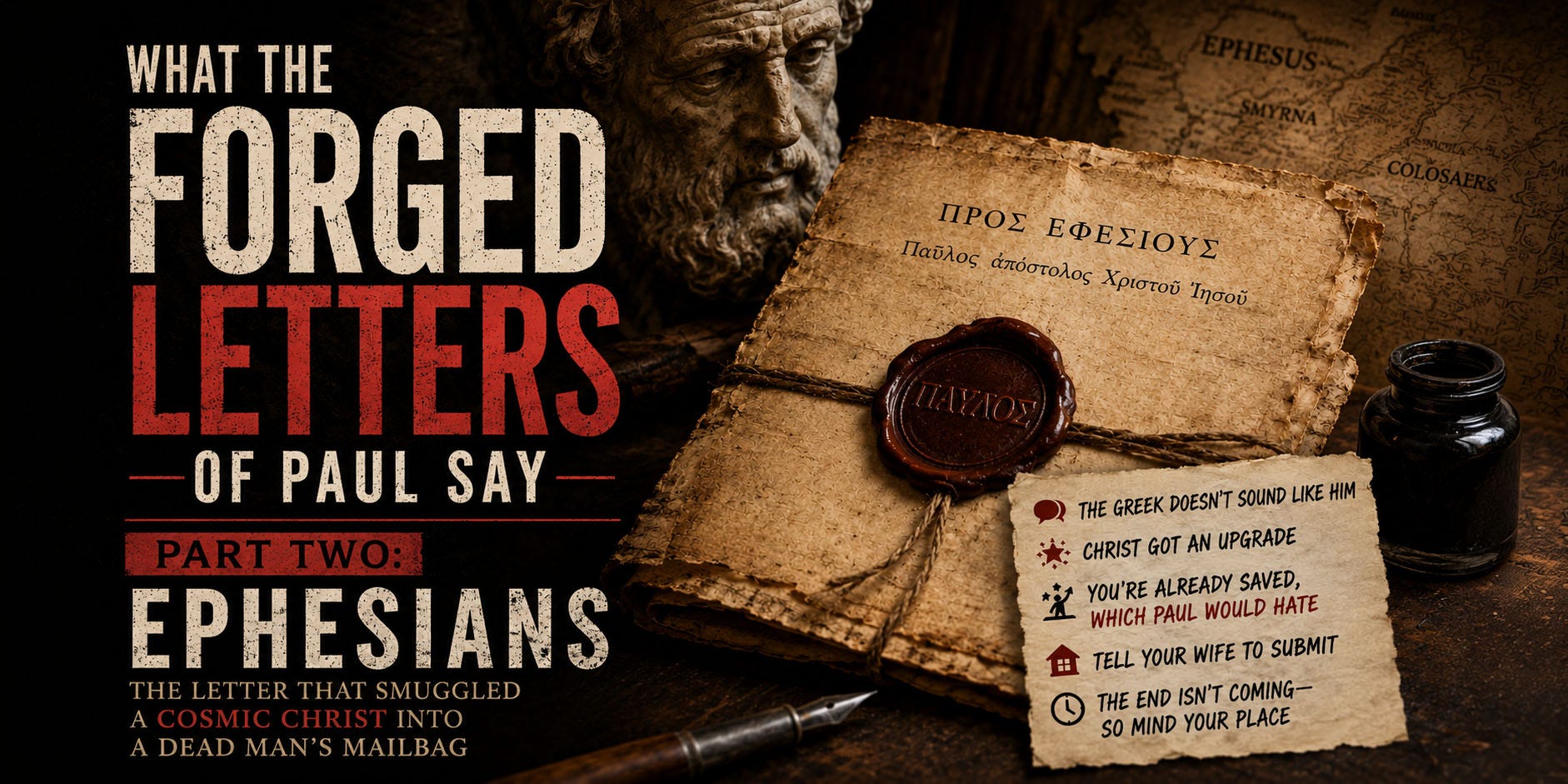
Last time I showed you Colossians, the soft case, the one where you have to squint to see the seams. Ephesians is not the soft case. Ephesians is where whoever did this got greedy, sat down with a copy of Colossians open beside them, and built a second letter out of the first one. It’s the strongest forgery argument in the entire Pauline corpus, and the reason is almost funny. We don’t just have a fake. We have the fake and we have the thing it was copied from, side by side, and we can watch the copying happen line by line.
Same four tools as before. The Greek, the borrowing, the theology, the historical setting. Only this time the tools don’t have to dig. The evidence is sitting on the surface, because the author left the source document lying right next to the crime.
And don’t read this piece only in your inbox, like it, comment on it, criticize it, so that I’m not in the void and you have a say in how The Unholy Truth takes shape.
The Letter to Nobody in Particular
The letter calls itself a message to the saints in Ephesus. Paul knew Ephesus. According to Acts he spent something like three years there, longer than almost anywhere else, teaching and arguing and building a congregation he'd have known by name. If Paul wrote a letter to the Ephesians, it should read like a letter to people he lived with for three years. It should be thick with names, inside references, personal business, the texture of a man writing to old friends. The undisputed letters are full of that. Romans ends with a long roll call of people Paul wants greeted by name, and he'd never even been to Rome.
The letter to Ephesus has none of it. Not one personal greeting. Nobody named, nobody remembered, no shared history, no inside business. It reads like a circular addressed to people the author has never met and knows nothing about, which is a strange way to write to a church you pastored for three years.
What turns the strange into the damning is that in the oldest and best manuscripts we have, the words in Ephesus aren’t there. The opening just says to the saints who are, with a blank where the place name should sit. The earliest copies have no destination at all. Which lines up exactly with what the letter reads like, a generic piece meant to circulate among many churches, with a blank slot for a place name that somebody later filled in with Ephesus to give the orphan a home. The address that’s supposed to anchor the letter to Paul’s life turns out to be a later patch over an empty space.
The Plagiarism Runs the Wrong Way
Ephesians and Colossians are close. Not vaguely similar, close, sharing material at a level that demands one of them was working from the other. Roughly a third of the words in Colossians turn up again in Ephesians. Whole sequences track each other. The instructions to wives, husbands, children, and slaves show up in both, in the same order, doing the same work. Phrases migrate from one letter to the other. When two documents overlap this heavily, one of them is the source and the other is the copy. That’s not a guess, it’s just what that much shared text means.
So, which way does it run? And this is where the author gets caught, because the borrowing has a direction, and the direction is wrong for Paul.
When the same phrase appears in both letters, the Colossians version tends to be the tighter one, used in a specific argument against a specific problem. The Ephesians version takes that same phrase and inflates it, generalizes it, lifts it out of any particular fight and floats it up into grand abstraction. Words get borrowed and their meaning shifts in transit. A term that meant one concrete thing in Colossians gets repurposed in Ephesians to mean something broader and vaguer. That’s the signature of a copyist working from a source, taking compact material and spinning it out, not an author tightening his own earlier draft.
Run that through what it would mean if Paul wrote both. You’d have to believe Paul sat down with his own letter to Colossae, a letter he’d just written, and rebuilt it into a second much longer letter, reusing a third of the vocabulary, keeping the household code in the same sequence, while subtly changing what his own phrases meant and draining them of the specific arguments he’d written them for. People don’t plagiarize themselves like that. They don’t reach for an old letter and laboriously expand it into a new one, shifting their own meanings as they go. A later author working from a revered model does exactly that. The relationship between these two letters isn’t the relationship between a man and his own prior writing. It’s the relationship between a forger and his template.
Sentences That Never End
The Greek tells the same story it told in Colossians, only louder.
If Colossians had long ceremonial sentences, Ephesians has sentences that seem to forget they’re supposed to stop. The opening section of the letter is, in the Greek, a handful of monstrous run-ons, clause hooked to clause hooked to clause, blessing piled on blessing, the whole thing rolling forward in a kind of liturgical drone that translators have to hack apart with semicolons and full stops just to render it survivable in English. One stretch near the beginning is famous among people who read the Greek for being nearly impossible to diagram, a single sentence that keeps spawning subordinate phrases like it’s afraid of the silence after the period.
That’s not the man who wrote Galatians. The undisputed Paul writes the way a person argues, in bursts, with interruptions, picking fights and answering them. The author of Ephesians writes the way a liturgy sounds, smooth and swelling and built for chanting in a room, not for winning a point. The vocabulary leans the same way it did in Colossians, full of terms Paul doesn’t otherwise use, and the whole register has shifted from a man making a case to a voice performing a benediction. Style alone never closes a case. But the style here points in precisely the direction every other piece of evidence points, and a witness whose every answer agrees with all the others is a hard witness to dismiss.

A Church Made of Bricks
The undisputed Paul talks about churches, plural and local. He writes to the assembly in Corinth, the assemblies in Galatia, gatherings of people in particular cities, each its own messy congregation with its own fights. When he uses the word we translate as church, he usually means the specific group of believers meeting in someone’s house in some named town. His horizon is local because his clock is short, the end is coming and there’s no time to build an institution.
Ephesians means something else by the word, something much bigger. Here the church is The Church, capital letters, a single vast unified entity spanning every congregation everywhere, the universal body of Christ across the whole world. The letter is preoccupied with this grand unity, Jew and Gentile fused into one new humanity, one body, one building rising into a holy temple. That’s a beautiful idea. It’s also a late one. Thinking of the church as one universal institution, rather than a scatter of local assemblies bracing for the end, is the thinking of a movement that has stopped expecting the world to end next week and started organizing itself for the long haul.
And then the line that gives the whole game away. Ephesians describes the church as built on the foundation of the apostles and prophets. The foundation. Set down in the past, by the apostles, as a finished thing the present church now stands on top of. That is not a sentence a living apostle writes about himself. Paul, of all people, the man who fought tooth and nail in Galatians to defend his own apostolic authority as a present, contested, ongoing fact, does not refer to the apostles as a foundation already laid in the past beneath the building. You write that sentence when the apostles are gone, when they’ve become the revered first generation you look back to, the bedrock under your feet rather than the men in the next room. The author is standing on Paul’s grave describing Paul as the foundation, in a letter signed by Paul. He forgot to keep himself in the present tense.
Salvation in the Past Tense
The undisputed Paul guards the timing of salvation as carefully as he guards the resurrection, and for the same reason. For him you’re not saved yet, not finally, not in the bag. You’re being saved, you’re justified now and you’ll be rescued at the end when Christ returns, but the final deliverance sits out in the future where the resurrection sits. Salvation is a hope you’re straining toward, not a receipt in your pocket.
Ephesians hands you the receipt. It says, flatly, that you have been saved. Past tense, completed, by grace you have been saved through faith, the whole transaction closed and behind you. This is the same move Colossians pulled with the resurrection, the future collapsed into an accomplished past, and it’s the same tell. The undisputed Paul keeps the decisive moment ahead of you because he’s still waiting for the end. The author of Ephesians puts it behind you because, for him, the urgent waiting is over and the theology has settled into something you possess rather than something you await. The tense gives away the date.
Why Build the Copy at All
So why would somebody do this? Why take Colossians, itself already written under Paul’s borrowed name, and build a second, bigger letter on top of it?
Because the first one worked. If a letter signed Paul could carry a cosmic Christ into the churches and get read as scripture, then the same trick could carry more. And the author of Ephesians had a bigger message than Colossians did, a grand vision of one universal church, Jew and Gentile welded into a single body, built on the apostles, growing into a temple of God. That’s an institution-builder’s dream, and it needed the biggest name available to sell it. Paul was the biggest name available. So the author took the model that had already proven it could pass, Colossians, and expanded it into a manifesto for the unified church, in Paul’s voice, over Paul’s signature.
And again, before anyone softens this into harmless tribute, the ancient world had no such category. They knew forgery when they saw it and they condemned it. Writing a letter under a dead apostle’s name to lend your own ideas his authority was understood, then as now, as a deception practiced for the leverage the name provided. Whoever wrote Ephesians wanted Paul’s weight behind a vision of the church Paul never lived to hold, and they got it, so thoroughly that the letter sat in the canon for nineteen centuries with most readers never once asking who actually held the pen.
That’s Ephesians, the copy of the forgery, the letter to a church the author never met, addressed to a city the earliest manuscripts don’t name, built out of a third of another fake while quietly changing what its borrowed words mean. Of the six it’s the one I’d stake the most on. Next in the series we take up Second Thessalonians, and Second Thessalonians has a peculiar twist the others don’t. It’s a forged letter that warns you, in Paul’s name, to watch out for forged letters.
Let me be straight with you. The Unholy Truth runs on readers who decide it’s worth paying for. If you’ve been meaning to become a supporter, now’s the time.
And if a paid subscription isn’t in the cards right now, sharing The Unholy Truth with family and friends supports the work just as much, at no cost to you.
Sources and Further Reading
Bart D. Ehrman, Forged: Writing in the Name of God (HarperOne, 2011)
Bart D. Ehrman, Forgery and Counterforgery: The Use of Literary Deceit in Early Christian Polemics (Oxford University Press, 2013)
Bart D. Ehrman, The New Testament: A Historical Introduction to the Early Christian Writings (Oxford University Press)
Raymond E. Brown, An Introduction to the New Testament (Doubleday, 1997)
Wayne A. Meeks, The First Urban Christians: The Social World of the Apostle Paul (Yale University Press)
E. P. Sanders, Paul: A Very Short Introduction (Oxford University Press)
Paula Fredriksen, Paul: The Pagan’s Apostle (Yale University Press, 2017)
Tags: Ephesians, Colossians, Paul, pseudepigrapha, biblical criticism, New Testament, early Christianity, forgery, Bart Ehrman, literary dependence, textual criticism
Advice of John Hunt is good.
Hi A Tanner
I like your writing style. It's fluent, persuasive, aimed at the general reader, the non-specialist who is interested in the subject but not the details of how scholarly opinion splits. But I totally get the amount of reading/research that has gone into this.
I expect you have some ideas in hand about publishing in book format. Or aren't interested in going down that route. If you want some advice there, I could perhaps help - been involved in publishing thousands of titles in this subject area (happy to send my CV). Wouldn't want payment (sold my publishing business a few years ago). Just have some occasional time on my hands.