


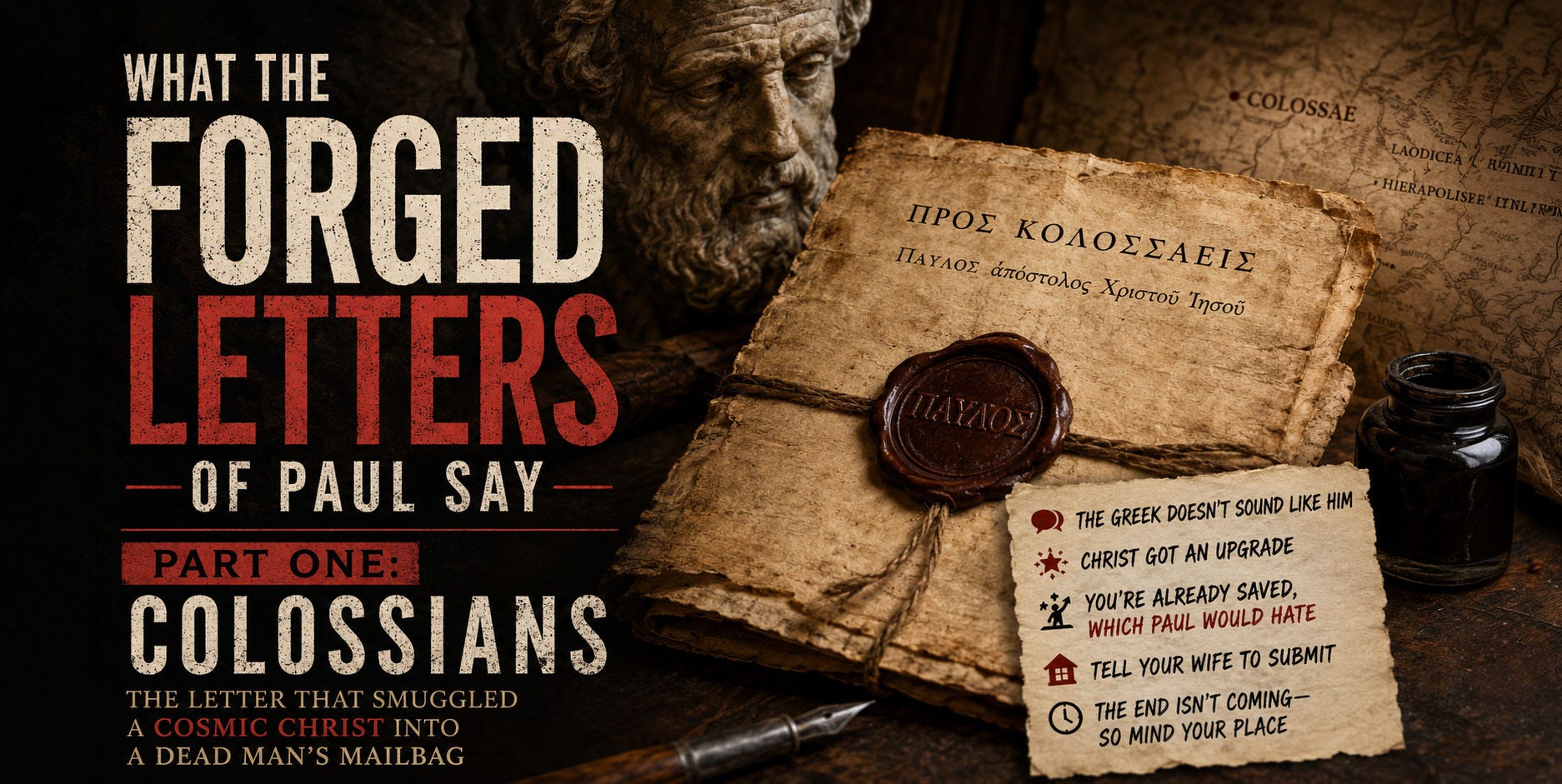
Somebody wrote a letter, signed Paul’s name to it, and sent it to a church in a town Paul had never visited. That’s the scholarly case against Colossians, and most people who own a Bible have no idea it’s even a question. They were handed thirteen letters with Paul’s name on the return address and told to read them as a set. Thirteen letters, one apostle, case closed, right?
Not so fast.
Scholars sort those thirteen into tiers, and the sorting isn’t a matter of taste. Seven of them, Romans, First and Second Corinthians, Galatians, Philippians, First Thessalonians, and the little note to Philemon, are the ones almost nobody disputes. They read like a man under pressure, doubling back, contradicting himself, losing his temper, and that texture is part of why they hold up. Those seven are the control group. They tell us what Paul’s Greek sounds like, what he seems to have believed about the end of the world, how he builds an argument, where he reaches when he needs a metaphor. Once you know the control group cold, you can hold the other six up against it and watch the seams show.
Colossians is where you learn to see the seams. It’s the gentlest case of the six, which is exactly why it’s the right place to start. Nobody’s going to convince you in one sitting that the letter’s a fake, and I’m not going to try. What I’ll do is show you the method, the five tools, working on a hard example, so that when we get to the easy ones later in this series you’ll already know what you’re looking at.
And remember, the same science used to analyze the authorship of texts has been used in court. The techniques that flag a disputed Paul are the techniques that flag a forged confession or a ghostwritten will. This is the same forensic linguistics a prosecutor leans on, pointed at a book people stake their lives on.
What “Undisputed” Actually Means
It’s easy to confuse how historians work with recent history and ancient history and to expect a similar strength of support from both. But recent history is about what happened. Ancient history, in almost every case, is a working hypothesis about what most likely happened, and it can change drastically with an archaeological discovery or a piece of evidence that’s been hiding in someone’s private collection.
If letters from Adolf Hitler turned up in circulation with no verifiable source, historians would scrap them regardless of how many of them sounded like something Hitler might have written. They wouldn’t even get mentioned in history classes. Anyone building a case on them would land somewhere between conspiracy theory and propaganda, especially if those letters carried atrocious political consequences.
Paul’s letters get different treatment, because if we applied that same standard we’d have nothing to talk about in ancient times. When someone refers to the undisputed letters of Paul, what they mean is that those letters are consistent with what scholars expect Paul would write.
In other words, direct evidence that Paul wrote any of the letters is nonexistent, and “undisputed letters” doesn’t mean “letters indisputably Paul’s”. Once you accept that, seven of those letters are considered consistent with what we know about Paul from other sources. This piece is about the other six.
The Greek Doesn’t Sound Like Him
In the seven letters we think are consistent with our expectation of how Paul would write, Paul writes like a man talking fast. His sentences punch, double back, break off mid-thought, pick up again three clauses later. He argues with imaginary opponents. He interrupts himself to swear he’s not lying. Read Galatians out loud and you can hear the vein in his forehead. The man had a temper and a deadline and it shows in every line.
Colossians, which we’ll focus on today, isn’t anything like that. It’s written in a liturgical tone, the sentences piling up clause on clause, genitive on genitive, in long ceremonial chains that roll forward without ever picking a fight. The opening thanksgiving runs on and on in a single Greek sentence so freighted with subordinate phrases that translators have to chop it into pieces just to make it read in English. That’s not how Paul writes when he’s awake. That’s how you write when you’re composing something to be read aloud in a service, polished, smoothed, built for the ear instead of the argument.
Then there’s the vocabulary, and this is where it gets hard to wave away even for the hardest critic of the forgery claim. Colossians is a short letter, and it’s packed with words that appear nowhere in the seven uncontested letters. Thirty-odd words that Paul, across thousands of lines of undisputed writing, never once uses. A few oddball words prove nothing. Every writer reaches for something new now and then. But a short letter studded with this many first-timers, clustered around the exact themes the letter wants to push, is a pattern. And running underneath it, the reverse problem: the little connective words Paul leans on constantly, the verbal tics that show up on nearly every page of the real letters, thin out or vanish here. The fingerprints don’t match anywhere on the hand.
You can explain any single piece of this away. Maybe Paul used a secretary and gave him a long leash. Maybe his style drifted with age. Maybe the subject called for a grander register. Each excuse holds for one data point. The trouble is they all have to hold at once, stacked on top of each other, and the stack gets taller with every tool we pick up.
Christ Gets an Upgrade
Theology is where the letter gives itself away, because what Colossians believes about Jesus is hard to square with what the undisputed letters show Paul working out.
Those seven letters read like an apocalyptic Jew with his hair on fire. His Jesus is the crucified messiah whom God raised and is about to send back, soon, in your lifetime, to judge the living and the dead and tear down the present order. Everything in the control group letters bends toward that imminent end. Paul tells the Corinthians not to bother getting married because there’s no time. He tells the Thessalonians the dead will rise when the trumpet sounds and the living will be caught up to meet the Lord in the air, and he clearly seems to expect to be among the living. The clock is running and the alarm is set for any minute now.
Colossians has a different Jesus, and he’s enormous. In the famous hymn near the start of the letter, Christ becomes the image of the invisible God, the firstborn of all creation, the one in whom and through whom and for whom everything was made, the one who holds the entire universe together. This is a cosmic principle, a being woven into the structure of reality itself, the glue of the cosmos. The crucifixion is still in there, but it’s been folded into something vast and metaphysical and frankly a little Greek. Paul’s Jesus is about to crash through the sky. The Jesus of Colossians is already everywhere, holding the molecules in place.
That looks like a generation of development, minimum. Christology tends to grow in one direction over time, from a man God exalted toward a divine being who was there at the creation, and Colossians sits much further down that road than anything in the undisputed letters. Communities don’t usually leap that far in the span of one apostle’s working life. They take decades to talk themselves into a cosmic Christ. The most economical reading is that somebody wrote this hymn after that talking had happened, then put it in Paul’s mouth.
Have a Substack? Let’s collaborate. Email me at tanner@theunholytruth.com
You’re Already Saved
The undisputed letters are rigid about resurrection, something that hasn’t happened to you yet. You were baptized into Christ’s death, yes, you died with him, but the rising is future, it’s the thing you’re waiting for, it’s the payoff at the end when the trumpet blows. Paul spells this out in Romans in language nobody can misread: we were buried with Christ so that we too might walk in newness of life, and the full rising is still out ahead of us. He’s so strict about this that when the Corinthians start acting like they’ve already arrived, already rich, already reigning, he slaps it down and spends a furious chapter hammering that the resurrection itself is still out ahead of them. Resurrection is not yet. That’s a hill the genuine Paul will die on.
Colossians strolls up the hill and plants the opposite flag. It tells the readers they have already been raised with Christ. Past tense, done deal, you’re up. The letter says you were buried with him in baptism and raised with him through faith, and it means raised now, already, accomplished. The thing the undisputed letters fought to keep in the future, the thing they called an error when the Corinthians reached for it, Colossians hands out as settled fact in the opening pages.
While the other evidence accumulates, this one just sits there, flat and hard to reconcile. The author of Colossians affirms something Paul spent ink and rage denying. You can stretch a man’s vocabulary. You can age his style. It’s much harder to have him affirm in one letter the exact claim he calls heresy in another and still call it the same man writing in the same lifetime. The eschatology moved, and the simplest account is that the author moved with it.
Tell Your Wife to Submit
The last piece is about what the letter wants from you, and it points the same direction as everything else, toward a later world that’s made its peace with staying put.
Near the end Colossians lays out a tidy domestic order**: wives submit to your husbands, husbands love your wives, children obey your parents, and slaves obey your masters in everything, work hard, don’t talk back.** It’s a neat little hierarchy, everyone in their slot, the household humming along quietly under the existing arrangement. Scholars call this a household code, and the form has clear roots in the ordinary moral writing of the surrounding Greek and Roman world, the standard advice on how to run an orderly home.
Sit that next to the undisputed letters and the contrast does the work. Paul shows no interest in running an orderly home, apparently because he didn’t think the home had long to last. He told people to stay unmarried if they could**, and he wrote** that in Christ there’s no slave or free, no male and female, the old categories collapsing in the face of what was coming. His movement was disruptive precisely because the end was near and the present order was a dead man walking. Why optimize the seating chart on a ship you’ve told everyone is sinking?
Because by the time Colossians was written, the ship had stopped sinking. The end hadn’t come, the fever was breaking, the movement was settling in for the long haul, and a settled movement needs rules for daily life, needs wives and slaves to know their places so the churches don’t draw the wrong kind of attention. The household code is the sound of apocalyptic urgency cooling into social respectability**, the early church getting comfortable,** learning to live inside the Roman world instead of waiting for God to burn it down. That’s a second-generation problem, and Colossians is solving it under a first-generation name.
Free subscriber who finds value here? Become a paid one to keep The Unholy Truth alive.
Who Wrote It, and Why
Put the five tools together and they all point one way. The Greek sounds composed instead of combative. The vocabulary is full of strangers. The Christ is a cosmic giant a generation too developed. The resurrection has already happened, which the uncontested letters called an error. And the social vision has gone from burn-it-down to mind-your-manners. Any one of these you could argue with. All five, leaning the same direction, stacked on the same letter, is hard to argue with. It asks to be explained.
The explanation most scholars reach for is pseudepigraphy, the ancient practice of writing under a borrowed name. And before anyone reaches for the gentle version, the idea that this was just a devoted student paying tribute to his teacher, no harm meant, understand that’s a modern comfort the ancient world wouldn’t have recognized. People in the ancient world knew what forgery was and they didn’t like it. They had a word for it. They complained about it, exposed it, treated a letter written under a false name as a lie told for an advantage. On this reading, when someone signed Paul’s name to a letter Paul didn’t write, they did it because Paul’s name carried weight, and they wanted that weight behind their own ideas. It was a grab for authority.
So the picture that fits the evidence is somebody with a cosmic Christ to sell, a household to put in order, and a resurrection they believed was already cashed in, reaching for the most powerful name they had. They wrote it down in Paul’s voice, as well as they could manage the voice, and sent it off to Colossae over a dead apostle’s signature. It worked well enough to land in your Bible.
That’s Colossians, the soft case, the one where you have to look hard to see it. Next in this series we take up Ephesians, and Ephesians is going to make this look subtle, because whoever wrote Ephesians had a copy of Colossians open on the desk while they did it.
Sources and Further Reading
Bart D. Ehrman, Forged: Writing in the Name of God (HarperOne, 2011), and his textbook The New Testament: A Historical Introduction to the Early Christian Writings (Oxford University Press) for the standard tiered treatment of the Pauline corpus.
Bart D. Ehrman, Forgery and Counterforgery: The Use of Literary Deceit in Early Christian Polemics (Oxford University Press, 2013), on how the ancient world actually regarded false attribution.
Raymond E. Brown, An Introduction to the New Testament (Doubleday, 1997), for a careful survey of the authorship debate from a scholar who weighed the case on the evidence.
Wayne A. Meeks and others on the household codes and their setting in Greco-Roman domestic ethics.
For Paul’s apocalyptic outlook, E. P. Sanders, Paul: A Very Short Introduction (Oxford University Press), and Paula Fredriksen, Paul: The Pagan’s Apostle (Yale University Press, 2017).
Tags: Colossians, Paul, pseudepigrapha, biblical criticism, New Testament, early Christianity, forgery, Bart Ehrman, Christology, historical Jesus