


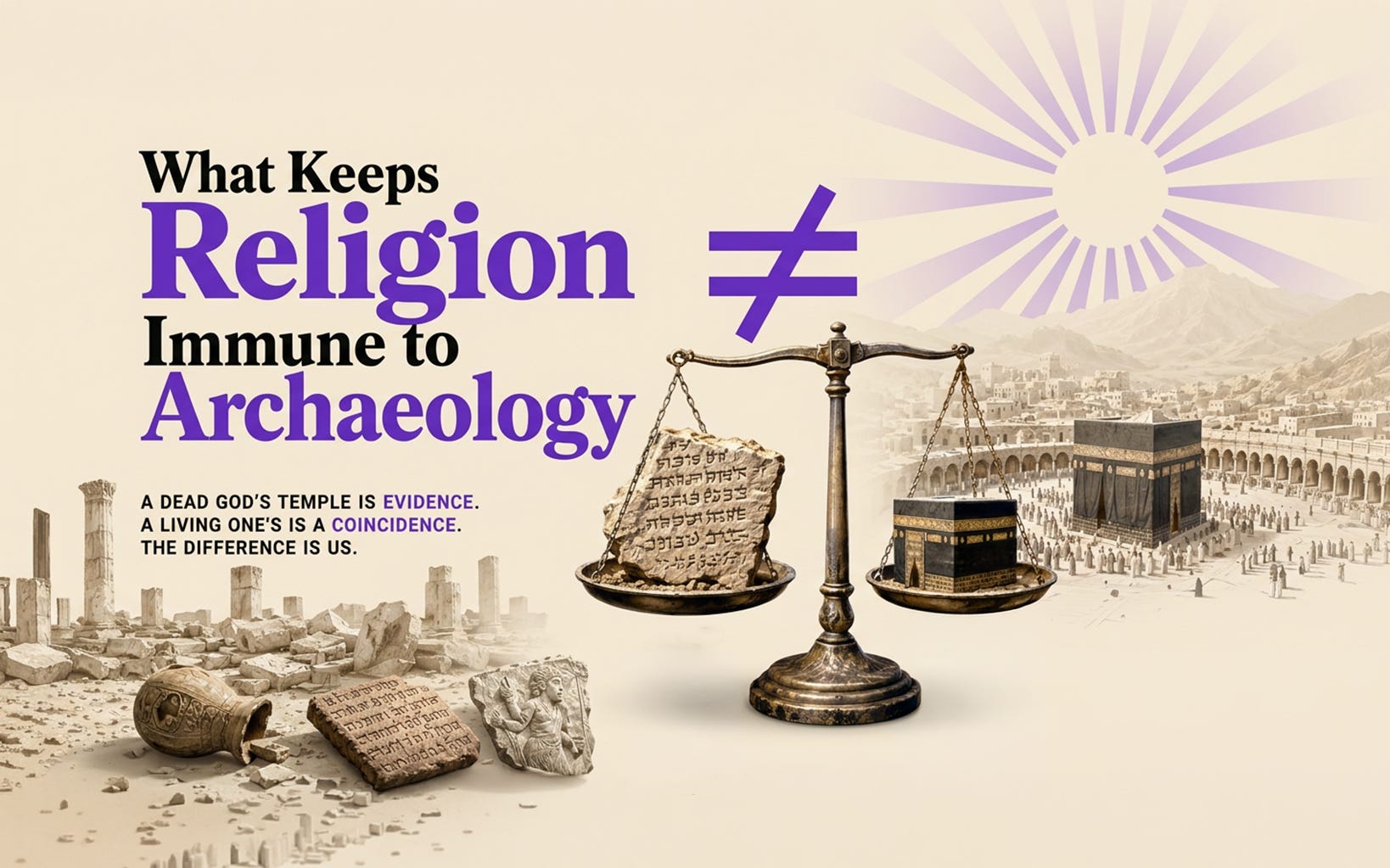
Similarity isn’t derivation, just as absence of evidence isn’t evidence of absence. When a Canaanite storm god and the God of Israel share a résumé (riding clouds, splitting seas, thundering from a mountain), that overlap doesn’t prove one became the other by itself. Parallel details can come from a shared cultural inheritance, from independent development, from the plain fact that ancient Near Eastern people had a limited vocabulary for describing power. The tablets from Ugarit, the inscriptions at Kuntillet Ajrud, the divine-council language salted through the Psalms: the fair reading is that the evidence strongly favors an Israelite religion that grew out of, and against, its neighbors’ gods.
Yet the part that gets left out of that retreat is that “strongly favors” is the ceiling any historical argument can reach the moment it runs into received doctrine, because doctrine has a move that history doesn’t. It can always say the evidence is a test, or a corruption, or a mystery, or an improbable but technically not impossible coincidence reserved for God. Nothing is off the table on the doctrinal side, which means no pile of pottery and no run of inscriptions can ever get past “strongly favors” and into “case closed.”
Run the Substitution and See How the Objections Do
So how do you check whether “strongly favors” is actually being treated as too weak, or whether something else is going on? Swap the religion.
Take the exact same standard of evidence, the same tablets-versus-scripture logic, and point it at a religion nobody in the room worships. Say the syncretism argument is about Marduk getting folded into a later Babylonian cult, or about the way Roman emperors picked up the trappings of eastern sun gods. Watch how fast the objection evaporates. Nobody clutches at “similarity isn’t derivation” to defend the theological independence of Sol Invictus. Nobody demands proof rather than strong inference before they’ll accept that Isis worship borrowed freely from older Egyptian material. We accept “strongly favors” as more than enough the second the god in question has no congregation left to offend.
In fact, the religion doesn’t have to be dead as long as it’s not the same. Suppose the claim is that early Islam drew its apocalyptic furniture, its Satan, its final judgment and bodily resurrection, from Zoroastrian and Jewish sources already circulating in late antiquity. Fred Donner and W. Montgomery Watt have made versions of the historical case; John Esposito has spent a career mapping how traditions cross-pollinate. A non-Muslim reader tends to find that argument pretty reasonable. They’ll take the evidence, move on, and not lose sleep over whether they’re jumping to conclusions.
The objection only regrows its teeth when the tradition on the table is a living one that the reader belongs to. Then, and mostly only then, “strongly favors” gets reclassified as overreach, and the demand for something closer to proof comes back. That asymmetry isn’t coming from the evidence, which hasn’t changed across the three cases. It’s coming from the reader’s relationship to the defendant.
The Kaaba’s Missing Paper Trail
Before Muhammad, the Kaaba was already a pilgrimage site and a working shrine, packed with the idols of the surrounding tribes. It drew pilgrims from all corners of Arabia into Mecca, and the pilgrims brought trade. That traffic was a serious source of income for the Quraysh, Muhammad’s own tribe, who kept custody of the shrine and profited from the people streaming in to visit it.
Then, all at once, the story arrived that Abraham and Ishmael had built the shrine with their own hands. The idol‑filled sanctuary got a new pedigree as the first house of monotheism, the idols came out, and the pilgrim money kept right on coming—now sanctified. Archaeological evidence for Abraham’s construction? Zilch. No dig, no inscription, no material trace that Abraham ever set foot in Arabia, let alone laid a foundation there.
So run the claim forward and watch what it asks you to swallow. Abraham supposedly came to Arabia and delivered the same monotheism Moses would later hand the Jews, and then that religion vanished without leaving a single fingerprint in the ground. It’s almost as if a divine power went back and erased every track, and did it in exactly the pattern you’d expect if a man were inventing a founding myth in the 7th century to keep his tribe’s shrine revenue flowing.
A stretch of history that empty lets an outsider draw the obvious conclusion and move on. The same readers who demand an open mind for their own tradition rarely ride to Islam’s defense with “nobody should jump to conclusions” and “absence of evidence isn’t evidence of absence.” They don’t insist that the improbable might have happened here, that a whole religion evaporated as though it had never existed and every Arab in the peninsula forgot who Abraham was and became a polytheist. And they’re just as quiet about the other side of the ledger. The miracles Muhammad is said to have performed were reportedly witnessed by major Arab cities, by crowds whose sheer numbers, on the believer’s own logic, ought to count as testimony too heavy to wave off.
The consistency only shows up when it’s someone else’s shrine. Point the identical reasoning at Mecca that gets pointed at Delphi or a Canaanite high place, and the missing paper trail reads exactly the way a missing paper trail always reads.
If you’re not already a paid subscriber and you’re finding value here, I’d love for you to consider becoming one to keep The Unholy Truth alive.
Doubt Is Where the Search Starts
None of this means the believer’s caution is dishonest. Francesca Stavrakopoulou, who specialized in reconstructing the god Israel actually worshipped before the editors tidied him up, will tell you that the sources are broken and the certainty is provisional. Bart Ehrman says the same thing about the New Testament roughly once a chapter.
While some facts are simply better supported than others, ancient history is still a claim about what most likely happened, not a recording of what happened, and it’s pinned to the best knowledge available at the time. And that’s what keeps every religion immune to archaeology. Present something with 99.9% odds of being true that contradicts a given tradition, and the tradition survives in the remaining 0.1%, because an improbability is never a threat to a system that reserves the right to live inside one.
What the substitution test exposes is that the provisionality gets applied unevenly, that the choice of whether to camp on the 99.9% or the 0.1% depends on whose tradition is in the dock. We hold a dead religion to “strongly favors” and call it settled history. We hold somebody else’s living religion to “strongly favors” and call it fair scholarship. We hold our own to a standard no historical claim was ever built to satisfy, and then treat the gap between that standard and the evidence as a point in doctrine’s favor.
And if you're wondering why I leaned on Islam for this one, two reasons. First, and most importantly, unlike over on Medium, I don't think I've picked up much of a Muslim following here yet, so the point had a chance to land before anyone got defensive. Second, going by the latest survey, a couple of readers think I've been going soft on Islam and giving it a free pass.😉 Tell me you want to hear more about Islam, the Quran, and their history, and I'll dig in.
Finally, I’ll leave you with this.
Truth-seeking starts with doubt, keeping nothing above scrutiny. If we could work that out, so would a super-intelligent creator of this magnificent universe.
Sources and Further Reading
Bart D. Ehrman, Misquoting Jesus and Jesus, Interrupted (on the provisional, edited nature of the textual record)
Francesca Stavrakopoulou, God: An Anatomy (on the reconstructed pre-canonical Yahweh)
Bruce M. Metzger, The Text of the New Testament (on transmission and corruption)
W. Montgomery Watt, Muhammad at Mecca (on early Islam and its late-antique context)
Fred M. Donner, Muhammad and the Believers (on the formation of the early community)
John L. Esposito, Islam: The Straight Path (on cross-tradition influence)
Bravo. I've read about this in other places, including some of the papers written by the archaeologists and historians. I also read a book written by a former Muslim who is now Christian. (I can't remember the exact title and it's in the States, while I am not, else I would include it here.) In it, she points out how much of Islam has its roots in Christianity. (I know that will upset some people.) The author advanced a theory that Muhammed heard some pieces of Christianity, but not the full story. He stitched together what he knew, then filled in the rest of the details, Is she correct? Maybe; we weren't there. A theory is just a theory until evidence confirms or denies.
If your faith is threatened by a theory, it's not very strong. If your faith is threatened by anything, that's a you problem. That's the importance of deconstruction; keep what's true and throw away the garbage. It's all about the relationship if it's really faith and the relationship doesn't live or die by the origin story. If I have a personal relationship with someone - anyone - that relationship isn't going to be threatened if I find out one of their parents went to jail or their parents weren't married or they were adopted or whatever. The archaeology doesn't threaten my relationship with God. It's interesting and fascinating, but it doesn't change anything, so I'm not threatened or offended by what's learned. If the history offends you, your insecurity is showing.
I have a suspicion this started from the times when Judaic priests worshipping a certain deity competed against priests of other deities by declaring their god EXISTING and other gods NON-EXISTING. I mean, the god in question has a habit of introducing himself as I AM, how much more Freudian can it get? But if the main selling point of the religion is the insistence on belief in a certain factual issue (existence or non-existence of a certain god), then that insistence on having all of the facts their way becomes the cornerstone of the religion. I mean, an old Roman would be much less offended if someone suggested to him that Venus cult has common roots with Aphrodite cult, or that some other gods might be existing.