


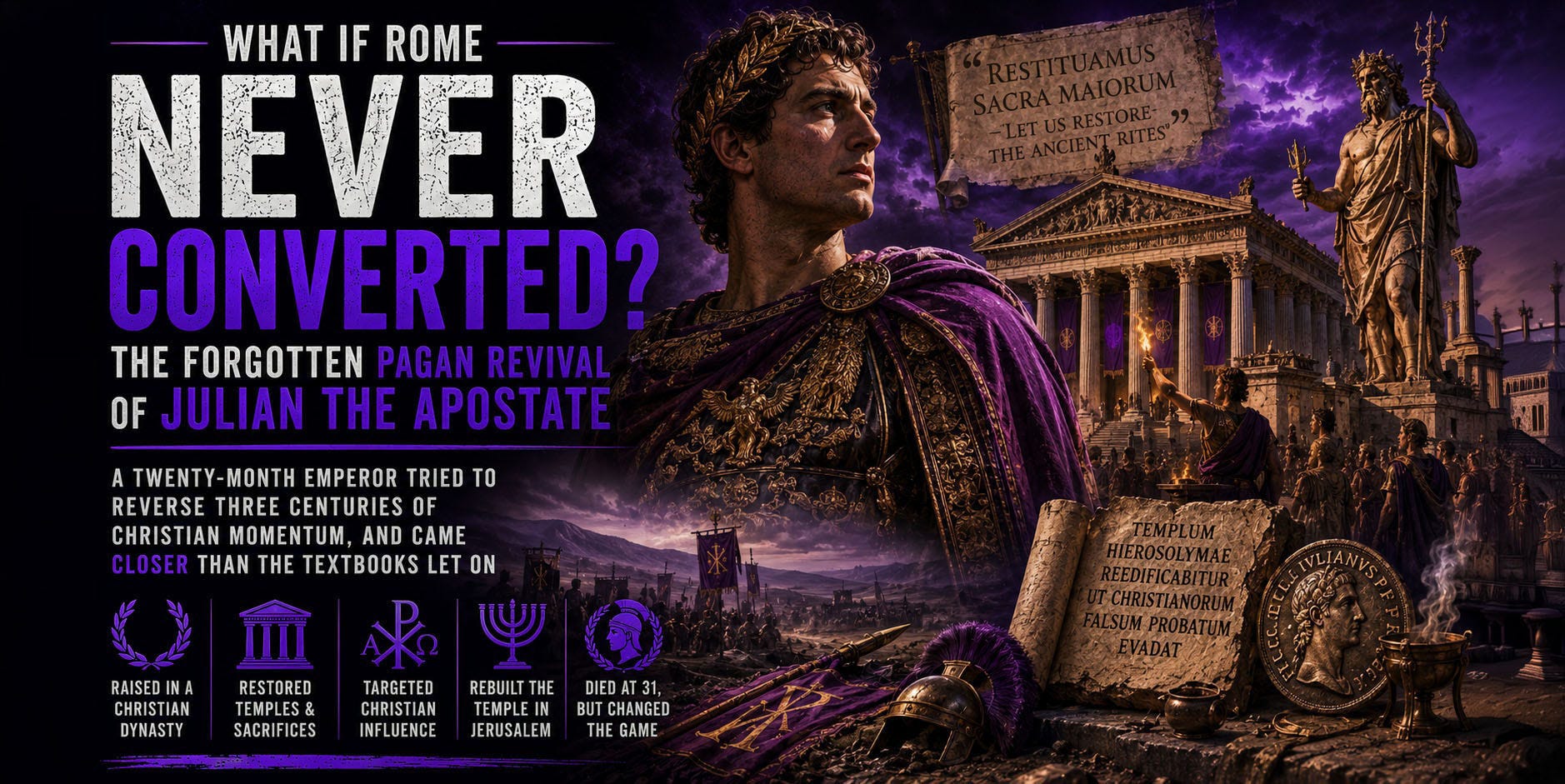
In 361 AD, a thirty-year-old philosopher-soldier walked into the imperial palace at Constantinople and announced, to the horror of half the court, that the whole Christian experiment was over. He wasn’t a barbarian at the gate, he was Constantine’s nephew, raised inside the dynasty that had made Christianity Rome’s most favored religion, tutored by the empire’s own bishops, baptized in the empire’s own church. And he’d spent his adult life quietly deciding that all of it was a mistake.
His name was Julian. History remembers him as “the Apostate,” a label his enemies gave him that stuck so well it’s still his Wikipedia disambiguator. For twenty months, he ran the most powerful state on earth on the premise that Christianity could be unwound. Then he died on a Persian battlefield with a spear in his side, and the rest is history.
The Family That Tried to Kill Him
It’s tempting to read that as proof the whole project was doomed from the start, that Christianity’s triumph was inevitable and Julian was just a historical speed bump. But is it really the case?
Let’s start with Julian’s relationship with Christianity.
In 337, when Julian was five or six, his uncle Constantine died and the empire descended into a purge. Constantius II, Julian’s cousin, moved to eliminate rival claimants to the throne, and that included most of Julian’s family: his father, an uncle, cousins. Julian and his half-brother Gallus survived, because they were considered too young to be threats, and Julian spent the rest of his childhood under house arrest in all but name, shuffled between estates, watched by tutors who were also informants.
The men doing the killing were Christian. The empire doing the killing was Christian. Julian was raised Christian, catechized, made a lector in the church, all while knowing exactly who had murdered his family and what religion they claimed while doing it.
Later, as a young man finally given some freedom to study, he was sent to Athens and Nicomedia, where he fell in with pagan philosophers and Neoplatonist teachers like Maximus of Ephesus. He found paganism in the hands of men who treated him like a mind worth investing in rather than a threat worth monitoring, the religion of people who weren’t his family’s murderers, and it’s not hard to see how that shaped what he came to believe.
What He Built
Julian became sole emperor in 361 after his cousne Constantius II died, and he moved fast. Within months he’d converted publicly to paganism, something he’d apparently kept private for years out of self-preservation.
He knew all too well that crude persecution had failed before, under Diocletian, and had instead made Christians more cohesive. Julian's approach was subtler and, in some ways, more dangerous to Christianity's momentum. He reopened pagan temples across the empire and ordered restitution of temple lands that had been seized. He reinstated animal sacrifice as public ritual. He tried to build something Greco-Roman paganism had never really had: an organized clergy, with ranks and offices, charitable functions, and moral teaching, modeled on the institutional strengths that had made Christianity so effective at building loyalty. He understood that Christianity's biggest advantage was organizational. Bishops ran networks. Congregations took care of their poor and buried their dead. Paganism, for all its temples, had never built anything comparable.
He also issued an edict banning Christians from teaching classical literature and rhetoric, on the logic that they didn’t believe in Homer’s gods and so were teaching students to admire what they privately rejected. It reads today as pettier than his other moves, and it was deeply resented, but it targeted something real: Christian intellectuals had been trained on classical education for generations and were redeploying it in Christian terms, and Julian wanted to choke off that pipeline.
And then there’s the Temple project. Julian ordered the rebuilding of the Jewish Temple in Jerusalem to strike at Christian theology specifically. Jesus had prophesied the Temple’s destruction as permanent (Luke 21:6, Matt. 24:2), and Christian writers had spent three centuries pointing to the ruins as living proof of that prophecy’s fulfillment. If Julian rebuilt it, he’d falsify a core Christian claim in front of the whole empire. Construction began and then stalled amid earthquakes and fires that Christian sources attributed to divine intervention, and Julian died before the question of what stopped it could be settled.
Irony had struck again. Julian’s strategy was structurally identical to Rome's original plan: humiliate and crucify Jesus to prove he wasn't the Messiah. And we all know how well that worked out.
If this piece gave you a new perspective, consider becoming a paid subscriber to keep this publication independent and support future research.
Twenty Months, Then a Spear at Samarra
If anything, Julian’s twenty-month reign was a mirror held up to the early Church. It exposed a truth Christians today often prefer to forget: the faith didn’t conquer Rome solely through divine inevitability, but through institutional muscle, political maneuvering, and a deep reliance on the very empire that once fed them to lions.
When Julian took his final breath on a dusty Persian battlefield in 363 AD, legend claims his last words were, “You have conquered, O Galilean.” Whether he said it or not, the triumph was complete. The imperial machinery Julian tried to dismantle reassembled itself overnight, stronger and more intolerant than before.
The “Apostate” proved that you can’t roll back the wheel of history once a religious revolution has learned how to rule. He tried to fight a church that had already become an empire by acting like an emperor and in doing so, he guaranteed that the future belonged entirely to the Galilean.
Sources and Further Reading
G.W. Bowersock, Julian the Apostate (Harvard University Press, 1978)
Rowland Smith, Julian’s Gods: Religion and Philosophy in the Thought and Action of Julian the Apostate (Routledge, 1995)
Ammianus Marcellinus, Res Gestae, Books 20-25 (the closest thing to a contemporary account of Julian’s reign)
I tend to think that had Julian prevailed, Christianity would have been more diverse, more tolerant and less influential. No way to know, of course.
Re "He understood that Christianity's biggest advantage was organizational. Bishops ran networks. Congregations took care of their poor and buried their dead. Paganism, for all its temples, had never built anything comparable."
This is the primary reason (IMHO, of course) why Christianity was attractive to Roman elites. Of course, they immediately started "improving" Christianity, adding features to worship services that survive today (clerical garb was developed based upon Roman administrative garb, "churches" the buildings anyway based up temples. (Christians met in homes mostly and didn't have a tradition of worship houses.) Lots more about the Roman legacy in the church in the book "Pagan Christianity."