

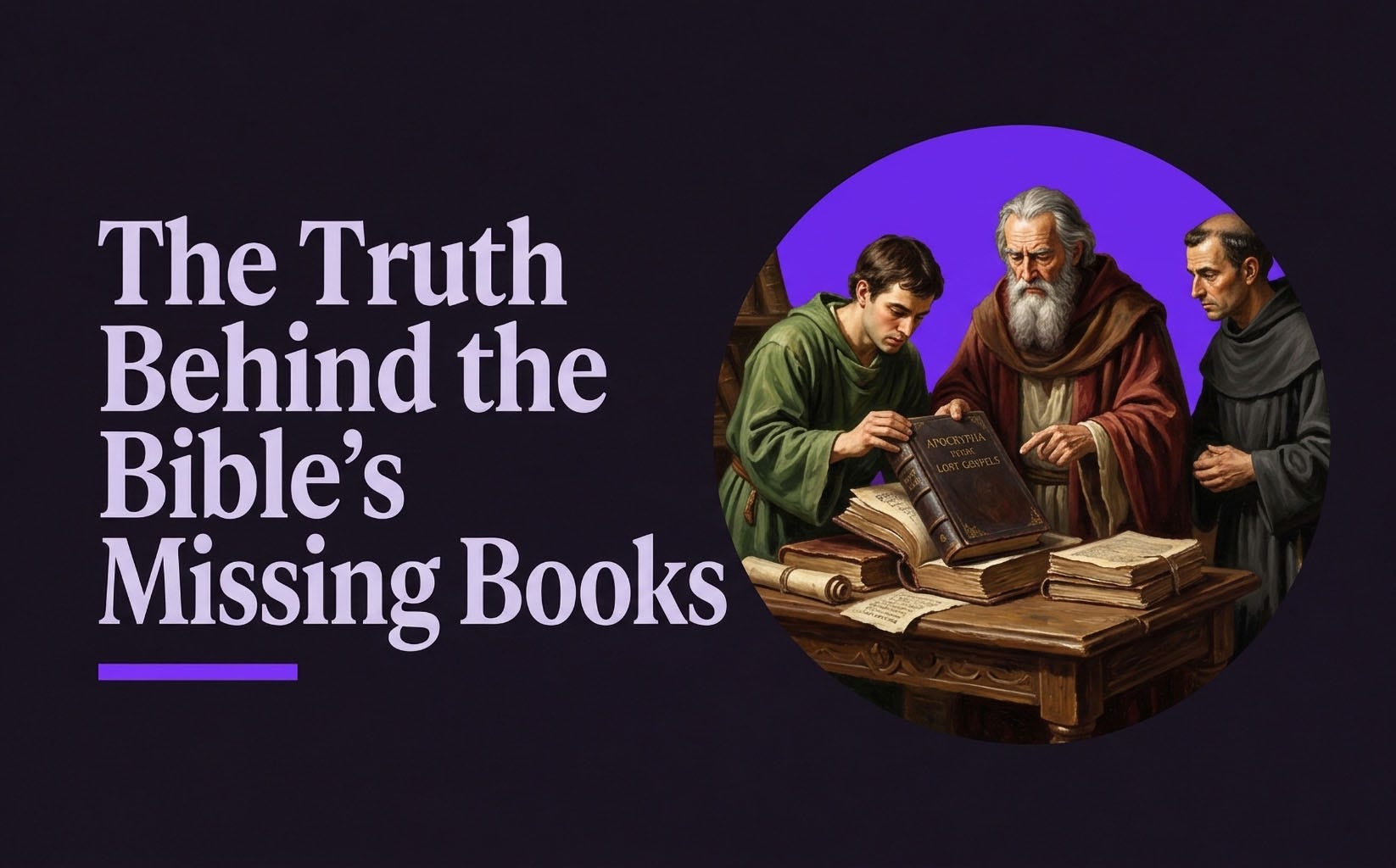
If you want to understand how the Bible was built, you have to look at the footprints of the books that didn’t make the cut. Ancient authors regularly pointed their audience toward texts we can no longer read, from forgotten Old Testament war chronicles to lost epistles written by Paul himself.
The boundary between what was considered sacred scripture and what was cast aside wasn’t cast in stone for centuries, since it was shaped by rival shipowners, regional politics, and scribal fatigue long before any official council issued a final list.
And logic dictates that if a book referencing another book is legitimate, so is the referenced book.
Six Popular Beliefs About the Bible’s Compilation
Most people come to this topic carrying ideas picked up from sermons, novels, and documentaries. Six of them come up again and again, and today we’re tackling those.
Constantine and the bishops at the Council of Nicaea chose the books of the Bible.
Church leaders hid or destroyed the books that didn’t make it in.
The Bible’s book list has remained the same since the time of the apostles.
Every word Paul wrote is in the Bible.
All Christians use the same Old Testament.
The excluded books are secret manuals of hidden knowledge.
No-Show Books the Old Testament Cites
Hebrew Bible writers sent readers to other books. Numbers 21:14 cites the Book of the Wars of the Lord. Joshua 10:13 and 2 Samuel 1:18 cite the Book of Jashar. First Kings 11:41 cites the Book of the Acts of Solomon, and the books of Kings repeatedly point to the Chronicles of the Kings of Israel and of Judah.
None of these survived, and no ruling removed them. Copying a book by hand cost money, and works that stopped finding readers stopped being copied. Most ancient literature disappeared this way.
In other words, reading the Bible from cover to cover is a relatively recent thing. Each book that made it into the Bible had its own journey, circulation, and claim to legitimacy.
Paul’s Lost Letters
First Corinthians 5:9 says “I wrote to you in my letter not to associate with sexually immoral people,” which refers to an earlier letter that doesn’t survive. Colossians 4:16 tells its readers to read a letter “from Laodicea,” which has also been lost.
A later forgery called the Letter to the Laodiceans, assembled from phrases in Paul’s real letters, filled that gap and appeared in some Latin Bibles for centuries. The idea that every word Paul wrote reached the modern Bible contradicts Paul’s own letters.
What Happened at Nicaea
Emperor Constantine and the bishops at the Council of Nicaea in 325 did not select the books of the Bible. The council addressed the relationship between the Father and the Son and the date of Easter, and the surviving records show no discussion of a book list.
The process ran slowly and unevenly across regions. Around 140, a wealthy shipowner named Marcion assembled the earliest known fixed collection: an edited Luke and ten edited letters of Paul. He rejected the Jewish scriptures entirely. His rivals had a motive to name their own accepted books.
The Muratorian Fragment, a damaged Latin list from the late second century, names most of the books now in the New Testament. It includes the Apocalypse of Peter and omits Hebrews, James, 1 and 2 Peter, and 3 John.
The earliest surviving list containing exactly the twenty-seven New Testament books in use today comes from Athanasius, bishop of Alexandria, in an Easter letter of 367. He wrote as one bishop addressing his own churches, and other regions kept using different lists for generations.
Disputed Books Inside the Bible and Accepted Books Outside It
Eusebius, a church historian writing in the early 300s, sorted books into recognized, disputed, and rejected groups. He placed Revelation in both the recognized and rejected groups because he couldn’t settle on one. Origen had earlier raised doubts about 2 Peter, and Hebrews stayed off lists in the West for generations because no one could name its author. Eastern churches questioned Revelation for centuries.
The oldest complete Bibles show how loose the boundaries were. Codex Sinaiticus, copied in the fourth century, places the Epistle of Barnabas and the Shepherd of Hermas immediately after Revelation with no marker separating them from the rest. Codex Alexandrinus, from the fifth century, adds two letters attributed to Clement of Rome, a leader of the Roman church. The scribes who produced these expensive volumes treated such works as part of the New Testament.
Four Different Old Testaments
The Old Testament had its own disagreements. Greek-speaking Jews and early Christians used a translation called the Septuagint, which contained Tobit, Judith, Wisdom, Sirach, and 1 and 2 Maccabees. Jerome, who produced the Latin Bible around 400, limited the Old Testament to the Hebrew list and ruled that the extra books could be read for edification but could not establish doctrine. Augustine, bishop of Hippo in North Africa, and the African church councils kept them.
The dispute lasted until the Reformation. Martin Luther placed the extra books in a separate section, and the Catholic Church responded at the Council of Trent in 1546 by declaring them scripture. The King James Version of 1611 still printed them between the testaments, and Protestant publishers mostly removed them in the nineteenth century, partly to reduce printing costs.
Today the Protestant Old Testament has 39 books, the Catholic one has 46, the Greek Orthodox one adds 1 Esdras, 3 Maccabees, the Prayer of Manasseh, and Psalm 151 to the Catholic list, and the Ethiopian Orthodox Bible contains 81 books in its broad canon. The answer to how many books the Bible has depends on the church answering.
Who Made the Decision
No single person or meeting made the decision. Congregations kept reading the books they found useful, and three tests came to decide the matter: whether a book could be tied to an apostle, whether it was old enough, and whether it agreed with what the community already taught. Influential bishops pushed these standards, and their preferences shaped the lists that survived.
Many excluded books were popular, and ancient Christians read some of them aloud in worship for generations. The rest of this story concerns what those books say. Free subscribers can upgrade to unlock the bonus section below, which covers the talking cross, the short-tempered child Jesus, and the sayings gospel that has no story at all.
If even a small fraction of regular readers became supporters, I’d spend less time running the business side of this publication and more time in the archives doing the research this work demands.
If you’re getting something out of these pieces, consider supporting The Unholy Truth. Supporters get the bonus sections, the Friday Editions, and the full archive.
Support the work and unlock exclusive content for the full story.
Sources and Further Reading
Bart D. Ehrman, Lost Christianities: The Battles for Scripture and the Faiths We Never Knew (Oxford University Press, 2003)
Bruce M. Metzger, The Canon of the New Testament: Its Origin, Development, and Significance (Oxford University Press, 1987)
Lee Martin McDonald, The Formation of the Biblical Canon (Bloomsbury T&T Clark)
Eusebius, Ecclesiastical History, Book 3 (recognized, disputed, and rejected books)
Athanasius, Thirty-Ninth Festal Letter (367)
James H. Charlesworth (ed.), The Old Testament Pseudepigrapha (Doubleday, 1983)
Elaine Pagels, Beyond Belief: The Secret Gospel of Thomas (Random House, 2003)
Bonus for Paid Subscribers
What the Excluded Gospels Say
If you leave it up to the sensational articles on the internet, the excluded books were secret manuals of cosmic riddles. While the Gospel of Thomas may fit that description, the Gospel of Peter and…