


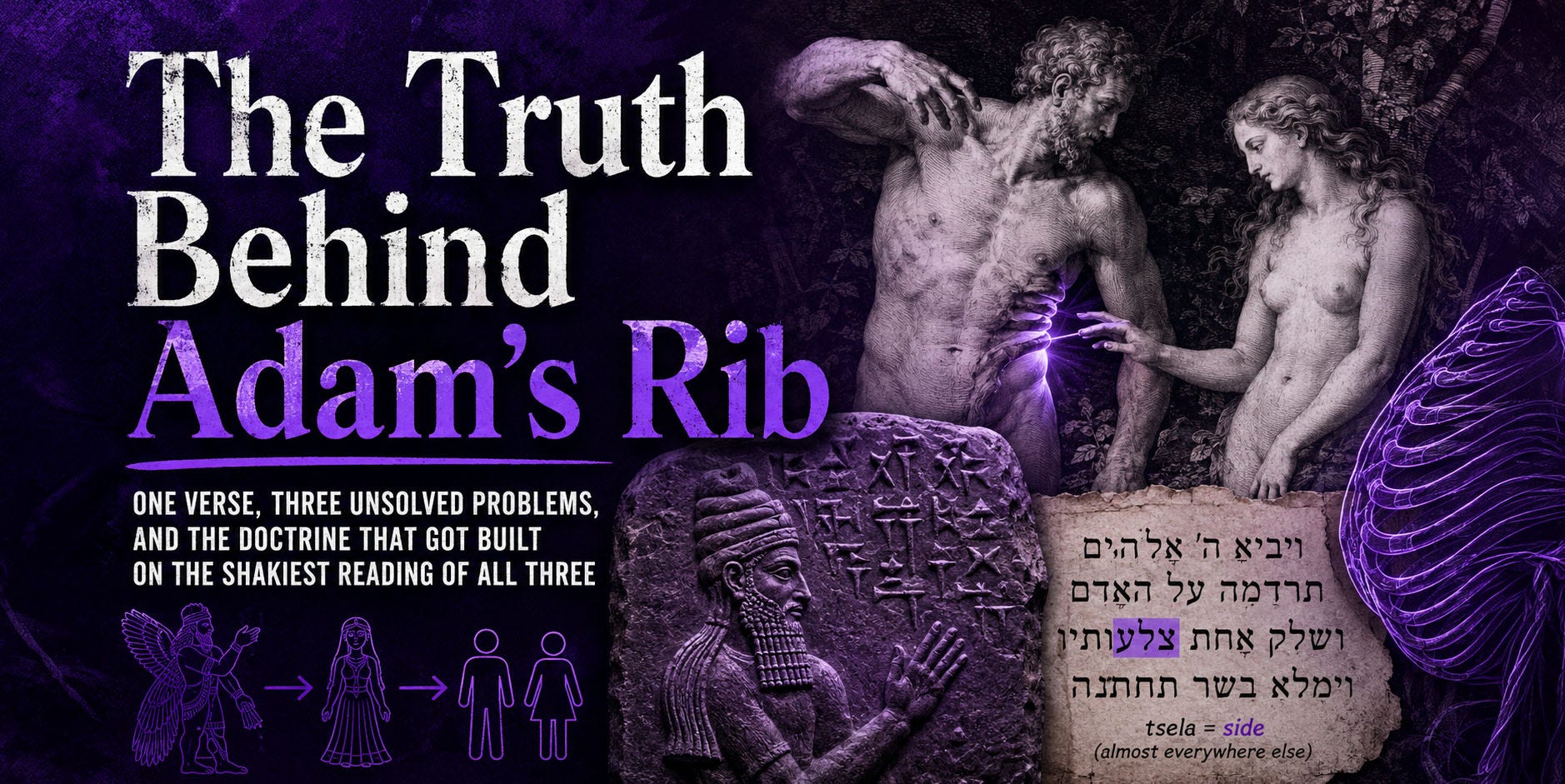
Whether they believe in it or not, everybody knows the story. After creating Adam first, God puts him under, cracks him open, pulls out a rib, and builds Eve from the spare part to accompany the first human. It’s the reason women got told for two thousand years that they were derivative, secondary, an afterthought stitched together from a man’s leftovers. Milton and Aquinas ran with it. Paul got there first, and he leaned on it hard enough to tell women to keep quiet in church. The sequence, man first and woman second, hardened into structure that outlived all of them, and it’s still standing: the Catholic and Orthodox priesthood remains male, right up to the Pope.
The story is simple, yet it’s one of the most contested passages in the Hebrew Bible, and the trouble starts at the level of a single word.
The Word Won’t Sit Still
The Hebrew is tsela. It shows up around forty times across the Bible, and almost everywhere else it means side. The tsela of the Tabernacle, the tsela of the Ark, the tsela of a hill David walks along while Shimei curses him from the ridge. It’s an architectural word, the flank of a structure, a plank, a chamber built onto a wall. When a Hebrew author wants a bone with anatomical precision, other words exist and get used.
So Genesis 2 is the one place the word gets rendered “rib,” and it’s the place with the most riding on it. Read tsela the way it reads everywhere else and God takes a side of the human, not a small curved bone under the lung. There’s a reading, going back a long way, that the first human was a single undifferentiated being and the operation was a split down the middle, one side male, the other female, which makes a lot more sense than the rib story does.
Now, honesty demands the other half. “Rib” isn’t a translation error someone can just point at and laugh off. It’s a defensible reading, it’s the mainstream one, and there’s a reason it’s defensible that has nothing to do with lazy translators. It has to do with where this story came from.
The Sumerian Original Has a Rib
Many centuries before Genesis reached its final form, Mesopotamia told a story about the god Enki. He eats plants he shouldn’t, a goddess named Ninhursag curses him, and eight of his body parts fall ill, one of them his rib. Ninhursag relents and creates eight healing deities, one per ailing organ. The goddess made to heal the rib is named Ninti, “the lady of the rib.”
So you may jump to the conclusion that this is too much of a coincidence, that the Hebrews said rib and meant it too. But the Sumerian word for rib is ti, and ti also means “to make live.” So Ninti is the lady of the rib and the lady who makes life at the same time, and the name only works because Sumerian happens to tie those two meanings into a single syllable.
Then look at Eve in Genesis 3:20, which names her Chavah and tells you why, she’s the mother of all living, the one bound up with life. The Hebrew authors kept the life-giving woman. They could not keep the pun, because in Hebrew tsela and “life” share nothing at all. Two syllables that mean one thing in Sumerian mean two unrelated things in Hebrew, so the joke can’t cross the border. What survives is the residue: a woman tied to a rib-ish body part and a woman tied to life, sitting next to each other, with the thing that once connected them left behind in a language nobody in the room still spoke.
What the borrowing does show is that the author was already picking and choosing. The life-giver made it across, the pun didn’t, the word went vague. Selective retention on one element and a loosened, architectural word on another is exactly what a borrowed-and-adapted story looks like, and it leaves the translation open rather than closed in either direction. The word means side almost everywhere. The source it came from had a rib. Both are true, they pull against each other, and anyone who tells you the verse obviously means one and not the other is flattening a dispute.
Two Creation Stories That Flatly Disagree
Set the rib aside, because the strongest problem with “woman came second” doesn’t need it.
Genesis doesn’t have one creation account. It has two, back to back, and they don’t match. Genesis 1 is the orderly one, six days, God speaking the world into being, and when humanity arrives in verse 27 it’s explicit: male and female created together, same moment, both in the divine image. No rib, no sequence, no ranking. Then Genesis 2 restarts the whole thing with a different divine name, a different order of events, a garden, the man formed first and the woman built afterward. These are separate sources, spliced by a later editor who kept both versions instead of choosing between them, which is the same editorial fingerprint you find all over the Torah.
So “woman came second” survives only if you privilege the second story and quietly ignore the first one printed directly above it. Read Genesis 1 as the lead and men and women show up as equals in the same breath, which is the very part that doesn’t wobble. There’s no translation dispute, no borrowed pun, no minority reading. The text contradicts itself on whether the sexes were made together, and the tradition resolved the contradiction by keeping the version that ranked women lower.
Not a paid subscriber yet? Consider joining to keep The Unholy Truth alive.
What Got Built, and What It Was Built On
A word that means “side” nearly everywhere, translated “rib” in the one verse where the stakes are highest. A Sumerian source that actually had a rib, tied to a pun that died the moment the story changed languages, leaving a life-giving woman and a rib stranded next to each other. An editor’s decision to preserve two creation accounts that disagree, resolved centuries later by readers who kept the version that suited them.
Out of that came a doctrine. Woman as secondary creation, dependent by design, the helper made from the leftover part. Paul cites the creation order in 1 Timothy 2:13 to argue women shouldn’t teach. Marriage law and custom across the Christian West took on the assumption that the sequence in Genesis 2 encoded a divine ranking.
What I find ironic in this whole debacle is that if there had to be an order, Eve should’ve been created first, because it’s the male body that resembles the female with no good reason for it. Adam’s creation and Eve’s creation from his rib explains nothing. Run it the other way and you explain why the male fetus first develops female reproductive organs before they recede, leaving residue behind, and why men are born with nipples and fully formed milk lines.
Sources and Further Reading
Ziony Zevit, What Really Happened in the Garden of Eden? (Yale University Press) — the case that tsela means “side,” and a survey of how contested the passage is.
Samuel Noah Kramer, History Begins at Sumer — the Enki-Ninhursag myth and the Ninti / “lady of the rib” wordplay.
Richard Elliott Friedman, Who Wrote the Bible? — the two creation accounts and their separate sources.
Carol Meyers, Discovering Eve: Ancient Israelite Women in Context — how later interpretation loaded the text with hierarchy the Hebrew doesn’t require.
Robert Alter, The Five Books of Moses — translation and commentary on Genesis 1-3.
Loved this and I am a male.
Yep. Female is the primary sex and probably had to be "made" first since everybody -- everybody -- in the world has the female X chromosome. You can't live without it. So, Eve was either first, or she was the rollout, after fixing Adam's vulnerabilities.