


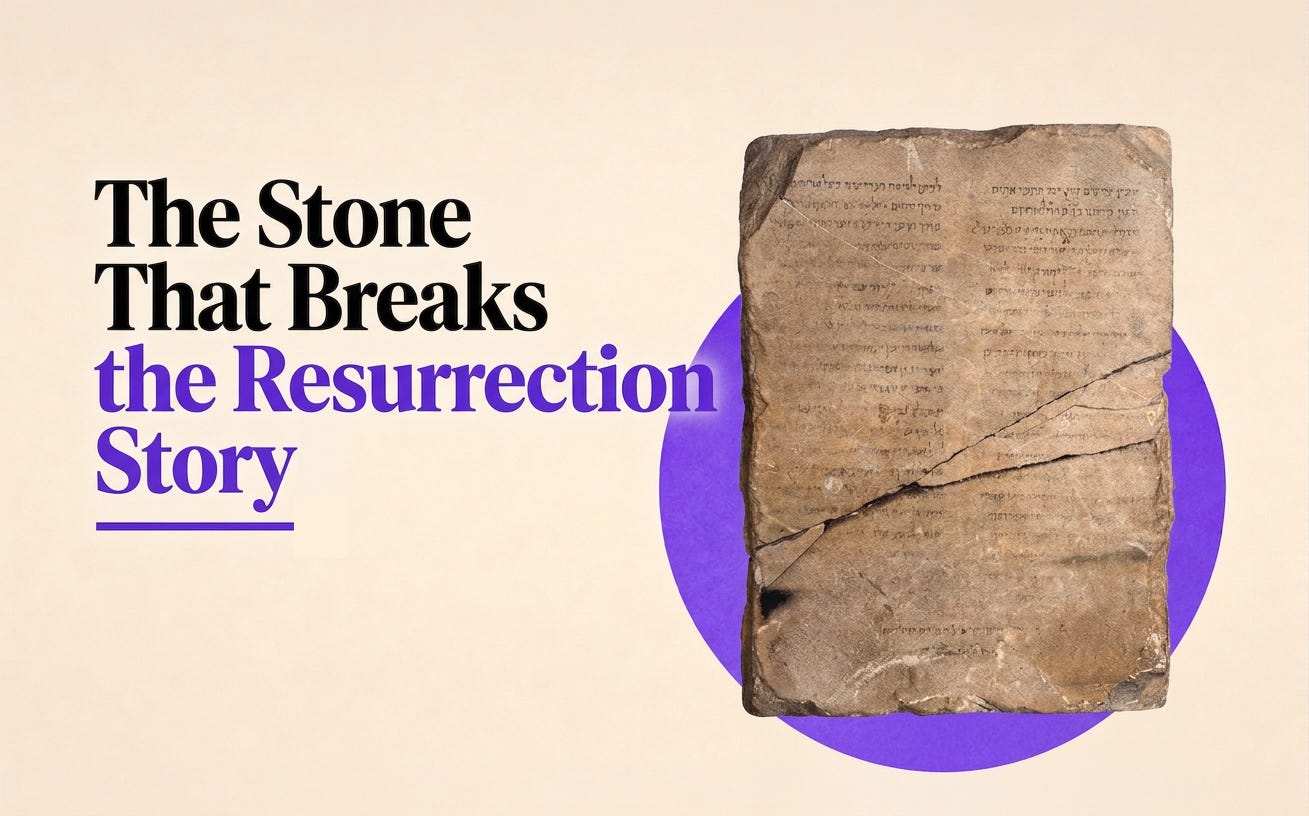
A stone tablet, later known as the Hazon Gabriel, sat in a Jordanian antiquities dealer’s shop for years before anyone with real training laid eyes on it. Like many other tablets before and after, it passed through the grey market the way these things do, a slab covered in ancient Hebrew columns that nobody in the academic world knew existed. A collector eventually bought it without knowing what he had, and it sat in his collection, essentially unstudied, until he finally brought it to a paleographer who could date a script by the angle of a stroke.
The ink had degraded badly, whole words were gone. What survived was a broken, ambiguous text that read like prophecy, angels, blood, a figure who might rise after three days. The first scholarly publication in 2007 released quietly, the way epigraphy usually does.
Then another scholar got hold of the tablet and zeroed in on one badly damaged phrase, reading it as a command: “in three days, live.” He argued this was a Jewish messianic text, written decades before Jesus, describing a messiah who dies and comes back after three days. If he’s right, the “Christianity invented the dying-and-rising messiah” story takes a direct hit, since here’s a Jewish text doing the same move first.
What turned the artifact into a headline was The New York Times, which ran the story in 2008. A fragmentary, ink-smudged stone that, a week earlier, maybe three people on Earth could read landed on the front page, with the question writing itself: did Jesus copy his resurrection from an older Jewish idea?
When you’re done reading, hit the like button and leave a comment. Criticize it, argue with it, trash it if you want. Your reaction directly decides what I write next.
A Three-Foot Slab Written in Ink
Most ancient inscriptions were typically cut into stone. Yet, the text of Hazon Gabriel was written on it in ink, which is unusual but possible. The slab stands about three feet tall and was reportedly found on the Jordanian side of the Dead Sea, near where the Dead Sea Scrolls turned up.
Experts date the writing to the first century BCE or the first century CE. That’s the same stretch of time as Jesus’ life and the last years of the Jewish Temple in Jerusalem. The text claims to be a message from the angel Gabriel, the same Gabriel who appears in the Hebrew Bible, announces Jesus’ birth in the Christian story, and plays a starring role in Islam by personally delivering God’s messages to Muhammad. On the stone, he talks about visions, a coming messiah, God’s power, and rising from death, which reads a lot like a preview of the New Testament.
A Stone From the Antiquities Market and the Forgery Question
The trouble starts with how it surfaced, since nobody pulled it out of the ground during a supervised dig. It showed up on the antiquities market, which makes archaeologists twitchy, though they deal with that headache constantly. Anyone with a shovel and free weekends can dig, plenty of people do it for a living, and a lot of what they find gets sold off quietly and later proves genuine. So the question that counts is whether the text on the stone holds up.
Some scholars studied the ink and the language and found that both fit the period. Others stayed skeptical because nobody knows where the stone has been and because ink is easier to fake than carving. There’s no consensus, but they all agree that a forger would’ve needed a lot of skill to pull this off. Nothing on the stone screams hoax, and the suspicion hangs over it anyway. You can’t blame the doubters much, since history is full of objects hailed as ancient that turned out to be embarrassing fakes. But one would expect that, having gone out of their way, a highly skilled forger would be after good money, yet the stone was sold before anyone even knew what it was.
What a Resurrection Text Older Than Jesus Means
The resurrection is the foundation of Christianity, and without it Jesus becomes one more teacher or preacher. When the Romans crucified him, his movement looked finished, a dead would-be messiah leaving behind a handful of disappointed followers. What brought it back to life was the talk that he'd risen, passed from one believer to the next.
Hazon Gabriel suggests Jews were already imagining a messiah who’d rise after three days before Jesus came along. If that holds, Jesus’ followers may have borrowed the central idea of the Easter story from a tradition that was already in circulation, and most of what’s been written about how Jews and Christians pictured the messiah needs a second look.
Some Christians argue that God was preparing people for Jesus’ message in advance. Others take the same evidence to mean resurrection stories were already part of the culture and got attached to Jesus the way they could’ve been attached to anyone.
Judaism’s Problem With a Messiah Who Dies
Judaism has never put much weight on a messiah who dies and comes back, an idea that belongs mostly to Christianity. This stone suggests some first-century Jews were at least playing with it, which complicates things for Jewish scholars as well. Jewish beliefs about the messiah in that period turn out to have been varied and experimental, with several versions competing for attention.
That said, Jews who expected the dead to rise at the end of days pictured it happening in the flesh, with bodies climbing out of their graves. The Gospels follow that picture, with a risen Jesus who eats fish in front of his disciples and tells Thomas to touch his wounds. Paul, writing years before any of the Gospels, describes something else: the dead rise with a “spiritual body” (1 Corinthians 15:44), and “flesh and blood cannot inherit the kingdom of God” (1 Corinthians 15:50).
“In Three Days, Live”: The Line Everyone Fights Over
The most argued-over line on the stone reads, “In three days, live.” Some scholars take it as a literal rising from death. Others read it as symbolic, maybe about spiritual renewal or rebuilding. Critics warn that people are reading Jesus into a text that’s older than Christianity and might have nothing to do with Easter.
Still, the resemblance is hard to wave off. If the reading is right, the idea of a leader rising on the third day was part of Judaism before Christianity existed, and that single line is what keeps Hazon Gabriel at the center of the argument.
A quick side note on the counting. According to the Gospels’ own timeline, Jesus rose in less than 48 hours. However, the Israelites had no concept of zero, so the day something happened counted as day one, making the Sunday following Jesus’ crucifixion the third day.
Black-Market Finds That Rewrote History Anyway
Hazon Gabriel also shows how complex archaeology gets. Objects with unclear origins split scholars, with some dismissing them, others embracing them, and everyone bringing their own biases. Keep in mind that some of the finds that rewrote history came through the black market too, including the Dead Sea Scrolls, the Nag Hammadi books (early Christian texts found buried in Egypt), and pieces tied to the Cyrus Cylinder, the clay record of the Persian king Cyrus the Great.
Religious groups tend to read the stone in whatever way protects their own tradition. Christians play it down, Jews tiptoe around it, and secular writers hold it up as proof that religious ideas grow out of older ones. By now, each camp mainly wants to know whose story the stone serves.
One of the Great Finds or One of the Great Fakes
Hazon Gabriel is either one of the most disruptive finds in Christian history or one of the most convincing forgeries anyone has made. Either way, it forces people to ask where religious ideas come from. Beliefs grow, shift, and spread from one group to the next, and this stone, authentic or not, puts that process on display and leaves the easy answers looking shaky.
The stone isn’t the only place a third-day rising shows up in Jewish writing. There’s one in the Hebrew Bible itself, centuries older, and Paul points to it without quoting it. In the bonus section for paid subscribers, I get into that verse, the rebel whose death may be behind the stone’s messiah, and why the word “live” might not say “live” at all. If you’re a free subscriber, upgrade to read it. And tell me in the comments whether you think this stone threatens long-held beliefs or is just an interesting piece of history.
Exclusive Content for Supporters
Hosea, a Beheaded Rebel, and a Smudged Word
Christians tend to treat “on the third day” as a detail that only makes sense after Easter**, though the phrase is centuries older.** The prophet Hosea, writing in the 700s BCE, put these words in the mouths of the people of Israel: “After two days he will revive us; on the third day he will raise us up, that we may live before him” (Hosea 6:2)…