


Every lost-scripture story you’ve read follows the same arc. Somebody stumbles on old writing in a cave or an attic or a rubbish heap, the writing says something the church would rather it didn’t, and the physical object goes into a museum where anyone with credentials and a plane ticket can go argue about it. The Nag Hammadi codices sit in Cairo. The Dead Sea Scrolls have been photographed, carbon dated, and picked over by teams who can’t stand each other. The Sana’a palimpsest has an ultraviolet imaging record.
Then there’s the one manuscript that broke the pattern, and it broke it in the least convenient way possible for the man who found it.
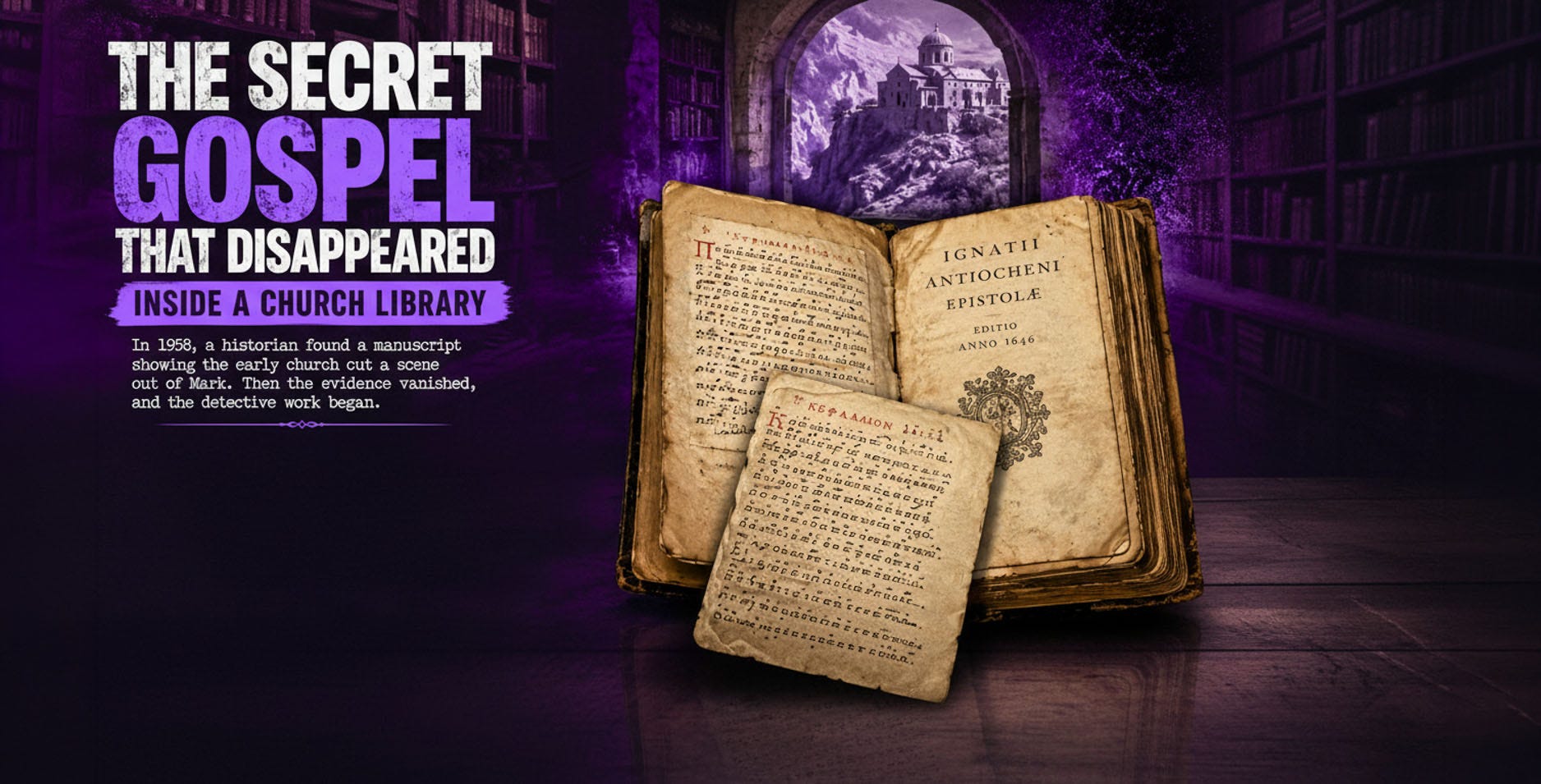
In the summer of 1958, Morton Smith, a Columbia University historian with a working knowledge of Greek paleography and a long-standing interest in ancient magic, was cataloging the neglected library of Mar Saba, a monastery bolted to a cliff face in the Judean desert southeast of Jerusalem. Inside a 1646 printed edition of the letters of Ignatius of Antioch, someone had copied three pages of Greek onto the blank endpapers in an eighteenth-century hand. Smith read it and understood immediately what he had, or what he’d been handed, depending on which scholar you ask.
The Letter Clement Didn’t Want Circulating
The text presents itself as a private letter from Clement of Alexandria, a theologian writing around the year 200 and one of the most quotable figures in early Christianity, to a man named Theodore who’d written to him in some distress about the Carpocratians. The Carpocratians were an Alexandrian Christian group the mainstream church loathed, in part because their critics accused them of teaching that spiritual maturity ran through sexual license.
Clement congratulates Theodore for shutting them down, and then does something no orthodox church father is supposed to do. He concedes the Carpocratians have a point about their source. There is, Clement writes, a longer version of the Gospel of Mark. Mark composed it in Alexandria after Peter’s death, working from his own notes, adding material meant for readers who’d advanced past beginner instruction, and the Alexandrian church kept it under guard and read it only to those “being initiated into the great mysteries.” A Carpocratian named Carpocrates got a copy out of the archive through what Clement describes as bribery and manipulation, then contaminated it with his own additions.
Then Clement instructs Theodore to deny the secret gospel’s existence under oath, because “not all true things are to be said to all men.” That line alone made the letter famous. Whether or not the man from Alexandria wrote it, somebody put in writing that the early church lied on purpose about which books it owned.
What Happens at Bethany
To settle Theodore’s questions, Clement quotes the disputed passage, which slots into Mark between what we number 10:34 and 10:35. Jesus arrives at Bethany. A woman whose brother has died begs for help, the disciples try to push her off, and Jesus goes to the tomb, rolls back the stone, and raises a young man by the hand. The young man looks at him and loves him, and asks Jesus to stay. Six days later Jesus gives him instructions, and that evening the young man comes to him “wearing a linen cloth over his naked body,” stays with him through the night, and receives from him “the mystery of the kingdom of God.”
A second, shorter fragment follows, slotting into the odd unfinished sentence at Mark 10:46.
Smith spent fifteen years working on this before publishing in 1973, and the conclusion he came to guaranteed the reception he got: he read the passage as evidence that Jesus ran a nocturnal initiation rite, possibly involving some form of erotic union, and that the canonical Gospels are what’s left after the church sanded that down. Half his colleagues thought he’d lost his mind. The other half noticed something more damaging, which is that the linen cloth and the naked young man show up again in Mark 14:51 with no explanation whatsoever, as if a scene had been cut and one thread left dangling. The passage explains a loose end in canonical Mark that nothing else explains.
Everybody Who Studied It Was Studying a Photograph
Smith took black-and-white photographs of the pages and, for reasons nobody has satisfactorily explained, never went back to examine the original again. He was a specialist in manuscripts. He knew what ink analysis could do. He argued about this document for the rest of his life on the strength of pictures he’d taken in an afternoon.
In 1976 a small group of scholars traveled to Mar Saba and confirmed the book existed and the writing was in it, and then said nothing publicly about the visit until 2003. The following year the monastery’s collection moved to the Greek Orthodox Patriarchate library in Jerusalem, where the librarian, Kallistos Dourvas, cut the handwritten leaves out of the binding so they could be photographed in color. Those color photographs exist. The leaves themselves stopped being anywhere. They’re not in the Patriarchate’s holdings, no one has produced them since, and there’s no accounting for where they went.
So the only object that could end the argument, through ink chemistry or paper analysis or any of the forensic work that has settled comparable disputes, went missing from inside a church library while under the care of the institution that had the most obvious motive to want it gone. That last part is where the conspiracy version writes itself, and it’s worth resisting, because institutional carelessness with unglamorous old books is a much better-documented phenomenon than institutional conspiracy.
The Case That Smith Was a Forger
Quentin Quesnell put the forgery question in print in 1975, pointing out that the tools to make a convincing fake had been sitting on library shelves since the 1930s. The full prosecution arrived in 2005 with Stephen Carlson’s The Gospel Hoax, which read the letter as a hoax Smith built with his own fingerprints deliberately left on it.
Carlson’s case had three pillars. He found a passage about salt losing its savor through adulteration and connected it to the Morton Salt Company, a signature hidden as a joke. He identified a manuscript at Mar Saba cataloged by one “M. Madiotes,” parsed the name from Greek roots for baldness and swindling, and pointed out that Morton Smith was bald. And he examined the handwriting under magnification and found what document examiners call forger’s tremor, the faint wobble in a line that gets drawn rather than written.
For about five years this looked devastating, and a lot of people who’d never liked Smith or his conclusions treated the matter as closed.
Three Clues, Three Retractions
Scott Brown went through the salt passage and found that the letter never describes salt being mixed with anything. The mixing in the text applies to true things and false ones, which is a stock ancient metaphor, and adulterated salt was a recognized problem centuries before anyone put it in a blue cylinder.
Brown and Allan Pantuck then tracked down the Madiotes manuscript and established that the hand belonged to an unremarkable eighteenth-century writer with no connection to Smith, and that the name reads closer to Modestos, which was about as unusual at Mar Saba as Michael is at an American high school.
The tremor went last and went hardest. Timo Paananen and Roger Viklund demonstrated that Carlson had done his handwriting analysis on halftone reproductions printed in Smith’s 1973 book. The wobble he’d measured was the dot pattern of a printing process. Working from the original photographs, the tremor disappeared.
None of that proves the letter is ancient. It does mean the most confident published case for forgery was built on a printing artifact, a common monastic name, and a brand of table salt.
Whatever the Mar Saba Manuscript Was, Its Final Act Is Pure Theater.
Imagine three handwritten pages sitting quietly in the back of an unread book for centuries, emerging just long enough to ignite a half-century academic civil war, and then dissolving back into the desert ether before anyone could hold a magnifying glass to the ink. It is the ultimate historical ghost story: a text that exposed the early church’s obsession with secrecy, only to disappear inside the very institution accused of keeping the secret.
In the end, the Mar Saba letter leaves us with a profound historical paradox. If Morton Smith forged it, he executed a masterpiece of literary sabotage so brilliant that even the forensic cases against him collapsed under scrutiny. If an ancient monk forged it, it reveals a lost world of early Christian dissent fighting for survival with every stroke of the pen. And if Clement really wrote it, then the foundational story of the Christian Gospel was edited, censored, and reshaped far earlier than most believers dare to imagine.
We will likely never know which door leads to the truth. The physical leaves are gone, the ink is unanalyzable, and the men who held the pages are dead. All that remains are black-and-white photographs of a vanishing act, a stark reminder that history is not a locked vault of permanent facts, but a dimly lit room where the lights can go out at any moment, leaving us to argue over what we thought we saw in the dark.
🔒 Paid Subscriber Bonus: Read the Full Mar Saba Letter Below
What did the text actually say? Below, I’ve included the full English translation of the letter attributed to Clement of Alexandria, including the suppressed passage from the “Secret Gospel of Mark” describing the night initiation at Bethany, and Clement’s explicit instructions to deny its existence under oath.
To read the complete text and support deep-dive historical analysis like this, consider upgrading to a paid subscription today.
Sources and Further Reading
Smith, Morton. Clement of Alexandria and a Secret Gospel of Mark. Harvard University Press, 1973.
Smith, Morton. The Secret Gospel: The Discovery and Interpretation of the Secret Gospel According to Mark. Harper & Row, 1973.
Quesnell, Quentin. “The Mar Saba Clementine: A Question of Evidence.” Catholic Biblical Quarterly, 1975.
Carlson, Stephen C. The Gospel Hoax: Morton Smith’s Invention of Secret Mark. Baylor University Press, 2005.
Brown, Scott G. Mark’s Other Gospel: Rethinking Morton Smith’s Controversial Discovery. Wilfrid Laurier University Press, 2005.
Brown, Scott G., and Allan J. Pantuck. “Morton Smith as M. Madiotes: Stephen Carlson’s Attribution of Secret Mark to a Bald Swindler.” Journal for the Study of the Historical Jesus, 2008.
Paananen, Timo S., and Roger Viklund. “An Eighteenth-Century Manuscript: Control of the Scribal Hand in Clement’s Letter to Theodore.” Apocrypha, 2015.
Smith, Geoffrey S., and Brent C. Landau. The Secret Gospel of Mark: A Controversial Scholar, a Scandalous Gospel of Jesus, and the Fierce Debate over Its Authenticity. Yale University Press, 2023.
Ehrman, Bart D. Lost Christianities: The Battles for Scripture and the Faiths We Never Knew. Oxford University Press, 2003.
I had never run into this before, thanks.
BTW I sent a message via the app, but don't know if it went through.
Hmmmm, James Miller wrote an article about the naked guy wrapped in linen and running from the Garden the night they came for Jesus. I will have to try and locate that article to refresh my memory on how James Miller approached it.
I just remember my reply back to one of the comments was that the guy was probably just another streaker out for attention, they always show up at major events. Your article, Tanner, offers a fabulous new twist …. ‘Love in the midst of Divinity in the making,’ so to speak.
Anyway, the whole Church history of it reads like a soap opera, and on and on it goes, still unresolved. I guess religion doesn’t have to be all that boring after all.