

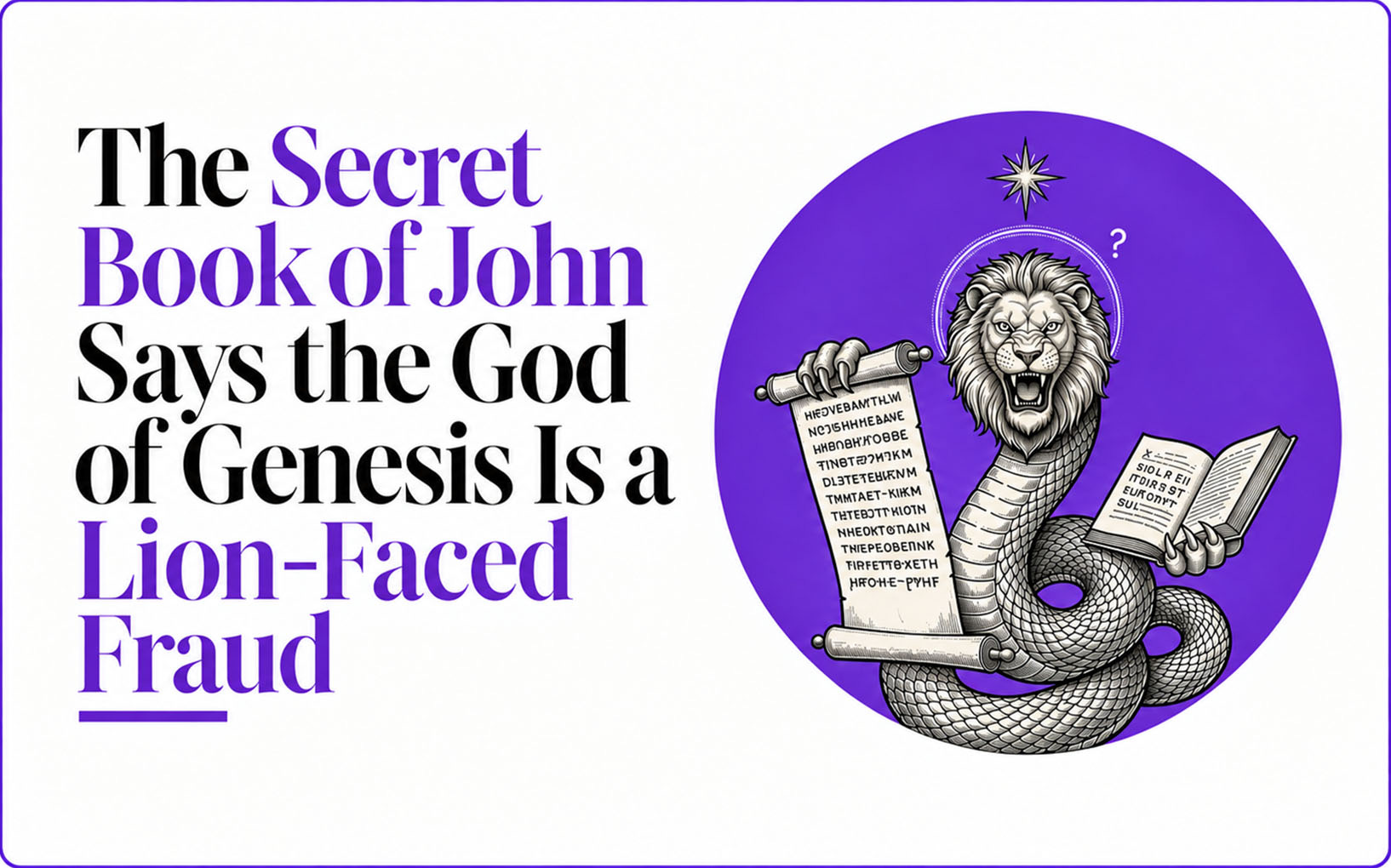
What if the God of the Old Testament wasn’t the supreme creator of the universe, but an insecure, lion-faced imposter who built the world by mistake?
That’s the premise of the Apocryphon of John, a piece of ancient alternative fiction so scandalous that the early Church spent centuries trying to scrub it from memory. But before it was buried in the Egyptian desert, it was the secret text everyone was quietly passing around.
Its true value lies in revealing how early Christians boldly wrestled with the deepest moral contradictions of Genesis, reimagining the Creator not as an unquestioned authority, but as a flawed entity whose rules demanded challenging.
A Text Old Enough for Irenaeus to Complain About
The book is called the Apocryphon of John, “Apocryphon” being a Greek word for secret writing, which is why you’ll see it sold as the Secret Book of John. It’s pseudepigraphical, meaning it was written decades after the death of the disciple John by an unknown person, and survives in four copies, all in Coptic, which is the final evolutionary stage of the ancient Egyptian language.
Three of those copies surfaced in 1945 near Nag Hammadi in Egypt, where a farmer accidentally dug up a buried jar of papyrus books, and the fourth sat in a Berlin library after a dealer sold it in Cairo in 1896, with no proper edition until 1955. Two of the copies are shorter than the other two, which tells us that people kept revising it, and the Greek original is older than all of them. Irenaeus, the bishop of Lyon in Gaul, wrote a five-volume attack on rival Christian groups around 180, and in the first volume he summarizes a creation story with the same cast, the same lion-faced villain, and the same plot.
Yaldabaoth and the Mistake That Built the World
The story opens with a God so far beyond description that the text won’t even call him God, since that would imply somebody above him. From this Invisible Spirit comes a chain of emanations, each one a reflection of the one before, until you reach Wisdom at the bottom of the chain. Wisdom makes the mistake. She conceives a child without her male partner’s approval, and what comes out is a misshapen thing, a lion-faced serpent with eyes like flashing fire. She’s so ashamed that she hides him in a cloud and names him Yaldabaoth.
Yaldabaoth steals the power his mother passed to him, builds a crew of lesser rulers, and sets about making a universe. Then he looks around at what he’s built and announces that he’s a jealous God and there’s no other god beside him. Anyone who’s read Exodus or Isaiah has heard those lines, because they come straight out of the speeches the Old Testament gives to Yahweh. The author wants you to notice what’s wrong with them. A being who has to announce that nobody ranks above him has been told otherwise, and a voice does come down from the heights to say, “You’re wrong, Samael,” a name the text translates as the blind god.
Christ Arrives as an Eagle and Tells Adam to Eat the Fruit
The rulers build Adam’s body out of pieces of their own nature, and it lies on the ground unable to move. They talk Yaldabaoth into blowing into its face, and the power he stole from his mother leaves him and enters Adam, who immediately turns out to be smarter than all of them put together. That scares the rulers, so they sell him the garden of Eden as a gift and forbid the tree of knowledge.
Why would a good Creator want to keep his own creatures ignorant? Readers have been asking that about Genesis 2-3 for as long as there have been readers, and the Secret Book gives the answer you’d expect from a text that has already shown you Yaldabaoth’s character. He wants Adam ignorant because an ignorant Adam is easier to rule. So Christ himself shows up in the form of an eagle perched in the tree of knowledge and tells Adam and Eve to eat. Eating the fruit becomes the first rescue in human history, and the god who punishes it is the jailer.
A Close Reader of Genesis With Questions the Church Wouldn’t Answer
All this may seem to be the work of people who hated the Jewish scriptures. The author quotes Moses by name, follows the order of Genesis 1-6 closely, and leans on phrases like “the spirit moved over the water” to argue that the Genesis text itself backs the story. The questions driving the book are the ones any thoughtful reader of the Hebrew Bible asks: why a perfect God forbids knowledge, why he’s jealous of other gods when he says there aren’t any, why he curses the world he just called good, and where suffering came from if the maker was kind.
Every charge the book brings against the Creator comes from something the Hebrew Bible says about him.
The forbidden knowledge comes from Genesis 2:17, where God warns Adam away from the tree of the knowledge of good and evil. The serpent tells Eve in 3:5 that God knows eating it will make them like gods, and God confirms it himself in 3:22 when he says the man has become like one of us, knowing good and evil, then throws him out of the garden before he can reach the tree of life. A reader who takes that verse at face value sees a God protecting his status, and the Secret Book takes it at face value.
The jealousy comes from Exodus 20:5, where he calls himself a jealous God, and Exodus 34:14, where Jealous is his name. The claim that nobody else exists comes from Isaiah 45:5 and 46:9, and Deuteronomy 4:35 says the same. Yet the Bible also has him forbid other gods (Exodus 20:3), ask who’s like him among the gods (Exodus 15:11), and preside over a council of them (Psalm 82:1). Nobody gets jealous of rivals who don’t exist, so the book gives Yaldabaoth the Isaiah line as a boast and sends a voice down from above to call it false.
The cursed world comes from the gap between Genesis 1:31, where everything is very good, and the curses that follow in 3:16-19, with painful childbirth, a cursed ground, and death. Genesis 6:5-7 adds the part the author likes best, where God regrets making humankind and decides to wipe it out. A Creator who regrets his work didn’t see it coming, and the book treats that as an admission that he’s ignorant. It also answers the problem of suffering, because a maker who rules by threat and punishment is the one you’d expect to build a world full of both.
Every apologetics shelf in every bookstore still runs on these same verses. The Secret Book solves them by splitting the divine in two, a distant good God and a bungling Creator, and Greek readers were already comfortable with that move. Plato, the Greek philosopher, had pictured the universe as the work of a lower craftsman rather than the highest God in his dialogue the Timaeus, and the author took that craftsman, gave him a bad temper and the Hebrew Bible’s boasts, and set him loose in the Garden. The result reads like a Bible study that ran into the philosophy classroom next door and left with a different conclusion than the pastor wanted.
How This Fight Affected the Four Gospels
Irenaeus read this myth and treated it as poison. In the third volume of the same work he argues that there can be exactly four gospels, no more and no fewer, because the world has four corners and four winds. It’s an argument from furniture, and it shows how badly he needed the number to come out at four.
The irony is that the people he was fighting had loved the Gospel of John first. Heracleon, a Gnostic teacher active around 170 (Gnostic comes from the Greek word for knowledge), wrote the earliest commentary on John that survives in any form, and it survives only because Origen, a later church scholar, quoted it while arguing with it. Irenaeus ended up claiming John as a cornerstone of his own side, while the Secret Book shows what the other side did with the same name, so two groups were each sure the apostle belonged to them.
Buried Truths of the Secret Book of John
Plenty of ancient Christian writings are known only by name, with their contents lost or reduced to a few quoted lines. The Secret Book of John isn’t one of them, meaning we didn’t know it existed at all until a farmer accidentally dug up a buried jar of papyrus books.
What does its discovery mean for the Christian faith? Not necessarily anything on the personal level. However, for curious minds, it reveals that Christians realized early on the mismatch between the Old Testament stories and what Jesus preached and looked for explanations.
The best material in the book comes after Eden, though, and I haven’t touched it yet. It covers what Yaldabaoth does to Eve, how he fathers the two sons the book identifies with Cain and Abel, what the flood looks like when the Creator is the villain, and the three trips the divine Forethought makes down into the prison of the body. All of it is in the bonus section for paid subscribers, so if you’ve read this far and you’re wondering how the author squeezes the rest of Genesis into a story about a lion-faced fraud, today is as good as any to upgrade and read on.
Exclusive Content for Paid Subscribers
Yaldabaoth’s Sons, a Flood With a Different Villain, and Three Descents Into the Body
Eden is only the opening act. Once Adam and Eve eat, Yaldabaoth works out that the woman carries a spark of the true light, which the book calls the Epinoia, and he sets out to take it. The spark leaves her before he can, and he attacks Eve anyway and fathers two sons on her. The book gives them the names Yahweh and Elohim, the two main names for God in the Hebrew Bible, so one author has taken the God of Genesis and split him into a pair of children, one with a bear’s face and the other with a cat’s. Yaldabaoth then calls them Cain and Abel to deceive the people, which turns the two names the Hebrew Bible uses for its God into the names of the Creator’s own children.
The book also reads the rest of Genesis through…