


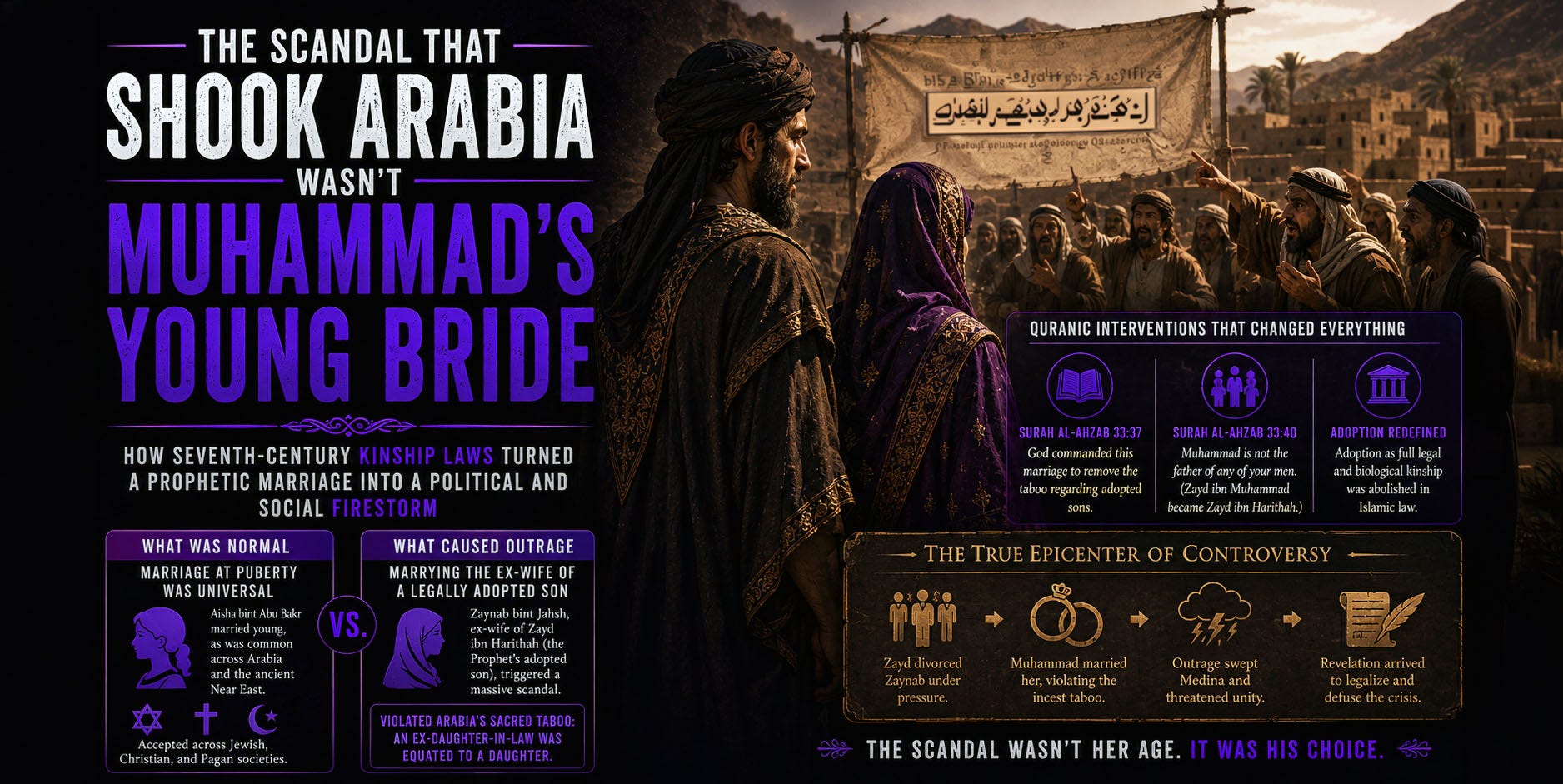
Modern critics love to obsess over Aisha’s age when targeting the Prophet of Islam. Polemicists routinely trot out her youth as an undeniable slam dunk, assuming seventh-century peoples shared twenty-first-century sensibilities about adolescence, adulthood, and consent. They forget that ancient Near Eastern societies, pre-Islamic pagan clans, and late-antique Mediterranean cultures routinely married off girls at puberty to secure critical tribal alliances. In the brutal desert politics of seventh-century Arabia, political betrothal was standard operating procedure across every single religious and cultural line. Nobody in Mecca or Medina batted an eye when Muhammad wed Aisha, because every family around them was playing by the exact same political playbook. The whole thing was so uncontroversial that the Islamic sources didn’t even try to hide the fact that Muhammad married the daughter of the most powerful political figure in the region before adolescence, and consummated the marriage after she reached puberty, and when that occurred remains a subject of debate.
If you want to see what actually set seventh-century Arabia on fire, you have to look at a completely different bedroom. The marriage that nearly derailed Muhammad’s entire movement had zero to do with age and everything to do with bloodlines. When Muhammad married Zaynab bint Jahsh, he broke one of the most sacred taboos of pagan Arab culture by taking the ex-wife of his adoptive son, Zayd ibn Harithah. To his contemporaries, that was outright incest.
The Sacred Taboo of Adopted Kinship
Pagan Arabia treated adoption with extreme, uncompromising seriousness. When a man adopted a young boy, that child took his father’s name, inherited his property, and became bound by the exact same marital prohibitions as a biological child. Zayd was initially known across Medina as Zayd ibn Muhammad, reflecting his full status as the Prophet’s legitimate heir and son. Under prevailing tribal law, marrying Zayd’s former wife carried the exact same moral weight and societal horror as marrying the ex-wife of one’s own biological son, because an ex-daughter-in-law was legally and socially equated to a daughter. Consequently, when Zayd divorced his wife so that Muhammad could marry her, it triggered an immediate and massive outrage.
Early historical sources—most notably al-Tabari and Ibn Sa’d—indicate that the marriage broke down after Muhammad saw Zaynab and expressed an attraction to her. Recognizing his leader’s desire and the obvious shift in political reality, Zayd stepped aside and divorced her. When Muhammad married Zaynab, he was immediately met with intense criticism for violating Arabia’s strictest incest taboo.
Quranic Interventions and Political Fallout
The scandal broke fast across the oasis, giving Muhammad’s enemies precisely the ammo they needed to undermine his religious authority. Opponents and political rivals in Medina seized on the union to brand the leader of the new faith a hypocrite who violated universal Arab incest prohibitions just to satisfy personal desire. The localized outrage ran so deep that it threatened to fracture his inner circle, alienate key tactical allies, and destroy the fragile moral legitimacy of his fledgling movement.
The response to this existential political crisis conveniently arrived through direct divine revelation, recorded in Surah al-Ahzab. The Quranic text directly addressed the surrounding controversy by fundamentally altering Arab social structures, declaring in verse 33:37 that God commanded the marriage specifically to dismantle the entrenched pagan taboo surrounding adopted sons. To reinforce this shift, verse 33:40 famously declared that Muhammad was not the father of any of their men, stripping Zayd of the surname Zayd ibn Muhammad and reverting his legal identity back to Zayd ibn Harithah. In a single theological stroke, adoption as a legal and biological equivalent to actual lineage was abolished in Islamic law.
The True Epicenter of Early Islamic Controversy
Focusing on Aisha’s age projects modern norms back onto an ancient world where early marriage was universal across Jewish, Christian, and pagan communities alike. Seventh-century Arabs didn’t view Aisha’s marriage as unusual or controversial because every neighboring clan participated in the exact same marital customs to build political bridges. It also ignores the West’s own legal history, where modern statutory ages of consent were non-existent until the 1700s, remaining as low as 13 in Spain and 12 in Vatican City until the 21st century.
The real shockwave that rattled the Arabian Peninsula came from Zaynab’s apartment.
Muhammad’s decision to marry Zaynab triggered a massive political crisis because taking the ex-wife of a legally recognized son violated Arabia’s strictest incest taboo. Facing severe public accusations of incest that threatened to undermine his authority in Medina, he was forced to dismantle the ancient institution of adoption itself. The resulting revelations in Surah Al-Ahzab were not a pre-planned social crusade, but a retrofitted legal shield designed to defuse a scandal, strip Zayd of his sonship, and retroactively validate the union. Polemicists who waste their energy weaponizing Aisha’s age ignore not only Near Eastern history but human history as a whole, completely missing the actual moment when a personal crisis reshaped the legal architecture of the early Islamic state. They also pass up the opportunity to question the ethics of pressuring a son to divorce his wife, the convenience of a divine verse dropping to resolve a personal predicament, and the dynamic of pursuing a seventh wife while four of them are still alive.
Upgrade to a paid subscription today to unlock the bonus material, where we walk line-by-line through the raw, unedited 9th-century accounts of al-Tabari and Ibn Sa'd to reveal what early Islamic sources actually recorded before modern apologists got their hands on them
"...assuming seventh-century peoples shared twenty-first-century sensibilities about adolescence, adulthood, and consent. They forget that ancient Near Eastern societies, pre-Islamic pagan clans, and late-antique Mediterranean cultures routinely married off girls at puberty to secure critical tribal alliances." They forget this was common everywhere, which is why I regularly point out that one cannot apply 21st Century morals to any other period in time. Actions only make sense within their cultural context. Catherine of Aragon was three years old when she was betrothed to Arthur, the eldest son of Henry VII of England. They married when she was 15 years old. That was in 1488. That means that at the age of THREE, she was basically married; the wedding and consummation were technicalities.
Well now, interesting parallels certainly abound when comparing the tantalizing details between two ancient civilizations and their two scheming “leading men.” Yes, there is another exemplar of questionable virtues and shady misdeeds who faced a similar conundrum, yet he too found a way to transform a wrong into a right, and to make his world go ‘round in everlasting wedded bliss.
King David, perched upon his rooftop, struck dumb by the beauty of a bathing Bathsheba, shares an uncanny resemblance to Muhammad’s tale of a similar mind-numbing-induced-seizure when spotting the “ lightly-dressed “ and bewitching Zaynab!
Oh, but the difference in problem resolution is stunning!
Muhammad simply changed a troublesome law, while at the same time perhaps applying a little pressure to an inconveniently alive husband. King David, on the other hand, stooped to the lowest level of the most badest behavior, and had one inconveniently alive husband, permanently done in and absolutely erased by the thrust of a sword.
For shame, but the lengths that men will go in pursuit of their wildest dreams!