


The stone rolls away, an angel announces the news, the women run to tell the disciples, Jesus appears in the garden, and later he shows the wounds to a doubter who needs proof.
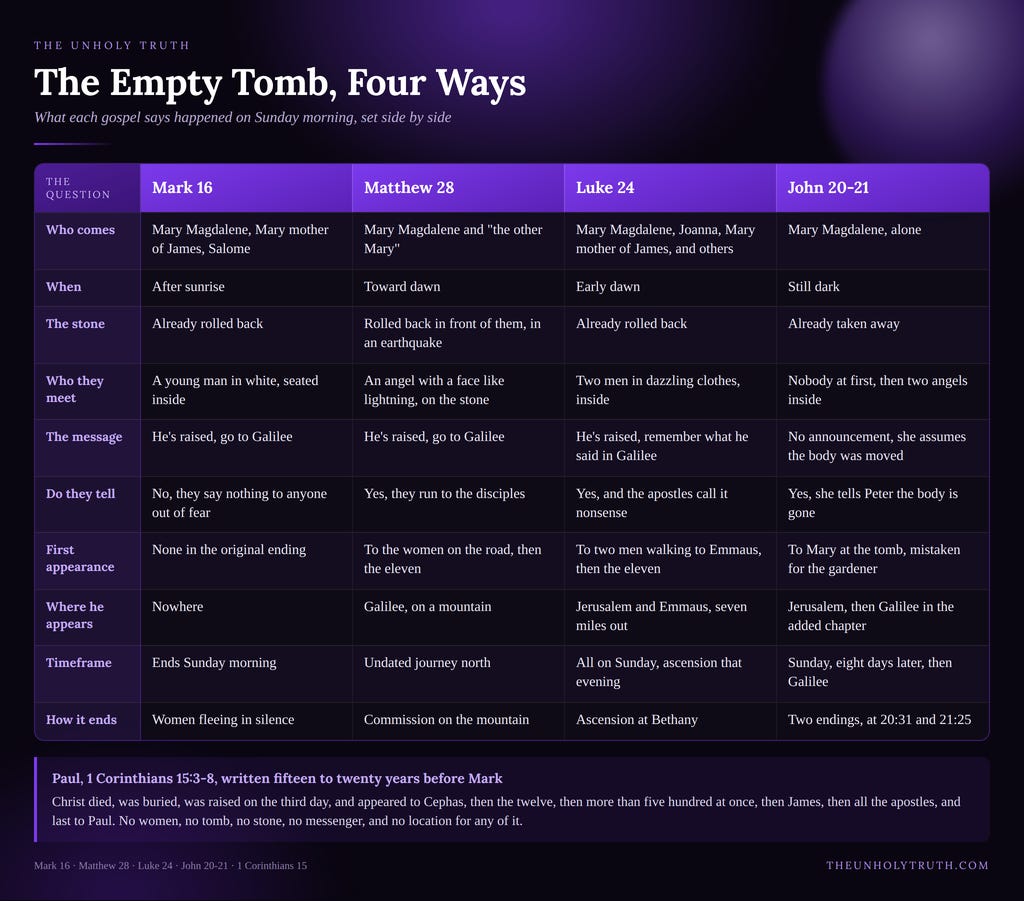
That coherent composite exists in no single gospel. It’s four accounts blended together with the disagreements ironed out. Taken one at a time, they disagree about who went to the tomb, when they went, who met them there, what they were told, whether they told anyone, and which end of the country Jesus turned up in.
The contradictions didn’t trouble many readers for most of Christian history, because the four were separate books, usually read on their own. Printing put all four into one volume in a language ordinary people could read, and the seams showed up.
And if you're Christian and think there's a satisfying explanation for all of them, the comments are open and I'd like to hear it.
Mark Ends With Nobody Seeing Anything
The earliest gospel we have was written around 70 CE, and it ends at chapter 16, verse 8. Three women come at sunrise worrying about who’ll move the stone, find it moved, and meet a young man in a white robe sitting inside. He tells them Jesus has been raised and they should go tell the disciples to head for Galilee. Then comes the last line of the book: they went out and fled, and said nothing to anyone, because they were afraid.
The book carries no risen Jesus, no reunion and no commission. If you open your own Bible you’ll see twelve more verses, and you’ll usually see them in brackets with a footnote. Those verses are missing from the two oldest complete manuscripts of the New Testament, the vocabulary in them doesn’t match the rest of Mark, and their content reads like a digest of scenes borrowed from the other three gospels. Somebody found the original ending unsatisfying and fixed it, which is a fair reaction to a resurrection account with no resurrection in it.
There are plenty of hypotheses about why the original Mark stops so abruptly, and the one I find most reasonable comes down to how books were put together. The last leaf of a codex sits on the outside with nothing protecting it, and losing it was a common enough accident, which would mean Mark’s ending may be missing.
The Messenger Gets an Upgrade in Every Version
In Mark it’s a young man, sitting, already inside the tomb when the women arrive. Matthew turns him into an angel of the Lord who descends during an earthquake, rolls the stone back in front of witnesses, sits on it, and has a face like lightning, while the tomb guards shake and drop like dead men. Luke has two men in dazzling clothes who appear once the women are already inside and puzzled. John has Mary Magdalene arrive alone in the dark, meet nobody, and run off assuming the body has been stolen, which is what she tells Peter. Only afterward does she come back and see two angels sitting where the body had been.
Matthew is the only writer who has them, and Matthew tells you why he needs them. A few verses after the tomb scene he mentions the story going around that the disciples came at night and took the body, and says that story is still circulating among his neighbors as he writes. He’s arguing with people, and the guards are his answer.
Galilee or Jerusalem, and Both Can’t Be Right
Mark’s messenger sends the disciples north to Galilee, promising they’ll see Jesus there. Matthew follows through: the eleven go to a mountain in Galilee, and that’s where the only group appearance in his gospel takes place. Luke has the risen Jesus tell them to stay in Jerusalem, keeps every appearance in the city or a few miles outside it, and wraps the whole thing up the same day, ending with the ascension at Bethany on Sunday evening. The same author, writing Acts, later stretches that to forty days.
Galilee sits seventy to ninety miles north of Jerusalem, several days on foot. One account has the disciples told to walk there immediately and another has them ordered to stay put. John splits the difference by putting the first appearances in a locked room in Jerusalem, then adding a chapter set back at the Sea of Galilee, after his gospel has already delivered its closing lines.
Luke Edits a Line of Mark
Mark’s messenger says, “He’s going ahead of you to Galilee. There you’ll see him.” Luke’s two messengers, in the same scene at the same tomb, say, “Remember how he told you, while he was still in Galilee.” The word Galilee stays and the tense changes. A promise about where Jesus will be becomes a reminder about something he said in the past, because Luke has decided the appearances happen in Jerusalem and the line in his source pointed the wrong way. That’s an author revising a text he has open in front of him.
The Unholy Truth is a full-time job. If you find value here, consider becoming a supporter to keep it alive.
Paul’s List Has No Women and No Tomb
The earliest written account of the resurrection isn’t in a gospel at all. Paul wrote 1 Corinthians around 53-55 CE, roughly fifteen years before Mark, and in chapter 15 he recites what he says he received from others, which makes it older still. Christ died, was buried, was raised on the third day, and appeared to Cephas, then the twelve, then more than five hundred at once, then James, then all the apostles, and last of all to Paul.
No women appear in that list. No tomb is described, no stone, no messenger, no Jerusalem and no Galilee. Paul uses the identical verb for his own experience on the road and for Peter’s, without marking any difference between them. The scene that opens all four gospels left no mark on the oldest source we have for the event.
Every Retelling Supplies What the Last One Lacked
If we line the four up by date, this is the direction we end up with: Mark gives you an empty tomb and frightened silence. Matthew adds an appearance and a military guard to shut down the rumor of theft. Luke has Jesus eat a piece of broiled fish so nobody can call him a ghost. John brings in Thomas and invites him to put his hand into the wound. Over thirty years the evidence in the story keeps improving, and it improves at exactly the points where critics were pressing.
Those critics existed early. A pagan writer named Celsus attacked the whole story in the second century for resting on the word of a hysterical woman, and the Christian scholar who answered him decades later argued about interpretation rather than denying the differences. Around the same time a Christian named Tatian took all four gospels and wove them into one continuous narrative, which stayed in use for centuries in Syrian churches. The habit of harmonizing is as old as having four accounts to harmonize.
The usual defense is that honest witnesses always differ on details, and courts see it constantly. Set that aside for a second and notice that Matthew and Luke were working with Mark’s text in front of them, copying his wording and altering it, which makes them something other than independent witnesses. Then notice what’s being disputed. Witnesses can disagree about the color of a car. These accounts disagree about which city everyone was in, how many people were at the tomb, who spoke to them, whether the women passed the message on, and whether Jesus appeared at all.
Reading the four one after another lets the differences slide past, because each version sounds coherent while you’re inside it. Setting them side by side in columns is what makes them impossible to ignore.
Sources and Further Reading
Bart D. Ehrman, Jesus, Interrupted: Revealing the Hidden Contradictions in the Bible (HarperOne, 2009)
Bart D. Ehrman, How Jesus Became God: The Exaltation of a Jewish Preacher from Galilee (HarperOne, 2014)
Bruce M. Metzger, A Textual Commentary on the Greek New Testament, 2nd ed. (United Bible Societies, 1994), on Mark 16:9-20
Bruce M. Metzger and Bart D. Ehrman, The Text of the New Testament: Its Transmission, Corruption, and Restoration, 4th ed. (Oxford University Press, 2005)
Dale C. Allison Jr., The Resurrection of Jesus: Apologetics, Polemics, History (T&T Clark, 2021)
Raymond E. Brown, The Virginal Conception and Bodily Resurrection of Jesus (Paulist Press, 1973)
N. T. Wright, The Resurrection of the Son of God (Fortress Press, 2003), for the case on the other side
Origen, Contra Celsum, trans. Henry Chadwick (Cambridge University Press, 1953), for Celsus on the women at the tomb
Again, thank you for this information and for the comments as well. The reason for my interest is complicated, and it is more personal than intellectual.
But the information and the intellectual aspect of your essays is very important to me as I am aging and trying to understand how my Catholic education wounded me in unfathomable ways. I ache to be cured before my wonderful life ends.
Pity the Gospel of Peter wasn’t canonized. A giant talking cross and a Jesus whose head stretched to the heavens would have been a nice addition. 😂