


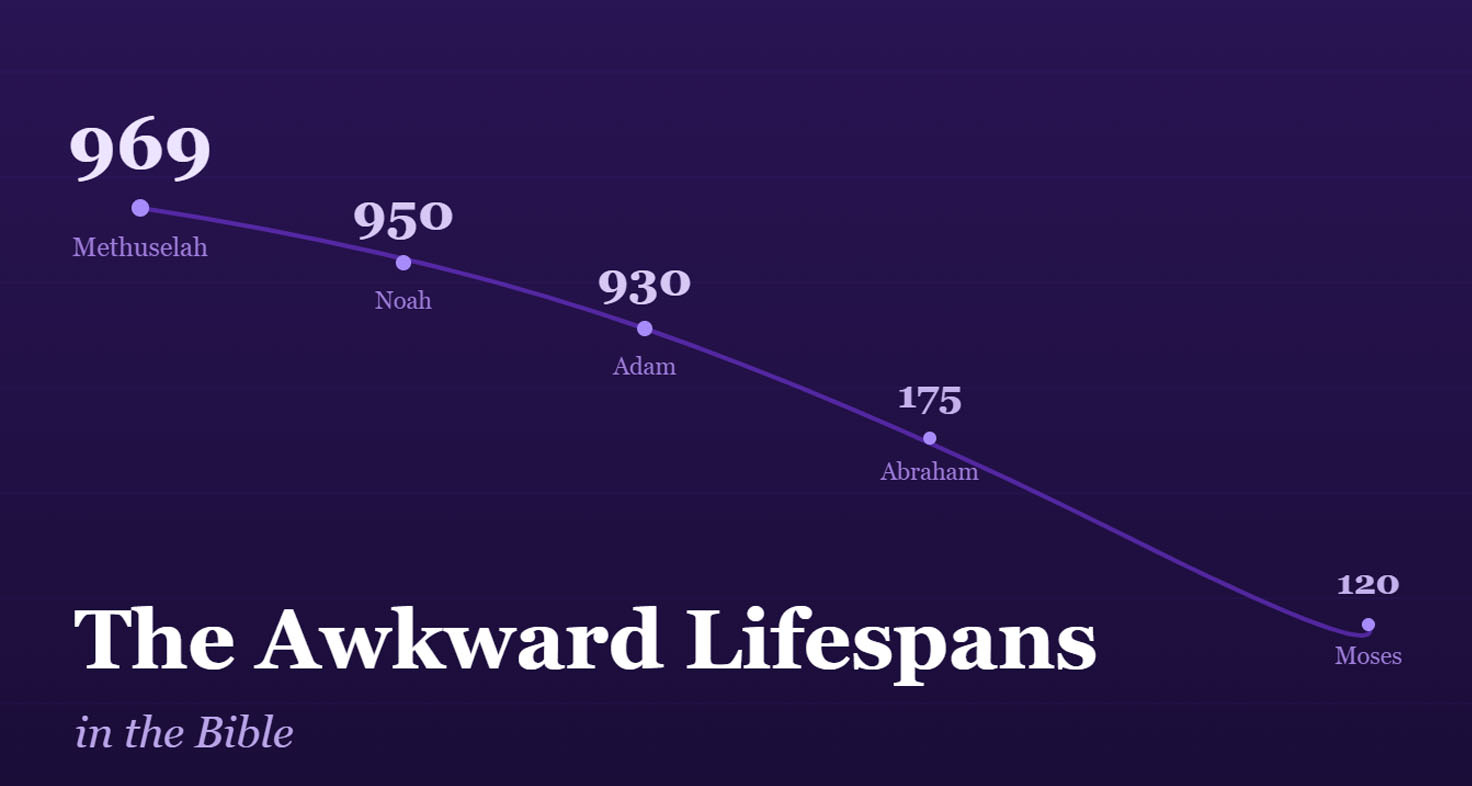
If you’ve ever had a look at Genesis, you must have noticed the unusual lifespans of characters. Adam lives 930 years, Seth makes it to 912, and Methuselah, the record holder, dies at 969, while Noah pushes past 950. Nobody in the chapter blinks at this, because thparallel is hard to misse text presents these as a matter of fact, nothing to read anything more into. The men of the early world simply lived for the better part of a millennium, fathered children at ages when a modern reader would expect a funeral, and kept going.
The instinct is to treat this as primitive exaggeration, a bit of ancient hype we can wave off, but that instinct misses what the numbers are doing.
Sumerian Kings Who Reigned for Millennia
Long before Genesis, scribes were already writing about kings who lived impossibly long. The Sumerian King List, a document copied and recopied across Mesopotamia from roughly the start of the second millennium BCE, opens with eight kings who ruled before a great flood. Their reigns make Methuselah look like he died young. Alulim, the first king, reigns 28,800 years. Another holds the throne for 36,000. The combined total for the antediluvian kings runs to hundreds of thousands of years before the flood wipes the slate clean and reign-lengths drop to something a human accountant could believe.
You have a list of named figures, absurdly long lifespans or reigns, a flood that interrupts everything, and a sharp drop in the numbers afterward. Genesis runs the same sequence. The patriarchs before Noah’s flood live close to a thousand years. After the flood, the ages start sliding down the slope, century by century, until Abraham dies at a comparatively modest 175 and Moses caps out at 120.
The writers of Genesis lived in a world where this was how you wrote about deep time and legendary origins. Enormous numbers signaled antiquity and importance, the same way a national myth might describe its founders as giants. Bruce Vawter and other scholars of the ancient Near East have noted that Hebrew scribes adapted this regional inheritance, then shrank the figures to a more sober scale. Sumer counts in tens of thousands while Genesis counts in hundreds, and that gap is already a theological edit, a quiet insistence that even the oldest humans were still mortal, still small next to the deity who outlasts them all.
The Numbers Behind the Numbers
The patriarchal ages are designed, and they shift from one manuscript to the next.
Three surviving versions of Genesis 5 and 11 don’t tell the same story: the Hebrew Masoretic Text behind most English Bibles, the Samaritan Pentateuch, and the Greek Septuagint. They disagree systematically, and the totals show it. The time from creation to the flood comes out to 1,656 years in the Masoretic Text, 1,307 in the Samaritan version, and 2,242 in the Septuagint. These gaps aren’t transcription slips, they follow patterns, which means somebody was adjusting the numbers on purpose, probably to line the chronology up with a preferred date for the flood or another anchor point further down the timeline.
Then there's base-sixty arithmetic. Mesopotamian math ran on a sexagesimal system, counting in sixties rather than tens, which is why we still carve a circle into 360 degrees and an hour into 60 minutes. Sixty makes more sense as a base than it first looks. Ten divides cleanly only by 2 and 5, while 60 divides by 2, 3, 4, 5, 6, 10, 12, 15, 20, and 30, which makes fractions and trade math far easier when you don't have decimals to lean on.
And several of the patriarchal ages suspiciously turn out to be exact products of that system.
Some scholars read the numbers as built from combinations of sixty, the square of seven, and other numbers chosen for their religious meaning rather than measured against any calendar. Whether every age decodes cleanly is debated, and honest scholars disagree about how far the pattern runs. What’s clear is that someone built the ages to a design rather than recording them off actual lives.
Enoch gives the game away, living 365 years, the only patriarch whose number jumps out, matching the days of the solar year. He’s also the one who doesn’t die in the ordinary way. The text says God took him. A man tied to the solar calendar gets lifted out of the order of deaths entirely, exactly what you’d expect if his number was chosen for its meaning rather than measured against a life.
Reading Age as Status
Treat these stories as ancient Near Eastern literature, not scripture, and they start making sense on their own terms. In the world that produced Genesis, a long life was a mark of divine favor and a sign of standing in the order of things. The further back you went toward creation, the closer humanity stood to its origin, and the longer people lived. The slow decline in lifespans across Genesis tracks a religious claim about distance from Eden rather than a medical record of failing health.
That’s why the numbers shrink in stages instead of collapsing all at once. The flood marks one threshold and the scattering at Babel marks another, and each break in the human story comes with a reset of the human scale. By the time you reach the ancestors of Israel, the ages have settled into a range that still reads as blessed (Abraham’s 175, Jacob’s 147) without straining belief past the point the writers wanted. Long life stayed the reward language of Israelite religion for centuries. Proverbs still promises length of days to the wise and righteous, and the commandment to honor your parents comes attached to the same promise. The arithmetic of Genesis 5 is that idea written large, projected back onto the dawn of the world.
What the Literalists Do With the Numbers
The people who read Genesis as straight history know the ages are a problem, and they’ve built explanations to keep them. The oldest is the vapor canopy: a layer of water vapor around the early earth that supposedly blocked radiation and let people live for centuries, until the flood released it and lifespans crashed. There’s no evidence such a canopy existed, and one thick enough to matter would have cooked the planet, so even creationists have mostly dropped it.
A second argument treats the decline itself as proof. Since the ages fall steadily after the flood, from Noah’s 950 to Abraham’s 175 to Moses’ 120, literalists read the curve as genetic degradation, a flawless original genome accumulating mutations and shedding years with each generation. It sounds scientific until you notice the curve is too smooth, tracking a theology of the fall far better than any mechanism of human aging.
Others rescue the numbers by redefining the year as a month or a lunar cycle, which scales Methuselah’s 969 down to something believable. The same conversion then has Enoch fathering children at age five. The math saves the old men by turning everyone else into an impossibility.
The honest literalist ends up at the last defense, that God willed it and no explanation is owed. That, at least, is consistent, but an argument that needs a miracle for every number has stopped making a historical claim.
If you’re getting something out of this and you’re not a paid subscriber yet, I’d love for you to become one. It’s what keeps The Unholy Truth going.
What the Awkwardness Is Telling You
The patriarchal ages are a piece of inherited Near Eastern technology, retooled by Hebrew scribes who lowered the figures, embedded their own numerical patterns, and bent the whole sequence toward a theology of decline and blessing. The manuscripts that can’t agree on the totals prove the numbers were live data for ancient editors, things to be calculated and adjusted, not sacred constants handed down untouched.
Read that way, Genesis 5 stops being a list of comically old men and becomes one of the more sophisticated things in the early chapters of the Bible, a deep-time chronology built out of borrowed forms and original math, doing exactly what its authors meant it to do.
Sources and Further Reading
Bruce Vawter, On Genesis: A New Reading
Claus Westermann, Genesis 1-11: A Commentary
Carol A. Hill, “Making Sense of the Numbers of Genesis,” Perspectives on Science and Christian Faith
Thorkild Jacobsen, The Sumerian King List
Ronald Hendel, The Text of Genesis 1-11: Textual Studies and Critical Edition
Tags: Genesis, biblical criticism, Methuselah, Sumerian King List, ancient Near East, textual criticism, Hebrew Bible, mythology, comparative religion, Old Testament
Now it all make sense for the first time.
It’s a story. A Jewish origin myth. Mythological people have mythological lifespans.