


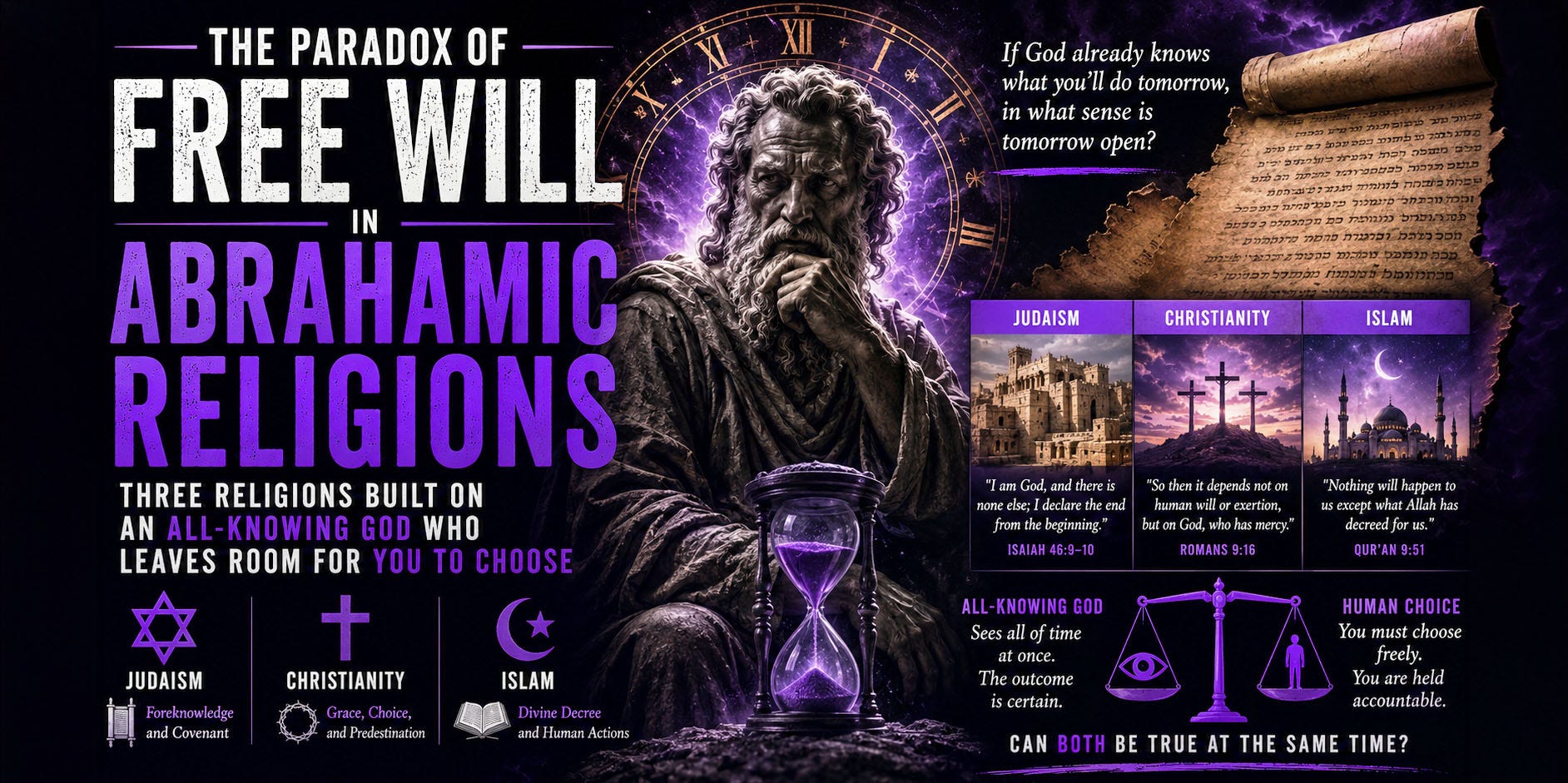
If God already knows what you’ll do tomorrow, in what sense is tomorrow open? Isn’t it fixed in the mind of a being who doesn’t get things wrong?
If an all-knowing God looked ahead and saw you eating that sandwich at 12:47 PM, then at 12:46 PM you were merely catching up to a script that was already finished, especially when you consider that only what God lets happen actually happens.
Today we’re talking about an internal problem that Jewish, Christian, and Islamic scripture all created for themselves the moment they combined two claims: God knows everything in advance, and humans are morally responsible for what they do. You can’t get judgment, reward, punishment, or a coherent afterlife off the ground without both. You can’t hold both without a contradiction sitting in the foundation.
The existence of the problem matters less than the fact that none of these religions resolved it in their founding texts.
Genesis Gives You the Choice, Then Takes It Back
The Hebrew Bible opens with the strongest free will story in ancient literature. God plants a tree, tells Adam and Eve not to eat from it, and they eat from it anyway, showing clear agency. Nobody forces their hand. The serpent persuades them by telling the truth about the tree, though persuasion operates differently than direct compulsion.
Except the text that gives you this moral drama comes from a tradition that insists God isn’t surprised by anything. Isaiah has God declaring the end from the beginning, announcing things not yet done before they happen. Psalms has every one of a person’s days written in a book before a single one existed. The prophetic tradition runs on the premise that God’s knowledge of the future is total, because otherwise prophecy is an educated guess dressed up in robes.
Either Eden’s choice was open, meaning God didn’t know the outcome until it happened, or God knew the whole time and the “choice” was theater staged for an audience of humans who couldn’t see the script. Genesis doesn’t pick a side. It runs both currents at once and trusts you not to notice the collision.
Exodus makes the problem worse. God tells Moses to go to Pharaoh, then hardens Pharaoh’s heart so he’ll refuse, and then punishes Pharaoh and his entire nation for refusing. The text doesn’t treat this as a paradox worth talking about. God wants a bigger show of power, so he engineers the resistance he’s about to punish. That’s scripture directly admitting free will can be switched off when the plot calls for it.
Paul Writes the Contradiction Into Doctrine
Christianity inherits the Hebrew Bible’s tension and then, through Paul, turns it into a theological argument.
Romans 9 is the passage every apologist wishes didn’t exist and every skeptic loves to quote. Paul explains why some Jews accepted Jesus and others didn’t, and he reaches for the potter and the clay. Does the clay get to ask the potter why it was shaped one way rather than another? Paul’s answer is that God has mercy on whomever he chooses and hardens whomever he chooses, and no one gets to talk back to him about it.
If God hardens whoever he wants to harden, then the person being hardened isn’t exercising free will, acting instead as a prop in someone else’s argument about sovereignty. Paul isn’t dodging the free will question here; he answers it directly by showing that human choice bends to divine selection whenever the two conflict.
Then there’s Jesus in John’s Gospel telling his followers that no one can come to him unless the Father draws them. That’s a strange thing to say if belief is a summons issued to some and withheld from others. Augustine later built an entire doctrine of predestination out of this material, and Calvin built a harder version on top of that, but neither of them created the tension.
The Gospels give you the flip side, too. Jesus wept over Jerusalem and said he wanted to gather its people the way a hen gathers her chicks, but they weren’t willing. That’s a God expressing frustrated desire instead of executing a plan he wrote himself. It’s the Genesis problem again: two Gods running in the same text, one who knows and determines everything, and one who wants something he doesn’t get.
The Qur’an Names the Problem and Refuses to Resolve It
The Qur’an keeps both halves in tension within single verses rather than spreading them across different books written centuries apart.
The Qur’an states that nothing happens to anyone except what God has decreed for them, and it pairs that with verses insisting that God doesn’t wrong anyone, because people wrong themselves through their own actions. That second half mirrors the Genesis story, insisting that whatever happens is on you, even while the surrounding text keeps saying that God has already written it down.
The tension got heated enough that it split early Islamic theology into camps. The Mu’tazila argued for human free will because they couldn’t stomach a God who punishes people for actions he determined in advance. Their opponents, the tradition that eventually crystallized around scholars like Al-Ash’ari, argued the opposite: God creates every human act in the moment it happens, and the human merely “acquires” it, which is a syntactic trick bolted onto hard determinism.
The Qur’an gives ammo to both sides because it was never trying to settle a philosophy seminar. It aimed to supply two distinct human desires: assure them the universe is under total control, and hold them accountable for their own choices. Those two comforts don’t fit together logically, but they fit together emotionally, which is why all three traditions kept both instead of picking one.
If you found this useful, consider becoming a paid subscriber. It’s what keeps The Unholy Truth going.
Why the Contradiction Never Gets Fixed
For society to function, free will probably has to stay a paradox. If we assume free will doesn’t exist, the judiciary system collapses, since no one is responsible for their own acts. If we insist on 100 percent free will, we lose the ability to understand what increases the likelihood of crime and prevent it. Criminologists studying poverty, trauma, or upbringing as predictors of criminal behavior show that choices are shaped by forces the chooser didn’t choose, and pushing that far enough makes moral responsibility look shaky.
Religion ran into the same wall thousands of years earlier. Judaism, Christianity, and Islam all needed God to know everything in advance, because a God who doesn’t know the future is too small to worship. They needed humans to be responsible for their choices, because a religion where no one can be blamed for anything has no moral teeth. Scripture wanted both prizes and grabbed for both without checking whether a hand could hold them at the same time, failing then just as it fails now.
Sources and Further Reading
Ehrman, Bart D. Lost Christianities: The Battles for Scripture and the Faiths We Never Knew. Oxford University Press, 2003.
Stavrakopoulou, Francesca. God: An Anatomy. Knopf, 2021.
Watt, W. Montgomery. Free Will and Predestination in Early Islam. Luzac & Co., 1948.
Donner, Fred M. Muhammad and the Believers: At the Origins of Islam. Harvard University Press, 2010.
The Tao Te Ching has a chapter which starts noting that the softest thing (running water) breaks the hardest thing (stone). Its last statement is "True words are contradictory." Westerners have a real hard time translating that last statement (even Ursula K. LeGuin).
When you realize that contradiction is the analogue of feedback, Taoism makes sense. Look at the brain; it's all circuits of nerves that excite and dampen themselves. Look at the weather, which is a bunch of systems that interrelate and are fundamentally unpredictable.
Another thing Westerners have a hard time with is understanding eternity. Let's suppose that time has dimensions analogous to space; thus you can move to a location in time similarly to moving to a location in space. An omniscient God is able to see what happens at all time locations. "Hardening the heart" is a poetic description of what happened, not a description of what God did or didn't do.
Free will is confusing because we lack omniscience. We don't even perceive eternity (under normal circumstances). And when it comes to interpreting ancient texts, we lack the contexts that supply the original meanings.
John Calvin and Martin Luther saw the contradiction, and came to the logical solution that there is no free will. Luther said his book criticizing the concept of free will was his best writing.