


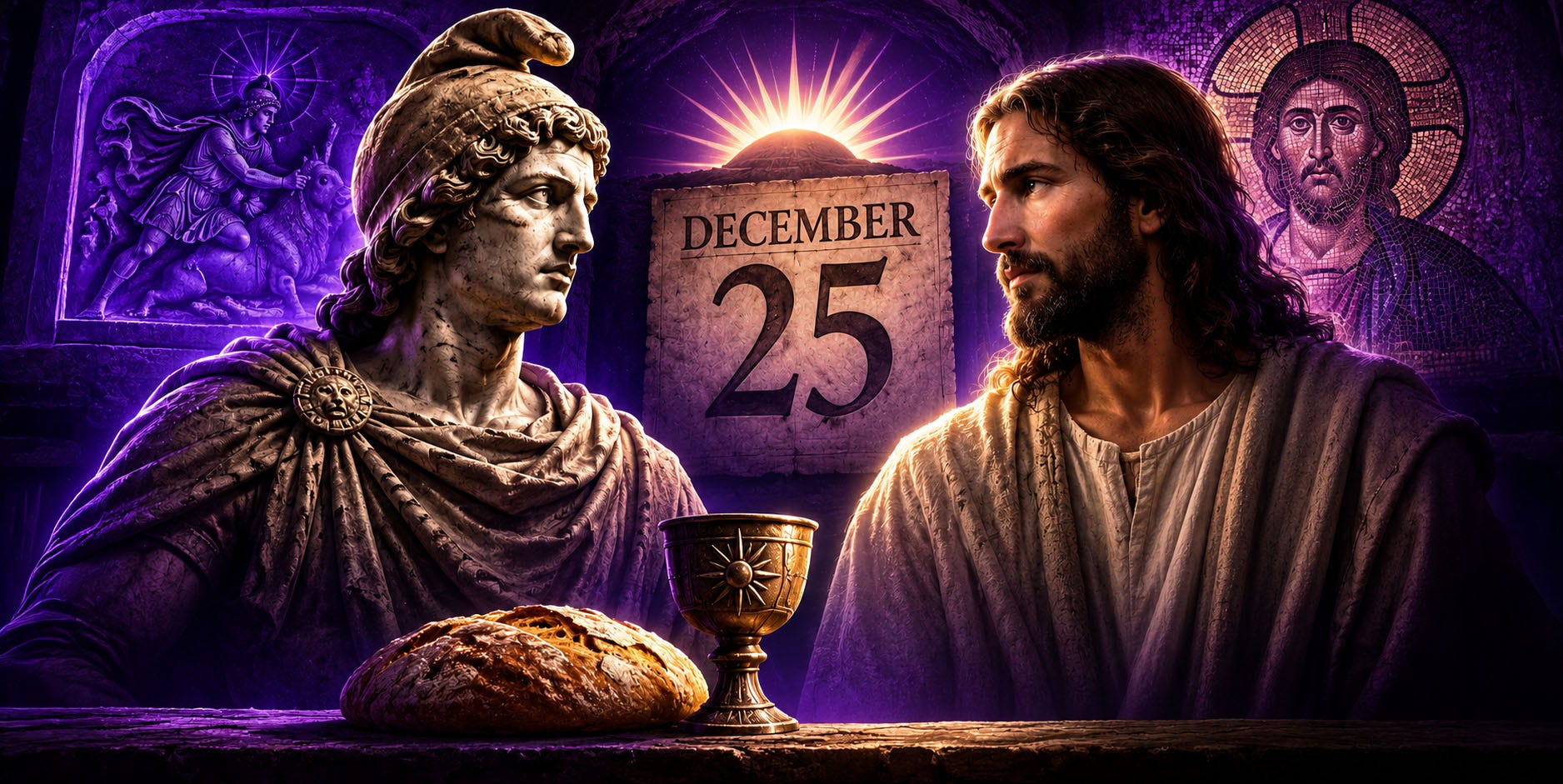
If you go to Italy one day for pleasure, walk into the Basilica of San Clemente in Rome, go down two levels, and you’ll find a small rectangular room with stone benches along both walls and a carved relief at the far end. A young man in a Phrygian cap kneels on a bull’s back, pulling its head up by the nostrils and driving a knife into its neck. A dog and a snake lap at the blood while a scorpion grips the bull’s testicles. What you’ll be observing is a mithraeum, and it sat there worshipping a god who wasn’t Jesus for something like two centuries before Christians built their church on top of it.
What the Roman Soldiers Were Doing
Mithraism spread through the Roman Empire from roughly the late first century CE onward, carried largely by soldiers, customs officials, and merchants along the frontier. The cult was for men only, organized into seven grades of initiation, and it met in these deliberately cave-like underground rooms from Britain to Syria. Archaeologists have found hundreds of them. The one under San Clemente is just the most theatrically convenient for making the point.
Members of this cult ate a ritual meal together. Bread and wine, on stone benches, in a windowless room, in honor of a god who had himself shared a banquet before ascending to heaven. However, how much we can reconstruct from the iconography is limited, since no Mithraic scripture survives and the reliefs have to speak for themselves. The banquet scenes are on those reliefs and there’s no getting around what they show.
The god was born from rock, emerging fully formed with a torch and a knife. Some reliefs show shepherds present at the birth, which is the kind of detail that makes apologists nervous enough to start talking about how complicated the dating is. What I find intellectually dishonest here is that the same people who turn anything slightly supporting scripture into a mantra, regardless of how reliable it is, get very picky about evidence that doesn't flatter it.
The Dating Is Complicated
Yet Christianity’s critics aren’t any better. While they may think Christians believe things with no evidence, they too jump to conclusions from a documentary they watched on YouTube or a podcast they listened to. They can see clearly the charlatans who exploit religion for money, but it doesn’t occur to them that there are also charlatans who target its opposition for the same reason.
The claim that Mithras was born of a virgin is false. He was born from a rock. The claim that he was crucified and resurrected after three days is false. There’s no death-and-resurrection narrative in the Mithraic material at all. The claim that he had twelve disciples comes from reading the zodiac signs that ring the tauroctony relief as if they were people. They’re the zodiac. Twelve of them, because that’s how many there are.
And the big one: the December 25 birthday. The evidence for Mithras specifically having a December 25 nativity is thin to nonexistent. What we have is a fourth-century Roman calendar, the Chronography of 354, listing December 25 as the birthday of Sol Invictus, the Unconquered Sun, a state cult that Aurelian formalized in 274 CE. Mithras got called Sol Invictus Mithras in some inscriptions, so the two got tangled together, and the tangle got flattened into a slogan.
So the honest version isn’t as big and as the internet version.
Why Even the Small Version Hurts
If you drop the fake parallels what you’re left with is that the Roman Empire had a widespread mystery religion, with initiation rites, a communal bread-and-wine meal, an underground fellowship of men bound by grades of secret knowledge, a god who slaughters a bull to bring life into the world, and a heavy solar association. It ran alongside Christianity for two hundred years. Both were competing for the same anxious, mobile, spiritually shopping population of the imperial provinces.
The Church Fathers knew it. Justin Martyr, writing around 155 CE, complains that in the mysteries of Mithras, bread and a cup of water are set out with certain incantations, and he explains this by saying that wicked demons imitated the Christian eucharist in advance. Tertullian says the same about Mithraic initiates being marked on the forehead, calling it the devil’s counterfeit baptism. Neither of them denies the resemblance. They can’t. Their readers had seen both. So they invented a doctrine of diabolical mimicry, a claim that Satan plagiarized Christianity before Christianity existed, which is what you say when the parallel is too obvious to deny and too damaging to concede.
That’s the actual evidence. Two second-century Christian intellectuals conceding, in writing, that their central sacrament looked like something the competition was already doing.
Birthdays Weren’t for Israelites
Christmas is an inherently pagan construct and we don’t need Mithras to make the case. Celebrating birthdays is so embedded in Western culture that it doesn’t occur to most people it wasn’t always a widespread thing.
Every Roman had a genius (men) or iuno (women), a personal guardian spirit that came into being with you and died with you. Your dies natalis was that spirit's day. You offered it wine, incense, cake, and flowers, wore white, and avoided bloodshed. Well-wishers came because good words and good company on the day were thought to shape the year ahead.
For Israelites the day you were born was a piece of information nobody bothered to keep. Ordinary people had no reason to track it, no document to record it on, and no ritual attached to it. The one birthday party in the New Testament is Herod’s, and it ends with John the Baptist’s head on a plate, which tells you roughly how the practice was regarded by the people writing.
We can say with reasonable confidence that Jesus never celebrated his birthday. In first-century Jewish Palestine it wasn’t customary to record the date someone was born. If you asked, you might get something rough anchored to a major event, a drought or a war or whose reign it fell under, which is exactly how Luke dates things when he tries.
Jesus also lived by a lunar calendar. Passover falls on the fourteenth of Nisan because Nisan is a moon month, and every festival he’d have kept ran on the same reckoning. The calendar Christians use now descends from Rome’s, reformed by Julius Caesar and reformed again by Pope Gregory in 1582. It tracks the earth’s orbit around the sun, in a city whose late imperial state cult worshipped the Unconquered Sun.
Not a paid subscriber yet? Consider joining to keep The Unholy Truth alive.
What Mithraism Tells Us
If anything, the Mithraism case shows that critics of Christianity are as vulnerable to misinformation as the next guy. I’m not claiming everything told about Mithras is wrong. What I’m saying is that what circulates isn’t evidence driven. Whatever your position, there’ll be someone ready to exploit what you feel strongly about and sell you “facts” that too perfectly support it.
For Christians it shows that their religion, like every other one, comes coated with long-standing traditions built up around the fundamentals. You can be sober enough to acknowledge that while still following the tradition to express yourself, weighting it accordingly. What doesn’t hold is the position that everything about Christianity is unique and the validity of the faith rests on that.
Sources and Further Reading
Manfred Clauss, The Roman Cult of Mithras: The God and His Mysteries (Edinburgh University Press, 2000)
Roger Beck, The Religion of the Mithras Cult in the Roman Empire (Oxford University Press, 2006)
Justin Martyr, First Apology, ch. 66
Tertullian, De Praescriptione Haereticorum, ch. 40
Thomas J. Talley, The Origins of the Liturgical Year (Liturgical Press, 1991)
Steven Hijmans, “Sol Invictus, the Winter Solstice, and the Origins of Christmas,” Mouseion 47 (2003)
Bart D. Ehrman, How Jesus Became God (HarperOne, 2014)
The trouble is that even though not all the similarities are valid, there are enough of them to substantially downgrade the claim that Christianity is original, unique and therefore the only true religion. And after that it’s surely a case of spiritual pick-n-mix.
"For Israelites the day you were born was a piece of information nobody bothered to keep."
Solomon said, "A good name is better than fine perfume, and one’s day of death is better than his day of birth." (Ecclesiastes 7:1) That sums up how the Israelites viewed birthdays. It sucked because you were going to suffer until you died and dying was great because you could finally rest.