


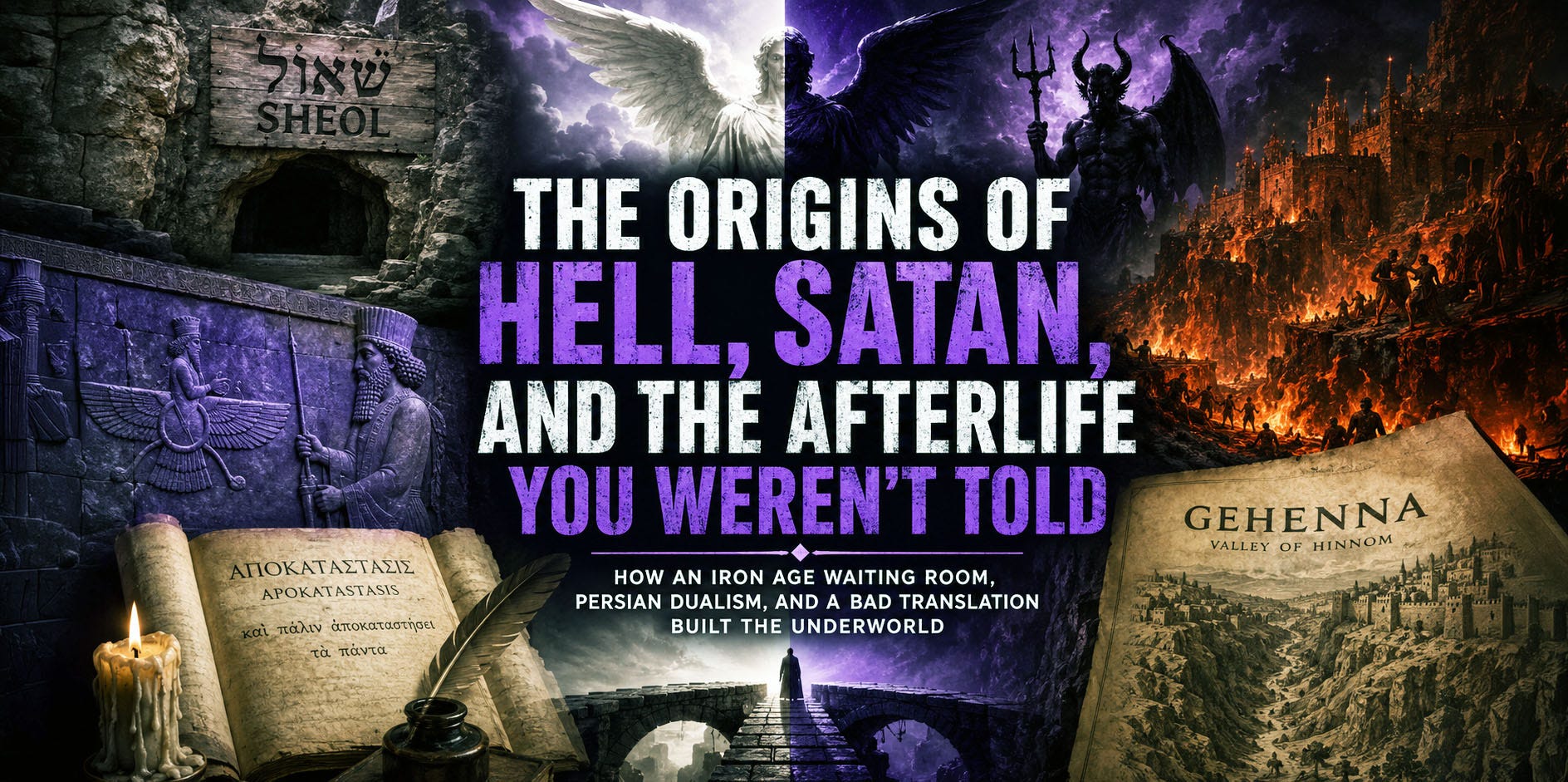
Some beliefs sit so deep in the culture that we assume they have to be in the Bible, and anyone suggesting otherwise sounds like they’re running an anti-Christian smear campaign. Today we’re going after three of them.
Many people will point at the Bible to tell you where hell comes from, usually with a vague gesture toward the back half. Trouble is, the God of Genesis, Exodus, and Judges never threatens anybody with eternal fire. He threatens famine, plague, invading armies, and boils, and when Yahweh wants to punish you in the oldest parts of the Hebrew Bible he does it here on the ground, in your lifetime, often hitting your grandchildren for good measure.
The furnace under the earth, the horned adversary, and the sorting of souls into reward and torment all showed up late, and every one of them came in from somewhere else.
And the irony of all is revealed at the end.
Sheol Was a Universal Waiting Room Until It Wasn’t
The Hebrew Bible uses Sheol roughly sixty-five times for where the dead go, and the picture is bleak without being punitive. Sheol’s dark, dusty, silent, and universal, where kings, prophets, and murderers land in the same pit and God stops paying attention. Psalm 6:5 asks how anyone can praise God from a place where nobody remembers him, Ecclesiastes 9:5 says the dead know nothing and get no further reward, and Job 14 gives a cut tree better odds than a man, since the tree can sprout again while the dead man lies down without rising.
There’s no fire, no demons, no torture, no postmortem sorting. An Iron Age Israelite would’ve found it strange that your earthly behavior determined your afterlife accommodations, because Yahweh settled accounts during your life, and Deuteronomy spells out the terms: obey and you’ll get rain, disobey and you’ll get locusts.
The Heavenly Court’s Prosecutor
In the Hebrew Bible, satan’s a common noun meaning adversary, accuser, or obstructor, usually appearing with the definite article as ha-satan, which functions as a job title.
In Numbers 22:22, Yahweh’s angel blocks Balaam’s donkey as an adversary, performing the function of a satan. Zechariah 3 shows the accuser standing in the heavenly court to bring charges against Joshua the high priest, only for Yahweh to overrule him like a judge reining in an overzealous prosecutor. In Job 1 and 2, the accuser attends a divine staff meeting with the other sons of God, reports on his travels, and proposes auditing Job’s piety. God signs off twice, meaning the accuser can’t touch Job without written authorization from management.
The clearest proof of this character’s late evolution sits in two parallel passages. In 2 Samuel 24:1, Yahweh grows angry with Israel and incites David to take a census, subsequently punishing seventy thousand people for the sin. Centuries later, the author of 1 Chronicles 21:1 retold the story and assigned the role of inciting David to Satan. The plot stayed identical while the underlying theology shifted, giving a writer somewhere else to dump divine liability.
The Persian Rewire
Judah spent roughly two centuries under Persian rule after Cyrus captured Babylon in 539 BCE. Persian imperial religion revolved around Zoroastrianism and its cosmic dualism, pitting Ahura Mazda against Angra Mainyu with the universe as their battlefield and humanity forced to pick a side. It featured an individual judgment at the Chinvat Bridge, an ordeal of molten metal for the wicked, a bodily resurrection, and a cleanup where evil gets erased.
Judaism entered the Persian period with Sheol and emerged with full apocalyptic machinery: a named adversary, ranks of demons, named angels, a war between light and darkness, and bodies climbing out of the dirt. Daniel 12:2, written around 165 BCE during the Maccabean crisis, holds the only clear resurrection promise in the Hebrew Bible, showing sleepers in the dust waking to either everlasting life or everlasting contempt.
While dating Avestan texts remains tricky because of centuries of oral transmission, the timeline on the Jewish side’s clear. These concepts appear in Jewish literature during and after the Persian and Hellenistic periods, whereas earlier texts lack them entirely. By the time the Dead Sea Scrolls were written, the shift had hardened into place, with the War Scroll depicting the Sons of Light fighting the Sons of Darkness under Belial’s command.
The Ravine Outside Jerusalem
The Synoptic Gospels (Matthew, Mark, and Luke) record Jesus using the word Gehenna for hell, referring to a location you can visit today. The Valley of Hinnom runs along the southern and western edge of Jerusalem’s Old City, earning its reputation through child sacrifice. 2 Kings 23:10 records King Josiah defiling the high place at Topheth in the valley so no one could pass children through fire to Molech, while Jeremiah 7:31 promises the ravine will turn into the Valley of Slaughter.
Gehenna started as a ravine with a horrific past before morphing into shorthand for divine judgment by fire. Mark 9:47-48 quotes the end of Isaiah, describing corpses lying with unquenched fire and undying worms, which describes dead bodies piled outside city walls rather than conscious souls suffering in an underground chamber.
Popular myth claims Gehenna served as Jerusalem’s burning garbage dump, but that story originated with medieval rabbi David Kimhi around 1200 CE and lacks support from ancient sources or archaeological digs.
From Serpent to Satan
Genesis 3 never mentions Satan in Hebrew, describing the tempter as a nachash or serpent. Creation includes this animal, and its sentence fits a beast: crawl on your belly, eat dust, and get crushed by human heels. Hebrew authors never point back to Genesis 3 to explain evil’s origin, and major prophets like Ezekiel, Isaiah, and Jeremiah ignore it completely.
The identification appears in Revelation 12:9, where a first-century author stacks four names onto the character: the dragon, the ancient serpent, the Devil, and Satan. Early Christians read Genesis 3 backward through Revelation 12, giving the garden snake horns retroactively.
The fall-from-heaven story came together through similar backward readings. Isaiah 14:12 mocks a fallen tyrant as helel ben shachar, the Shining One, explicitly framing the passage as a taunt against the king of Babylon. Jerome translated helel into Latin as lucifer, the ordinary word for the morning star, and the King James translators capitalized it into a proper name. Readers inherited a biography of the Devil built out of a mistranslated nickname for a dead Mesopotamian king.
Ezekiel 28 underwent identical treatment, where a prophecy directed at the king of Tyre was reinterpreted by church fathers as the Devil’s original resume.
Watchers, Titans, and Folk Tales
The machinery transforming the accuser into the ultimate enemy was built in intertestamental Jewish literature that didn’t make the Protestant canon. The Book of the Watchers in 1 Enoch expands the brief verses of Genesis 6 into a story where two hundred angels descend, teach humanity forbidden arts, father giants, and end up chained beneath the earth to await fire.
Jude quotes 1 Enoch directly as prophecy, while 2 Peter 2:4 claims God cast sinning angels into tartarus, adopting the Greek term for the abyss beneath Hades where Zeus imprisoned the Titans. New Testament writers routinely pulled from shared Jewish and Greek underworld lore.
Luke 16 demonstrates this borrowing through the story of the rich man and Lazarus. The structure of reversed fortunes and communication across a fixed chasm matches an Egyptian folk tale about Setne and Si-Osiris that circulated across Greco-Roman Egypt.
How Augustine Closed the Door
Early Christians debated hell’s nature for centuries before the hardline position won out. Origen of Alexandria argued in the third century for apokatastasis, the universal restoration of all souls, reasoning that punishment from a good God must correct rather than destroy. Gregory of Nyssa defended a similar view without facing contemporary backlash.
Augustine locked down the Latin West by arguing in City of God that hell’s fire’s eternal, physical, and conscious. He insisted that finite sins against an infinite God deserve infinite torment, explicitly including unbaptized infants. Three centuries after Origen’s death, the Second Council of Constantinople formally condemned his restoration theology.
The visual details came later from art and literature. Scripture gives Satan no pitchfork, horns, or red skin. Medieval artists recycled features from Pan and satyrs, while Dante’s Inferno designed the nine circles and frozen lake around 1320. John Milton later provided the rebellion, the celestial war, and the charismatic personality in Paradise Lost.
What ends up in modern sermons is a composite built from Persian dualism, Canaanite star myths, a Judean ravine, Greek underworld mythology, Egyptian folk tales, North African theology, Florentine poetry, and English epic verse.
And the irony of it all? Islam borrowed hell, Satan, and the afterlife from Christianity and put them in writing, which means, strictly speaking, the versions most Christians believe about hell, Satan, and the afterlife today are more Quranic than biblical.
If you find value here, become a supporter of The Unholy Truth. Paid subscriptions are what make this work possible.
Sources and Further Reading
Bart D. Ehrman, Heaven and Hell: A History of the Afterlife (2020)
Elaine Pagels, The Origin of Satan (1995)
Henry Ansgar Kelly, Satan: A Biography (2006)
T.J. Wray and Gregory Mobley, The Birth of Satan (2005)
Philip Jenkins, Crucible of Faith: The Ancient Revolution That Made Our Modern Religious World (2017)
Alan F. Segal, Life After Death: A History of the Afterlife in Western Religion (2004)
Francesca Stavrakopoulou, God: An Anatomy (2021)
Jan N. Bremmer, The Rise and Fall of the Afterlife (2002)
Mary Boyce, Zoroastrians: Their Religious Beliefs and Practices (1979)
George W.E. Nickelsburg, 1 Enoch: A Commentary (2001)
It was all originated in the convents where demented nuns learned to threaten small children with eternal damnation for the horrible offense of talking in class.
Electricity needs a positive and negative pole. The potential difference between them, known as voltage, drives current through the circuit.
Religion acts in the same manner. Having an eternal afterlife, either in a wonderful paradise or a place of unbearable torment, creates the same effect. The difference between eternal bliss and eternal damnation is the force that drives the faithful. This is what leads such people to follow a belief system which is not rational, and to devote themselves to a leader who demands regular donations.