


In 1849 and 1850, Austen Henry Layard, an English diplomat turned archaeologist, directed excavations at Kuyunjik, a mound across the Tigris from the Iraqi city of Mosul. Beneath the rubble his workmen uncovered the ruins of an Assyrian palace, and in two of its chambers the floor was buried under a foot-deep drift of broken clay tablets covered in wedge-shaped writing that no living person could read.
The tablets belonged to Ashurbanipal, the last great king of Assyria, who had spent his reign collecting texts from across Mesopotamia for his library at Nineveh. When Babylonian and Median armies burned the city in 612 BCE, the fire hardened the clay and the collapsing palace sealed the library for almost twenty-five centuries.
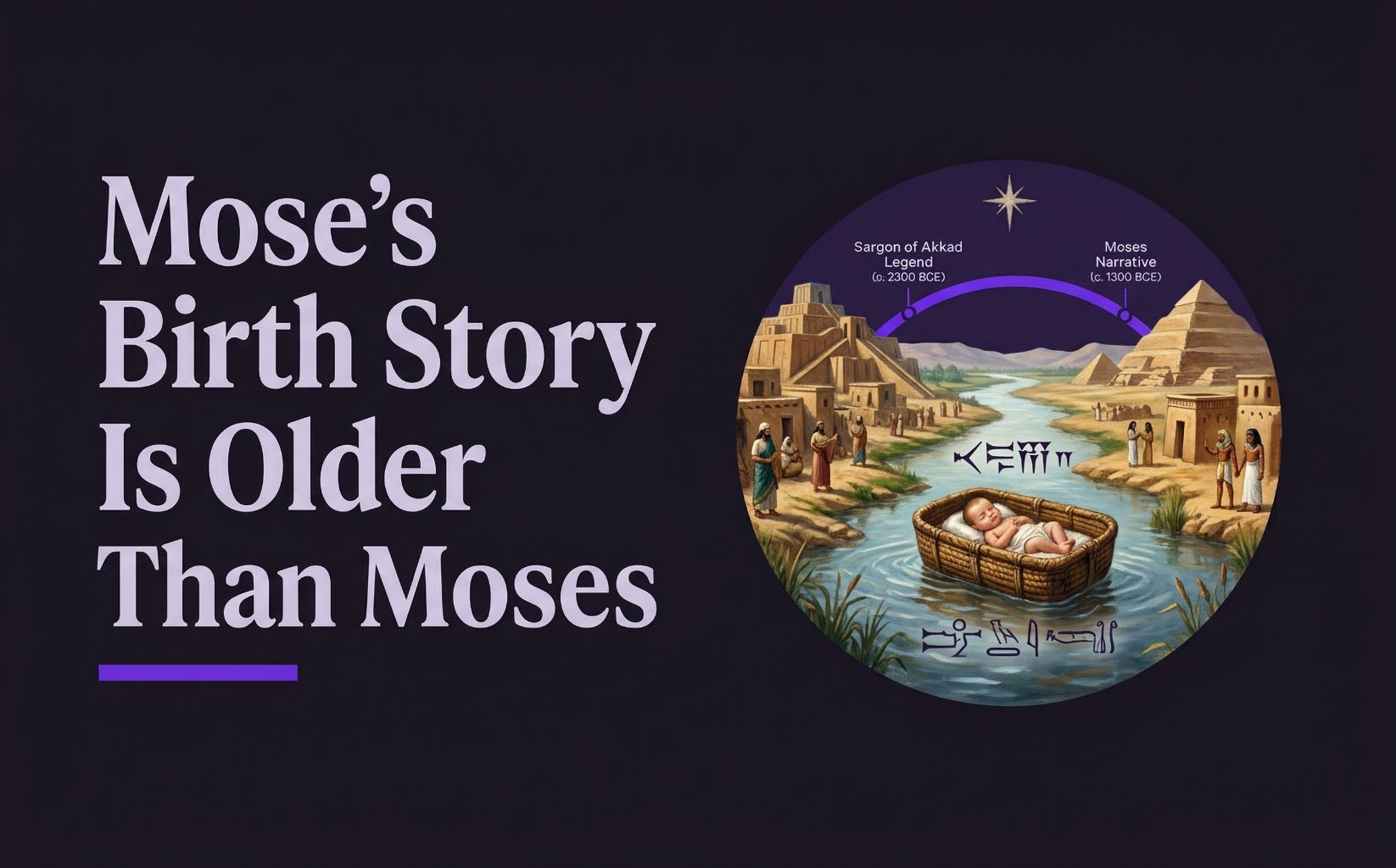
Crates of fragments went to the British Museum, where they waited for readers. One of the first capable ones was George Smith, a former banknote engraver who had taught himself the script. In 1872 he picked up a fragment describing a flood, a man who built a boat, and a bird sent out to test the land, and by the standard account he was so shaken that he began pulling off his clothes in the middle of the reading room. The flood tablet made the newspapers, but the same collection held thousands of other pieces, including a tablet in which a king introduces himself in the first person as Sargon, mighty king of Akkad with a story eerily similar to the one in the Bible as well as the Quran
The Birth of Moses in Exodus 1 and 2
The Bible’s version begins in Egypt generations after Joseph. A new king who has no memory of Joseph sees the Hebrew population growing and treats it as a security threat. He puts the Hebrews to forced labor building the storage cities of Pithom and Ramesses, but they keep multiplying, so he orders two Hebrew midwives, Shiphrah and Puah, to kill every Hebrew boy at birth. The midwives refuse, telling Pharaoh that Hebrew women give birth before a midwife can arrive. Pharaoh then widens the order to all his people and commands that every newborn Hebrew boy be thrown into the Nile.
A man and a woman from the tribe of Levi have a son and hide him for three months. When they can’t hide him any longer, the mother makes a basket from papyrus, coats it with bitumen and pitch, lays the baby inside, and sets it among the reeds on the riverbank. The baby’s sister stands some distance away to see what happens.
Pharaoh’s daughter comes down to bathe, sees the basket, and sends her servant to bring it. She opens it, finds a crying baby, and recognizes him as one of the Hebrew children. The sister steps forward and offers to find a Hebrew woman to nurse him, and the woman she brings back is the baby’s own mother, who is paid wages to raise her son. When the boy is older, she brings him to Pharaoh’s daughter, who adopts him and names him Moses, explaining that she drew him out of the water. The next chapters follow him from the palace to exile in Midian, and then to the burning bush.
A King With No Father and a Basket Sealed With Tar
The scribes who wrote the legend placed it in the mouth of Sargon of Akkad, who ruled Mesopotamia around 2300 BCE and built what’s usually called the first empire in history. The tar in the story is bitumen, the black pitch that seeps from the ground across Iraq. The water-drawer, named Akki, raises the baby as his own son and trains him as a gardener. The goddess Ishtar favors the gardener, and he goes on to rule for fifty-five years. For a king with no royal ancestry, the story supplied a pedigree from the gods, who had kept him alive on purpose.
Exodus 2 Follows the Same Sequence
Exodus 2 presents nearly the same series of events. A woman from the tribe of Levi hides her newborn son for three months, then weaves a basket, coats it with bitumen and pitch, lays the baby inside, and sets it among the reeds at the edge of the river. Pharaoh’s daughter sees the basket and sends a servant to fetch it, and the child grows up in a household that isn’t his own before he rises to lead a nation.
The correspondence covers the materials as well as the plot. Reeds, tar, a river, a baby his mother can’t keep, and a rescuer who takes him in appear in both versions. The Hebrew word for the basket is tevah, which occurs in the Old Testament in only two stories, Noah’s ark and the Moses basket. The writer chose a word that already meant a vessel carrying one family through the water and added the tar.
The differences follow the needs of each story. Sargon’s rescuer is a laborer, which suits a man who will become a king. Moses’ rescuer is royalty, which suits a man who will one day stand before a king and demand the release of his people.
Why Judean Scribes Had Access to Assyrian Texts
Sargon’s story belongs to Mesopotamia and Moses’ story belongs to Israel, but contact between the two cultures was constant in the relevant centuries. The oldest surviving copies of the Sargon legend come from the library at Nineveh, assembled by Assyrian kings of the seventh century BCE, when Assyria dominated the Near East. Judah was a vassal state at the time, paying tribute and sending officials to the Assyrian court.
About a century before those tablets were copied, Sargon II, an Assyrian king who took the name of the ancient emperor, destroyed the northern kingdom of Israel and deported much of its population. Refugees and scribes from the north moved south into Jerusalem afterward, in the same period when Judean writers were gathering the traditions that became the Torah. The Hebrew Bible shows awareness of this Sargon, since Isaiah 20:1 names him as the king who sent his commander against the city of Ashdod, and it’s the only place in the entire Bible where the name appears.
The legend also functioned as royal propaganda. It gave a ruler without famous ancestors a divine origin, and under a king named Sargon it was circulating in the court that controlled Judah.
Founders and Heroes Share a River Story
Sargon and Moses are one pair among many. The Greek hero Perseus is shut in a wooden chest and thrown into the sea by his grandfather, then pulled out by a fisherman. Romulus and Remus, the twin founders of Rome, are left in a trough on the Tiber, nursed by a she-wolf, and found by a shepherd. Cyrus the Great, founder of the Persian Empire, is handed to a herdsman as a baby with orders to leave him to die. In 1909 the psychoanalyst Otto Rank collected dozens of such tales and found that nearly all of them share the same outline: a baby of uncertain parentage, threatened by a powerful man, exposed to the elements, rescued by humble or foreign people, and grown into greatness.
The function of the pattern is legitimacy. A man with no pedigree to cite demonstrates that something better stands behind him, a god who preserved his life against impossible odds. The legend did that work for a Mesopotamian conqueror whose parentage was unknown, and Israel’s writers needed a founder whose authority came from somewhere other than a throne or a bloodline.
Coincidence and Reverse Borrowing Both Fail
The traditional reading holds that mothers in desperate times have surely set babies afloat, so the overlap proves nothing. The overlap extends well past a baby on a river, though. The basket is made of reeds, the seal is bitumen, the water is a river, the rescuer works at the water or stands at its edge, and the child grows up in another household before taking power. Each element is ordinary on its own, and the full set of six is the Sargon legend.
The alternative holds that Sargon’s scribes copied a Moses story. That would require a Hebrew text from after the traditional date of Moses to reach Mesopotamia and attach itself to a king who lived centuries earlier, and no trace of such a text has turned up. The Assyrian version has a documented home in a royal library, in the capital of the empire that held Judah as a vassal.
How Mainstream Christian Scholars Read the Parallel
Most mainstream Christian scholars, Catholic and Protestant, accept the parallel and don’t treat it as a threat to their faith. Brevard Childs, an Old Testament scholar at Yale, published a study in 1965 titled “The Birth of Moses,” placing the story among the ancient accounts of exposed infants who grow into leaders, and the reading of Exodus 2 as an adapted common motif has been standard in major commentaries on the book ever since. Their working position is that the story carries a theological message about God’s providence, since the man who will break Pharaoh’s power is raised inside Pharaoh’s own household, and that the literary shaping says nothing against the larger claim that God acted in Israel’s history. They also point out that ancient writers didn’t separate biography from legend the way a modern historian does, and a founder’s life was expected to follow a recognizable pattern.
Conservative and evangelical scholars hold a narrower line. They grant the similarity and argue that it doesn’t establish borrowing, since the two stories differ on the mother’s role, the rescuer’s rank, and the child’s destiny, and a historical Moses could have been set afloat by a mother in real danger. James Hoffmeier, an Egyptologist and evangelical scholar, argues that the Egyptian name and setting of the story fit the period it claims to describe. An Egyptian setting fits any writer who knew Egypt, though, and it doesn’t account for the six shared elements listed above.
Evangelical institutions also settle the outcome before the evidence comes in. The Evangelical Theological Society, the main professional body for conservative biblical scholars, requires its members to affirm that the Bible is inerrant, and many seminaries make faculty sign a similar statement before they’re hired. Peter Enns, an Old Testament professor who accepted ancient parallels like this one in a 2005 book, left Westminster Theological Seminary in 2008 after the school suspended him over it. A scholar who has signed a paper promising that the text contains no error can’t follow a parallel to its conclusion, because the conclusion was fixed before the evidence was read. It’s a jury signing the acquittal before the trial opens and then asking everyone to trust the verdict.
And people like me keep giving them space to explain what they think, while evangelical institutions behave as if mainstream Christian scholarship doesn’t exist and treat any claim that doesn’t fit their faith as atheistic.
The Exodus account presents the baby story as the opening scene of a national history, and the same story kept circulating and changing long after Exodus was written. The bonus section below examines what happens under closer inspection, including a name that doesn’t work in Hebrew, a family tree that breaks a later law, and how Matthew reused the story when he needed a birth narrative for Jesus. It’s available now to paid subscribers.
So, what do you think?
The comments section is open to all, but you need to be at least a free subscriber, as required by Substack.
Bonus for Paid Subscribers
The Egyptian Name and Matthew’s Reuse of the Story
Exodus 2:10 says Pharaoh’s daughter named the boy Moses because she drew him out of the water. The Hebrew verb for “to draw out” is mashah, so “Moshe” would mean “the one who draws out,” which describes a rescuer and contradicts the story’s explanation of the name. An Egyptian princess…