


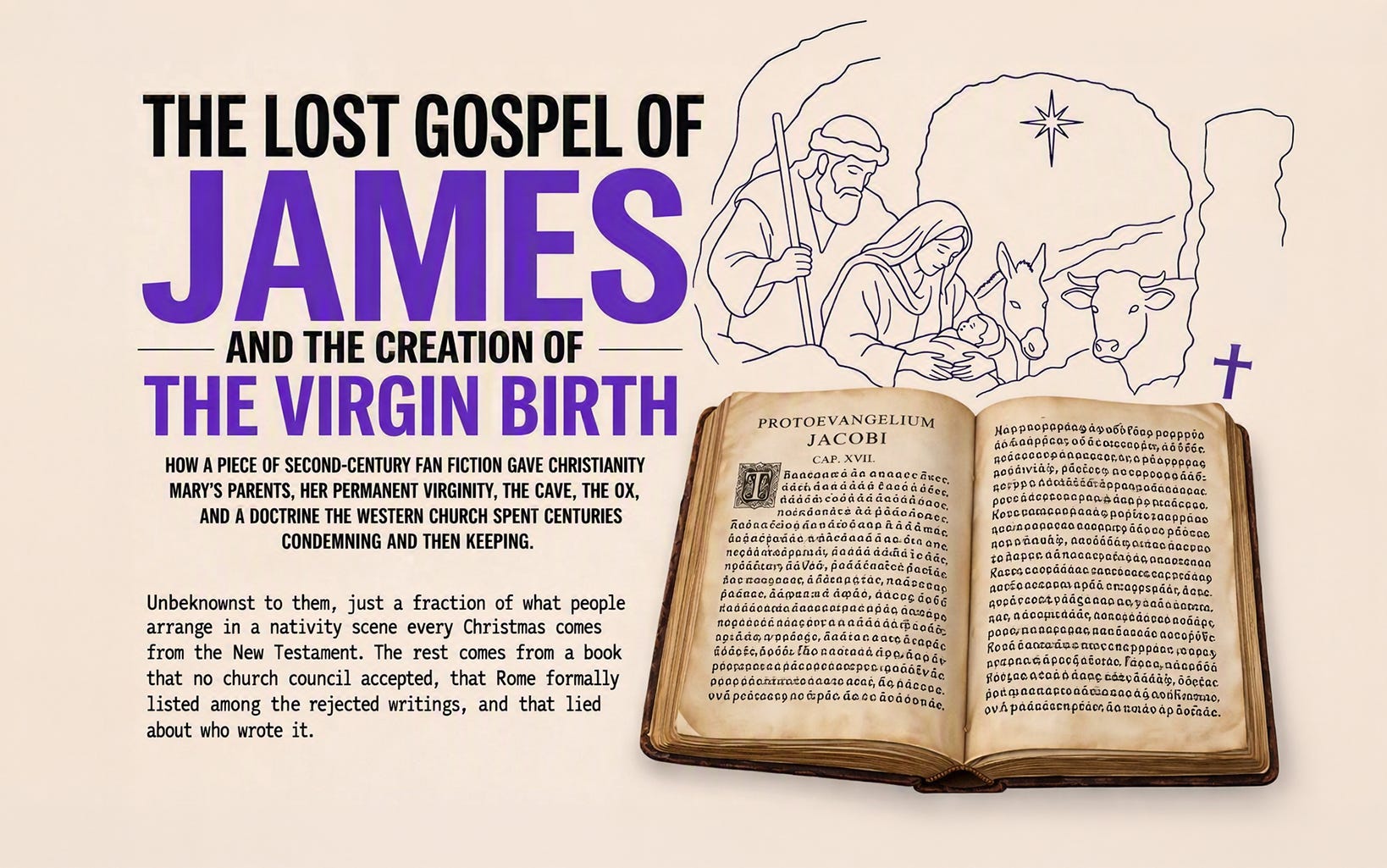
Unbeknownst to them, just a fraction of what people arrange in a nativity scene every Christmas comes from the New Testament. The rest comes from a book that no church council accepted, that Rome formally listed among the rejected writings, and that lied about who wrote it.
Four Gospels, Two Nativities, and One Line of Greek
Mark opens with a grown man walking into a river. John opens before creation itself. Paul, writing decades before any of the Gospels, says only that Jesus was born of a woman, born under the law, which is the least remarkable thing you can say about anybody. Two Gospels tell a birth story, and they don’t agree on much: Matthew has magi, a murderous king, and a flight to Egypt, while Luke has shepherds, a census, and a manger. What they share is the claim that Mary conceived without a man.
Matthew grounds that claim in Isaiah 7:14, quoting the Greek Septuagint, where the word is parthenos, virgin. The Hebrew reads almah, a young woman of childbearing age, and Isaiah’s own context points to a child born in his lifetime as a sign to King Ahaz about a war that was already underway. The Hebrew has a perfectly good word for virgin, betulah, and Isaiah didn’t use it.
That’s the whole foundation. Everything else you think you know about Mary got built later, and most of it got built in one book.
A Second-Century Book That Signed James’ Name
The Protoevangelium of James (the Infancy Gospel of James, or just the Book of James) was written somewhere between about 150 and 200 CE, most likely in Syria or Egypt. It closes by claiming James, the brother of Jesus, wrote it in Jerusalem after Herod’s death. That’s false. The author writes in polished literary Greek, works from the Septuagint rather than the Hebrew, and gets Judean geography wrong in ways nobody who lived there could manage. He also gets Judaism wrong. He has a girl raised inside the Jerusalem temple, fed by an angel, and has the high priest wandering into the Holy of Holies whenever the plot requires an oracle. As Bart Ehrman puts it in his work on the apocryphal gospels, the author was a gentile Christian writing well outside Palestine, imagining a Jewish world he’d never seen.
None of that hurt its circulation. It survives in more than 140 Greek manuscripts, the oldest being Papyrus Bodmer V from the fourth century, and it was translated into Syriac, Coptic, Armenian, Georgian, Ethiopic, and Old Church Slavonic. Origen knew it by the early third century. Clement of Alexandria already knew a version of one of its scenes. In terms of raw influence on what ordinary Christians pictured when they thought about Jesus’ birth, it beat most of the canon.
Mary Gets a Nativity of Her Own
The book opens on a wealthy man named Joachim and his wife Anna, childless and humiliated for it. Joachim goes into the wilderness to fast for forty days, Anna prays in her garden, an angel announces a child, and Anna vows to dedicate that child to God. If this sounds familiar, it’s Hannah and Samuel from 1 Samuel 1, with the names changed and the volume turned up.
Mary is born, and Anna turns her bedroom into a sanctuary so nothing unclean will touch the girl. At three she’s handed over to the temple, where she lives on food delivered by an angel. At twelve the priests panic, because a menstruating girl inside the sanctuary would defile it, so they gather the widowers of Judea and hold a contest. Joseph’s staff sprouts a dove. He objects that he’s an old man with sons and she’s a child, gets overruled, and takes her home as a guardian rather than a husband. Mary is later assigned the purple and scarlet thread for the temple veil, and she’s spinning it when Gabriel arrives.
Joachim and Anna appear in no biblical text. Every Saint Anne church, every Anna in a Catholic family tree, every icon of Mary’s parents traces back to this book and nowhere else. Lily Vuong’s study of the text makes the driving obsession clear enough: the author is building a woman whose purity is temple purity, uninterrupted from conception onward.
The Old Widower Who Solved the Brothers Problem
The Gospels are inconvenient on this point. Mark 6:3 names four brothers of Jesus, James, Joses, Judas, and Simon, and mentions sisters. Paul, who met one of them, calls James the Lord’s brother in Galatians 1:19. Matthew says Joseph had no relations with Mary until she gave birth, which any ordinary reader takes to mean he did afterward.
The Book of James disposes of all of it with one detail. Joseph is elderly, he’s a widower, and he already has sons when he’s assigned to Mary. The brothers become stepbrothers, the marriage is never consummated, and Mary stays a virgin permanently. Origen cites the Book of James for exactly this explanation, which tells you the fix was already circulating as an answer to an argument Christians were having by the early 200s.
The Midwife Who Reached In
Then comes the scene that decided a doctrine. Joseph and Mary are traveling, she’s about to deliver, and he puts her in a cave outside Bethlehem. (Justin Martyr also knew a cave tradition by the mid-second century, and Constantine’s builders later put the Church of the Nativity over one. The stable is Luke’s manger plus a lot of Renaissance carpentry.) A midwife arrives, sees the birth, and runs out announcing a miracle. A second woman named Salome refuses to believe it and says she’ll examine Mary physically. She does, and her hand withers and starts to burn. An angel tells her to pick up the child, she does, and the hand is healed.
That scene establishes something Matthew and Luke never claimed, which is that Mary remained physically virgin during and after the delivery, not only before conception. Theologians call it virginitas in partu, and it entered Christian doctrine through a gynecological exam invented by an anonymous author around 180 CE.
Jerome Condemned the Book and Kept Its Conclusions
By the late fourth century, a Roman named Helvidius made the reasonable argument that Mary had normal children after Jesus. Jerome went after him in Against Helvidius (383) and won the argument for the next sixteen centuries. He rejected the Book of James by name, since he wanted Joseph a lifelong virgin too, so he replaced the stepbrother solution with a new one: the brothers were cousins. Different mechanism, same result, and the perpetual virginity Jerome defended came out of the book he was dismissing.
The West kept condemning it. The Gelasian Decree lists it among the apocrypha to be rejected. Then a seventh-century Latin forger repackaged the whole thing as the Gospel of Pseudo-Matthew, added an ox and a donkey at the manger by reading Isaiah 1:3 into the scene, and sent it back into circulation. From there it fed the Golden Legend, the mystery plays, and the entire medieval painting tradition. In the East it was never controversial at all, and it still supplies the liturgical calendar: the Presentation of the Theotokos on November 21 is a feast day commemorating an event whose only source is this book.
The long tail runs to 1854, when Rome defined the Immaculate Conception of Mary, a doctrine unimaginable without centuries of devotion to Joachim and Anna’s miraculous daughter, and to 1950, when the bodily Assumption was defined out of the Dormition narratives that grew from the fifth century onward in the same devotional soil. Stephen Shoemaker’s work traces that later stream in detail.
The Mantelpiece
Count what’s left.
Mary’s parents, her name-day feasts, her childhood in the temple, her lifelong virginity, the cave, the ox and the donkey, Joseph as a white-bearded old man rather than a young husband, and the stepbrothers who let the whole system hold together. Every one of those comes from a pseudonymous second-century novella that the Latin church put on a list of books Christians shouldn’t read.
The irony is in the shape of the argument, since the same people who’ll tell you their faith rests on scripture alone are decorating their lawns every December with a scene assembled almost entirely from a book their own tradition threw out.
In the exclusive content of this piece, supporters get the Book of James itself, broken into its nine working scenes with my notes on what each one was invented to fix and which doctrine it eventually produced. The frozen-world passage in chapter eighteen is some of the best writing to come out of second-century Christianity, and almost nobody has read it.
So what do you make of all this? If you grew up with the perpetual virginity taught as plain scripture, I want to hear it. Comments are open.
If even a small fraction of regular readers became supporters, I’d spend less time running the business side of this publication and more time in the archives doing the research this work demands.
If you’re getting something out of these pieces, consider supporting The Unholy Truth. Supporters get the bonus sections, the Friday Editions, and the full archive.
Support the work and unlock exclusive content for the full story.
Sources and Further Reading
Bart D. Ehrman and Zlatko Pleše, The Apocryphal Gospels: Texts and Translations (Oxford, 2011)
Ronald F. Hock, The Infancy Gospels of James and Thomas (Polebridge, 1995)
Lily C. Vuong, Gender and Purity in the Protevangelium of James (Mohr Siebeck, 2013)
Raymond E. Brown, The Birth of the Messiah (Doubleday, rev. ed. 1993)
Stephen J. Shoemaker, Ancient Traditions of the Virgin Mary’s Dormition and Assumption (Oxford, 2002)
J. K. Elliott, The Apocryphal New Testament (Oxford, 1993)
Bruce M. Metzger, The Canon of the New Testament (Oxford, 1987)
Jerome, Against Helvidius: On the Perpetual Virginity of the Blessed Mary (383 CE)
…
Oh, but there’s joy in all of this fiction! How delightful are Biblical tales to turn the mundane and ordinary into something more intriguing, whether true or not. At least in the Old Testament, belief in some of the nonsense stories are not required for the religion to be upheld. In Christianity, the nonsense remains a core part of the essential doctrine. Failure to believe in the pure, virginal Mary can only lead to a failure of the dogma the Church insists upon.
There’s a Catholic College in Massachusetts where at one time awhile ago, an Eastern Rite Catholic Priest taught a class filled with religious zealots that Jesus was born like every other human child, and was not the result of a miraculous or divine creation. Well, certainly that produced crazed hysteria among some of his students, so much so that many vacated their seats and walked out into the sunset, Bible in hand, and opened to passages confirming their long held die-hard beliefs.
Sigh …
I certainly did grow up with this and as a female in this tradition it was a complete mind fuck and the basis of all the religious trauma from my youth. My dad basically wanting to put me in a chastity belt while telling my brothers to use condoms.