


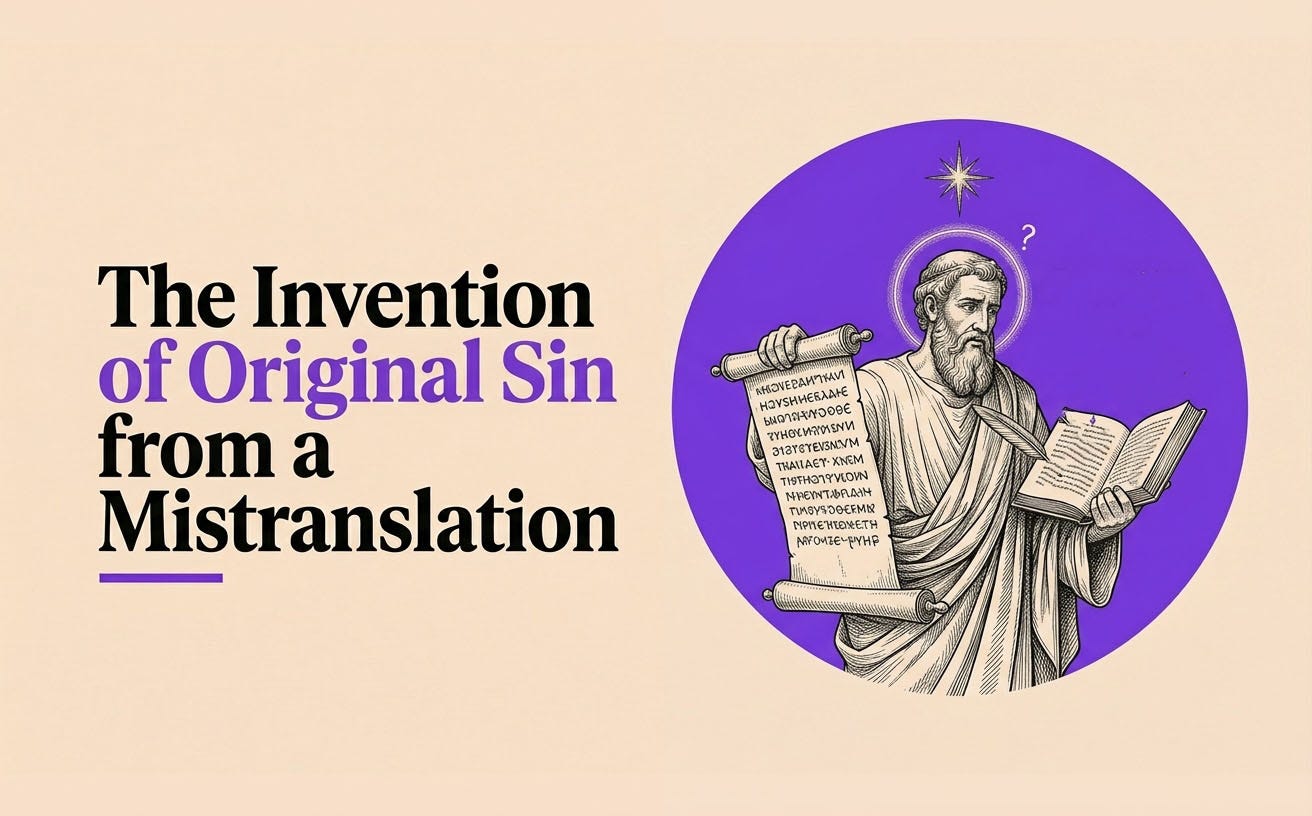
It is easy to dismiss religion’s most damaging ideas as the work of extremists, a small group of fanatics whose beliefs don’t reflect the whole. But some of the most destructive doctrines aren’t hiding on the margins. On the contrary, normalized, they sit quietly at the very center of mainstream faith.
Chief among them is Original Sin.
For centuries this one idea has told people they enter the world corrupt and condemned from their first breath. It planted inherited guilt in millions of minds and taught them their basic nature is broken. When a baby died before a priest could baptize it, the church told the parents their child was lost and often wouldn’t bury it in consecrated ground. Imagine what that did to those parents, “knowing” their children were doomed forever.
What makes all that emotional wreckage so infuriating is that the story never started out this way.
The people who first wrote and heard Genesis 2-3 were asking plain, ancient questions about hard work, pain, and death, and nobody among them read the garden as the place humanity picked up a cosmic guilty verdict. So how did a story about human limits turn into centuries of spiritual dread?
To see how a basic origin tale turned into a burden carried by ordinary believers, you have to start with how its first readers understood it, and then find the point where a bishop in North Africa misread one line of Paul.
Before We Begin
I know the word “invention” in the title might come across as provocative and upset some Christian readers. Nonetheless, I chose it on purpose. Scripture leaves plenty of room for interpretation, and people have read the Eden story in good faith in many different ways; I understand that.
However, when you bring in an idea the text never states and read it back into the text so it says what you need, you’ve gone beyond the borders of interpretation. If you disagree, let me know in the comments. I’m curious to hear your case.
How Early Readers Understood the Garden Story
The people who wrote and first heard Genesis 2-3 took it as an origin story, the kind every ancient culture told. Why do snakes crawl? Why does childbirth hurt? Why does farming break your back? Why do we die? The story answers each question with a curse handed out at the end of chapter 3 and stops there. God throws the couple out of the garden to keep them away from the tree of life (Genesis 3:22), which tells you what the writer thought had been lost. Humans were cut off from living forever and sent out to sweat for their bread until they went back to dust, and nobody’s soul picked up a stain on the way out.
Then the story goes quiet. Adam turns up in a genealogy in 1 Chronicles, and there’s a line or two in Job and Hosea that may or may not mean him, but the prophets, the psalms and the law never once trace human wickedness back to that fruit. When Israel’s writers explain why people do wrong, they point at the people doing it.
They also ruled out inherited guilt in so many words. “Parents shall not be put to death for their children, nor shall children be put to death for their parents” (Deuteronomy 24:16). Ezekiel spends an entire chapter on the subject and lands here: “A child shall not suffer for the iniquity of a parent, nor a parent suffer for the iniquity of a child” (Ezekiel 18:20). Jeremiah throws out the old proverb about fathers eating sour grapes and their children’s teeth going numb (Jeremiah 31:29-30). A doctrine that makes every newborn guilty of a forefather’s crime runs straight into the prophets of the book it claims to come from.
Sin Shows Up One Chapter Late
The first time the Hebrew word for sin appears in the Bible, it’s aimed at Cain in Genesis 4:7, just before he kills his brother. God warns him that sin is crouching at the door and wants him, “but you must master it.”
One generation after the supposed fall, God tells Adam’s son he can beat sin on his own. Cain fails, and he’s punished for his own murder with nothing said about his father’s fruit.
Later Jewish teachers built on that. Genesis says twice that the inclination of the human heart is evil from youth (6:5 and 8:21), and the rabbis turned that inclination into a fixture of human nature: everyone’s born with a pull toward wrong and a pull toward good, and God gave the law as the counterweight. They weren’t even sure the bad pull was all bad. One rabbinic commentary on Genesis says that without it nobody would build a house, marry or have children. A drive you’re born with and expected to steer is a very different thing from a guilty verdict handed down before you’re born, and Judaism kept the first and never took up the second.
Everyone Blamed Somebody Before They Blamed Adam
In the centuries just before Jesus, Jewish writers started asking a bigger question: where did evil come from in the first place? Adam wasn’t their first answer.
The Book of Enoch, a Jewish apocalyptic text from around the third century BCE, blamed angels. Its retelling of Genesis 6 has heavenly beings called the Watchers come down, sleep with human women and teach people metalwork, weapons, sorcery and makeup. One angel gets the whole bill: “the whole earth has been corrupted through the works that were taught by Azazel: to him ascribe all sin” (1 Enoch 10:8). Ben Sira, a Jerusalem scribe writing around 180 BCE, blamed Eve: “From a woman sin had its beginning, and because of her we all die” (Sirach 25:24). The Wisdom of Solomon, written by a Jew in Alexandria, blamed the devil’s envy for bringing death into the world (2:24).
Look at what those writers were worried about. When Adam and Eve come up at all, the subject is death, the moment mortality came in, and even that was one theory among several.
The closest any Jewish text comes to original sin was written after Rome burned the Temple in 70 CE. A writer grieving that catastrophe, in the book we call 4 Ezra, cries out: “O Adam, what have you done? For though it was you who sinned, the fall was not yours alone, but ours also who are your descendants” (7:118). Around the same time another apocalypse, 2 Baruch, answers him almost point for point. Adam is responsible for his own soul, it says, and “each of us has been the Adam of his own soul” (54:19). That second answer is the one Judaism kept.
Paul Needed Everyone in the Same Hole
Paul’s argument in Romans is that Jesus’ death and resurrection rescue Jew and Gentile alike, which means both groups need rescuing from the same thing. He locates that shared problem in Adam: “Sin came into the world through one man, and death came through sin, and so death spread to all because all have sinned” (Romans 5:12). Elsewhere he writes, “as all die in Adam, so all will be made alive in Christ” (1 Corinthians 15:22).
Paul reasons from the cure back to the disease, which makes his Adam largely a counterpart to Christ: one man brought death and one man brings life. The final clause of Romans 5:12 gives each person’s own sin as the reason death reached everyone (“because all have sinned”). Paul ties humanity to Adam through death and through sin as a power at large in the world, and he leaves each person’s guilt with that person.
The Greek-speaking church read him this way for centuries. Irenaeus, the second-century bishop of Lyon, described Adam and Eve as children who stumbled and humanity as a race still growing up. The Eastern Orthodox churches still teach that people inherit Adam’s mortality and a damaged nature, and they’ve never accepted that people inherit his guilt.
Two Words of Bad Latin in North Africa
The Greek phrase at the end of Romans 5:12 is eph’ hō, and it means “because” or “inasmuch as.” The Latin Bible read in Hippo, a port town in what’s now Algeria, rendered it in quo, which can mean “in whom.”
Augustine became bishop of Hippo in the 390s, and he admitted in his Confessions that he’d hated Greek as a schoolboy. He worked from the Latin. “In whom all sinned” meant in Adam: every human who’d ever live was present in Adam when he ate, so every human sinned with him and carries his guilt from conception. Around 396 Augustine gave the idea the name it still has, peccatum originale, original sin.
A century and a half earlier, Cyprian, bishop of Carthage, argued that babies should be baptized promptly because they carry “the contagion of the ancient death,” though he added that what’s forgiven in them are the sins of another and not their own. Augustine took that contagion and turned it into a verdict. Modern Bibles have quietly walked his reading back. The NRSV has “because all have sinned,” and the translation approved by the US Catholic bishops has “inasmuch as all sinned.”
Sex, Dead Babies and the Manichaean Hangover
If guilt passes down from Adam, it needs a delivery route, and Augustine found it in sex. Since the fall, he argued, the body won’t obey the will, and the clearest proof is sexual arousal, which shows up uninvited and won’t show up on command. Every child is conceived through that disordered lust, and the guilt rides along.
It helps to know who was making the argument. Before his conversion Augustine spent about nine years as a follower of Mani, a Persian prophet who taught that the material world, and the body above all, belonged to the forces of darkness. He also spent his twenties with a concubine who bore him a son, and he’s the man who prayed “give me chastity and continence, but not yet.” His opponents noticed. Julian of Eclanum, an Italian bishop who fought him in print for over a decade, accused him of never having left Mani behind.
If guilt starts at conception, a baby who dies before baptism dies guilty, and Augustine accepted that. The best comfort he could offer grieving parents was that their children would get “the mildest punishment of all” (Enchiridion 93). The church spent the next fifteen centuries trying to soften that, inventing limbo along the way, until its International Theological Commission published a document in 2007 saying there are grounds to hope unbaptized infants are saved.
Hunting for Words in a Text Its Copyists Kept Editing
Augustine hung his entire doctrine on a preposition, and that’s the trap of word-hunting in the Bible. It’s risky even in the original languages, Hebrew, Aramaic and Greek, and it’s worse in a Latin translation. People like to pretend God dictated scripture letter by letter. In reality, the scribes paid to copy these books worked as editors. They rephrased awkward lines for clarity as they copied, wrote notes in the margins, and sometimes a later copyist merged an earlier scribe’s note into the text itself. The copyists cared about carrying the sense of a passage across, and they treated the exact wording as theirs to adjust. Augustine handled two words in a translation of a copy as if God had chosen them, and he built a verdict on every human being ever born out of them.
So the trail runs from an origin story about why we die, through a Jewish tradition that put each person in charge of their own wrongdoing and a Jewish apostle who needed a universal problem for his universal answer, to a North African bishop with weak Greek and a troubled relationship with his own body who read a preposition as a person. Every Western Christian baptized as an infant for the remission of original sin is living inside that reading.
Exclusive Content for Paid Subscribers
How the Invention of Original Sin Resulted in the Invention of Mary’s Immaculate Conception
Augustine’s theory contained a gap from the start. If guilt travels with conception, and Jesus was born of Mary, the question is how Jesus came to be born clean. The virgin birth covered …