


If you’d asked a Christian in second-century Syria which gospel Matthew wrote, you might not have gotten the answer you’d expect. The Greek Matthew sitting in your New Testament wasn’t the only candidate. There was another book, written in Aramaic or Hebrew, circulating among Jewish followers of Jesus, and a long line of church fathers thought it might be the original. Papias said so, Jerome said he’d translated it personally, and Origen quoted from it as scripture. For about three centuries, the question of which Matthew counted as the original stayed open.
Then it got closed by political math. Jewish Christianity lost. The gospel its followers used got pushed into the heretic file and erased so thoroughly that today we have it only in fragments, scattered across the writings of the men who decided it didn’t belong.
This is the story of the Gospel of the Hebrews, the book that almost was Matthew, and the church’s slow, deliberate work to make sure it was forgotten.
The Sentence That Started Everything
Around the year 110, a bishop named Papias of Hierapolis wrote something that’s caused arguments ever since. The full work is lost, but Eusebius preserved a quote in his church history:
Matthew compiled the sayings in the Hebrew dialect, and each one interpreted them as best he could.
That’s the whole thing, one line with no context and no follow-up, and Papias couldn’t have meant canonical Greek Matthew. Canonical Matthew was already in Greek when Papias was writing, and it shows obvious signs of being composed in Greek rather than translated from anything. The author of Greek Matthew used the Greek Septuagint when quoting the Old Testament, even in places where the Hebrew would have served his argument better. Whatever Papias was talking about, it wasn’t the book we have.
So what was he talking about? Nobody knows for sure. Some scholars think he was referring to a hypothetical sayings collection, maybe related to what we now call Q. Others think he was citing the existence of a separate Hebrew or Aramaic gospel attributed to Matthew that circulated alongside the Greek one. Still others think Papias was just confused, repeating a tradition that had grown up around the apostle’s name.
Whatever the truth, that single sentence created a problem the early church would spend the next four centuries trying to solve. If Matthew really had written a Hebrew gospel, and if a Hebrew gospel attributed to him was still being read by Jewish Christians, then which one was the original? Papias’s offhand reference gave Jewish-Christian communities a permanent piece of ammo. They could always point to the bishop of Hierapolis, an early authority, and say their gospel was the one he’d been talking about.
Jerome Says He Held It in His Hands
Three hundred years later, Jerome thought he had the answer. Jerome was the most learned biblical scholar of his age, the man who translated most of the Bible into Latin (the Vulgate). He knew Greek, Hebrew, and Aramaic, and he was constantly chasing down obscure manuscripts.
In several of his works, he claims to have personally examined a Hebrew or Aramaic gospel preserved by a Jewish-Christian community called the Nazarenes in the Syrian city of Beroea. He says he was given permission to copy it. He says he translated parts of it into Greek and Latin. And he says, more than once, that he thought it might be the original Matthew that Papias had referenced.
Jerome’s testimony is the closest thing we have to a firsthand account of this lost gospel. Here’s what he tells us. It was written in a Semitic language, probably Aramaic in Hebrew script, and the Nazarenes used it as their primary scripture. Its narrative ran close to Matthew but wasn’t identical. Some passages didn’t appear in canonical Matthew at all, while others had small but meaningful differences. Jerome’s translations of certain lines from it, scattered across his commentaries, give us our best surviving fragments.
What Jerome doesn’t tell us, but what’s obvious from his writing, is that he kept changing his mind about what to call this book. Sometimes he names it the Gospel of the Hebrews, sometimes the Gospel of the Nazarenes, sometimes the Gospel of the Apostles, sometimes just “the Hebrew Matthew.” Modern scholars argue that he may have been conflating two or three separate Jewish-Christian gospels, mistaking them for one and the same. That confusion is itself part of the story, because it shows how poorly the orthodox tradition understood the books it was busy rejecting.
Jerome was the closest the Latin church ever got to a sympathetic reader of these texts. He still ended up treating them as historical curiosities rather than serious canonical candidates. If the most learned biblical scholar of late antiquity couldn’t keep the various Jewish-Christian gospels straight, the chances of any of them surviving the medieval transmission process were already poor.
The Holy Spirit Calls Jesus Her Son
The fragments we have from the Gospel of the Hebrews are short, but they’re strange enough to suggest a book with its own theological flavor. The most arresting line comes from a quote preserved by Origen and later cited by Jerome:
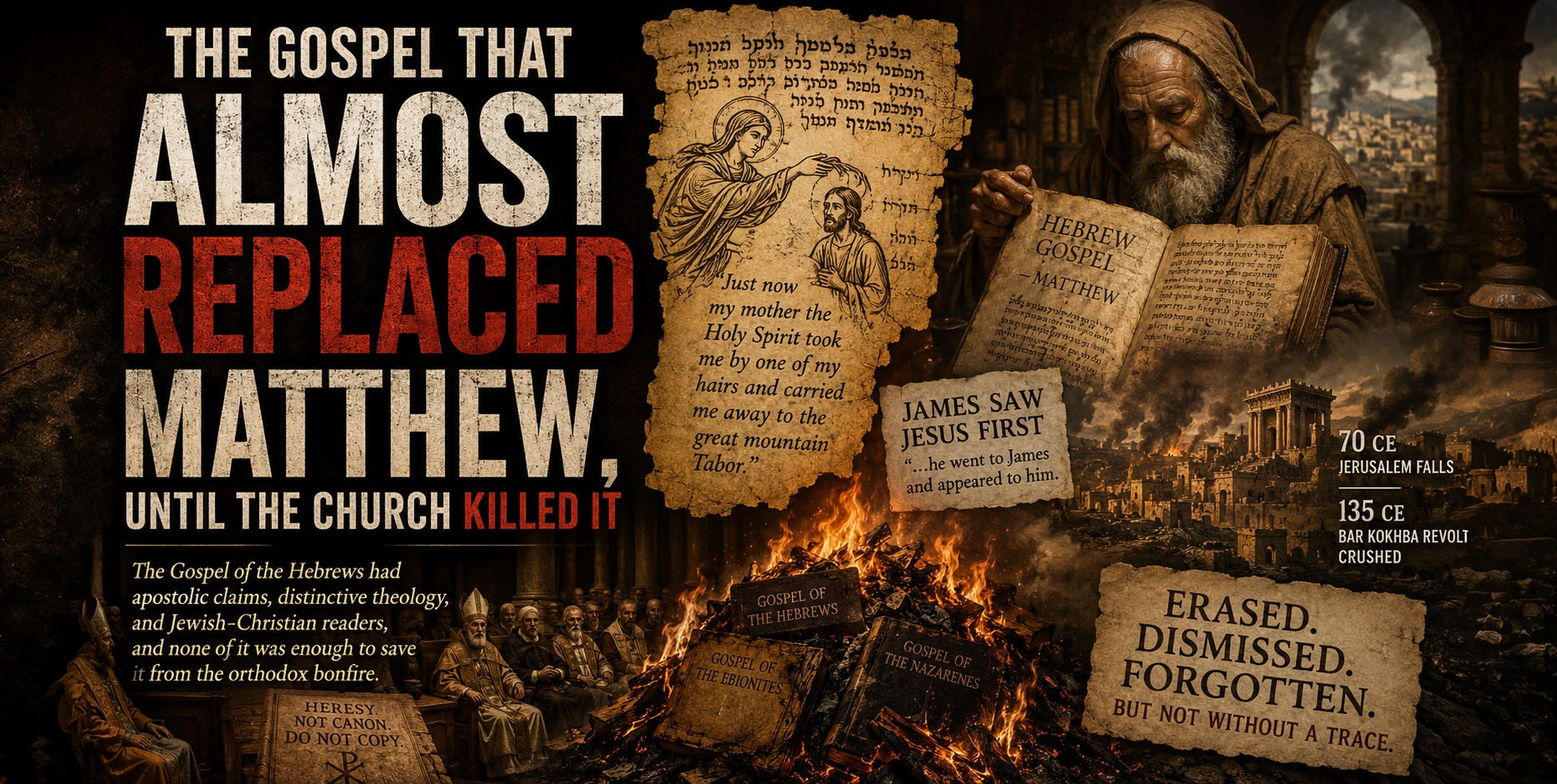
Just now my mother the Holy Spirit took me by one of my hairs and carried me away to the great mountain Tabor.
Jesus is speaking, and he’s calling the Holy Spirit his mother. In Hebrew and Aramaic, the word for spirit (ruach) is grammatically feminine, which is part of what’s going on here, but this gospel takes the grammar and runs with the theology. The Holy Spirit here is a maternal figure who picks Jesus up and carries him somewhere physical, far from any abstract force or undefined third person of a Trinity. Traces of the same idea show up elsewhere in early Christian writings, particularly in the Syrian tradition, but by the time orthodoxy crystallizes in the fourth century, the feminine Holy Spirit has been scrubbed out. The Greek-language church, working with a neuter Greek word (pneuma), had no use for the image.
The stakes were significant. A gospel that depicted the Holy Spirit as Jesus’s mother would have complicated every later doctrine the church built about the Trinity, the virgin birth, and the relationship between divine persons. This is exactly the type of text fourth-century orthodoxy couldn’t allow to keep circulating, once the councils started locking down what Christianity was allowed to say.
James Sees the Risen Jesus First
Another fragment, again preserved by Jerome, describes the risen Jesus appearing first to James, his brother:
“And when the Lord had given the linen cloth to the servant of the priest, he went to James and appeared to him. For James had sworn that he would not eat bread from that hour in which he had drunk the cup of the Lord until he should see him risen from among them that sleep.”
Compare this to the canonical gospels. In Mark, the risen Jesus first appears to a group of women (depending on which manuscript you read, he may not appear to anyone in the original ending). Matthew has him appearing to Mary Magdalene and the other Mary, then to the disciples. Luke gives the first sighting to two disciples on the road to Emmaus. John gives it to Mary Magdalene. Paul’s list in 1 Corinthians 15 puts Peter first.
Nobody, in any canonical text, puts James first. Yet James was the leader of the Jerusalem church for thirty years after the crucifixion. Paul calls him a pillar. Acts shows him presiding over the apostolic council. Josephus mentions his execution by stoning around 62 CE. James was, by any reasonable measure, the most important Christian figure of the first generation in Jerusalem.
The Gospel of the Hebrews, written and used by Jewish Christians, gives James the priority his historical role would suggest. The canonical gospels, written and edited by Gentile or Hellenized Christian communities, give it to Peter or Mary Magdalene. That difference carries weight. It tells you which version of the Jesus movement was telling which story, and why. If your church traces its legitimacy through Peter, you write a gospel where Peter sees the risen Christ first. If your church traces its legitimacy through James and the Jerusalem family of Jesus, you write a different gospel.
Paul himself, writing earlier than any of the canonical gospels, includes James in his list of resurrection witnesses (1 Corinthians 15:7). He puts the appearance later in his sequence, after Peter and the Twelve, but he doesn’t deny it. The tradition was alive and circulating in the first century. By the time the canonical gospels were assembled and standardized, the James appearance had been moved or quietly dropped. The Gospel of the Hebrews kept it, and that’s part of why the book was eventually deemed too inconvenient to preserve.
One Gospel or Three? The Sources Can’t Agree
The church fathers who quoted these Jewish-Christian gospels were heresy-hunters, and they were sloppy about it. We have references to multiple Jewish-Christian gospels, but it’s not always clear whether the fathers are describing different books or the same book under different names. Modern scholars usually distinguish three.
The Gospel of the Hebrews. Quoted by Clement of Alexandria, Origen, Eusebius, and Jerome. Notable for the feminine Holy Spirit and the James resurrection appearance. Possibly composed in Greek, possibly composed in Egypt, possibly used by Hellenized Jewish Christians outside Palestine.
The Gospel of the Ebionites. Quoted only by Epiphanius in his Panarion, a fourth-century heresy catalogue. Used by the Ebionites, a Jewish-Christian sect that rejected Paul, rejected the virgin birth, and considered Jesus a fully human prophet adopted by God at his baptism. The Ebionite gospel reportedly began not with a birth narrative but with the baptism of Jesus, which made sense given their adoptionist theology.
The Gospel of the Nazarenes. Quoted mainly by Jerome. Written in Aramaic and used by the Nazarenes of Syria. The most likely candidate for what Jerome thought might be the original Hebrew Matthew. Closer in structure to canonical Matthew than the other two, with some additional material and some variant readings.
A.F.J. Klijn’s standard work on these gospels argues for treating them as three separate texts, despite the constant slippage in the patristic citations. James Edwards has argued, controversially, that one of them (the Gospel of the Nazarenes) served as the source behind several distinctive passages in canonical Luke. Most scholars don’t go that far, but the broader point holds. These Jewish-Christian gospels carried weight, and major church fathers took them seriously enough that the question of canonical priority remained alive for centuries.
What Killed Jewish Christianity
To understand why these gospels lost, you need to understand what happened to the community that used them.
The original Jesus movement was Jewish. All the apostles were Jewish. The first decades of the church were an internal Jewish debate over whether Jesus was the messiah, with no one yet imagining a new religion. James, the brother of Jesus, ran the Jerusalem church and seems to have expected his followers to keep observing the Torah. Paul disagreed about Gentile observance, and the two camps argued about it for years, but everyone agreed that Jewish believers should remain Jewish.
Then two catastrophes broke Jewish Christianity’s back. The first was 70 CE. The Romans destroyed the Jerusalem Temple and razed most of the city. The Jerusalem church, which had been the spiritual headquarters of the entire movement, was scattered. The tradition says the Jewish Christians fled to Pella across the Jordan before the siege. Whether or not that’s literal, the institutional weight of Jewish Christianity never recovered.
The second was 135 CE. The Bar Kokhba revolt, the second major Jewish uprising against Rome, ended in catastrophic defeat. The Romans expelled Jews from Jerusalem, refounded the city as Aelia Capitolina, and effectively ended Jewish presence in the city for centuries. Bar Kokhba himself had been hailed by Rabbi Akiva as messiah, which meant Jewish Christians who insisted Jesus was the messiah had been on the wrong side of the war. After 135, Jewish Christianity in its historical heartland was a husk.
Meanwhile, Gentile Christianity was exploding across the Mediterranean. Paul’s mission to non-Jews had taken root in dozens of cities. Greek-speaking, Greek-thinking, Greek-writing Christians outnumbered Jewish Christians within a generation of Paul’s death, and by the second century they outnumbered them by orders of magnitude. The Greek gospels (the four we have) were the texts of the winning side. The Hebrew or Aramaic gospels were the texts of a shrinking, marginalized community whose theological positions increasingly looked like leftovers from a previous era.
By the time orthodox Christianity had emperor backing in the fourth century, Jewish Christians had become a problem to be classified, refuted, and forgotten. The label “Christian” had moved on without them.
How Epiphanius Drew the Line
Epiphanius of Salamis wrote a massive heresy catalogue in the late fourth century called the Panarion, which means “medicine chest.” The idea was that he was providing the cures for various theological diseases. The Ebionites got their own chapter. So did the Nazarenes, treated as a separate heresy.
What’s striking about Epiphanius’s treatment is how he handles their gospel. He quotes from it, sometimes at length. He notes that it resembles Matthew. He acknowledges that it was used by communities that traced their origins back to the earliest Jerusalem church. And then he condemns it, because the people using it rejected Paul, denied the virgin birth, and held Jesus to be a human prophet rather than a preexistent divine being.
The condemnation tracked the people who used the text. Orthodox Trinitarians could have used the same gospel without trouble. The Ebionites held the wrong views on Paul, the virgin birth, and Christ’s divinity, so their gospel went with them. Texts get rejected over the company they keep. The text itself is usually beside the point.
This is the pattern. The Gospel of the Hebrews has no virgin birth narrative, which doesn’t fit fourth-century orthodoxy. The Gospel of the Ebionites has Jesus adopted as son of God at his baptism, which contradicts the eternal-son doctrine being hammered out at Nicaea and Constantinople. The Gospel of the Nazarenes preserves a Jewish-Christian piety that the Gentile church no longer recognized as its own.
So they got dropped, quietly and without ceremony. The process worked through citation falling off, copying ceasing, and communities being dissolved or scattered. No formal council vote was required. By the sixth century, you couldn’t find these gospels anywhere except as fragments inside the works of the men who had argued against them, and the communities that had read them as scripture were either extinct, folded back into rabbinic Judaism, or pushed eastward into Persian territory where they slowly disappeared from the record.
Fragments That Survived Inside the Canon
Even though the Gospel of the Hebrews and its cousins got erased, some of their material may have leaked through into the texts that survived.
The pericope of the woman caught in adultery (John 7:53 to 8:11) is famously absent from the earliest manuscripts of John. Eusebius mentions that “the Gospel of the Hebrews” contained a story about Jesus and an accused woman. Some scholars have suggested that the adultery pericope migrated from the Gospel of the Hebrews into John, where it eventually settled. It’s a guess, but a well-grounded one. The passage’s textual history is bizarre enough that some explanation is needed for how it ended up where it did.
The unique resurrection appearance to James, found nowhere in the canonical gospels in this developed form, may have been the source for Paul’s brief mention of it in 1 Corinthians 15:7. Paul wrote earlier than the canonical gospels, and he may have been drawing on the same tradition that the Gospel of the Hebrews preserved. If so, the Jewish-Christian gospel may be older, in its core tradition, than any of the canonical four.
Various extra-canonical sayings attributed to Jesus by the church fathers, the so-called agrapha, are sometimes linked to the Jewish-Christian gospels. One of them: “Be approved money-changers.” Another: “He who has marveled shall reign, and he who has reigned shall rest.” These didn’t make it into the New Testament, but they’re attested early, and they may reflect the kind of material the lost Jewish-Christian gospels contained.
What survived was the echo of the gospel. The book itself is gone. The Jesus tradition was bigger and weirder than the four canonical books we have. The ones that won were the ones written by the right kinds of communities, in the right language, with the right theology for the moment when the empire decided which version was official.
If you’re not already a paid subscriber and you’re finding value here, I’d love for you to consider becoming one to keep The Unholy Truth alive.
How the Empire Picked Its Books
People often treat the New Testament as if Jesus personally left behind twenty-seven books, fixed for all time, with no room for doubt or discussion. The truth is that the canon was a fight, and authenticity was only one of the things at stake. Just as often, the issue was whether the people reading a book were on the winning side of the church’s political battles.
The Gospel of the Hebrews had apostolic provenance claims at least as strong as canonical Matthew. It had use among communities with direct continuity to the Jerusalem church. It was treated as scripture by Clement of Alexandria and Origen, two of the most important Christian thinkers of the second and third centuries. Jerome thought it might be the original Matthew. By any neutral measure, its case for inclusion was at least worth a serious hearing.
It lost anyway, because politics decided the matter. The people who read the Gospel of the Hebrews were the wrong people, and the empire that adopted Christianity in the fourth century needed a clean, Greek, Gentile-friendly canon to work with. Jewish Christianity, along with its texts, was a remainder problem from an earlier era that the bishops chose to round off.
What we have now is the gospel of the winners, and that doesn’t make it untrue, but it does make it incomplete. Somewhere out there, in a Syrian library that no longer exists, there was a book that called the Holy Spirit Jesus’s mother and put James at the head of the resurrection witnesses, and Jerome held a copy of something close to it in his hands sixteen hundred years ago. No one alive has read it. Whatever Matthew actually wrote, if he wrote anything at all, went into the ground with the people who preserved his memory in their own language.
Sources and Further Readings
Bart Ehrman, Lost Christianities: The Battles for Scripture and the Faiths We Never Knew (Oxford, 2003).
Bart Ehrman, Lost Scriptures: Books That Did Not Make It into the New Testament (Oxford, 2003).
A.F.J. Klijn, Jewish-Christian Gospel Tradition (Brill, 1992). The standard scholarly work on the surviving fragments.
Wilhelm Schneemelcher, ed., New Testament Apocrypha, Volume 1: Gospels and Related Writings (Westminster John Knox, 1991).
Petri Luomanen, Recovering Jewish-Christian Sects and Gospels (Brill, 2012).
James R. Edwards, The Hebrew Gospel and the Development of the Synoptic Tradition (Eerdmans, 2009). Argues controversially that a Hebrew-language gospel underlies portions of Luke.
Jerome, Lives of Illustrious Men, chapter 3 (on Matthew), and his commentaries on Matthew and Ephesians, where most of the fragments are preserved.
Eusebius, Ecclesiastical History, Book 3.39 (on Papias) and Book 3.25 (on disputed and rejected books).
Epiphanius, Panarion, sections on the Ebionites and Nazarenes.
Thanks much for this. As a non-Christian, I mourn what has been lost. I like to think that some of my favorite bits of Matthew come from this older tradition, but that has no basis in scholarship.