


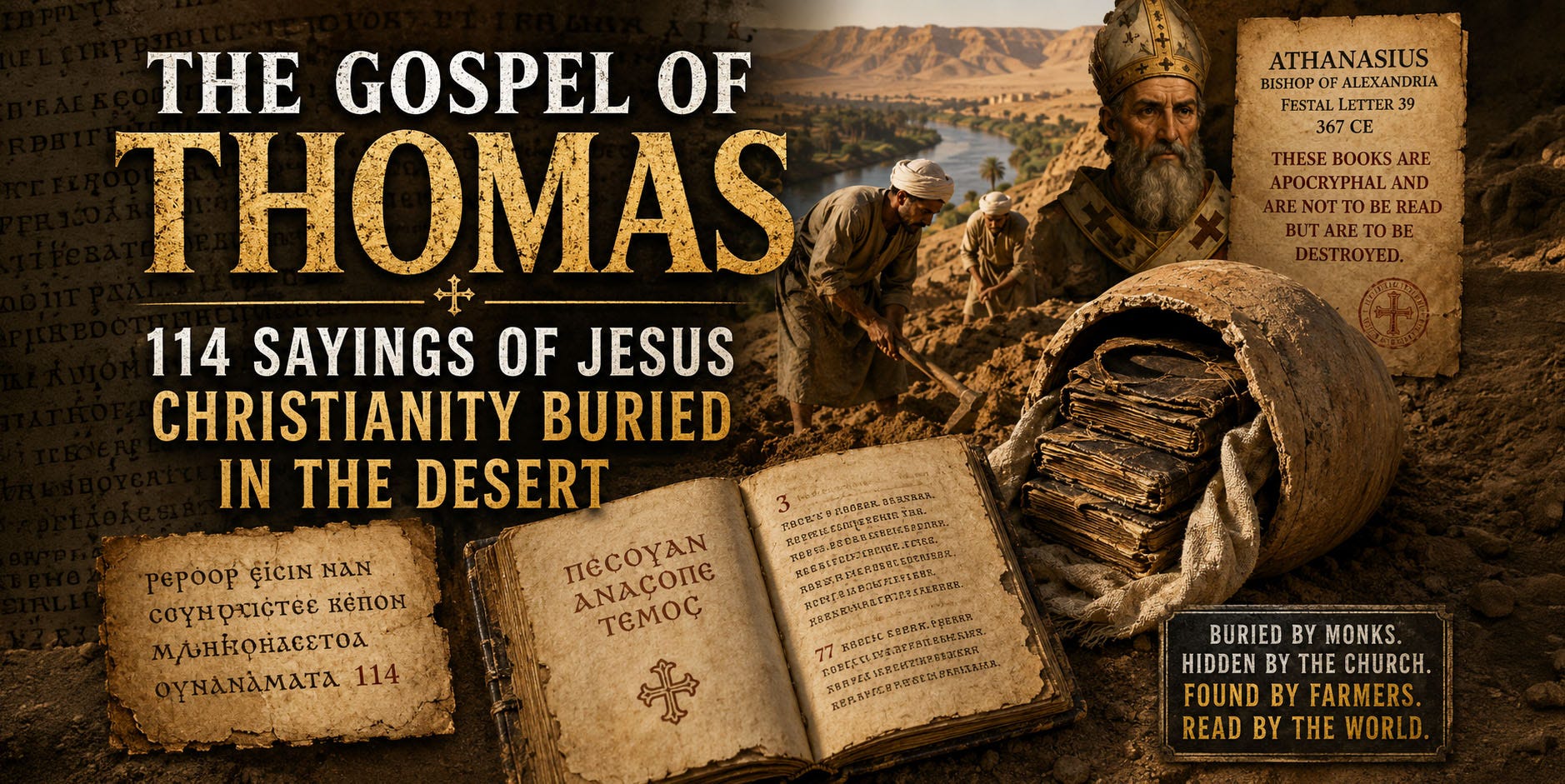
In December 1945, a farmer named Muhammad Ali al-Samman and his brothers were digging for soft soil to fertilize their fields at the foot of a cliff near the Egyptian village of Nag Hammadi. Their mattocks struck a sealed clay jar about a meter tall. Muhammad Ali later said he hesitated before breaking it. He worried a jinn might be sealed inside, since these were lonely cliffs and old jars in lonely places aren’t usually full of money. He smashed it open anyway.
Inside were thirteen leather-bound codices containing fifty-two ancient texts. The brothers had no idea what they were holding. Some of the codex covers ended up burning in their mother’s bread oven over the following days because she needed kindling and the leather worked fine. What survived eventually moved through the Cairo antiquities black market, got confiscated by Egyptian authorities, smuggled out of the country, smuggled back, and finally translated by an international team led by James Robinson at Claremont. Among those fifty-two texts sat a document scholars had long assumed was lost: the complete Gospel of Thomas, in Coptic, copied around 350 CE from a Greek original at least two centuries older.
For sixteen centuries, the Church had managed to keep this text out of human hands. Then two illiterate Egyptian farmers stumbled across it while looking for something to spread on their crops.
The discovery wasn’t quite as clean as that sentence makes it sound. Muhammad Ali was in the middle of a blood feud at the time. A few months later he and his brothers killed a man they believed had murdered their father, hacked out his heart, and ate it. Police started searching the house. Worried the codices would be confiscated or destroyed, Muhammad Ali gave most of them to a local Coptic priest. The priest’s brother-in-law, a history teacher in town, recognized one volume might be valuable and sent it to Cairo to a dealer. From there the chain ran to museums, the Jung Institute in Zurich, and eventually to a coordinated international scholarly effort that produced the first complete English translation in 1977.
By the time the world could read it, the book had already been pulled out of a desert by people with no idea what it said, then routed through black markets and Swiss psychoanalysts and Egyptian courts, and then finally rendered into a language any literate human could pick up and read. Athanasius’s 367 CE order to destroy the text had run aground on a fertilizer dig in the wrong century.
What’s in the Codex
The Gospel of Thomas isn’t a gospel in the sense that Mark or Luke is a gospel. There’s no story. No virgin birth, no temptation in the wilderness, no calling of the disciples, no Sermon on the Mount, no Triumphal Entry, no Last Supper, no trial before Pilate, no crucifixion, no empty tomb, no resurrection appearances, no ascension. None of the narrative spine of canonical Christianity exists in this text. What you get instead is a list. The document opens with a single line:
“These are the secret sayings which the living Jesus spoke and which Didymos Judas Thomas wrote down.”
Then come the sayings, one hundred and fourteen of them in total. Some run a single line, others unfold into short parables, and others stage dialogues where a disciple asks Jesus something and gets an answer. A meaningful number of them are familiar from the canonical gospels in slightly different forms. Many are not in the canonical gospels at all. A few flatly contradict what later Christianity decided Jesus came to do.
That last category is the one that mattered to the bishops.
The Dating Fight Nobody Outside Academia Hears About
The standard line you’ll hear from any Christian apologetics site is that Thomas is a late, derivative, gnostic forgery written long after the four “real” gospels, picking sayings from them and corrupting them with Eastern mysticism. The dating, in this telling, is around 140 CE or later, safely after Matthew, Mark, Luke, and John. Easy to dismiss.
The actual scholarly fight is messier. Helmut Koester at Harvard argued for decades that Thomas preserves a sayings tradition that runs parallel to and possibly earlier than the canonical gospels. April DeConick has done detailed compositional work showing that the core of Thomas, what she calls the “Kernel Gospel,” likely dates to 30-50 CE, with later accretions added over the following decades. Stevan Davies has argued for a date in the 50s or 60s. Even scholars who reject the earliest dates, including Bart Ehrman, will tell you that some sayings in Thomas reflect an oral tradition that runs independently of the canonical gospels rather than copying them.
Why does this matter? Because Q, the hypothetical sayings source scholars reconstruct from material shared by Matthew and Luke but absent from Mark, is also a sayings collection. Q has no passion narrative. No miracles. No resurrection. Q is a list of things Jesus said, structured the way Thomas is structured. If you put Q and Thomas side by side, you’re looking at two reconstructions, one entirely hypothetical and one held in a clay jar for sixteen centuries, of an early Jesus movement that preserved teachings without preserving any story of his death and rising.
If that picture is right, then everything you’ve been told about what Jesus’s first followers believed is filtered through one specific editorial choice: turning a sayings teacher into a dying-and-rising god.
A Jesus Who Doesn’t Need a Church
Read Thomas without the assumptions that come from a lifetime of hearing about Christianity, and the figure you meet doesn’t sound much like the one preached from pulpits.
In saying 3, Jesus is asked about the kingdom of God. The answer is direct:
“If those who lead you say to you, ‘See, the kingdom is in the sky,’ then the birds of the sky will precede you. If they say to you, ‘It is in the sea,’ then the fish will precede you. Rather, the kingdom is inside of you, and it is outside of you.”
In saying 77, the metaphysics get bigger:
“I am the light that is over all things. I am all: from me all came forth, and to me all attained. Split a piece of wood; I am there. Lift up the stone, and you will find me there.”
In saying 70:
“If you bring forth what is within you, what you bring forth will save you. If you do not bring forth what is within you, what you do not bring forth will destroy you.”
Notice what’s absent from these sayings. There’s no sin requiring atonement and no blood sacrifice to make it work. There’s no priest standing as middleman, no church to belong to, no sacrament to perform, no creed to recite, no bishop, no apostolic succession, no liturgy. The Jesus of Thomas points at something already inside you and tells you to wake up to it. Institutional membership doesn’t enter the picture.
For a Church whose entire business model depended on people needing the Church to access God, this was a problem.
Saying 13 and the Three Secret Words
Saying 13 is the moment the gospel turns conspiratorial in a way that must have terrified the proto-orthodox bishops who first ran across it. Jesus asks his disciples to compare him to something. Peter says he’s like a righteous angel. Matthew says he’s like a wise philosopher. Then Thomas speaks:
“Master, my mouth is wholly incapable of saying whom you are like.”
Jesus takes Thomas aside and tells him three secret words. When Thomas returns to the other disciples, they press him on what Jesus said. Thomas refuses to tell them. “If I tell you one of the things which he told me, you will pick up stones and throw them at me, and a fire will come out of the stones and burn you up.”
There it is. Secret teaching. A two-tier system, where the disciple who recognizes that Jesus can’t be reduced to angel or philosopher gets the private instruction. Peter, the rock on which Catholicism claims its building was raised, gets the wrong answer. The Roman Church spent centuries constructing the doctrine of apostolic succession from Peter. Thomas has Peter looking like the slowest student in the room.
Worse for the institutional Church, the whole premise of saying 13 is that Jesus had esoteric teaching he didn’t share with the general disciple group, let alone with the public. The entire structure of an open, evangelical, universal Christianity depends on Jesus having delivered one teaching openly to everyone. Thomas has him whispering different things to different people.
Saying 114 and the Argument Christians Still Use Against the Text
Saying 114 is what conservative apologists love to quote, because it sounds bad in English:
“Simon Peter said to them, ‘Let Mary leave us, for women are not worthy of life.’ Jesus said, ‘I myself shall lead her in order to make her male, so that she too may become a living spirit resembling you males. For every woman who will make herself male will enter the kingdom of heaven.’”
Out of context, this looks like ancient misogyny. Apologists who want to dismiss Thomas point at this saying and call it gnostic woman-hating. The actual reading runs close to the opposite. In the ancient Mediterranean world, “male” stood for completion, wholeness, the active principle. “Female” stood for division, materiality, the receptive principle. When Jesus says he’ll make Mary male, the saying gives Mary, a woman, the same access to spiritual completion as any male disciple. In a world where the Pauline corpus was busy telling women to be silent in church and cover their heads, Thomas has Jesus elevating Mary Magdalene to equal apostolic status.
That reading is a much bigger problem for the Church than the surface reading would be. Thomas, along with the Gospel of Mary and the Gospel of Philip, places Mary Magdalene at the center of Jesus’s inner circle. The Roman Church spent fifteen hundred years recasting her as a reformed prostitute (a claim Pope Gregory I manufactured in 591 CE in his thirty-third homily, with zero textual support) to head off that exact problem.
What Happened in 367 CE
For the first three centuries after Jesus, there was no New Testament. There was a sprawl of texts circulating among various Christian communities. Some communities read Mark and Matthew, others read the Gospel of Peter, the Gospel of the Hebrews, the Gospel of the Egyptians, or Thomas. There was no single canon and no central authority enforcing one.
That changed, slowly, as bishops in major cities like Rome, Alexandria, and Antioch consolidated power and started excluding texts they didn’t like. The decisive moment came in 367 CE, when Athanasius, the bishop of Alexandria, sent out his annual Festal Letter (his thirty-ninth) to the churches under his authority. In that letter he listed the twenty-seven books he declared the authoritative New Testament. The list was the four canonical gospels, Acts, the Pauline letters, the catholic epistles, and Revelation. Everything else was rejected. Athanasius didn’t just say “I prefer these.” He said the other books were apocryphal, heretical, dangerous to read, and ought to be destroyed.
Athanasius was operating with the full institutional weight of his office. He was the bishop of Alexandria, which sat at the head of the entire Egyptian church. The monastic settlements stretching south along the Nile, including the Pachomian monasteries near Nag Hammadi, all answered to him.
The Monks Who Couldn’t Quite Throw the Books Away
The Pachomian monastery at Pbow was within walking distance of the cliffs where Muhammad Ali found the jar in 1945. The codices in the Nag Hammadi library were copied around 350 CE, in Coptic, the language of Egyptian monks. The leather bindings contain scraps of Greek correspondence about monastic business that have been dated to the mid-fourth century. The most plausible reconstruction of how the books got there, accepted by scholars like James Robinson and Elaine Pagels, is that they belonged to monks in the Pachomian community and were buried by them.
What happened in 367? Athanasius’s Festal Letter went out across Egypt. Bishops below him enforced it. Monks in Pachomian monasteries would have received clear instructions: the texts on the prohibited list were to be destroyed.
Somebody at one of those monasteries, possibly a small group of dissident monks, couldn’t bring themselves to burn what they had. They wrapped thirteen leather codices in cloth, sealed them in a clay jar, and buried the jar at the foot of the Jabal al-Tarif cliffs above the Nile. They were hoping someone would come back for them later. Nobody did. Sixteen hundred years passed. Then Muhammad Ali al-Samman went looking for fertilizer.
The monks who buried those books were betting against the Church, and the bet ran sixteen centuries before it paid out. In 1945, two brothers digging for soft soil cashed it in for them.
If you’re not already a paid subscriber and you’re finding value here, I’d love for you to consider becoming one to keep The Unholy Truth alive.
What Thomas Does to the Standard Story of Jesus
The official Church history of the canon goes like this. The four gospels were the four gospels because they were written by apostles or apostolic associates. They circulated immediately. They were universally accepted from the start. The texts excluded from the canon were excluded because they were late, heretical, or both. The canon reflects what Jesus’s earliest followers actually believed about him.
Thomas, sitting in its clay jar for sixteen centuries, breaks every piece of that story.
It breaks the dating story, because the sayings tradition Thomas preserves probably runs alongside the synoptic tradition rather than after it, and parts of it may predate the canonical gospels outright. It breaks the universal-acceptance story, because Thomas was being copied, treasured, and read by an organized Christian community in Egypt centuries after the canon was supposedly settled, which means no consensus existed. It breaks the heresy story, because the figure who emerges from Thomas’s sayings is a wisdom teacher whose teachings overlap heavily with the canonical Jesus and diverge only on questions the institutional Church had heavy political reasons to settle one way. It breaks the inevitability story, because if Thomas had been included in the canon (or if Mark had been excluded, which was a live possibility for decades during the second century), Christianity would today look almost unrecognizable to anyone reading this.
The Jesus you’d worship would teach that the kingdom is already inside you. He wouldn’t have died for your sins because he wouldn’t have needed to. There’d be no Easter, no Eucharist, no Pope, no Vatican, no need for any of it. That’s the version of Christianity the monks at Pbow saw when they opened their codex of Thomas, and that’s the version Athanasius needed gone. The clay jar was their compromise. They couldn’t bring themselves to follow the order to burn the books, and they couldn’t keep them either.
Sources and Further Reading
Bart D. Ehrman, Lost Christianities: The Battles for Scripture and the Faiths We Never Knew (Oxford University Press, 2003)
Bart D. Ehrman, Lost Scriptures: Books that Did Not Make It into the New Testament (Oxford University Press, 2003)
Elaine Pagels, The Gnostic Gospels (Random House, 1979)
Elaine Pagels, Beyond Belief: The Secret Gospel of Thomas (Random House, 2003)
Helmut Koester, Ancient Christian Gospels: Their History and Development (Trinity Press International, 1990)
April D. DeConick, The Original Gospel of Thomas in Translation (T&T Clark, 2006)
April D. DeConick, Recovering the Original Gospel of Thomas: A History of the Gospel and Its Growth (T&T Clark, 2005)
James M. Robinson, ed., The Nag Hammadi Library in English (HarperCollins, revised edition 1990)
Stevan L. Davies, The Gospel of Thomas and Christian Wisdom (Bardic Press, 2005)
Marvin Meyer, The Gnostic Discoveries: The Impact of the Nag Hammadi Library (HarperSanFrancisco, 2005)
Possibly your best yet, thank you.
Oddly enough, I've seen a few online comments from USA (Im in UK) recently, presumably evangelicals, and, for some reason, Thomas seems to really scare them, & they appear desperate to dismiss it.
Personally, I think Thomas makes a lot of sense, as does gospel of Mary.
Here I am, reading another article written by Tanner and learning about things I've never heard of/read before. This one is a real gem Tanner.
My brain was doing summersaults when I read the bit about Jesus saying that he will turn Mary into a man. It was already reeling from the introductory line saying that women do not deserve life. I don't know why really ~ because the Bible is full of all of that kind of ancient babble.
And then, after finishing that whole paragraph, a comedy skit played out in my mind in which all of the devout Christian females try to turn themselves into men in order to deserve life. 😆😹🤣🤣