


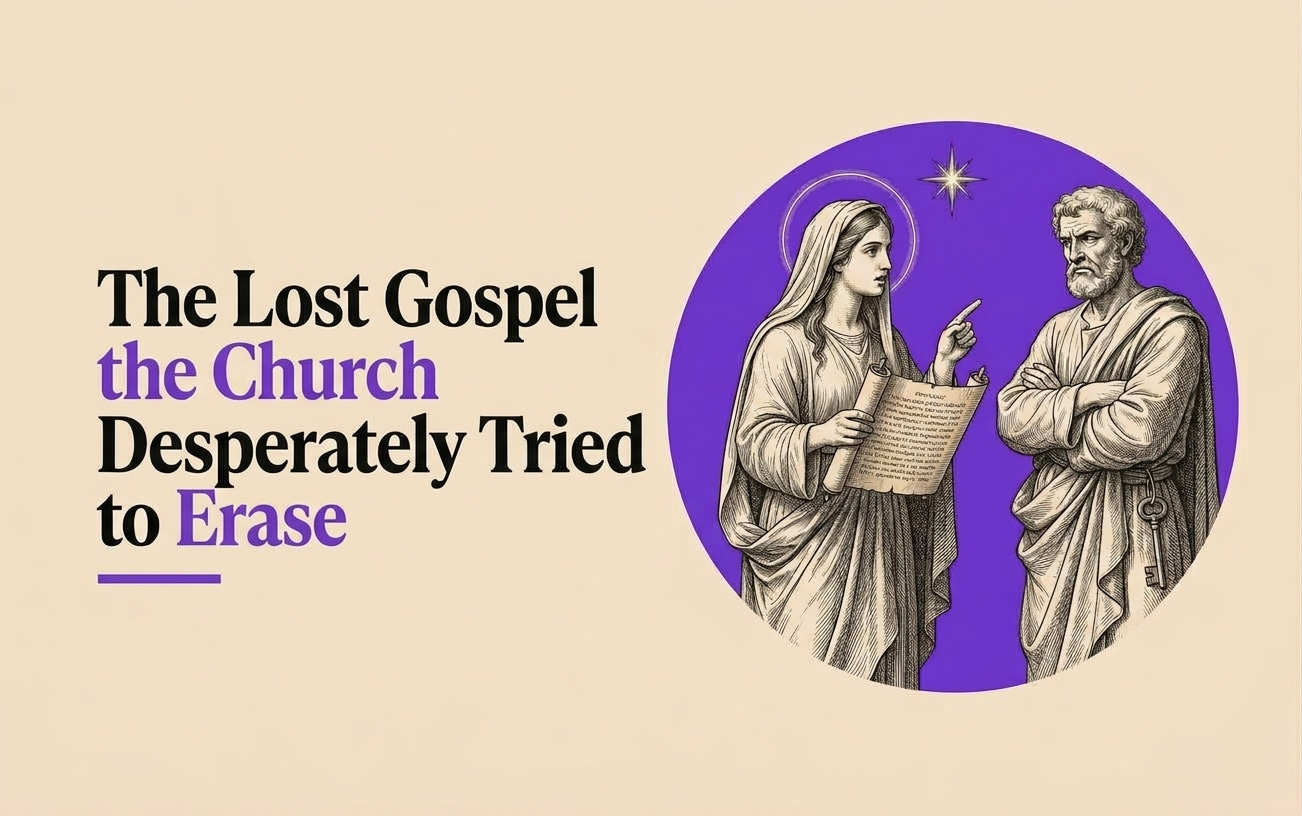
Before a single canon was closed, a war was fought over who got to speak for the risen Christ. On one side stood the men who would build an empire’s church, writing letters to quiet women and seal the hierarchy. On the other was a silent, shifting tradition that remembered something else entirely: a woman who stood up when the apostles cowered, who held to her vision when Peter doubted, and who was trusted with mysteries the rest were never meant to hear.
That story didn’t survive in the Bibles handed down through centuries of Western cathedrals, but it lived on in a fifth-century Coptic manuscript that came through water damage, world wars, and fifteen hundred years of Egyptian dust. It’s missing half its pages, but it carries enough truth to unravel fourteen hundred years of quieted history.
A Gospel Missing Half Its Pages
In the spring of 1896, amid the bustling noise and dust of Cairo’s antiquities market, a German scholar named Carl Schmidt stumbled upon a leather-bound relic that had spent fourteen centuries sleeping in the Egyptian soil. Written in the ancient script of Christian Egypt (aka Coptic) it was a fifth-century papyrus codex unlike anything the scholars of Europe had ever seen. Luckily, Schmidt recognized its value immediately, secured the book, and set out to give its long-buried secrets back to the world.
What he hadn’t know at the time was that history itself was about to throw a sixty-year obstacle course in his path.
By 1912, after years of painstaking translation, Schmidt’s first edition was finally resting at a printing house, ready to be pressed into history. Then, a water pipe burst overhead, drowning the typeset pages in torrents of water before a single copy could ship.
Before Schmidt could rebuild his work, Europe erupted into the catastrophe of the First World War. The chaos froze scholarly publishing across the continent, and by the time the smoke cleared, Schmidt passed away, his life’s work unfinished, left sitting in a drawer. Decades dragged on, and just as interest was rekindled, the Second World War broke out, locking down libraries and cutting off international research once again.
Then came 1945. Far south along the Nile, near the town of Nag Hammadi, an Egyptian farmer dug into the dirt and unearthed a jar filled with an entire library of forgotten gospels. Suddenly, the isolated manuscript Schmidt had bought fifty years prior was no longer an anomaly but part of a vast, hidden constellation of early Christian thought. Scholars rushed back to their desks, setting the Cairo text alongside these new discoveries to compare, contextualize, and cross-reference.
Finally, in 1955, nearly six decades after it was bought in a Cairo stall, the text was published.
Around the same time, two fragile third-century Greek fragments emerged from separate digs in Egypt. They provided crucial evidence: centuries before the Coptic translation was buried, this book had been copied, shared, and treasured across the Mediterranean in its original Greek, likely composed sometime in the second century.
Yet, when scholars finally read what had survived, they realized the tragedy of its long voyage. Time, moisture, and neglect had taken a bitter toll. The first six pages were gone entirely. Four more had been ripped from the middle. Roughly half of the entire gospel had dissolved into history.
At the heart of what survives, a woman is speaking. The manuscript never explicitly gives her full name; it calls her Mary. But as she steps forward to steady the terrified disciples, speaking with authority and revealing mysteries no one else had heard, scholars realized there was only one woman in the early Christian world who fit the frame. This was Mary of Magdala, the premier witness at the tomb, holding open a book that history had tried, for sixty long years, to keep closed.
Jesus Leaves and the Apostles Fall Apart
When the surviving text picks up, the risen Jesus is finishing a conversation with his followers. He tells them that sin comes from people tangling themselves up in the material world, and that nobody should go around laying down rules beyond the ones he gave them. Then he sends them out to preach and leaves.
They don’t go. They sit there grieving, asking how they’re supposed to preach to the nations when the people who killed Jesus could do the same to them.
Mary is the one who stands up. She greets them, tells them not to weep or doubt, and reminds them that Jesus’ grace will protect them and that he’s made them into true human beings. The text says she turned their hearts toward the good, and they started talking about what Jesus had said.
Then Peter asks her for help. He calls her sister, says they all know Jesus loved her more than any other woman, and asks her to tell them whatever Jesus told her that the rest of them never heard. Before anything goes wrong, Peter himself admits that Mary had private teaching from Jesus.
So she tells them. She’d seen the Lord in a vision, and he praised her for not flinching at the sight of him. The next four pages are missing, and when the text resumes, she’s describing a soul climbing upward past four powers that try to hold it down: Darkness, Desire, Ignorance and Wrath. The soul talks its way past each one and goes free.
Andrew and Peter Turn on Her
When she finishes, she goes quiet, and Andrew speaks first. He tells the others to say what they like about her story, but he doesn’t believe Jesus said any of it, because these teachings sound strange.
Peter goes further, and he aims at her instead of the teaching. Would Jesus really speak to a woman privately and keep it from them? Are the men supposed to turn around and listen to her now? Did Jesus prefer her to them?
This is the same man who, a page earlier, asked her to share the teachings only she knew. He believed she had private teaching until he heard it and realized what it meant: Jesus had trusted a woman with something he never gave Peter.
Mary weeps and asks Peter if he thinks she made this up, or that she’d lie about the Lord.
Levi’s Answer to Peter
The one who stands up for her is Levi, the tax collector the Gospels also call Matthew. He tells Peter he’s always been hotheaded, and now he’s going after the woman the way their enemies would. If Jesus made her worthy, who’s Peter to reject her? Jesus knew her well, Levi says, and that’s exactly why he loved her more than the rest of them.
Then Levi tells everyone to be ashamed of themselves, to get on with preaching, and to stop inventing rules and laws beyond what Jesus taught. In the Coptic version, they all go out to preach. In one of the Greek scraps, only Levi goes.
The book ends without telling us whether Peter ever came around.
The Same Peter Shows Up in Other Lost Gospels
If this were the only text with Peter turning on Mary, you could put it down to one writer’s grudge. It’s a pattern, though. In the last saying of the Gospel of Thomas, Peter tells Jesus that Mary should leave them, because women aren’t worthy of life. Jesus answers that he’ll make her male, which tells you how far that writer could stretch his imagination. In the Pistis Sophia, a long third-century book of dialogues with the risen Jesus, Peter complains that Mary talks too much and keeps the men from getting a word in. Mary tells Jesus she’s afraid of Peter because he hates women.
Three separate books, written by different hands, all cast Peter as the man who wants Mary to sit down and be quiet. Whoever these writers were, they knew which apostle the anti-woman side claimed, and they knew which side Mary stood for.
The Fight Behind the Story
Christians in the second century were fighting about exactly this question. In Paul’s own letters, the ones scholars agree he wrote, women do the work of leadership. He trusts his letter to the Romans to Phoebe, a deacon of her church. He greets Prisca, who taught alongside her husband, and Junia, whom he calls outstanding among the apostles. Later copyists and translators found Junia so awkward that for centuries many Bibles printed her as a man named Junias, a name that appears nowhere else in ancient records.
Then come the letters to Timothy, written in Paul’s name decades after his death, which forbid women to teach or hold authority over men and tell them they’ll be saved through childbearing. In the early 200s, Tertullian, the North African church writer, complained that women in his day were teaching and baptizing, and that they pointed to a story about a woman apostle to justify it.
The Gospel of Mary comes from that fight. The side that wrote 1 Timothy built the church structure that lasted, and the side that wrote the Gospel of Mary lost. Their book stopped being copied, and it sat buried in Egypt until a dealer sold it in Cairo.
From First Witness to Fallen Woman
The Gospel of Mary doesn’t call her a sinner, and neither does it make her Jesus’ wife. The kissing scene people remember from The Da Vinci Code comes from the Gospel of Philip, a different book.
The prostitute everybody learned about came from somewhere else entirely.
If you’ve been reading free, this is the one to upgrade for. Supporters keep The Unholy Truth running, and you can still comment on every post either way.
Exclusive Content for Paid Subscribers
How a Pope Turned the First Witness Into a Prostitute
On a Sunday in September 591, Pope Gregory the Great preached a sermon in Rome on a passage from Luke 7. In that story…