


Five ideas sit at the center of popular Christianity: hell, the Trinity, original sin, the rapture, and the rule that the Bible alone settles every question of faith. Most people assume all five come straight from Scripture, an assumption Muslims also tend to make about their Holy Book when it comes to religious fundamentals. Some of these ideas have been blown so far out of proportion and made so central that suggesting they’re not biblical sounds like a conspiracy theory. After all, common wisdom says that so many people wouldn’t believe in something that’s missing from the Bible or rests on mistranslations, and yet the evidence for both is there to check.
Today, we’re limiting it to the ideas that seminaries also teach to pastors, which means mainstream scholars of Christianity would find little to dispute in the facts, though we’d perhaps split on their interpretation or meaning.
Disagreement with any part of it is welcome, and comments are open to everyone. I’m as interested in what people’s beliefs rest on as in the beliefs themselves, even where I don’t share them.
Subscribe for free to get the next origin story in your inbox, and upgrade whenever you want the bonus sections.
Either way, thank you for being here.
The Morning Star Everyone Misread
“Hell” comes from the Old English hel or helle, which goes back to a Proto-Germanic word, *haljō, meaning a hidden or covered place. So when scribes translated Hebrew, Aramaic, and Greek texts into Western languages, they repurposed preexisting words. Things wouldn’t have gotten that confusing if each original had kept its own name. Instead, they reached for the same word, hell, to cover Sheol, Hades, and Gehenna, which shaped what we understand when someone says “hell.” The Hebrew Bible has no hell in that sense at all. Everyone who died went to Sheol, a dim underworld that took the good and the bad alike, and Jacob, who believes his son Joseph is dead, says he’ll go down there mourning him (Genesis 37:35).
Satan appears in the Hebrew Bible as a prosecutor in God’s court who holds civil conversations with God, and in the New Testament’s last book he’s thrown into the lake of fire to be tormented alongside everyone else sent there (Revelation 20:10). The interesting part about why Revelation is in the Bible is that the churches in the West accepted it because second-century writers said John the apostle wrote it, while the churches in the East doubted that claim for centuries.
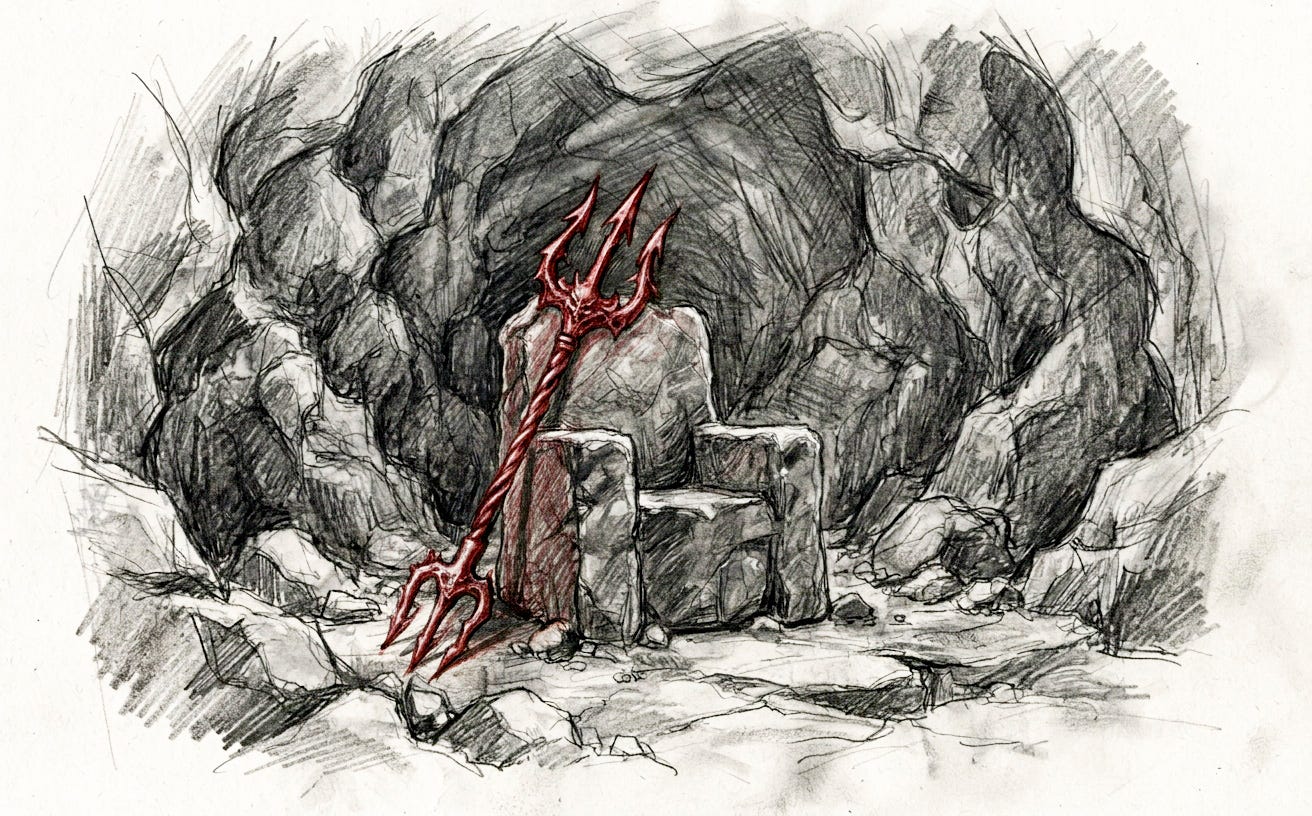
Still, nowhere in the Bible does someone hand him a throne. The pitchfork version came centuries later, and one of its main sources is a misread insult. Isaiah 14:12 mocks a dead king of Babylon (verse 4 says so outright) by calling him the shining one who fell from the sky. Jerome, who translated the Bible into Latin around the year 400, rendered “shining one” as “lucifer,” church writers took it as the devil’s name from before his fall, and medieval painters and Dante, whose Inferno turned hell into a building with floors, did the rest.
As for heaven, Paul’s hope in 1 Corinthians 15 is bodies raised from the dead, Jesus promises that the meek will inherit the earth (Matthew 5:5), and the Bible’s last chapters end with the holy city descending from heaven to earth (Revelation 21:2) while nobody floats up to meet it. In the Gospels, the resurrection of Jesus is something physical, which matters because it reflects the belief that resurrection would be physical for everyone in the afterlife. The Bible never presents the soul as an indestructible essence that the afterlife revolves around.
That said, Paul breaks from Jewish thinking about the afterlife when he describes the resurrected body as spiritual, yet anyone who follows that path ends up turning the miracle of the resurrection into Jesus’ ghost visiting people, and even if they believe it, people would rarely consider hauntings as resurrections.
The Verse a Scholar Was Pressured Into Printing
The word “Trinity” entered Christian vocabulary around the year 200, and the full teaching of one God in three equal persons took until the councils of Nicaea in 325 and Constantinople in 381 to settle, both called by Roman emperors who wanted a unified church more than an open debate.
In the Gospels, Jesus says the Father is greater than he is (John 14:28), admits he doesn’t know the day the world will end while the Father does (Mark 13:32), and speaks of someone he calls his God (John 20:17). Paul puts “one God, the Father” and “one Lord, Jesus Christ” in the same sentence (1 Corinthians 8:6) and treats them as two names with two jobs.
For centuries one verse covered the gap. In the King James Bible, 1 John 5:7 says of the Father, the Word, and the Holy Ghost that “these three are one,” the only sentence in all of Scripture that states the idea outright.
The verse first appears in Latin, a translation that was supposed to come from Greek manuscripts, yet no Greek manuscript from the first thousand years of Christianity contains it, and it started as a note in the margin of Latin copies before sliding into the text itself. Erasmus, the Dutch scholar who produced the first printed Greek New Testament in 1516, left it out and took a beating from church authorities for doing so. A Greek copy containing the verse turned up in time for his 1522 edition, and it appears to have been written for the occasion. That pressure on one translator is how the verse reached the English Bible, since the King James translators worked from Greek texts built on his editions.
Modern translations dropped the verse or footnoted it, and the doctrine stayed exactly where it was.
The most telling detail about the Trinity is that no known church ever read the Bible on its own and concluded that the Father, Jesus, and the Spirit are equally God, or that Jesus didn’t mean it when he put the Father above himself. If a church in the Middle East wasn’t influenced by the church in Europe, it didn’t have the Trinity, which is likely also why the Quran never embraces it, because the Christianity it was built on missed those elements along with anything that comes from Paul and not from Jesus.
Adam’s Guilt and Augustine’s Latin
The Eden story has a talking snake, a piece of fruit, a curse of painful childbirth and hard farming, and an eviction, yet the word “sin” doesn’t appear until Cain in Genesis 4:7 and nothing says Adam’s guilt passes to his descendants. Ezekiel 18:20 says flatly that a son doesn’t carry his father’s guilt, and Jewish readers of the Eden story never came near the idea.
Original sin belongs to Augustine, the bishop of Hippo in North Africa, who built it in the early 400s while arguing against a monk who taught that people can choose good on their own. His best text was Romans 5:12, where Paul says death spread to everyone because all sinned. Augustine read it in a Latin translation that rendered the phrase as “in whom all sinned,” which puts every human being inside Adam’s body when he reached for the fruit. He read Greek poorly, and the Greek says nothing about being inside anyone. The Eastern Orthodox churches, who have always read Paul in Greek, never adopted the inherited guilt that Western Christianity treats as the starting point of salvation, while the practice of baptizing babies to wash that guilt away grew up around Augustine’s version.
If Augustine was right, and every person is born carrying original sin and can’t reach heaven without being cleansed of it, then Paul never wrote a word explaining it, and the first generation of believers went to hell without ever being warned. Baptism started as an optional ritual for adult converts, and it later became a mandate even for children born into believing families.
The Latin Bible was a translation, and sometimes a translation of a translation, so word hunting may not be a great idea.
So are sins inherited in the Bible? Yes and no. For example, the Ten Commandments have God punishing children for their fathers’ sins down to the third and fourth generation (Exodus 20:5), Joshua has Achan’s sons and daughters executed along with him for his theft (Joshua 7), and the survivors of Jerusalem in Lamentations complain that their fathers sinned and they’re the ones carrying the weight (Lamentations 5:7).
The same Bible argues the opposite with equal confidence. Deuteronomy 24:16 forbids executing fathers for their children’s crimes or children for their fathers’, and Ezekiel 18 quotes a popular proverb about parents eating sour grapes while the children’s teeth go numb, then tells the people to stop saying it, because the person who sins is the one who dies (Ezekiel 18:2-4, 20). Jeremiah 31:29-30 makes the same point.
The thing is, the Bible was never meant to be a single, coherent book, and each of its writings reflects a snapshot of the evolving theology of Judaism and, later, Christianity.
Original sin is a doctrine I have strong feelings about, because it wasn’t an innocent doctrine. The church decided whether a baby got it. The pain of countless parents is hard to imagine, parents who were told their baby, born out of wedlock, would go to hell through no fault of the child, and who were powerless to change it. The grief ran deeper for parents whose children died before anyone could baptize them, because on top of burying a baby they carried the fear that the child was damned.
What original sin means has evolved over time, and the Bible had no part in it, since the text stayed the same while society changed. A doctrine produced around the year 400 became unacceptable to the societies that inherited it, and by the time the church softened its position, the harm was already done, because people had stopped caring about it the way they once did, anyway.
The Seven-Year Countdown That Starts in 1830
Millions of Americans expect to be pulled into the sky before a seven-year stretch of catastrophe. One passage supplies the raw material: in 1 Thessalonians 4:17, Paul says believers will be “caught up” to meet Christ in the air, and the Latin version of that phrase gave us the word rapture. The passage says nothing about seven years, and nothing about disaster waiting on the ground afterward.
The package was assembled in the 1830s by John Nelson Darby, an Irish preacher in the Plymouth Brethren, a small breakaway sect. It spread through the Scofield Reference Bible of 1909, which printed Darby’s scheme as notes beside the biblical text, where millions of readers took the notes for Scripture, and a novel series called Left Behind carried it to tens of millions more. The Catholic and Orthodox churches, and nearly every Protestant church for eighteen hundred years, had never heard of it.
Validity of Christianity
Whether a given doctrine holds up and whether Christianity as a whole holds up are two separate questions. Each doctrine has to prove itself on its own evidence, and no single one of them is the beam the whole house rests on, the Trinity included. Most believers hold the Trinity in a way that conflicts with the teaching of their own churches, and they aren’t aware of it, a group that includes about a third of American evangelicals.
Does believing Jesus is divine but not God’s equal make someone a bad Catholic? There’s no evidence to suggest the disciples taught it as Jesus’ teachings or that Paul believed in it. Were they less Christian? In fact, logic dictates the Trinity would have spread from day 1 as part of Christianity, and there wouldn’t have to be creeds to vote on if Jesus or Paul taught it.
Christianity is far too complex to be offered as a package of doctrines that must be accepted all or nothing. The rapture shows what that demand produces: it has to be true because it ships with the package, even though its source can be traced to a preacher in the 1830s, and the idea didn’t exist before then. Each teaching can be examined, kept, revised, or dropped on its own merits, without the others standing trial alongside it.
The Unholy Truth is a full-time commitment, made possible directly by readers like you. If you find value in these deep dives, consider upgrading your subscription to keep the work going and unlock all exclusive content on the site.
What Believing Scholars Do With All of This
So, how do believing scholars reconcile all this?
Paid subscribers get the exclusive content, including which doctrine got dropped and what that concession says about the four that stayed.
Exclusive Content for Paid Subscribers
Five Escape Routes and the One Doctrine Left Behind
Contrary to popular belief, believing scholars often don’t dispute the facts. They agree that the verse was added, that the Latin was mistranslated, and that the rapture timeline began in the 1830s. Then they usually turn to one of five common responses, each revealing where the pressure points are.
The oak in the acorn.
A famous nineteenth-century English cardinal argued…
Sources and Further Reading
Bart D. Ehrman, Misquoting Jesus (HarperSanFrancisco, 2005), on the added verse in 1 John 5:7
Bruce M. Metzger, A Textual Commentary on the Greek New Testament, 2nd ed. (United Bible Societies, 1994)
Bruce M. Metzger, The Canon of the New Testament: Its Origin, Development, and Significance (Oxford University Press, 1987)
Bart D. Ehrman, How Jesus Became God (HarperOne, 2014)
Elaine Pagels, Adam, Eve, and the Serpent (Random House, 1988)
Timothy P. Weber, On the Road to Armageddon (Baker Academic, 2004)
Bart D. Ehrman, Heaven and Hell: A History of the Afterlife (Simon & Schuster, 2020)
N. T. Wright, Surprised by Hope (HarperOne, 2008)
John R. W. Stott and David L. Edwards, Evangelical Essentials (InterVarsity Press, 1988)
The “rapture” is the biggest bunch of BS! The stupid Left Behind books have pilots disappearing from planes in the sky, leaving passengers to die in crashes, along with people on the ground! What total nonsense!
You didn’t address “speaking in tongues”. Lots of hilarious videos online with scumbag greedy televangelists babbling nonsense while claiming it’s the Holy Spirit taking over!