


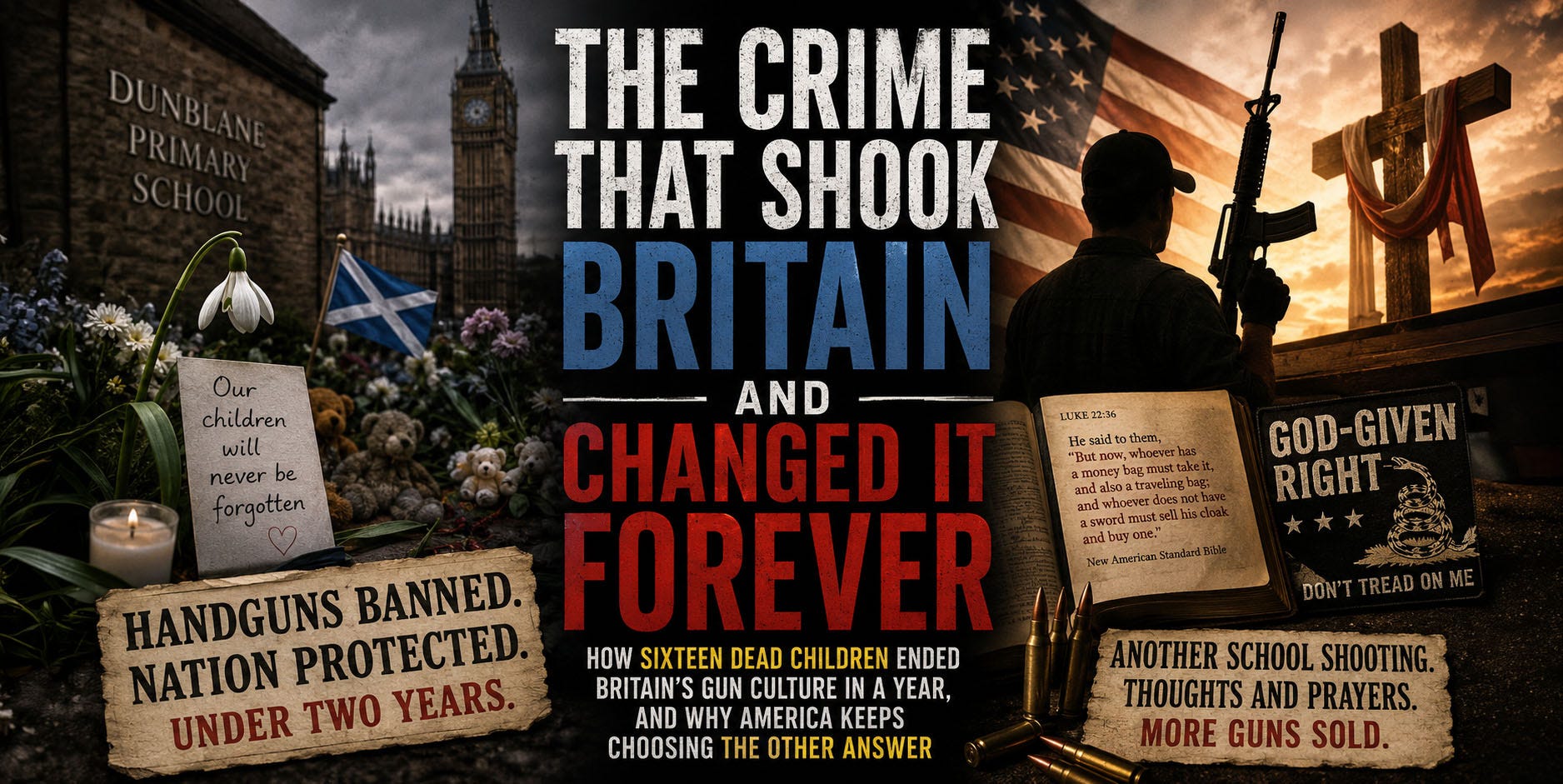
On the morning of March 13, 1996, a 43-year-old man named Thomas Hamilton walked into Dunblane Primary School near Stirling, Scotland, carrying four legally owned handguns and 743 rounds of ammunition. He went to the gymnasium, where a teacher named Gwen Mayor had just brought her class of five- and six-year-olds for their PE lesson. In less than five minutes he fired 105 shots. When he was done, sixteen children and Gwen Mayor were dead, fifteen more children were wounded, and Hamilton had turned a gun on himself.
It was the deadliest mass shooting in British history, and it landed on a country that already knew what one of these felt like. Nine years earlier, on August 19, 1987, a 27-year-old gun obsessive named Michael Ryan had moved through the market town of Hungerford in Berkshire and the surrounding countryside armed with two semi-automatic rifles and a Beretta pistol. He killed sixteen people, including his own mother and an unarmed police officer, wounded fifteen more, then shot himself, and no motive was ever established. Britain reacted to Hungerford by banning most semi-automatic rifles and leaving handguns alone. That gap is exactly what Hamilton walked through.
And Hamilton targeted the softest spot in any society: its children.
This is the story of how a nation looked at sixteen dead kids and vowed it would never happen again, and meant it too. And by the time you finish you’ll also see why this seemingly unrelated topic is on The Unholy Truth.
What Hamilton Was Allowed to Own
The most damage to the British gun lobby’s case was that every weapon Hamilton carried was legal. He held a firearms certificate, he was a member of gun clubs, and the two revolvers and two pistols he brought into that gym had all been signed off by the state.
There was no escape hatch, since you can’t call it “the act of a criminal who got guns illegally” when the man passed every check the system had. What makes the whole thing even more tragic is that the local police had questioned Hamilton’s fitness to hold a firearms license as far back as 1991. They’d had complaints about his behavior around boys for years, and the license stayed anyway.
The grief of the English and the Welsh was no less than Scotland’s grief, so the question the island of Great Britain asked went further than “how do we stop criminals getting guns.” It became “Why the hell is a private citizen permitted to keep an arsenal of handguns at home at all?”
Once that’s the question, the gun lobby has already lost.
The Speed of It
The Cullen Report, the official inquiry into the shooting, came out in October 1996, seven months after the killings. It recommended tighter handgun control but stopped short of an outright ban. That could have been the end of it, and I’d have no reason to write this piece.
It wasn’t.
The public had already moved past the politicians. The Snowdrop Campaign, started by a handful of mothers in Dunblane, gathered around 750,000 signatures in six weeks demanding a full ban. A letter from the mother of one of the murdered children ran in two national newspapers. The pressure built faster than the representatives in the Palace of Westminster could manage.
As the elections drew nearer, the very conservative government that argued against tighter laws the day after the massacre was forced to champion the Firearms Act of February 1997, which banned handguns above .22 caliber. The half-hearted ban couldn’t save the Conservatives, and after the Labour Party’s landslide win that May, Tony Blair’s government closed the remaining gap with a second Act in November, extending the ban to .22s and effectively ending private handgun ownership in Great Britain. The government also ran a buyback to collect the now-illegal weapons, so the incentive to hand a gun in wasn’t only staying out of prison; it was cash in hand.
After the 1987 Hungerford massacre the British gun lobby had successfully killed off most serious reform by calling it a knee-jerk overreaction to a one-off. After the 1996 Dunblane, however, the lobby couldn’t run that play because the “one-off” line was dead.
The island of Great Britain went from the crime to a near-total ban in under two years, and that took one general election and two governments of opposing parties, and both landed in the same place, because the public had made the other position politically radioactive.
The Massacre That Didn’t Repeat
Since the handgun ban, Britain has had no school shooting. In three decades, the island has had two mass shootings of any kind, Cumbria in 2010 and Plymouth in 2021, and those two were enough to put gun licensing back under national scrutiny and send coroners and MPs pushing for tighter laws.
In the US?
In the first three months of 2026, the Gun Violence Archive (GVA) logged 69 mass killings, in which four or more people were shot dead in a single event. In only three months.
There are three tragedies here.
The first is the counting. The 69 uses four or more killed in a single event as the bar, a deliberately conservative line, and it still hit 69 in three months. This is despite the fact that US federal law defines mass murder as three or more people in one event. Leave it to the GVA, and America’s mass murder problem is solved overnight by raising the bar to twenty a head.
Secondly, 2026 started, in fact, as a good year. Q1 was the lowest quarter for shooting deaths in a dozen years. Sixty-nine mass killings in three months is what America’s progress looks like, and the country counting them is relieved.
Thirdly, and most importantly, the model travels. Not in large numbers yet, but it has started: shooters abroad, from Germany to Brazil, who studied the American playbook and copied it down to the details. Criminologists who track this call it an export. America’s most consistent cultural product overseas may turn out to be the one nobody is buying on purpose.
Chip in and keep The Unholy Truth open to everyone, if you haven’t already. Most of it stays free, your support is what makes that possible, and you get the full archive and more personal, exclusive pieces in return.
The Sacred Machine
You might wonder why The Unholy Truth, a publication about the religion-history-politics triangle, keeps circling back to gun laws. Well, the reason couldn’t be simpler. In America, the gun stopped being a tool and became an object of worship.
The evidence is in how carefully people handle it. Watch how a politician, a network, or a manufacturer talks about guns after a school is shot up, and you’ll hear the same hush they reserve for someone’s faith. Tread lightly. Respect deeply held beliefs. Don’t offend. The scholars who study this have a word for what’s happened to the gun in American life: it’s been sacralized, lifted out of the category of things you’re allowed to weigh, measure, and regulate, and placed in the category of things you revere. Once an object is sacred, its cost in bodies becomes unspeakable, because you don’t run a cost-benefit analysis on a holy relic.
Mind you, the careful, both-sides hedging around guns isn’t neutrality. It’s deference to a faith, and the thing being defended with that deference is a machine whose purpose is to put holes in people. Britain looked at sixteen dead five-year-olds and decided no belief was worth that. America looked at the same arithmetic, many times over, and decided the belief was worth more than the children.
How does that happen to a country? It happens the way it always happens. You take an ordinary object, you wrap it in scripture and flag and founding myth, and you keep wrapping until no number of small coffins can cut through the cloth.
Sources and Further Reading
The Cullen Report (1996), official inquiry into the Dunblane shooting.
Firearms (Amendment) Act 1997 and Firearms (Amendment) (No. 2) Act 1997.
Peter Squires, University of Brighton, on the British legislative response to Dunblane and Hungerford.
“Shall not be infringed: how the NRA used religious language to transform the meaning of the Second Amendment,” Humanities and Social Sciences Communications (2019).
“The sacred gun: the religious and magical elements of America’s gun culture,” Politics and Religion, Cambridge University Press.
Roxanne Dunbar-Ortiz, Loaded: A Disarming History of the Second Amendment.
Mencken and Froese (2019) on gun attachment, insurrectionism, and Christian nationalism.
Tags: Dunblane, gun control, Second Amendment, American religion, gun culture, Christian nationalism, mass shootings, sacralization, UK gun laws, comparative religion
People naturally sacralize many things. Most of them are innocuous. But when they are not, the only solution is to not make the dangerous sacralized objects available.