


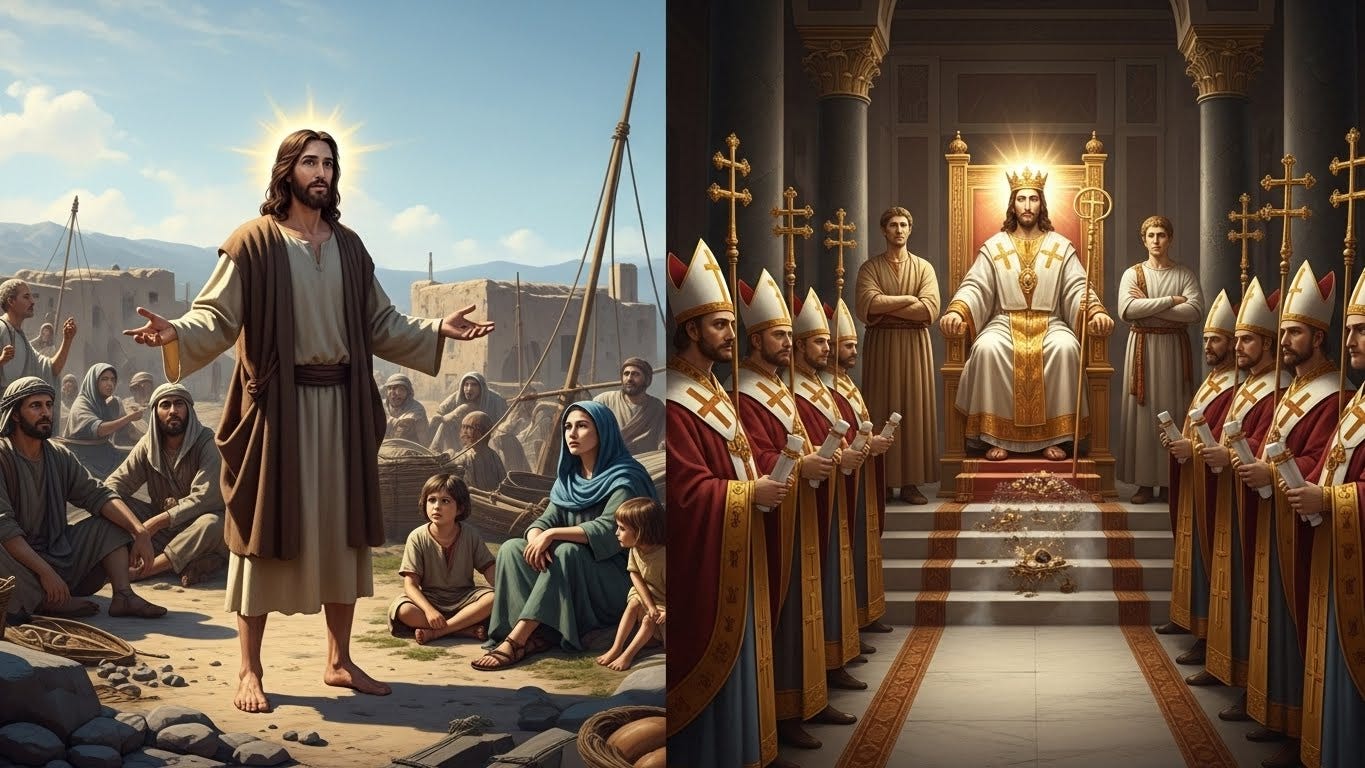
Jesus was a poor, loudmouthed Jewish guy preaching in occupied Palestine. He flipped tables, attacked the rich, and warned about religious hypocrites. Not exactly empire material. But a few centuries later, this same guy somehow became the polished poster-boy of Rome — sitting on thrones in cathedrals, backing armies, blessing emperors.
What happened, you ask?
The answer lies in the “council era” — a string of meetings where bishops and politicians sat around deciding which version of Jesus to sell to the masses. These weren’t spiritual brainstorms. They were political operations. The goal? Turn a rebel into royalty. Make Jesus useful to kings, not carpenters.
From Street Preacher to Roman Mascot
The Roman Empire didn’t adopt Christianity because they liked the message. They adopted it because they could weaponize it. Constantine, the emperor who legalized Christianity in 313 CE, wasn’t baptized until he was on his deathbed. He wasn’t interested in Jesus — he was interested in control. The empire was falling apart. Too many gods, too many cults, too many riots. One religion meant one leash.
To pull this off, the empire needed to smooth out the messy parts of Christianity. They needed one God, one doctrine, one leader — and a Jesus who obeyed the state. So they called the first ecumenical council: Nicaea, 325 CE.
Council of Nicaea: Jesus Becomes Divine
Before Nicaea, Christians were all over the place. Some said Jesus was divine. Others said he was just a man. Some said he was adopted by God. Some said he existed before creation. It was theological chaos.
Enter Emperor Constantine. He wasn’t interested in figuring out the truth. He wanted unity. And unity meant picking one version and crushing the rest.
So the Council of Nicaea decided: Jesus wasn’t just the Son of God anymore. He was God. Father’s equal. And if you didn’t agree? Pity. You were a heretic. Arius, a popular priest who said Jesus had a beginning and was created by God, got stomped out. His books were burned. His followers were exiled. Welcome to the new empire religion.
The Council of Nicaea marks the moment when Roman politics fused with Christian theology to create orthodoxy by decree— Bart D. Ehrman, How Jesus Became God (2014)
Council of Constantinople: Meet the Holy Ghost… Now Also God
A few decades later, they realized something: Wait, what about the Holy Spirit?
So in 381 CE, the Council of Constantinople upgraded the Holy Ghost too. Once just a force or messenger now he was fully divine — the third piece in a divine triangle. That triangle became the Trinity, and if you didn’t believe it, congratulations, you were once again a heretic.
Jesus was now officially part of a divine bureaucracy. He didn’t serve God — he was God himself, along with two other versions of God. Confused? That was the point. It was complicated enough that only bishops could explain it — and they made damn sure the emperor needed them to do it.
The doctrine of the Trinity was not a product of early Christianity but of later imperial politics and philosophical language— Karen Armstrong, A History of God (1993)
Council of Ephesus: Mary Becomes the “Mother of God”
Jesus wasn’t the only one getting a PR upgrade. In 431 CE, the Council of Ephesus decided Mary was more than being Jesus’ mom. She was Theotokos — “God-bearer.” That meant she didn’t give birth to a man who became God. She gave birth to God Himself.
Why does this matter? Because it helped shut down anyone who thought Jesus was two separate things: divine and human. The council wanted a clean, simple image — no messy theology about when Jesus “became” divine. And what better way to elevate him than to say God came out of a woman’s womb?
It also gave Roman emperors a divine mother-figure to promote. Empresses loved it. Mary statues started popping up everywhere. Power loves symbols.
Calling Mary ‘Mother of God’ was never about Mary. It was about defending Jesus as a divine being from the womb— Richard Rubenstein, When Jesus Became God (1999)
Council of Chalcedon: Jesus Gets Two Natures, But Don’t Ask Too Many Questions
By 451 CE, things were still messy. Some Christians said Jesus was all divine. Others said he was all human. So the Council of Chalcedon gave the ultimate political answer: He’s both.
They wrote a new formula: Jesus is “truly God and truly man.” Two natures in one person. Not mixed, not divided. Got it? No? Too bad. This was now official church dogma. The Empire had spoken.
Never mind that no one could actually explain how that worked. The bishops didn’t care if it made sense. They just needed one answer — one doctrine to force on the empire.
The Chalcedonian Definition is less a theological breakthrough and more a compromise hammered out under imperial pressure— Diarmaid MacCulloch, Christianity: The First Three Thousand Years (2009)
Heretics, Exiles, and Book Burnings: Cleaning Up the Jesus Mess
Each council redefined Jesus while crushing everyone who disagreed.
Arians? Exiled.
Nestorians? Exiled.
Monophysites? Exiled.
Gnostics? Long gone — their books were already torched or buried in jars in the desert.
This wasn’t debate. It was suppression. Bishops used Roman law to silence dissent. Disagreeing with the council was illegal. You could be imprisoned or killed for the “wrong” opinion about Jesus.
Jesus, the guy who said “blessed are the peacemakers,” was now defended by sword-wielding armies and fiery mobs.
Orthodoxy is just the heresy that won— Walter Bauer, Orthodoxy and Heresy in Earliest Christianity (1934)
From Galilean Dirt to Golden Thrones
So by the end of the council era, here’s what we had:
Jesus was fully divine, from birth to death to resurrection.
He was part of a Trinity, which no Jew (including Jesus himself) ever preached.
He had two natures but was one person — don’t ask how.
His mother was divine-adjacent.
And anyone who said otherwise was a criminal.
The poor Jewish preacher was now an imperial deity, enshrined in golden churches, enforced by Roman law, and explained by philosophers in robes. The whole faith got rewired into a system that mirrored the empire: rigid, top-down, obsessed with power, and quick to crush rebels.
The Church became an empire in miniature, reflecting the very structures of the state it once opposed— Elaine Pagels, The Gnostic Gospels (1979)
Jesus Was Never Safe After That
Jesus never stood a chance. Once emperors and bishops got their hands on him, it was over. They took his sandals off and put him in a robe. They took his parables and turned them into legal codes. They took his open-air sermons and shoved them behind cathedral walls.
The Jesus who told rich people to give up everything got turned into a divine king worshipped by popes dripping in gold.
And the councils? They were more than just theological meetings. They were rebranding sessions. Image makeovers. Political PR campaigns dressed up as holy debates. They didn’t ask what Jesus said. They asked what version of Jesus would keep the empire in one piece.
Last Thoughts
The councils reshape theology, hence history.
They locked the Bible into a fixed canon.
They elevated church leaders above the people.
They outlawed dissenting books and burned them.
They created a version of Christianity that fit with empire, not with the Sermon on the Mount.
This council-built Jesus became the foundation for centuries of crusades, inquisitions, colonization, and control. He wasn’t the friend of the poor anymore. He was the divine right of kings.
The councils gave the Church a theology that justified empire and made questioning Jesus the same as questioning the state— Reza Aslan, Zealot: The Life and Times of Jesus of Nazareth (2013)
To be honest, only a small portion of subscribers are paid—most of my posts are free for everyone to read, with some exclusives. But reader support buys something priceless: time. Time to research, question power, and hold the powerful accountable. If you can afford it, your support helps keep this work alive.
Sources and Further Reading
Bart D. Ehrman – How Jesus Became God: The Exaltation of a Jewish Preacher from Galilee
2014
A detailed examination of how early Christians came to see Jesus as divine and how church doctrine developed through time.Karen Armstrong – A History of God: The 4,000-Year Quest of Judaism, Christianity and Islam
1993
Explores the evolution of the concept of God in the Abrahamic faiths, including the political construction of the Christian Trinity.Richard E. Rubenstein – When Jesus Became God: The Struggle to Define Christianity during the Last Days of Rome
1999
Focuses on the Arian controversy and the Council of Nicaea, highlighting the power struggles that shaped Christian orthodoxy.Diarmaid MacCulloch – Christianity: The First Three Thousand Years
2009
Comprehensive church history that covers the major councils and their political motivations.Elaine Pagels – The Gnostic Gospels
1979
Analyzes early Christian texts suppressed by the Church and shows how alternative Christianities were erased by the emerging orthodoxy.Walter Bauer – Orthodoxy and Heresy in Earliest Christianity
1934
A groundbreaking work that argues what we now call “orthodoxy” was originally just one of many competing Christian sects.Reza Aslan – Zealot: The Life and Times of Jesus of Nazareth
2013
Portrays Jesus as a political rebel and critiques how his teachings were transformed by later Church authorities.Council of Nicaea (325 CE) – Nicene Creed
Primary historical source that formalized the belief in Jesus as consubstantial with God the Father.Council of Constantinople (381 CE) – Niceno-Constantinopolitan Creed
Expanded the Nicene Creed to include the Holy Spirit as divine.Council of Ephesus (431 CE) – Theotokos Doctrine
Declared Mary as the “Mother of God” to reinforce Jesus’ full divinity.Council of Chalcedon (451 CE) – Chalcedonian Definition
Established the doctrine of Jesus’ dual nature — fully divine and fully human — in one person.