
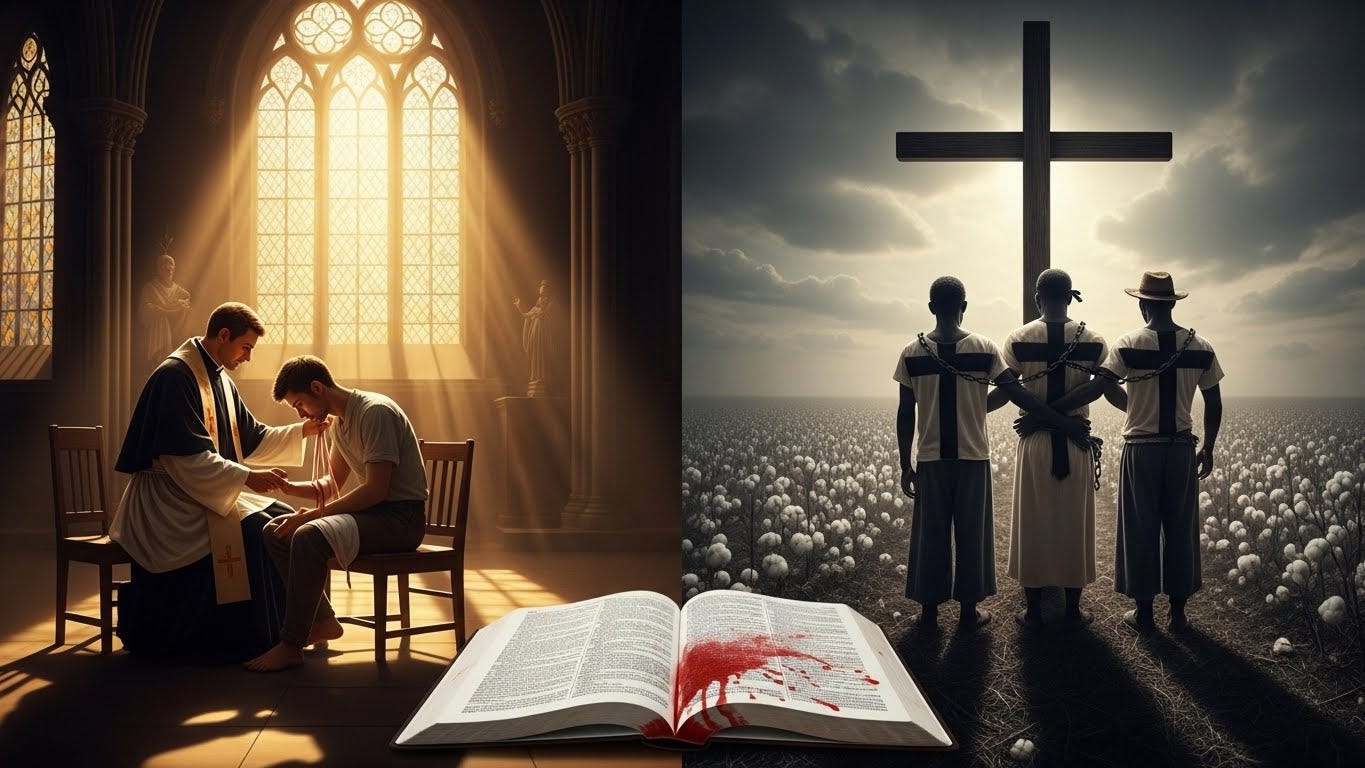
The Bible and Blood — How Scripture Was Used to Justify Slavery
From American plantations to European theology, a look at how “God’s word” became slave owners’ favorite legal defense.
For centuries, Christianity has claimed to be the backbone of human rights. Churches built hospitals, cared for the poor, and created schools when governments didn’t care. Christian thinkers helped shape laws about charity, justice, and mercy. Words like “equality,” “dignity,” and “human value” owe a lot to Christian moral philosophy — or at least, to its best version.
When Christians talk about ending slavery, fighting for women’s education, or standing up to tyrants, they point to the teachings of Jesus: love your neighbor, feed the hungry, heal the sick. The idea that every soul has value before God became one of the moral pillars of Western civilization.
People like William Wilberforce and John Wesley used faith to challenge cruelty. The Quakers were among the first religious groups to denounce slavery completely. Christian reformers built movements that inspired abolition, labor rights, and universal education.
At its best, Christianity tried to be a moral compass for humanity.
But history shows something darker: the same book that inspired mercy also defended chains. The same sermons that preached equality also blessed whips and auctions.
When the Cross Turned into a Whip
The irony is brutal. The same Bible that says, “Love your neighbor as yourself,” was used to justify whipping, raping, and selling those very neighbors.
Christianity’s message of salvation became a business license for slave traders. Preachers quoted verses not to comfort the oppressed, but to keep them obedient. Slave owners didn’t ignore the Bible — they weaponized it.
The Church didn’t just stand by during slavery; it organized it, rationalized it, and profited from it.
“Slaves, obey your earthly masters with fear and trembling, just as you would obey Christ.” — Ephesians 6:5
That verse echoed across plantations and pulpits. And it wasn’t some fringe misinterpretation — it came straight from the Apostle Paul, one of Christianity’s founders.
The Holy Permission Slip
Long before the American South, European theologians had already built the religious foundation for slavery. In the 15th century, Pope Nicholas V issued the bull Dum Diversas, giving Portugal permission to “capture, vanquish, and subdue” all non-Christians — and enslave them forever.
That papal decree, later reinforced by others, became known as the Doctrine of Discovery. It told European powers that any land not ruled by Christians was theirs for the taking. Africans, Arabs, and Indigenous peoples were seen as “pagans” — and therefore “property.”
God’s law became empire’s weapon.
“The Lord your God will deliver them over to you, and you shall utterly destroy them.” — Deuteronomy 7:2
This Old Testament verse, once about ancient tribal wars, was rebranded as a divine manual for conquest. Europeans used it to conquer continents and baptize entire civilizations into submission.
Paul’s Theology of Obedience
Paul’s letters became the slave owner’s favorite reading material. They told slaves to serve faithfully, respect their masters, and expect no reward except in heaven.
In Colossians 3:22, Paul wrote:
“Slaves, obey your earthly masters in everything; and do it, not only when their eye is on you and to curry their favor, but with sincerity of heart and reverence for the Lord.”
Slave owners didn’t have to invent their theology — they just copied Paul’s words.
Even worse, 1 Timothy 6:1–2 explicitly warns slaves not to disrespect Christian masters:
“Let as many servants as are under the yoke count their own masters worthy of all honor, that the name of God and his doctrine be not blasphemed.”
In plain English: disobeying your master insults God.
That line became gospel law in the American South. Obedience became holiness. Resistance became sin.
Jesus and the Sound of Silence
When challenged, defenders of slavery often said, “Even Jesus didn’t condemn it.” And they were right — he never did, at least not directly.
He talked about compassion, forgiveness, and humility — but never about freeing slaves. He healed the sick, fed the hungry, and comforted the broken — but he didn’t challenge the Roman Empire’s system of human bondage.
That silence gave future Christians all the space they needed to twist morality. If the Son of God didn’t reject slavery, then who were they to question it?
“He that knew his master’s will, and did not prepare himself, shall be beaten with many stripes.” — Luke 12:47
That verse — describing a servant beaten for disobedience — became a favorite sermon topic. It was read to enslaved Africans who were forced to sit in church, learning that their suffering was “God’s discipline.”
The Curse of Ham
Then came the Bible’s most disgusting racial myth. In Genesis 9, Noah curses his son Ham’s descendants after Ham sees him drunk and naked:
“Cursed be Canaan; a servant of servants shall he be unto his brethren.”
Centuries later, Christian theologians decided that Ham’s descendants were Black Africans. They claimed that God had marked them for servitude forever. It was total nonsense — linguistically, historically, and geographically — but it became the cornerstone of white supremacy.
Missionaries, bishops, and colonial preachers repeated it like fact. Black people were said to be “naturally cursed,” “meant to serve,” and “fulfilling prophecy” by being enslaved.
This grotesque theology didn’t just justify slavery — it sanctified racism.
“The negro race, the descendants of Ham, are by divine appointment subjected to servitude.” — Reverend Josiah Priest, 1843
That quote wasn’t fringe lunacy. It was mainstream theology in the American South.
The Slave Bible — Holy Editing
Slave owners didn’t trust the real Bible — it was too dangerous. Passages about freedom and rebellion had to go.
So they made their own version.
In 1807, British missionaries published “The Slave Bible” in the Caribbean. It removed every story that could inspire hope or revolt — including Moses freeing the Israelites from Egypt. About 90% of the Old Testament and half of the New Testament were deleted.
Gone were the words “Let my people go.” Gone were verses about liberation. What remained were lines about submission, obedience, and fear.
It wasn’t just religion. It was psychological warfare.
The Church’s Bloody Hands
Slavery wasn’t some accidental misuse of Christianity. It was institutional.
The Catholic Church blessed ships filled with chained Africans. The Church of England invested in slave-trading companies like the Royal African Company, profiting from every sale. Priests stood at docks to bless voyages that carried human cargo.
Even Protestant reformers weren’t innocent. John Calvin and Martin Luther both accepted slavery as a natural part of life. Thomas Aquinas said it was a punishment for sin.
And when enslaved Africans were brought to America, plantation owners built chapels right on their land. Sunday sermons taught slaves to accept their suffering as divine will.
“Servants, be subject to your masters with all fear; not only to the good and gentle, but also to the froward.” — 1 Peter 2:18
In other words, obey even the cruel ones.
When Faith Fought Back
But even under the whip, religion was a double-edged sword. Some enslaved Africans learned to read and found a different message — one of deliverance.
They found Exodus. They read about God freeing His people from bondage, and they saw themselves in Moses. That story became a weapon of hope.
They turned their faith into rebellion, singing coded spirituals like “Go Down, Moses” and “Swing Low, Sweet Chariot.” To the masters, those songs sounded harmless. To the slaves, they were messages of escape and defiance.
A new Christianity was born — one that sided with the oppressed, not the oppressor.
“Between the Christianity of this land and the Christianity of Christ, I recognize the widest possible difference.” — Frederick Douglass
Douglass, once enslaved himself, tore apart the hypocrisy of a nation that claimed to follow Jesus while chaining his children.
God’s Civil War
By the 1800s, America’s conscience was split in two. Northern abolitionists preached that slavery mocked God’s love. Southern preachers thundered that ending it would defy His law.
Both sides quoted the same Bible. Both prayed to the same God.
When the Civil War began, ministers in the South told soldiers they were fighting for God’s divine order. Their opponents said they were fighting for God’s justice.
“Both read the same Bible and pray to the same God, and each invokes His aid against the other.” — Abraham Lincoln
The Bible, once a source of moral guidance, had become a weapon of division.
And when the war ended, the theology of slavery didn’t die. It just evolved — into segregation, lynching, and “separate but equal.”
The Long Afterlife of Holy Racism
Even after emancipation, churches remained segregated. Preachers continued to twist scripture to defend white supremacy. The “Curse of Ham” myth survived into the 20th century.
And to this day, many Christian institutions still struggle to admit how deeply they helped create racial hierarchies. Some denominations have only recently apologized for their role in slavery. Others stay quiet, pretending it was all “misinterpretation.”
But history doesn’t lie.
The same book that taught charity and love was also used to excuse genocide, rape, and slavery. It gave divine approval to empire, racism, and centuries of human misery.
Last Thoughts
Christianity built hospitals — and plantations. It wrote hymns — and slave codes. It preached love — and legalized torture.
It gave the world the idea that all people are equal in God’s eyes, then spent centuries deciding who counted as “people.”
The story of Christianity and slavery isn’t about good versus evil. It’s about how religion bends to power — how verses become weapons, and how morality collapses when money and authority hide behind “God’s will.”
The Bible’s pages are soaked in blood — not because of what’s written in them, but because of what people chose to see there.
Your turn: Drop a comment, follow for more unholy truths, and tell the world what you think.
Sources and Further Reading
What Fifteenth-Century Papal Bulls Can Teach Us About Indigenous Identity
https://berkleycenter.georgetown.edu/responses/what-fifteenth-century-papal-bulls-can-teach-us-about-indigenous-identityDoctrine of Discovery, Until Otherwise
https://blogs.loc.gov/law/2023/07/doctrine-of-discovery-until-otherwise/How Christian Slaveholders Used the Bible to Justify Slavery
https://time.com/5171819/christianity-slavery-book-excerpt/Frederick Douglass, Narrative of the Life of Frederick Douglass, an American Slave (1845)
Josiah Priest, Slavery, As It Relates to the Negro, or African Race (1843)
“Christianity and Slavery,” BBC History
https://www.bbc.co.uk/religion/religions/christianity/history/slavery_1.shtmlReligion and the Founding of the American Republic
https://www.loc.gov/exhibits/religion/rel03.htmlDavid M. Goldenberg, The Curse of Ham: Race and Slavery in Early Judaism, Christianity, and Islam (Princeton University Press, 2003)
From Slavery to Freedom
https://nmaahc.si.edu/explore/stories/slavery-freedom“Slavery and the Church,” Smithsonian Magazine
https://www.smithsonianmag.com/history/slavery-and-the-church-180975832


Excellent item, particularly demonstrating how the same bible was interpreted for any convenient truth.
As an ex-Catholic I am once again speechless to realize what the institution has stood for over the centuries and baffled by the devotion of believers who cry at if sanctified at the sighting of a Pope.