


In the autumn of 312 CE, outside the gates of Rome, the waters of the Tiber River ran slick with blood as two rival emperors collided in a bid for absolute power. Under a bruised, crimson sun, the Battle of the Milvian Bridge shattered the old Roman world. The victor, Constantine, marched through the imperial gates, claiming his staggering triumph was forged not merely by iron and blood, but by a luminous celestial vision, a divine sign under which he was commanded to conquer.
That single afternoon set off a seismic shift, pulling a once-persecuted underground sect into the gilded halls of imperial favor and sparking the conversion of the Roman Empire. Yet, the victory brought no peace. Within a few short decades, the war for the empire was eclipsed by an even fiercer battle, not fought with swords against pagans, but with quill and ink among Christians themselves.
In backroom councils, desert monasteries, and imperial palaces, the ultimate fight began: deciding which holy words held the absolute truth of God, and which deserved to be erased from history as heresy.
It is in this world of theological controversy that the story of the Gospel of Philip is often placed. According to a popular modern narrative, church leaders decided which writings represented true Christianity and pushed competing voices into obscurity, with the Gospel of Philip becoming one of the supposed casualties.
Subscribe for free to get the next origin story in your inbox, and upgrade whenever you want the bonus sections.
Either way, thank you for being here.
Before We Begin
Let me say up front that the title mimics sensationalist headlines, so nobody should feel cheated by the piece. The whole point, in fact, is that the content won’t match the title. With that out of the way, I think it’s fair to begin by summarizing the most popular version of the story surrounding the Gospel of Philip.
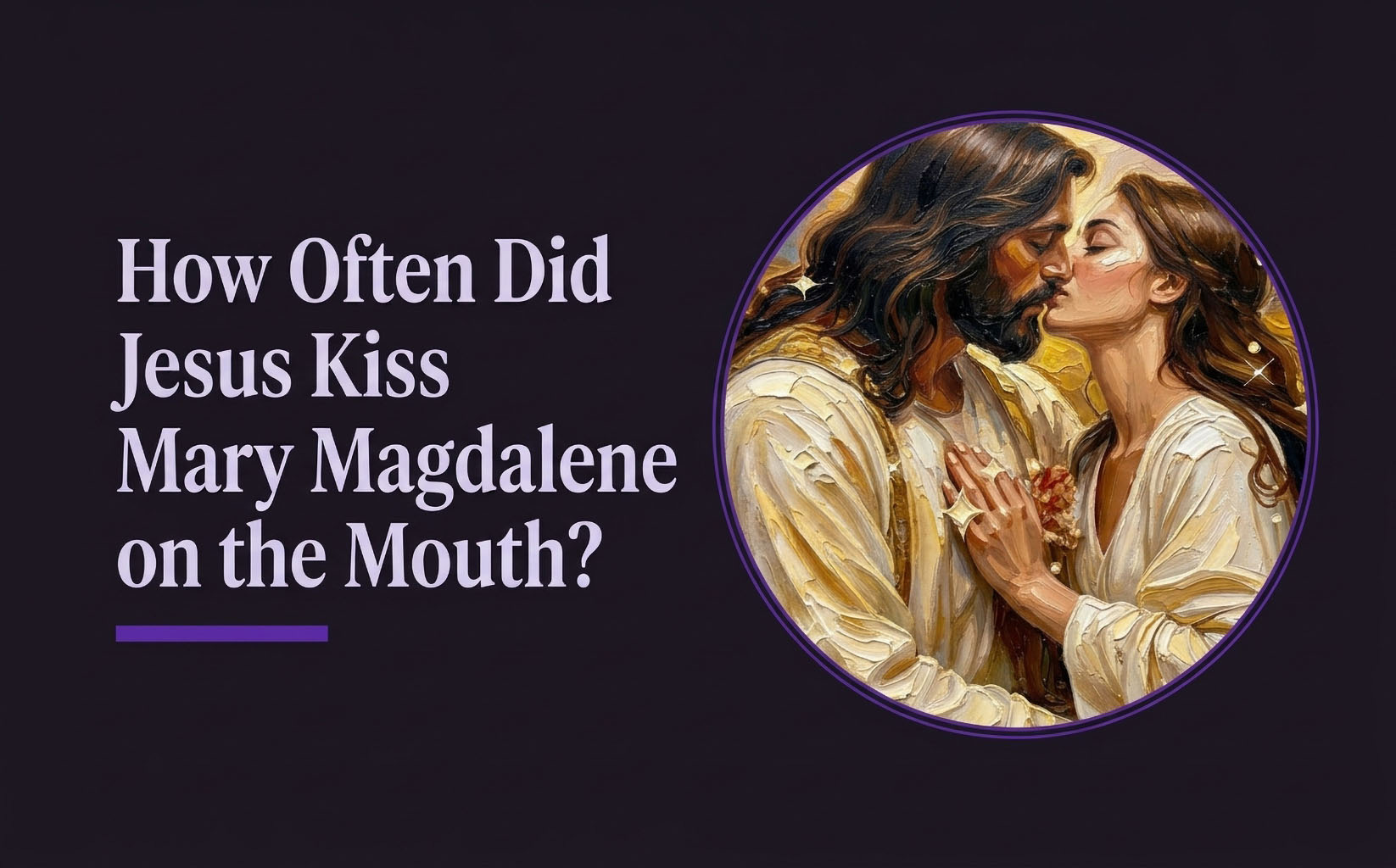
Early Christians once read a gospel that portrayed Jesus as a man with a lover, or perhaps a wife, a book in which he kisses Mary Magdalene on the mouth while the male disciples complain about it. Bishops who wanted a celibate, divine Christ could not allow that, so in the fourth century they banned the book, ordered every copy burned, and erased it from the church's memory.
In this version of events, one copy escaped the flames because someone hid it in the Egyptian desert, where it remained for nearly 1,600 years until a farmer uncovered a clay jar in 1945. The Da Vinci Code, the 2003 novel that sold tens of millions of copies, quotes the passage about the kiss and has a character claim that “companion” meant “spouse.” Documentaries, magazine covers, and viral social media posts have repeated the story ever since, often using words such as “banned,” “forbidden,” or “the gospel the church didn’t want anyone to read.”
The story has a villain, a cover-up, and a love affair, and every part of it makes a claim that can be tested against the historical record.
Let’s dig into it.
What Bishops Hated About the Gospel of Philip
The book gives bishops a lot to dislike, which is why the story that it was banned sounds believable. Written in Greek in the third century, probably in Syria, by followers of Valentinus (a teacher who had run a school in Rome about a century earlier), it criticizes Christians who said Mary conceived Jesus through the Holy Spirit. Its argument is simple: a woman cannot conceive by a woman, and in the Semitic languages known to the author, the word for “spirit” was feminine.
The text also says that people who claim Jesus died first and then rose from the dead have it backward. According to the author, he rose first and died afterward. It further argues that people hoping for a bodily resurrection are mistaken, because the body is what leaves a person exposed and vulnerable. By that time, bishops had been preaching bodily resurrection for more than a century.
All of this gives church leaders plenty of reasons to dislike the book. Yet despite that, there’s still no historical record of any order to ban it.
The Easter Letter From Alexandria Blamed for the Ban
Every story about the discovery of the Nag Hammadi books points to the same document: Festal Letter 39, written in 367 CE by Athanasius, the bishop of Alexandria. Each year, Athanasius sent an Easter letter to churches and monasteries across Egypt. In this particular letter, he listed the 27 books of the New Testament that Christians still use today. He also warned against other religious writings, calling them inventions of heretics who falsely claimed their books were ancient.
However, the letter itself makes the dramatic story fall apart. Athanasius never mentions the Gospel of Philip, and he never orders any books to be burned.
Instead, the letter organizes books into categories. First are the books he accepts as Scripture. Second are books he says new converts may read for instruction, such as The Shepherd of Hermas and The Teaching of the Apostles (Didache), though he doesn’t consider them Scripture. Third are the apocryphal books that he advises Christians to avoid.
So anyone looking for a command to burn banned gospels won’t find it; instead, they’ll find a recommended reading list.
How Book Burning Worked When Emperors Meant It
When the Roman government wanted a book destroyed, it said so clearly. After the Council of Nicaea in 325 CE, Emperor Constantine ordered the writings of Arius, a priest whose teachings about Jesus had been condemned, to be burned. The order, preserved by the church historian Socrates Scholasticus, even threatened death for anyone caught hiding a copy. It named the books, set a punishment, and had the power of the state behind it. That’s what a book-burning order looks like.
Church writers were also willing to name books they considered dangerous. Eusebius, a historian who wrote during Constantine’s reign, listed the Gospels of Peter, Thomas, and Matthias as false works that no orthodox author should trust. He called them absurd and impious. Yet he never mentions the Gospel of Philip. In other words, the fourth-century writer most concerned with separating genuine books from fake ones didn’t even bother to discuss it.
The Gospel of Philip has none of the evidence we’d expect if it had been officially targeted. There’s no surviving order to destroy it, no punishment for owning it, and no ancient writer calling for its suppression.
A much simpler explanation is that the book disappeared through neglect. Most ancient books were written on papyrus, which decays quickly unless copies are constantly made. If a text stopped being copied, it could vanish within a few generations. A book read by only a small religious group in the third century already faced long odds of survival and needed no emperor, bishop, or church council to make it disappear.
A Jar, a Cliff, and a Farmer’s Mother
In 1945, while Europe was still licking its fresh wounds following a disastrous war, an Egyptian farmer digging for fertilizer near a cliff discovered a sealed clay jar containing thirteen leather-bound books. According to later reports, some loose pages were burned as cooking fuel before scholars realized their importance. The only complete copy of the Gospel of Philip was found in one of these books, alongside the Gospel of Thomas.
Whoever placed the books in the jar was trying to preserve them. Most scholars believe the collection came from a nearby monastery. If that’s correct, the very religious community often accused of suppressing the Gospel of Philip may have been responsible for preserving the only surviving copy.
The surviving manuscript was copied around 350 CE, only a few decades before the famous Easter letter that warned Christians against certain religious writings. Many scholars have suggested that the books were hidden because of that letter.
The problem is that nobody knows for sure. Nothing found in the jar explains why the books were buried, and the person who sealed it left no explanation. As a result, the reason for the burial remains uncertain.
The Kiss and the Damaged Page
The copy from the jar is the only source for the famous kiss. The Gospel of Philip calls Mary Magdalene Jesus’ “companion,” says he loved her more than the other disciples, and claims he often kissed her. The author uses the ordinary word for “wife” elsewhere in the text, so choosing “companion” seems deliberate, whatever conclusion the reader reaches.
The manuscript has a hole at the spot where it should say where he kissed her, and the missing word could just as easily be “mouth,” “cheek,” or “hand.” With no second copy to compare, nothing can settle which word stood there. Most modern translators fill the gap with “mouth,” usually in brackets, and the headlines dropped the brackets.
Even if the word were there, it would show what some Christians in the third century believed about Jesus and Mary Magdalene, since no reliable source that can be checked independently describes their relationship.
Who Dug the Hole
The headlines get nearly every piece of this story wrong. Nobody banned Philip by name, nobody burned its copies, and the kiss on the mouth rests on a missing word.
The single surviving copy owes its existence to whoever sealed that jar and carried it to a cliff. What nobody has settled is who made that call and why they chose a hole in the ground over a fire. A monk dodging an inspector, a community retiring a book the way worn-out sacred texts get retired, and a librarian protecting a favorite are three different men, and the paperwork stuffed inside the book covers says something about which of them fits best.
Today’s eclusive content explains what a kiss between a teacher and a disciple meant to the Christians who wrote this book, and why the other disciples were jealous of Mary Magdalene.
Sources and Further Reading
James M. Robinson, ed., The Nag Hammadi Library in English (Brill, 1977; rev. ed. HarperOne, 1988)
Marvin Meyer, ed., The Nag Hammadi Scriptures (HarperOne, 2007)
Hugo Lundhaug and Lance Jenott, The Monastic Origins of the Nag Hammadi Codices (Mohr Siebeck, 2015)
Bart D. Ehrman, Lost Christianities: The Battles for Scripture and the Faiths We Never Knew (Oxford University Press, 2003)
Bentley Layton, The Gnostic Scriptures (Doubleday, 1987)
R. McL. Wilson, The Gospel of Philip (Harper & Row, 1962)
Athanasius, Festal Letter 39, in Nicene and Post-Nicene Fathers, Series 2, Vol. 4
Socrates Scholasticus, Ecclesiastical History, Book 1, ch. 9
Epiphanius of Salamis, Panarion, 26.13
Eusebius of Caesarea, Ecclesiastical History, Book 3, ch. 25
John W. B. Barns, Gerald M. Browne, and John C. Shelton, Nag Hammadi Codices: Greek and Coptic Papyri from the Cartonnage of the Covers (Brill, 1981)
Exclusive Content for Paid Subscribers
The Secret Ritual Behind the Gospel of Philip’s Kiss
In some cultures, parents think nothing of giving an infant a quick kiss on the lips before bedtime. In others, a kiss on the lips is strictly sexual, so a parent kissing a child that way would look creepy and make an observer from that culture feel uncomfortable.
The meaning of a kiss depends on who’s kissing and where.
So what about back when the gospel was written down?
The kiss in the Gospel of Philip is usually read as proof of a secret marriage or a love affair that the church later covered up, and thrillers and documentaries have popularized that reading. The third-century Christians who wrote the book understood it differently. In their circles a kiss between…
Excellent as ever, Tanner.
One quick thought. It's likely Jesus was Essene, & that would fit with the communal living, poverty & asceticism of Jesus and the apostles. Most Essenes were also celibate, which would probably rule out conjugal relations between Jesus and Mary, & his kissing a woman might well offend apostles for that reason.
That may be complete nonsense, & the simple idea of the apostles being jealous or misogynistic makes sense on a more basic human level any way.
And frankly I like the idea of them being a couple.
Also, remember the Gospel of Mary, which preached that there was no physical resurrection, no evil, and the spirit of God was within us (talking from memory here - apologies if I'm conflating Mary & Thomas), all of which was an anathema to the church since it undermined its authority as the necessary intermediary between people and God, and taught that there was no physical resurrection.
In that light, one can well imagine that any gospel which elevated Mary to anything but an ex hooker would be completely unacceptable to the church.
That's a bit of an incoherent ramble, and I know it doesn't add up.....
“Bishops who wanted a celibate, divine Christ could not allow that, so in the fourth century they banned the book, ordered every copy burned, and erased it from the church's memory.”
And that is an over simplistic bias .