


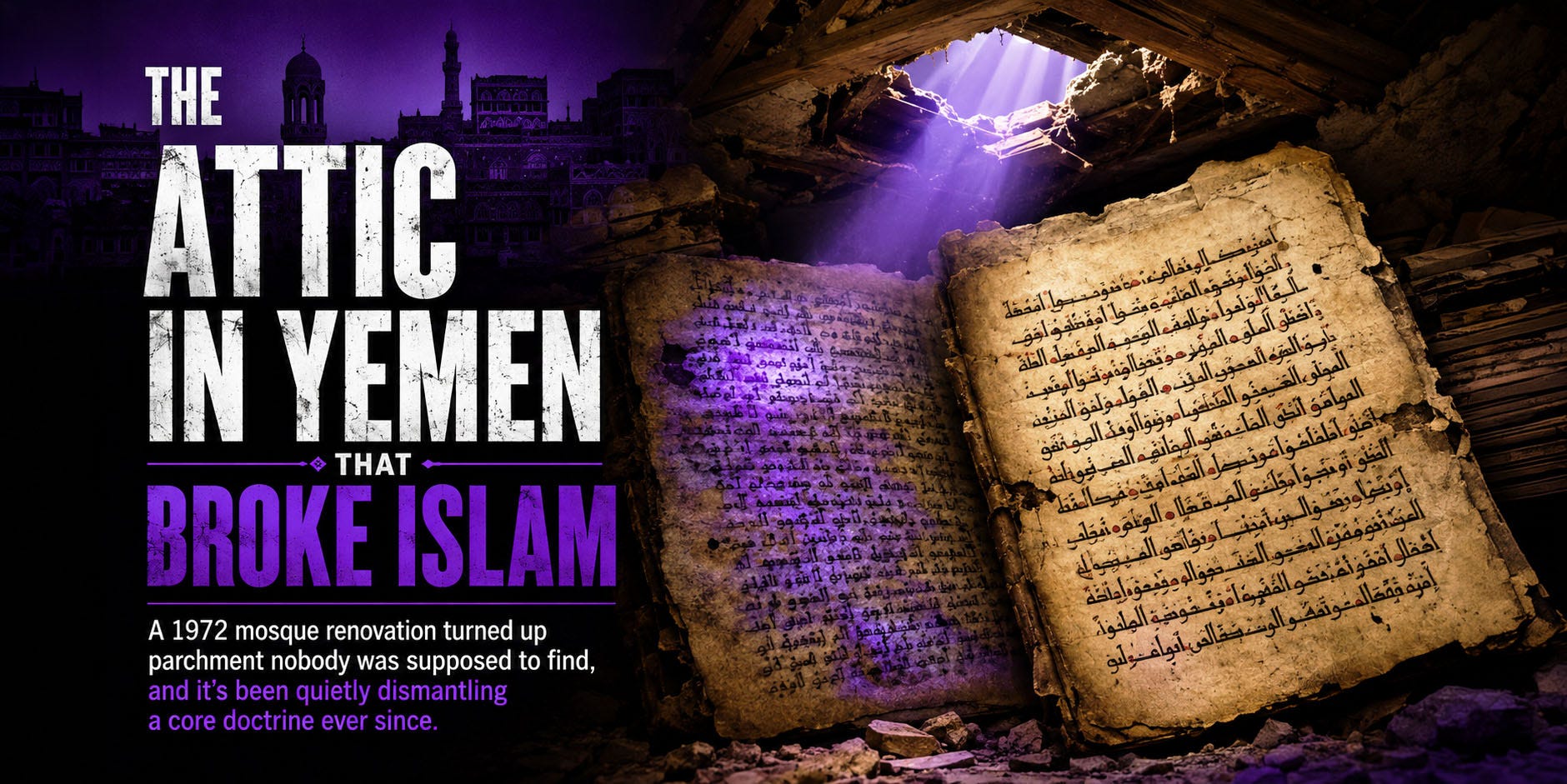
The Quran survived fourteen centuries word for word, unchanged, memorized by millions in an unbroken chain back to the Prophet himself. That belief is one of the fundamentals of Islam, because Islam also claims the Hebrew Bible and the New Testament were originally God’s word too, just corrupted by human hands over time. The Quran is supposed to be the one exception, the only scripture that was never touched.
Then in 1972, a work crew fixing a ceiling in Yemen knocked a hole straight through that claim, which didn’t have a leg to stand on to begin with.
Before We Begin
Just a quick note before we go any further.
I already sent a separate email with a preview of Monday's post. This Friday I'm skipping the post to give your inbox some breathing room. If you think that's a bad call, let me know in the comments, so I know what's working for readers and what isn't.
In the bonus section for supporters, you'll find the specific manuscript variants behind Wednesday's piece on the Yemen attic discovery, the verb changes, the flipped chapter order, and the numbers behind just how far off from standard that erased text really was.
Even terzijde, zeker gezien de bevolkingsomvang van Nederland binnen Europa, heb ik een disproportioneel hoog aantal ondersteuners en daar wil ik het land van tulpen en klompen :) hartelijk voor bedanken.
Workers Renovating a Mosque Found a Library
The Great Mosque of Sana’a had a storage space above its ceiling, the kind of forgotten loft every old building accumulates. During restoration work that year, the ceiling gave way and buried the crew in decaying parchment, thousands of sheets that had been stuffed up there and left to rot for who knows how many centuries. Nobody involved understood what they’d found. The workers shoveled the material into potato sacks and stacked them on a staircase, which is not how you’d treat priceless manuscripts if you knew that’s what they were.
Word reached the head of Yemen’s antiquities authority, who recognized the find could matter and intervened before the sacks got hauled off as trash. What followed was decades of slow, underfunded cataloging, first by Yemeni authorities and later with German researchers brought in to help sort a hoard that eventually topped fifteen thousand sheets. Most of it turned out to be Quranic material spanning nearly a thousand early codices. One folio in particular became the center of everything that followed.
A Palimpsest Is a Manuscript With a Secret Underneath
Because parchment was expensive, scribes frequently scraped off old text to reuse the surface, much like the TV networks wiping master tapes to record new shows, inadvertently erasing vital history. Over centuries, however, ink and pressure conspire: the erased layer can bleed back through, leaving faint traces invisible to the naked eye but readable under ultraviolet light. That is precisely what German scholar Gerd Puin and his team discovered when examining a manuscript from the Sana’a cache, now cataloged as Sana’a 01-27.1.
The text visible on top matched the standard Quran in circulation today, the version tracing back to the canonical seventh-century codification. Underneath, however, the erased layer revealed a distinctly different Quranic text. While clearly recognizable in structure, it contained word substitutions, altered phrasing, and a chapter order that matched no known arrangement, not even the early personal copies circulating before the text was officialized. Detailed textual analysis confirmed that this wasn’t scribal sloppiness, but a text still in flux at the exact moment someone decided to erase it and write the “correct” version on top.
Radiocarbon work by Behnam Sadeghi and Mohsen Goudarzi, published in Der Islam in 2012, dated the parchment to before 671 CE with high confidence, putting the lower text within living memory of Muhammad’s death.
If you find value here, become a supporter of The Unholy Truth. Paid subscriptions are what make this work possible.
Islamic Tradition Already Knew This
Islamic scholarship has never actually denied that variant codices existed. The ‘official’ story includes early leaders ordering the destruction of competing versions precisely because there were competing versions to destroy. Some early figures famously resisted handing their copies over. The sanctioned reading variants still used in recitation today are themselves an institutional acknowledgment that the text wasn’t perfectly uniform from the start.
What this palimpsest does is take that story out of ancient history books, where it can be managed, footnoted, and explained away as minor dialectal variation, and puts it in your hands as ink on seventh-century parchment.
The fact that the standard reading looks, in case after case, like a correction of something else in the manuscript record is the kind of claim textual critics make about the New Testament without anyone calling it heresy. Apply the same method to the Quran and you’ve touched the one text every school of Islamic theology insists cannot have a history, because a text with a history is a text somebody wrote, edited, and standardized rather than a text that fell from heaven whole.
Why Half the Cache Still Hasn’t Been Properly Studied
Access to Sana’a 1 and its companion fragments has never been simple. Yemeni authorities restricted photography and publication rights for years, and the manuscripts that remain in the Dar al-Makhtutat in Sana’a are still, by most accounts, undercataloged. Then Yemen’s civil war made the question moot for a while: a collection housed in an active conflict zone doesn’t get much scholarly access regardless of anyone’s intentions. Estimates suggest roughly half the material recovered in 1972 has never been properly photographed or published, which means the fullest picture of what that ceiling was hiding may still be sitting in storage, waiting for a stable enough Yemen to let researchers back in.
The comparison to the Dead Sea Scrolls writes itself, and not just for the dramatic accident-of-discovery story. Both finds sat under tight institutional control for decades after they surfaced, both involved a small circle of scholars gatekeeping access to material with obvious doctrinal stakes, and both eventually forced a public reckoning that the guardians would rather have avoided. The scrolls took nearly fifty years to reach full publication. Sana’a’s attic might take longer, if the region ever settles enough to finish the job.
What’s already out of the bag is enough. A ceiling collapsed in Yemen and dropped proof that the Quran, like every other scripture humans have ever produced, went through drafts.
Sources and Further Reading
Sadeghi, Behnam, and Mohsen Goudarzi. “Ṣan’ā’ 1 and the Origins of the Qur’ān.” Der Islam, 2012.
Puin, Gerd-Rüdiger. “Observations on Early Qur’an Manuscripts in Ṣan’ā’.” In The Qur’an as Text, edited by Stefan Wild. Brill, 1996.
Puin, Elisabeth. Published analyses of Sana’a manuscript DAM 01-27.1, 2008-2009.
Lester, Toby. “What Is the Koran?” The Atlantic, January 1999.
Sadeghi, Behnam, and Uwe Bergmann. “The Codex of a Companion of the Prophet and the Qur’ān of the Prophet.” Arabica, 2010.
People get a little crazy about their religion. Each believe they are following the only ”correct” version. Every religion has evolved.
Tanner,
It's curious - no? What animates the need of Faith to be unquestioned? What (writhing) insecurity is it that seems to squelch heresy?
For me, the story of these parchments - one that is still unfolding- is institutional fright. Which shows up in so many other places, contexts, times.
In short, another great pixel in the grand mural of the human condition.
Take care,
Alan