


High above Jerusalem on the Mount of Olives, the disciples lean in to ask Jesus a quiet, nervous question: How will we know when the end is coming?
If you leave it to the Gospel of Matthew, the answer is a grim list of geopolitical chaos: wars, rumors of wars, famines, and false messiahs. But if you happened to be reading another text widely popular among early Christians in the second century, Jesus skips the list and gives Peter a full guided tour.
What Peter sees is a full-color, hyper-detailed horror show, and it drew the exact blueprint for the hell Western culture has been terrified of ever since.
Jesus on the Mount of Olives
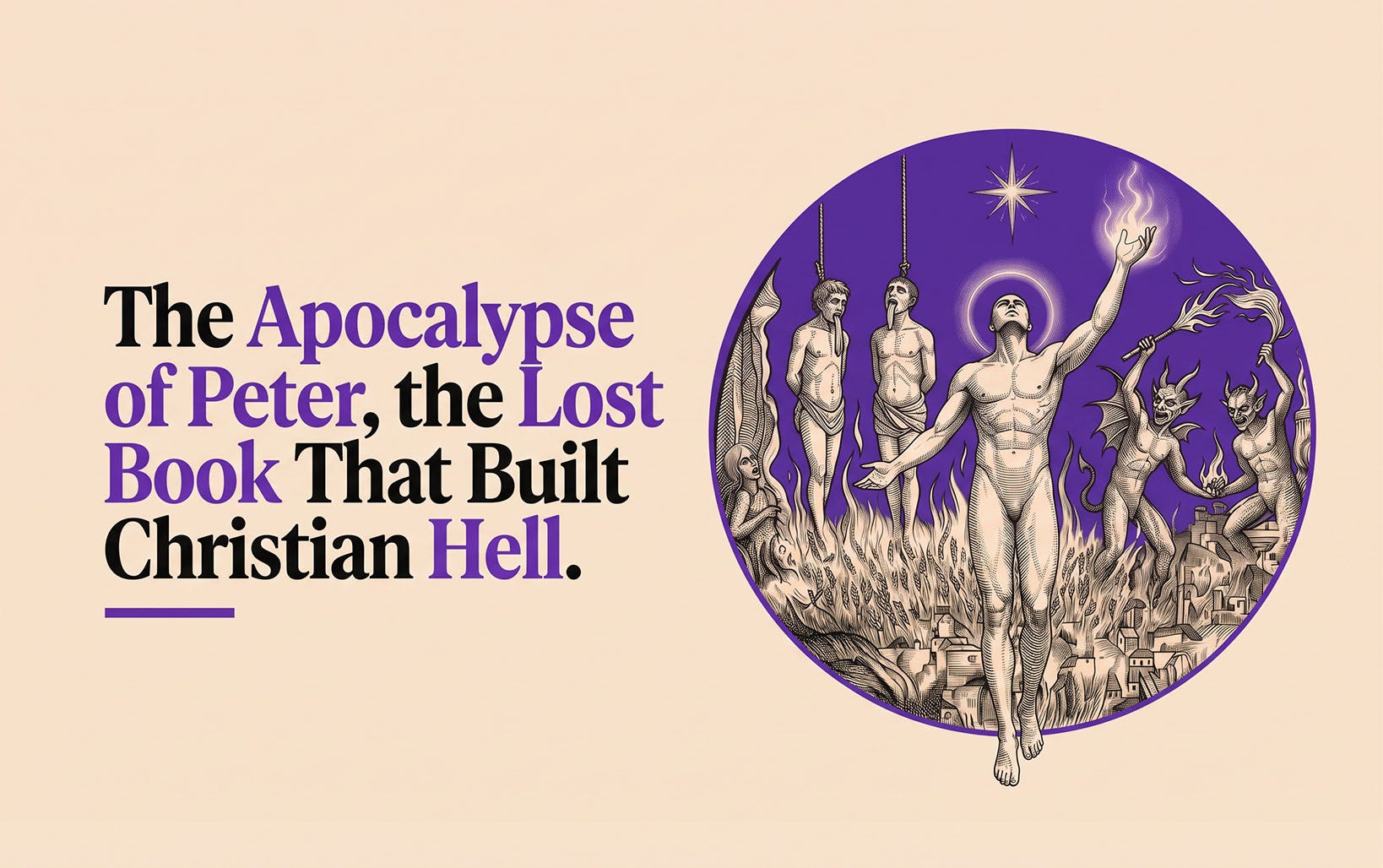
The book opens much like the end-times speech in Matthew 24, with Jesus on the Mount of Olives and the disciples asking for the signs of his return. Matthew’s answer is wars, famines, and false messiahs. The Apocalypse of Peter gives the same answer and then goes on: Jesus extends his hand and shows Peter what happens to the wicked after Judgment Day.
The catalog Peter witnesses:
Blasphemers hang by their tongues over flames.
Women who made themselves beautiful to lure men into adultery hang by their hair over boiling mud. The men who slept with them hang upside down by their feet, heads sunk in it.
Murderers are thrown into a pit crawling with venomous things, while the souls of the people they killed stand by, watch, and praise God for his fairness.
Loan sharks stand up to their knees in a lake of pus and blood.
False witnesses chew their own tongues with fire burning in their mouths.
The rich who trusted their money and let widows and orphans go hungry roll in rags over red-hot stones sharper than swords.
Women who had their babies aborted or left out to die sit up to their necks in a pit of filth. Across from them sit the children, crying out to God, and bolts of fire shoot from the children into their mothers’ eyes. The Ethiopic version adds that those children are handed to a caretaking angel to be raised. An angel named Ezrael, the angel of wrath, runs the whole operation.
Every punishment matches its crime, and usually it falls on the body part that committed the sin: the tongue that lied, the hair that seduced, the hands that grabbed the money (I wonder what happens to the adulterous men). Ancient readers knew the principle as measure for measure. Modern readers know it as the structure of Dante’s Inferno, where flatterers wallow in excrement and fortune-tellers shuffle along with their heads twisted around backward.
Where a Second-Century Writer Found His Torture Chambers
Long before the writer of the Apocalypse of Peter picked up his reed pen, Greek religion had been sending visitors to the underworld for centuries. Odysseus talks with the dead in the Odyssey. Plato ends the Republic with a soldier named Er who wakes up on his funeral pyre and reports how souls get judged, and the mystery cults handed their followers maps of the afterlife. Jewish writers had their own version. The Book of Enoch, the one I wrote about getting kicked out of the Bible, shows its hero in a hollow place in a mountain where the dead are held until judgment, sorted by what kind of people they were.
The Apocalypse of Peter even borrows a Greek landmark by name. In one Greek copy, the saved are baptized in the Acherusian lake. That’s the lake in Plato’s Phaedo where ordinary souls are cleansed before being sent back to be born again. A Christian writer reached into Greek myth, took one of its lakes, and gave it to Jesus.
His addition was scale and detail. Earlier texts tell you the wicked suffer, while this one tells you which wicked end up in which pit, with which part of their body, and who’s standing around watching.
Scripture in Egypt, Scripture in Rome
The Apocalypse of Peter was more than fan fiction, and the early church took it very seriously.
Clement of Alexandria, the leading Christian teacher in Egypt around 200, quotes it by name as scripture on the fate of abandoned infants. The Muratorian list, one of the oldest surviving lists of accepted Christian books, accepts exactly two apocalypses, John’s and Peter’s. It adds that some in the church don’t want Peter’s read aloud. Methodius, a bishop writing around 300, calls it divinely inspired. A sixth-century Bible manuscript, Codex Claromontanus, carries a list of scripture that includes the Apocalypse of Peter, placed after Revelation.
The doubts were there from the beginning, and they grew. Eusebius, the church historian writing in the early 300s, files it among the books he calls spurious, next to the Shepherd of Hermas and the Letter of Barnabas. Even so, more than a century after Eusebius, the historian Sozomen reports that some churches in Palestine still read it aloud once a year on Good Friday. On the day Christians mark the crucifixion, those congregations sat listening to women hanging by their hair over boiling mud.
It never made the final cut, and the reason is easy to see. Peter didn’t write it. The book dates to about a century after his death, probably the 130s, since one passage seems to have Bar Kokhba in view. Bar Kokhba led a Jewish revolt against Rome from 132 to 135, claimed to be the messiah, and punished Christians who wouldn’t join him. Church leaders sorting out the canon cared a great deal about who wrote what, and a book with no solid line back to Peter was always going to lose that fight.
Lost for Fourteen Centuries, Found in a Monk’s Grave
After that, the book faded out of Christian memory. For most of church history, scholars knew it only from those scattered mentions and a handful of quotations.
Then in the winter of 1886-87, a French archaeological team digging at Akhmim in Upper Egypt opened a grave believed to belong to a monk and found a small book buried with him. It held a piece of the Gospel of Peter and a long section of the Apocalypse of Peter in Greek. Somebody had cared about this book enough to take it into the ground with him.
A fuller version surfaced in an Ethiopic manuscript in 1910, folded inside a longer work about the second coming. The Ethiopian church, which kept Enoch and Jubilees after everyone else dropped them, had held on to this one too. Scholars generally treat the Ethiopic as the closer match to what the original said.
The Hell You Inherited From a Rejected Book
The book lost its canon fight, but its hell won. In the late 300s, someone wrote the Apocalypse of Paul, which lifted the tour of hell, expanded it, and handed it to the other great apostle. That book became one of the most copied texts of the Middle Ages, translated into Latin, Syriac, Coptic, Armenian, Slavonic and more. When Dante’s pilgrim hesitates at the start of the Inferno, he says he’s neither Aeneas nor Paul, the two men who’d already gone down to see the dead. His readers knew which journey of Paul’s he meant, and it isn’t in the Bible.
The preacher describing specific torments for specific sins, the church wall painted with devils shoveling sinners into the fire, the Inferno assigned in literature classes: all of it runs back through Paul’s tour to Peter’s. The detailed hell most Christians carry in their heads came from a book the church decided wasn’t scripture, and almost nobody sitting in the pews has heard of it.
The Clause That Let the Damned Out
The strangest part of the Apocalypse of Peter comes near the end, after all the torture is done. It says something about who gets out of hell that later Christians found so disturbing that copyists muddied it, rewrote it, and in one case scrawled an angry note in the margin. That passage, what the copyists did to it, and the theologian they blamed for the whole idea are in the supporter bonus below.
If you’ve been reading free, this is a good one to upgrade for. Supporters keep The Unholy Truth running, and you can still comment on every post either way.
The Exclusive Content for Paid Subscribers
The Universalist Secret Scribes Tried to Erase
The most dangerous idea in early Christianity wasn’t that Jesus was a revolutionary, nor was it that the Roman Empire was doomed. It was the idea that…