

Today we’re stepping away from manuscripts and ancient texts and into religion as it exists in modern society, and into how a country argues with itself over what belongs in a classroom.
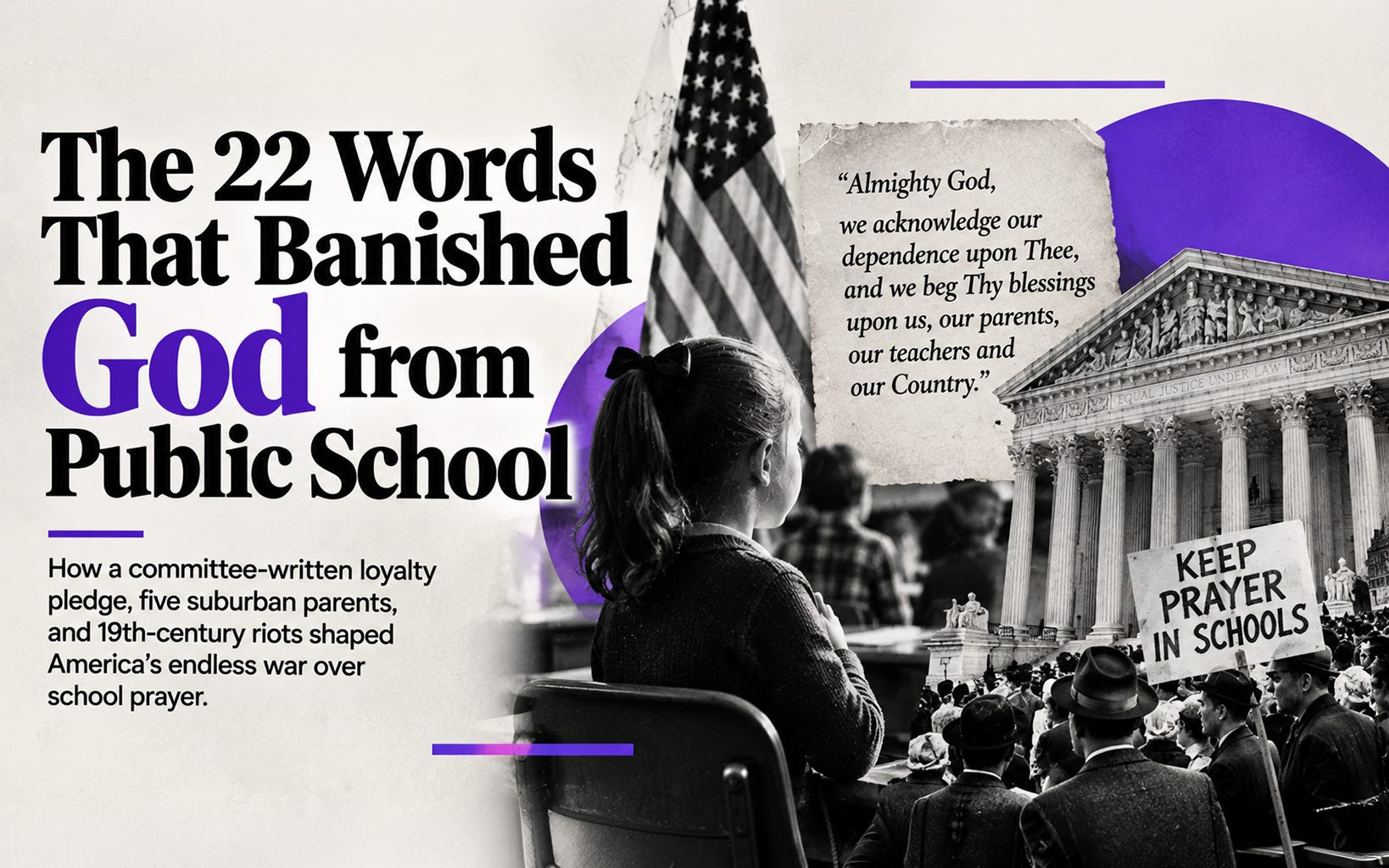
“Almighty God, we acknowledge our dependence upon Thee, and we beg Thy blessings upon us, our parents, our teachers and our Country.”
The whole thing is these twenty-two words. This is the very text at the center of Engel v. Vitale, the 1962 decision that six decades of American political speech treats as the day God was thrown out of the public schools.
The New York Board of Regents Composed It by Committee
The Board of Regents sets education policy for the state of New York. In 1951 it issued a statement on moral and spiritual training in schools, and this prayer came attached as a recommendation to local districts.
You can hear the committee in the language. The Regents wanted something no denomination could object to, so they wrote around every point of doctrine that has ever divided anyone. There’s no Jesus, no Trinity, no Torah, no scripture, no request beyond a general blessing. God gets acknowledged, and then parents, teachers, and country get mentioned in the same breath. It’s a loyalty exercise with a deity in the first line, and it was designed that way on purpose so that Catholic, Protestant, and Jewish parents in the same classroom would all find it inoffensive.
No district was required to use it. Yet, the school board in New Hyde Park, out on Long Island, adopted it and directed that it be said aloud at the start of each day.
Five Parents Sued, and Their Neighbors Punished Them for It
The suit was brought by five parents in the district, among them Steven Engel and Lawrence Roth. Between them they were Jewish, Unitarian, a member of the Ethical Culture Society, and one man who believed in nothing at all. The defendant, William Vitale Jr., was the president of the school board, which is how a case about a state prayer ended up carrying two ordinary Long Island surnames.
The families paid for it. Engel and his household got obscene phone calls, taunts in the street, and the treatment a small suburb reserves for people who embarrass it. This is worth remembering when the case gets described as an elite imposition from above. It started with parents who had to keep living next door to everyone who hated them for it.
Hugo Black Built His Opinion Out of English History
The Court ruled on June 25, 1962, by six to one. Justice Hugo Black wrote the majority. Justice Potter Stewart dissented alone, and two justices took no part.
Black was raised Baptist in rural Alabama, and the argument he wrote has nothing to do with disbelief. He went back to the Book of Common Prayer, the single order of worship that the English government imposed by act of Parliament in the sixteenth century, revised whenever the throne changed hands, and enforced against everybody who wanted to pray differently. The people who couldn’t stomach it got on ships. Some of them founded the colonies that became this country, and their descendants wrote the clause Black was interpreting.
His line was that it’s not the business of the government to compose official prayers for Americans to recite as part of a religious program the government runs. The objection isn’t to prayer. The objection is to a state board of education deciding what worship should sound like in a room where attendance is compulsory.
The Southern Baptists Called It a Victory
Herschel Hobbs, then president of the Southern Baptist Convention, said the ruling had struck one of the most powerful blows of his lifetime for the freedom of religion, and that believers should be eternally grateful for it. H.H. McGinty, editor of the Missouri Baptist paper Word & Way, wrote that the Court was right and justified. Denominational leadership backed the decision, and the Convention passed a resolution in 1964 endorsing that position.
Baptists had four centuries of practice at being the people whose worship the state disapproved of, and they could see what a government-written prayer implied. If Albany can compose the words your child says every morning, Albany has taken a position on how God should be addressed.
The denomination that now leads school prayer campaigns spent 1962 congratulating the Supreme Court for ending one.
Fifty Constitutional Amendments in Three Days
The backlash came from a different direction and it came fast. Within three days of the decision, more than fifty constitutional amendments to overturn it had been dropped in Congress. Representative Frank Becker of New York pushed the best known of them and forced the House Judiciary Committee, whose chairman, Emanuel Celler, wanted nothing to do with the subject, into eighteen days of hearings in the spring of 1964.
Nothing passed. Nothing has passed since. Ronald Reagan made a school prayer amendment a personal priority and got it to the Senate floor in March 1984, where it drew fifty-six votes in favor and forty-four against, eleven short of the two-thirds required. Sixty-four years of attempts have produced no amendment and a great many speeches.
Paid subscribers make The Unholy Truth possible. If you can afford it, this is the way to keep it going.
What Ruling Never Touched
Students can pray in public schools, and they could in 1962 just as they can now. They can pray silently, aloud, alone, in groups, over lunch, before a test, in a club that meets on school property with the same access any other club gets. A teacher can’t lead it and a district can’t script it.
The follow-on cases went after school-sponsored exercises for the same reason: devotional Bible reading and the Lord’s Prayer as official practice in 1963, clergy-led graduation prayers in 1992, student prayers broadcast over the stadium loudspeaker before football games in 2000.
The direction reversed in 2022, when the Court sided with a high school football coach who prayed at midfield after games and threw out the older test for these cases. “Our Father in Heaven, never mind the starving children and struggling elderly, pay some attention to what we do for fun today so that I can negotiate a higher salary next season.”
That’s the ground the Texas Ten Commandments law is being argued on right now, with a petition in front of the justices as of last month. Whatever the justices do with it, the fight is over who gets to write what goes on the wall and who has to sit in front of it. Students keep the right to pray either way.
And that brings us to the biggest irony in this entire political exercise.
Politicians who campaign on putting the Ten Commandments back into public-school classrooms are not necessarily acting out of religious conviction and might as well be atheists. They are acting in a political environment where the gesture earns points with a particular electorate. If putting the commandments on classroom walls were politically costly, the same politicians championing these laws would suddenly discover other priorities.
If even a small fraction of regular readers became supporters, I’d spend less time running the business side of this publication and more time in the archives doing the research this work demands.
If you’re getting something out of these pieces, consider supporting The Unholy Truth. Supporters get the bonus sections, the Friday Editions, and the full archive.
Support the work and unlock exclusive content for full stories.
Sources and Further Reading
Engel v. Vitale, 370 U.S. 421 (1962), full text at Cornell Legal Information Institute
The First Amendment Encyclopedia, “Engel v. Vitale”, Middle Tennessee State University
Congressional Research Service, “School Prayer: The Congressional Response, 1962-1998”
Word&Way, “Supreme Rule for Christian Nationalism”, on Baptist reaction in 1962
Abington School District v. Schempp (1963); Lee v. Weisman (1992); Santa Fe ISD v. Doe (2000); Kennedy v. Bremerton School District (2022)
Steven K. Green, The Bible, the School, and the Constitution: The Clash That Shaped the Modern Church-State Doctrine (Oxford, 2012)
Ray Allen Billington, The Protestant Crusade, 1800-1860, on the Philadelphia riots
Minor v. Board of Education of Cincinnati (Ohio, 1872)
Here's a question. A bunch of religious organizations (and their political representatives) want the Ten Commandments posted in schools, courtrooms. But why the 10 Commandments? I thought faith in Jesus made the law of the Old Testament unnecessary. But more important, Jesus never refers to the 10 Commandments. Why not just post the commandment that Jesus thought was the most important - Love your neighbor as yourself.
I can remember being led in sectarian prayer (including Jesus) in school in the early 60s. Unfortunately I can't recall what year it stopped, so I don't know if it was before or after the ruling.