


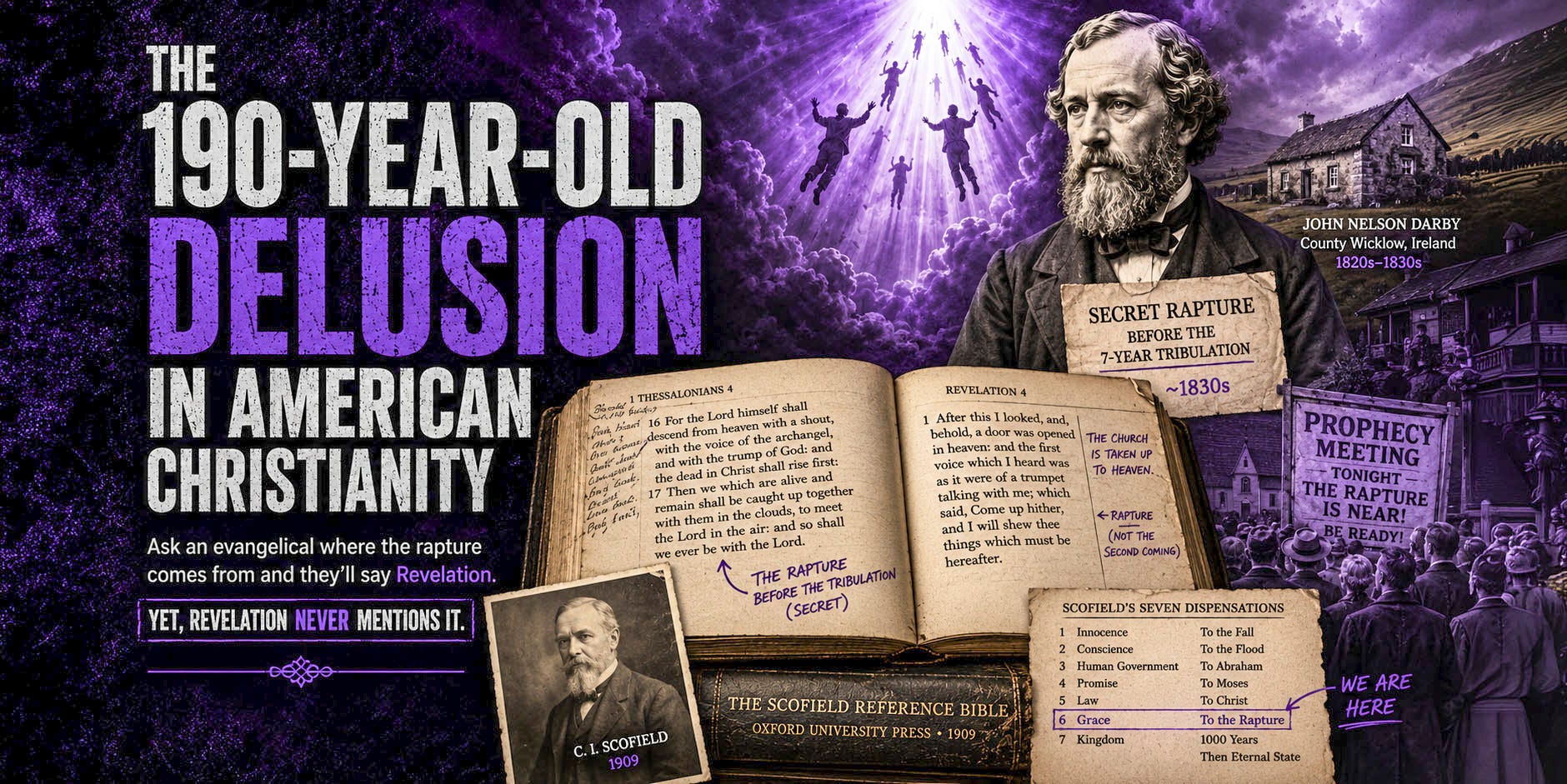
An American evangelical will assert with full confidence that the rapture comes from Revelation, which is awkward, because Revelation never mentions it. The book runs twenty-two chapters through seals, trumpets, bowls, a dragon, a woman on a beast, a lake of fire, and a new Jerusalem, and nowhere in any of it do Christians vanish off the earth ahead of the trouble. The whole doctrine rests on two verses in a letter Paul wrote to a small congregation in Greece, plus a line in Matthew about two men working in a field. Nobody read those passages as a secret evacuation until roughly the year Joseph Smith published the Book of Mormon.
Behind this confidence runs a chain of people who each took the doctrine on delivery from whoever stood in front of them, and no one in the line ever went back to ask where the first copy came from. That’s how faith handles knowledge. You inherit the finished product, you defend it, and going looking for its origins feels like disloyalty rather than curiosity. The rapture is the clearest case I know of, because the assembly work happened recently enough that we can name the men, the room, and the year.
This post features exclusive content available only to supporters.
What Paul Wrote to Thessalonica
The verses are 1 Thessalonians 4:16-17. Paul tells a worried congregation that the Lord will descend with a shout, with the voice of an archangel and the trumpet of God, that the dead in Christ will rise first, and that those still living will be caught up together with them in the clouds to meet him in the air. The Greek verb for “caught up” is harpazo, which the Latin Bible renders rapiemur, and that Latin is where the English word rapture comes from.
Read the passage as Paul’s readers would have. There’s a shout, an archangel’s voice, and a trumpet, which is the loudest arrival anybody in the first century could imagine, and the dead are climbing out of the ground in front of everyone. Nothing about it is secret, and nothing in it happens in two stages. The pre-tribulation rapture takes that single event and splits it in half, putting years of catastrophe between the quiet removal of the church and the public return of Christ. Paul never suggests a gap. Neither does anyone else in the New Testament.
The church didn’t suggest one either. Irenaeus, the bishop of Lyons writing around 180, spends the fifth book of Against Heresies explaining how Christians will endure the reign of the antichrist, because he assumed they’d be here for it. That expectation held for the next seventeen centuries, through Augustine, through the medieval church, through Luther and Calvin, through the Puritans. Two candidates get offered as early exceptions, a sermon wrongly attributed to Ephraem the Syrian and a 1744 essay by the Welsh Baptist Morgan Edwards, and both are single ambiguous passages that produced no followers, no movement, and no doctrine. A tradition needs more than two disputed paragraphs in eighteen hundred years.
County Wicklow, and a Curate Who Quit
John Nelson Darby trained as a lawyer at Trinity College Dublin, gave up the bar for the ministry, and served as an Anglican curate in the Wicklow mountains south of Dublin. He resigned in 1828 over the established church’s entanglement with the British state and threw in with the Plymouth Brethren, a movement built on the conviction that the visible church had failed past repair.
That conviction is the engine of everything he built next. If the institutional church is a ruin, then God’s real plan has to be running somewhere else, and Darby found it by separating Israel and the church into two distinct peoples with two distinct destinies. Once you hold them apart, the prophetic clock for Israel can’t run while the church is on the ground, so the church has to be taken out of the way before the final seven years begin. The secret rapture solves a problem that only exists if you’ve already accepted Darby’s division.
He worked this out in front of an audience. Lady Powerscourt hosted prophecy conferences at her estate in County Wicklow through the early 1830s, and by 1833 Darby dominated the proceedings. Mark Sweetnam and Crawford Gribben, who’ve done the closest work on the Irish origins of all this, point out that no minutes were kept, which is why the exact moment of invention stays blurry. What the record does show is that Darby’s earliest published prophetic writing, from 1829, expects the church to go through the tribulation, and that the secret removal appears afterward. There’s a popular claim that he lifted the idea from a fifteen-year-old Scottish girl named Margaret MacDonald, who had a prophetic vision in Port Glasgow in 1830. F. F. Bruce, the Manchester biblical scholar, judged direct borrowing unlikely and said the material was in the air. Either way the date holds, and the date is the point.
Seven Crossings and a Country That Said Yes
Britain mostly shrugged. Darby’s own movement split over him, and the Church of England had no use for a man who’d walked out of it. Between 1862 and 1877 he made repeated preaching tours of North America, and there the reception ran the other way.
Postwar America, on the other hand, was apparently the ideal soil. It had a Bible-reading Protestant public, thousands of independent congregations, no bishop anywhere with the authority to rule an interpretation out of bounds, and a recent experience of national catastrophe that made end-times arithmetic feel urgent rather than eccentric. Darby’s system spread through the summer prophecy meetings, above all the Niagara Bible Conference, and picked up the endorsement of Dwight L. Moody, the most famous evangelist in the country. By the 1890s a network of pastors, Bible institutes, and periodicals was teaching it as the plain sense of scripture.
The Kansas Lawyer Who Put It in the Margins
Cyrus Ingerson Scofield enlisted in the Confederate 7th Tennessee Infantry at seventeen, fought at Antietam, got a discharge, was conscripted again, and deserted across Union lines into Kentucky. He read law in St. Louis, won a seat in the Kansas legislature, and became United States Attorney for Kansas at twenty-nine, then resigned in 1873 while under investigation for his handling of money. His wife divorced him in 1883 for desertion, and he remarried the same year. He’d converted in 1879, and he was ordained a Congregationalist minister in 1883 with no theological education of any kind. Through the 1890s he signed himself Rev. C. I. Scofield, D.D., and no institution on record ever granted him the degree.
In 1909 Oxford University Press published his reference Bible, and the design did the work. Scofield’s notes sit on the same page as the King James text, the first English Bible to run commentary alongside scripture that way since the Geneva Bible of 1560. A farmer in Missouri opening it at 1 Thessalonians 4 found Paul’s words on top and Darby’s system underneath, in the same typeface, inside the same leather binding, over the imprint of Oxford. The edition sold more than two million copies by the end of the Second World War, and it became the standard study Bible of American fundamentalism. Millions of readers learned the two-stage second coming as something they’d read in the Bible, because in the only sense that mattered to them, they had.
Everything downstream runs through that page. Dallas Theological Seminary opened in 1924 to train pastors in the system. Hal Lindsey’s The Late Great Planet Earth came out in 1970 and sold ten million copies inside the decade and twenty-eight million by 1990, making it the best-selling nonfiction book of the seventies. The Left Behind novels arrived in 1995 and moved tens of millions more. Somewhere along the way a prophecy timeline drafted by an Irish curate hardened into a voting bloc’s position on Middle Eastern policy, which is a strange fate for a footnote.
Count the Years
The empty driver’s seat, the clothes on the floor, the bumper sticker warning you the car will be unmanned, the church-basement arguments over whether the church goes up before, during, or after the tribulation, the wall charts with their seven-year blocks, the countdown sermons keyed to the evening news. All of it is younger than the Book of Mormon, younger than the Alamo, younger than the presidency of Andrew Jackson. Not one Christian on earth held the belief when the United States was founded.
The people who’ll tell you they take the Bible literally, without additions, without tradition, without a magisterium putting words in God’s mouth, learned their end of the world from a nineteenth-century Irishman’s notes printed in the margin, and they’ve never once noticed the margin.
In the exclusive content section for supporters, I’ve pulled the Scofield notes themselves, the annotations on 1 Thessalonians 4 and Revelation 4:1 that turned a private theory into scripture for millions, along with his seven dispensations exactly as he printed them and a breakdown of how the page layout did the persuading.
So where did you first hear it? If you grew up being told the rapture was in Revelation, I want to know who told you, and what happened the first time you went looking for the verse. Comments are open.
If even a small fraction of regular readers became supporters, I’d spend less time running the business side of this publication and more time in the archives doing the research this work demands.
If you’re getting something out of these pieces, consider supporting The Unholy Truth. Supporters get the bonus sections, the Friday Editions, and the full archive.
Support the work and unlock exclusive content for the full story.
Sources and Further Reading
Ernest R. Sandeen, The Roots of Fundamentalism: British and American Millenarianism, 1800-1930 (University of Chicago Press, 1970)
Timothy P. Weber, Living in the Shadow of the Second Coming: American Premillennialism, 1875-1982 (University of Chicago Press, 1987)
Paul Boyer, When Time Shall Be No More: Prophecy Belief in Modern American Culture (Harvard University Press, 1992)
Matthew Avery Sutton, American Apocalypse: A History of Modern Evangelicalism (Harvard University Press, 2014)
Daniel G. Hummel, The Rise and Fall of Dispensationalism (Eerdmans, 2023)
Mark S. Sweetnam and Crawford Gribben, “J. N. Darby and the Irish Origins of Dispensationalism,” Journal of the Evangelical Theological Society 52 (2009)
Bart D. Ehrman, Armageddon: What the Bible Really Says about the End (Simon & Schuster, 2023)
The Scofield Reference Bible (Oxford University Press, 1909; revised 1917)
Irenaeus, Against Heresies, Book 5
My upbringing was rooted in a strict evangelical tradition (Missionary Baptist), one where the "old ways" were the only way. My father was a blue collar preacher, a minister who quietly served while following the prescribed path with unquestioning diligence. Most of my extended family—grandparents, uncles, aunts, and cousins—were also deeply involved in the same fundamentalist religious culture. My family had flaws, but overall they were loving, nurturing people. Their particular framework of belief, however, was all they knew, all they wanted to know, and to them anything outside of it was simply wrong. They were wholeheartedly convinced of this, including the end times prophecy you address here.
Naturally, that was the perspective I absorbed growing up. For a long time it was all I knew. Yet from an early age I carried an unarticulated, little understood discomfort with those core ideas, a discomfort that only grew stronger as my world gradually broadened. I spent my early adulthood struggling to reconcile those beliefs with what I felt deep inside. Although it did not happen overnight, by my late thirties—unable to embrace that worldview any longer—I walked away from nearly everything I had been taught. In its place, I found a way of understanding life that made complete sense to me. It was not something entirely new, but something I had sensed all along without being able to fully articulate, because it was fundamentally different from anything I had been given language for. Now at age 70 I look back with a measure of amusement and satisfaction at my experience. Your articles provide the studied evidence of the inconsistenties I had sensed early on.
The Book of Enoch (dropped by the Catholic Church, maintained by the Ethiopian Church) is relevant because it has a timeline explaining the entire 7,000 years of the existence of this heaven and earth. It gets anchored in history with the Babylonian Captivity. According to the timeline, the Millennium started in 1187 CE, and thus Judgement Day is 2287 CE. Thus the Tribulation (which Enoch doesn't mention) already happened. And there was no Rapture.
Interestingly, after Enoch got dropped from the Canon that became the Bible, Revelation got added. And it's Revelation that talks about the Tribulation. Also, before being accepted by the Catholic Church, Revelation was maintained by heretics, and the Catholics carefully checked the text for heresy before adopting it.