


When Captain James Cook’s ship runs aground on the Great Barrier Reef in the winter of 1770, the crew is marooned for seven weeks on the northeastern coast of Australia. As the naturalists walk the bushland, they catch sight of a creature unlike anything in European classification: a tall, muscular animal that bounds across the scrub on two legs, balancing on a heavy tail.
Cook points out the strange grey beast to a local Indigenous man and asks what it’s called. The man looks at the captain, shrugs, and replies, “Kangaroo.”
In the language of the Guugu Yimithirr people, “kangaroo” means “I don’t understand what you’re saying,” not the word the locals used for the animal, as Cook interpreted it.
The story is a myth, unfortunately, but it still captures what happened to “Son of Man” in translation. Let me explain.
Subscribe for free to get the next origin story in your inbox, and upgrade whenever you want the bonus sections.
Either way, thank you for being here.
“Son of Man” in the Bible
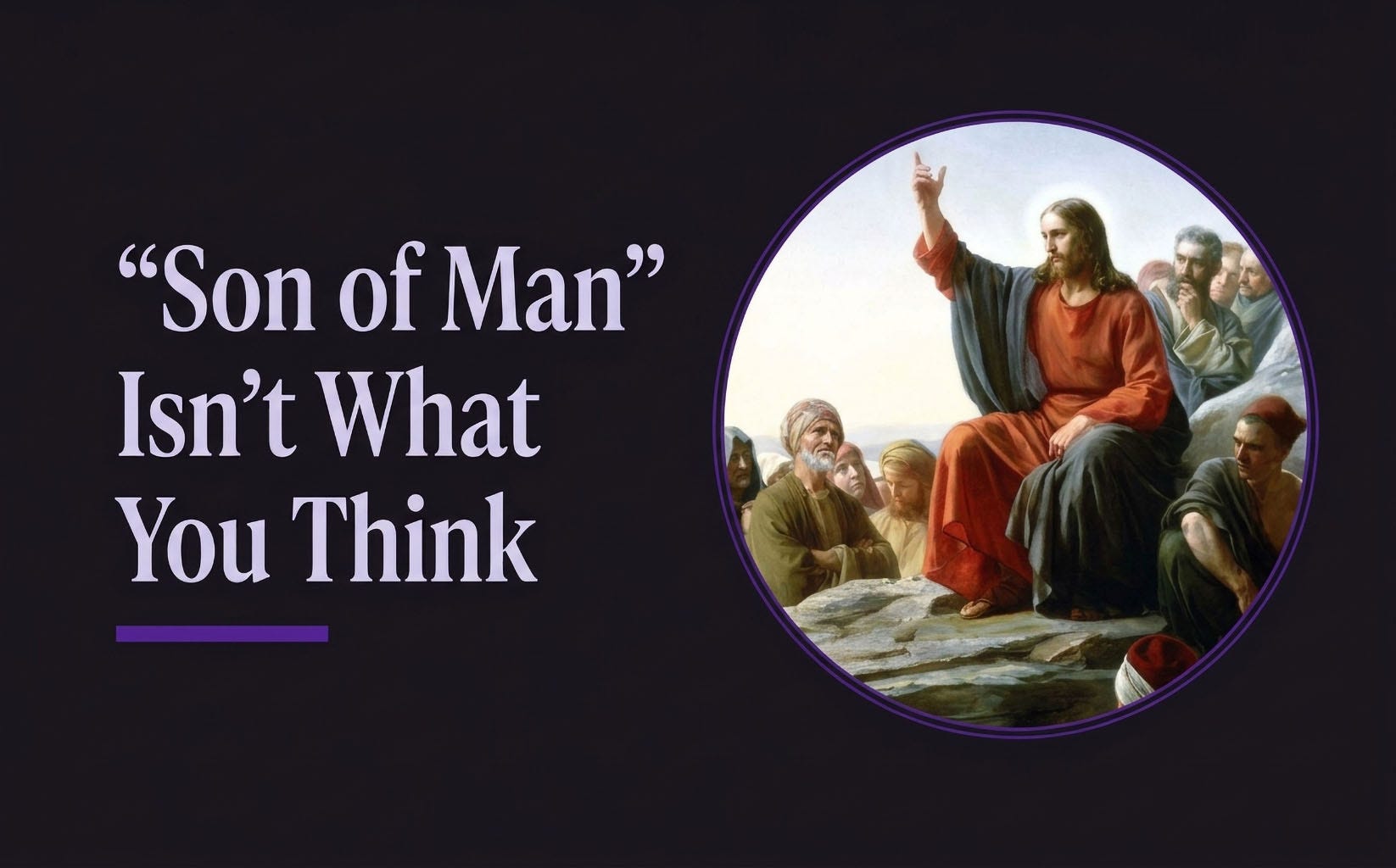
Jesus’ favorite name for himself appears about 80 times in the Gospels, putting it far ahead of “Messiah” and “Son of God.” Churches have had two thousand years to explain it, and they’ve produced two explanations that point in opposite directions: one says the name is about his humanity, the other says it’s the highest claim he ever made. The people who stood before him in Galilee would’ve been baffled by both. The reason has been sitting in the Old Testament the whole time, in a book where God uses the same phrase 93 times for somebody else.
The Name Nobody Else Says
Something is off about “the Son of Man” before its meaning even comes up. Jesus says it constantly, and almost nobody else in the New Testament says it at all. The Gospel narrators never use it in their own voice, and the disciples never call him that. Paul, whose letters are the earliest Christian writing on record, covers Jesus’ death, resurrection, and return in detail and doesn’t use the phrase once.
When it finally comes out of a crowd’s mouth, in John 12:34, it comes as a question: “Who is this Son of Man?” A title that supposedly announced who Jesus was left his own audience asking what he was talking about.
The Greek is strange too. Word for word it reads “the son of the man,” which no Greek speaker would’ve come up with unprompted. It’s a stiff translation of something said in another language, and what it meant in that language is where both church answers start to wobble.
Two Answers That Can’t Both Be Right
The first reading, the one taught in most churches, holds that Son of God names Jesus’ divine side and Son of Man names his human side. It dates to the early second century, when Christian writers working in Greek began pairing the two phrases as matching labels for his divinity and humanity, and the pairing settled into sermons, hymns, and catechisms for the next eighteen centuries.
The second reading, taught in seminaries and apologetics books, starts from Daniel 7:13-14, where the seer watches four monstrous beasts rise out of the sea and then sees “one like a son of man” arrive with the clouds of heaven to receive everlasting rule over every nation. On this reading, each “Son of Man” saying in the Gospels is a claim to cosmic authority, the most exalted thing Jesus could’ve called himself.
The same three words are therefore taught as both the humblest and the grandest thing Jesus said about himself. Both readings rest on one undefended assumption: that the phrase is a title, and the Old Testament’s own use of the phrase puts that assumption to the test.
What a Galilean Crowd Heard
If “son of man” is a claim to rule the nations, the prophet Ezekiel got there first, because God calls him “son of man” 93 times. Nobody has ever built a doctrine on that, and modern translations show why. Many of them print the phrase in Ezekiel as “mortal.”
Psalm 8:4 does the same thing in a single verse, setting “man” and “son of man” side by side as one idea said twice. Numbers 23:19 says God is no man who lies and no son of man who changes his mind. In Hebrew and in Aramaic, the language Jesus taught in, “son of” marks membership in a group. “Sons of the prophets” are members of a prophets’ guild, “sons of Israel” are Israelites, and a “son of man” (bar enasha in Aramaic) is a member of the human race: a person, somebody.
That includes the verse the exalted reading is built on. Daniel’s figure is “one like a son of man,” a humanlike shape set against four beasts, in the same chapter where the first beast is “like a lion.” The chapter then explains its own vision (7:18, 7:27) and says the humanlike figure stands for “the holy ones of the Most High,” the faithful people of Israel.
Aramaic speakers also used the phrase in ordinary talk to mean “a person” or “one,” often when saying something about themselves that they wanted to put modestly, much as an English speaker says “a guy’s got to eat.” Read with that in mind, some of the Gospel sayings change. In Mark 2:27-28 Jesus says the sabbath was made for people, “so the son of man is lord even of the sabbath,” and the “so” only works if the son of man is the same people he just mentioned. In Mark 2:10 the son of man has authority on earth to forgive sins, and Matthew’s telling of that scene ends with the crowd praising God for giving such authority “to human beings” (9:8), in the plural. “Foxes have holes, and birds of the air have nests, but the son of man has nowhere to lay his head” (Matthew 8:20) is a homeless preacher talking about a life like his.
If every Son of Man saying sounded like the one about foxes, the seminary reading would be finished. What keeps it alive is a question about what Aramaic could and couldn’t say.
Upgrading is what keeps The Unholy Truth running and unlocks the bonus section at the end of each post.
The Idiom in the Dust
For two thousand years, people have argued about whether “Son of Man” was a title that emphasized Jesus’ humanity or his divinity. But the original phrase does not fit into either category. When Jesus used it, he was speaking the ordinary language of everyday people, not using a grand religious title. It was a common expression that reflected the shared human experience of weakness, hardship, and mortality.
Later, when the Gospels were written in Greek, the phrase was translated as “the Son of Man.” That translation made it sound like a special title. Over time, what had once been a living, everyday expression became a technical theological term.
In a sense, generations of readers built a huge theological structure around a phrase that may originally have meant something much simpler: a human being, a person like you, standing right here among you.
Read the Paid Subscriber Bonus Section
Free readers get the story. Paid subscribers get the receipts. Upgrade today to unlock the breakdown of how Geza Vermes, Maurice Casey, and Joseph Fitzmyer dismantled two thousand years of translation errors using first-century inscriptions and dead languages.
Sources and Further Reading
Maurice Casey, The Solution to the “Son of Man” Problem (T&T Clark, 2007)
Geza Vermes, Jesus the Jew: A Historian’s Reading of the Gospels (Collins, 1973)
Delbert Burkett, The Son of Man Debate: A History and Evaluation (Cambridge University Press, 1999)
John J. Collins, Daniel: A Commentary on the Book of Daniel (Hermeneia, Fortress Press, 1993)
Bart D. Ehrman, Jesus: Apocalyptic Prophet of the New Millennium (Oxford University Press, 1999)
Larry W. Hurtado and Paul L. Owen (eds.), “Who Is This Son of Man?” (T&T Clark, 2011)
George W. E. Nickelsburg and James C. VanderKam, 1 Enoch 2: A Commentary on the Book of 1 Enoch, Chapters 37-82 (Hermeneia, Fortress Press, 2012)
Exclusive Content for Paid Subscribers
The 130-Year Paper Trail Behind the Aramaic Reading
The reading of “Son of Man” as ordinary Aramaic for “a person” is often dismissed in churches as a recent theory designed to diminish Jesus. It first appeared in print in 1896. Since then it has been tested against every piece of Aramaic recovered from the period, and the scholars who tested it…
“ What if God was one of us?
Just a slob like one of us?
Just a stranger on the bus,
Trying to make his way home?”
https://music.amazon.com/albums/B01LZKEN0P?do=play&trackAsin=B01LZ8KS0I&ts=1794404626&ref=dm_sh_WQwOPFT8Sp3G6TP5aY1rlvwIP
"On this reading, each “Son of Man” saying in the Gospels is a claim to cosmic authority, the most exalted thing Jesus could’ve called himself." Daniel 7:13-14
Daniel seems kind of a bad book to link rational ideas to. I appreciate your erudition, but this comes across as a no brainer to me. Nevertheless, you do write extremely well.