


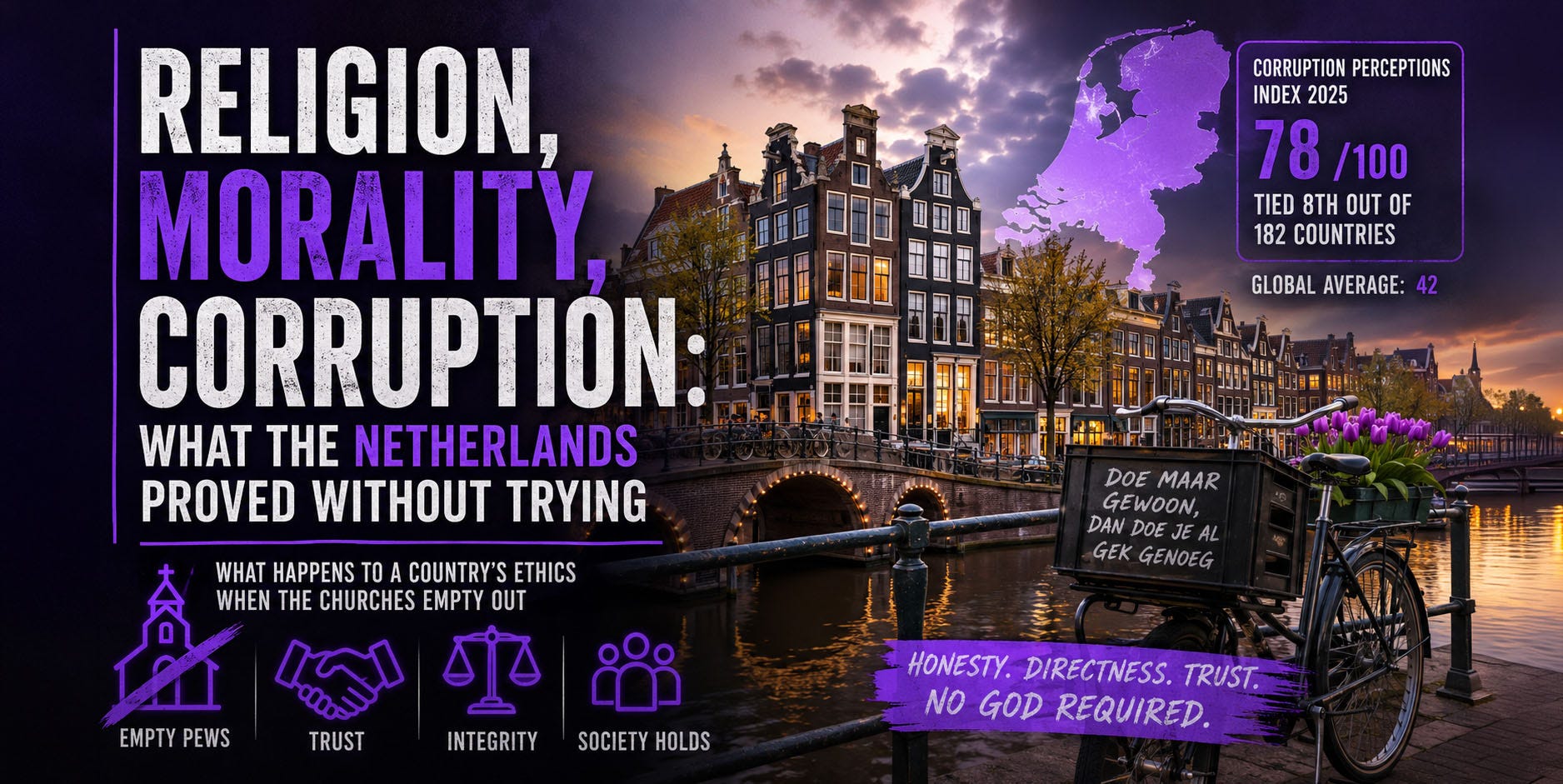
There’s a claim you hear from American pulpits too often: take away God and you take away morality. With no divine judge there’s no reason to behave, so society rots from the inside out, lying becomes normal, corruption spreads, and the whole thing collapses into hedonism and theft.
There are two major problems with this panic. First, defending faith purely for its social utility rather than its validity, treating God as a necessary piece of social engineering, is a remarkably unflattering case for belief. Second, we already have a test case: the Netherlands has been running this secular experiment for sixty years. The results are finally in, and they are inconvenient for everyone, including those who want this to be an inspiring story about religion holding a nation back.
Sixty Years of Emptying Pews
In the late 1960s, roughly seven in ten Dutch people identified as religious. By 2025, Statistics Netherlands put the figure at 42 percent of residents aged 15 and up who identified with a church, religion, or philosophical group, down from 44 percent the year before. That leaves 58 percent reporting no religious affiliation at all.
The identification numbers flatter the situation. Only 13 percent of Dutch people over 15 attended a house of worship monthly in 2025, and among Catholics, the largest single religious bloc, just 14 percent showed up that often. So the country's biggest religion consists mostly of people who tick a box on a form and never darken a door. Limburg, the one province with hills in an otherwise famously flat country, is the last place where religious identification holds a majority, and even there only 8 percent attend services monthly.
Age tells the rest of it: 59 percent of Dutch people over 75 call themselves religious, compared with 30 percent of 18-to-25-year-olds.
If the pulpit theory held, the Netherlands should be a moral wasteland by now, sixty years into the free fall, with the last practicing believers dying off and nothing left to hold the place together.
The Country Got Cleaner Instead
In Transparency International’s 2025 Corruption Perceptions Index, the Netherlands scored 78 out of 100, tied with Luxembourg at eighth place among 182 countries. The global average that year was 42, with more than two-thirds of ranked countries scoring below 50. The United States, which is considerably more religious, came in 29th with a score of 64.
Look at the rest of the top ten and the pattern gets worse for the argument. Denmark, Finland, New Zealand, Norway, Sweden, Switzerland, Iceland: this is a roster of the most secularized societies on earth. The correlation between low religiosity and low corruption isn’t perfect, and Singapore sits at number three without much secularism to speak of. But if you were building a case that abandoning God produces institutional rot, you’d want the evidence pointing in the opposite direction from where it’s pointing.
The Dutch didn’t get cleaner despite losing religion. Both things happened over the same decades, and one didn’t cause the other.
Pillarisation, and What It Left Behind
For most of the 20th century, Dutch society ran on verzuiling, pillarisation. Catholics, Protestants, socialists, and liberals each had their own schools, newspapers, broadcasters, unions, sports clubs, and political parties. You could live your whole life inside your pillar and never meaningfully interact with anyone from another one.
The system had an unintended consequence. Since no pillar could ever win outright, everything had to be negotiated. Governing meant sitting down with people whose worldview you considered wrong and hammering out an arrangement everyone could live with. This produced what the Dutch call the poldermodel, consensus-building as a national reflex, and it required a specific kind of honesty. Coalition partners who lie to each other can’t build anything. In a country where no faction ever holds a majority, your word functioning as collateral isn’t a moral nicety. It’s infrastructure.
Then the pillars began to collapse in the 1960s; the churches emptied out, nonetheless the habits stayed.
That’s the part the “no God, no morality” argument can’t process. Dutch honesty was never load-bearing on theology. but on the practical necessity of dealing with people you’d have to deal with again next week, and on institutions built to make that possible. A 2025 Radboud University study found that fears about social cohesion crumbling as churches emptied appear unfounded: most Dutch people still report feeling well connected through social networks and maintain trust in others. The scaffolding came down and the building stayed up, because the scaffolding was never the building.
Directness Isn’t Permissiveness
Which brings us to the reputation problem. Foreigners see legal weed, a regulated paid sexual services market (a.k.a red light district), euthanasia, same-sex marriage since 2001, and conclude the Dutch are the loosest people in Europe.
They’ve confused two entirely different things. Dutch policy tolerance is about what the state does with behavior it can’t stop anyway. Dutch social conservatism is about how you’re expected to behave in front of other people, and on that front the country is unforgiving in ways Americans consistently underestimate.
There’s a phrase for it: doe maar gewoon, dan doe je al gek genoeg. Just act normal, that’s crazy enough already. It’s an instruction to not be conspicuous, not show off, not put yourself above anyone. Tall poppy syndrome with a Calvinist accent, and it survived Calvinism by decades. Dutch curtains stay open, a habit with genuinely Protestant roots (nothing to hide, nothing to see), and the social logic of it outlived any theology behind it.
Now add the directness and Dutch bluntness reads to outsiders as rudeness, yet it’s the very operating principle of a low-corruption society. If you can tell your boss his plan is bad in a meeting, in front of everyone, without career consequences, then bad plans get caught early and nobody has to whisper. Flat hierarchy plus mandatory candor is an anti-corruption mechanism, which might seem bad manners to outsiders. Corruption needs deference and it needs silence. The Dutch supply neither.
Lying, in this setup, isn’t a sin against God. It’s a violation of the thing that makes the whole arrangement work, and the response to it is social rather than theological: you become someone whose word means nothing, in a small country where everyone will remember.
Not a paid subscriber yet? Consider joining to keep The Unholy Truth alive.
What the Dutch Case Costs Both Sides
The believers who insist morality requires God have to explain how the least religious countries in Europe run the cleanest institutions in the world.
The atheists who think dropping religion automatically upgrades a society don't get an easy win either. Dutch integrity wasn't produced by unbelief, and the Dutch case backs up what I argued in Sorry, Killing Religion Won't Save Anyone: it was produced by centuries of institutions that made honesty structurally necessary, some of them built by churches. The Netherlands inherited a functioning moral culture and then stopped attending the ceremonies that came with it, which is a very different move from building one from scratch. Religiosity alone doesn't equal morality, but whether a society can construct that machinery without the religious phase first is a question the Dutch case doesn't answer, because they never had to try.
What their experience does establish is that the ethics survived the theology, and sixty years on, with the churches turned into bookshops and climbing gyms, the Dutch still won’t cut in line, still won’t take the bribe, and still tell you exactly what they think of your idea.
All that said, ask a Dutch person about any of this and they’ll tell you the country is a mess. The politicians are useless, the coalition is falling apart, nothing works. Some of that is a national pastime they’d cheerfully admit to, and the rest is a standard set so high that failures which would pass unnoticed elsewhere bring governments down. And that reveals something fundamental about human nature.
If you’d like to support the work with a one-time payment, you can do that here.
Sources and Further Reading
Transparency International, Corruption Perceptions Index 2025 (published February 2026)
Centraal Bureau voor de Statistiek (CBS), Religieuze betrokkenheid; persoonskenmerken (2026)
Bernts, Tom & Berghuijs, Joantine, God in Nederland 1966-2015, Ten Have
God in Nederland study, Radboud University / HDC Centre for Religious History, Vrije Universiteit Amsterdam (2025)
Knippenberg, Hans, “Secularization in the Netherlands in its historical and geographical dimensions,” GeoJournal 45:3 (1998)
Lijphart, Arend, The Politics of Accommodation: Pluralism and Democracy in the Netherlands, University of California Press
The secular societies you list are small and prosperous. It is possible to know how everyone in your society relates to you. That is, 'not an acquaintance' doesn't mean stranger. Thus ethical behavior is possible.
Larger societies have the stranger problem. The stranger you meet may threaten your safety. And you are probably unaware of decisions being made that impact your life. Paranoia in such a society is to be expected. Religion becomes a refuge because people are answerable to a moral authority.
Ken je het boek "Hoe God verdween uit Jorwerd" van Geert Mak?