


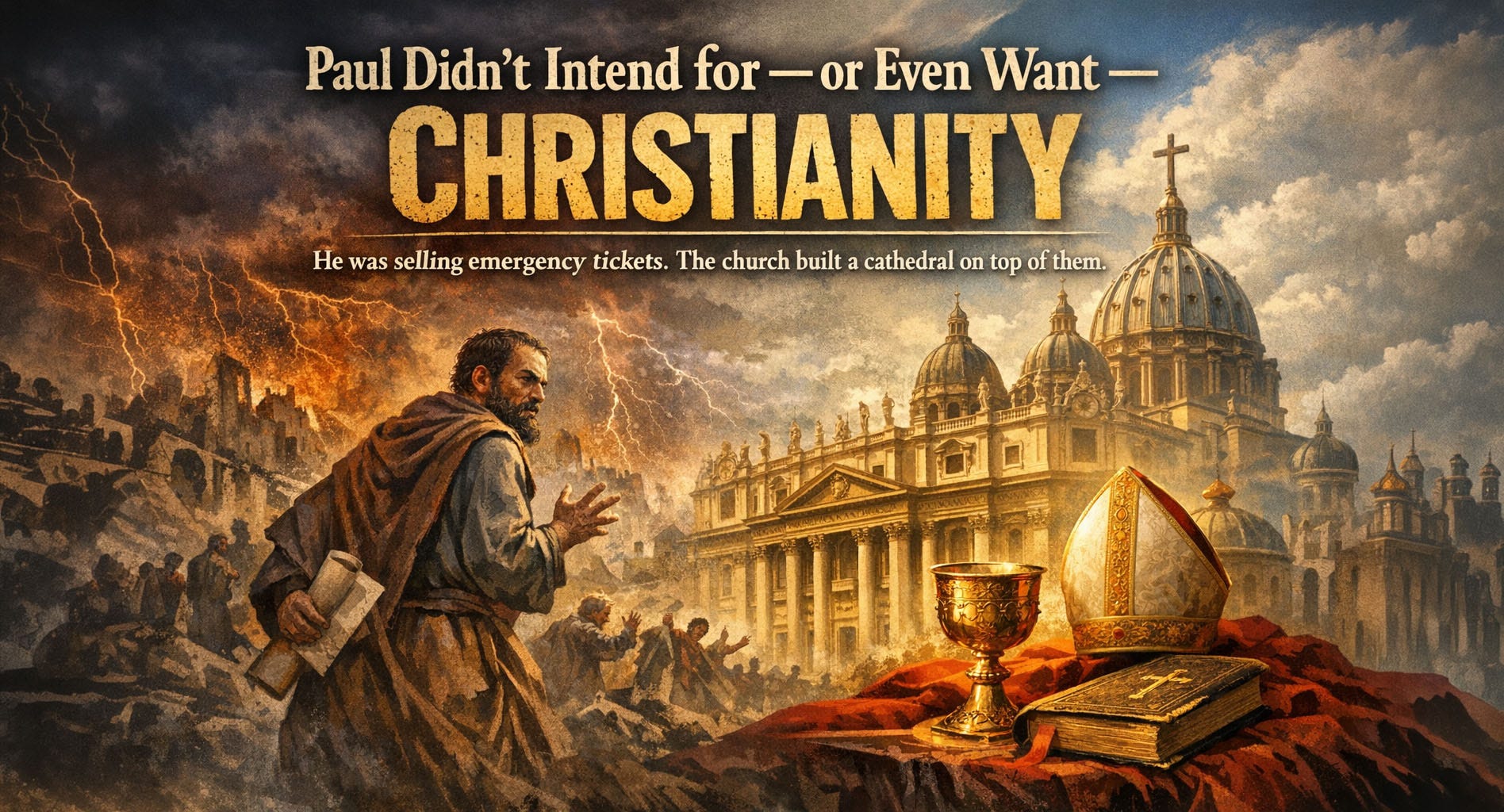
As some of you will know, yesterday I published 7 Jesus Quotes the Church Never Preached and Meant It Too on Medium and I ended it with the distinction between the intentions of Jesus and Paul. Today we’re going to dig into that topic.
Bear in mind that the two pieces are loosely related and can be read in any order. No one can deny how influential Paul was— more so than Jesus' hand-picked disciples, none of whom were Paul. He’s often called the founder of Christianity as an independent religion, given that what would eventually become Christianity was still a denomination of Judaism the day Jesus was sentenced to capital punishment.
That’s the part most Christians have never sat with long enough to understand. Every sermon, every creed, every Bible lesson presents Paul as the master theologian of a brand-new faith — the guy who took the rough teachings of Jesus and organized them into a coherent system that would carry the world for two thousand years. The biggest irony is that Paul didn’t even believe there would be two thousand years to come. He didn’t believe there’d be two hundred. On some days, he might barely have believed there’d be twenty.
The man was an apocalypticist through and through — a self-appointed apostle who talked about the end of days constantly, and not in the sense that it would happen someday down the road. Even Jesus himself said only the Father knew when that day would come. Paul, somehow, seems to have believed the Father had taken him into confidence about something Jesus had openly admitted he didn’t know.
Once you understand that, everything else about his letters starts to look different. The urgency, the shortcuts, the contradictions with Jesus — they all start to make sense at once. The church’s later convulsions trying to smooth it all over start to make sense too.
Paul wasn’t laying a foundation for a religion meant to be followed by generations to come. For all practical purposes, he was handing out lifeboats.
What Jesus Was Doing
Look at what Jesus spends his time talking about according to the canonical Gospels. It's how you treat other people. Not the Trinity, not substitutionary atonement, not justification by faith alone — the ethics.
Feed the hungry, clothe the naked, visit the sick, forgive your enemies, don’t pile up wealth while others starve, don’t judge, don’t be a hypocrite, and don’t pray on street corners so everyone can see how holy you are. The Sermon on the Mount is a behavioral code, not a doctrinal one. The parable of the sheep and the goats in Matthew 25 doesn’t separate people based on what they believed. It separates them based on what they did. The goats went to hell for walking past hungry people, not for having bad theology.
Jesus was preaching a way of living. It was demanding. It was specific. It asked people to do inconvenient, costly, often humiliating things for strangers. And it assumed you were going to keep doing them, day after day, as a practice — not as a one-time transaction.
James, the brother of Jesus who led the Jerusalem community after the crucifixion, understood this perfectly. His letter in the New Testament is one long beatdown of the idea that faith without works means anything. “Faith without works is dead.” He says it outright. He says it more than once. He even calls out people who quote scripture at the poor while doing nothing to help them. James was the closest thing the early movement had to an executor of Jesus’s actual vision, and his message was consistent: what you believe is worthless if it doesn’t change what you do.
Paul’s pitch, on the other hand, was completely different.
Paul’s Doomsday Clock
Read 1 Thessalonians. It’s the earliest document in the New Testament — written around 50 CE, roughly twenty years after the crucifixion — and Paul is telling the Thessalonian community not to grieve too hard for believers who’ve already died, because Jesus is coming back soon and they’ll all be caught up together in the clouds. “We who are alive, who are left,” he writes, will meet the Lord in the air. We who are alive. He counted himself in that number. He expected to be there for it.
1 Corinthians 7 is even more telling. Paul gives advice on marriage, and his advice boils down to: don’t bother. If you’re single, stay single. If you’re married, try to live as though you aren’t. If you have a wife, live as though you don’t. Why? Because “the time is short” and “the present form of this world is passing away.” This wasn’t pastoral counsel for a community expecting great-grandchildren. The building was on fire.
Romans 13:11 — “the night is far gone, the day is near.” 1 Corinthians 15:51 — “we will not all sleep, but we will all be changed.” Philippians 4:5 — “the Lord is at hand.” Over and over, across letters to different communities, Paul says the same thing: this is ending soon, in our lifetime, so get ready.
Bart Ehrman has pointed this out for decades. So has Dale Allison. So have the majority of serious New Testament scholars who aren’t writing for evangelical publishing houses. Paul was an apocalypticist. He believed the resurrection of Jesus was the first signal of the general resurrection, which was about to happen any minute. The whole cosmic drama was in its final act.
You don’t design institutions on that timeline.
Why the Shortcut Made Sense
If you’ve got five hundred years to build a movement, you can afford to be demanding. You can ask people to follow 613 commandments. You can ask them to restructure their entire lives around ethical practice. You can ask for generational commitment, because you have generations to work with.
With five years, none of that works. You need volume and speed — a message simple enough to deliver to a Greek shopkeeper in Corinth or a Roman centurion’s wife in Philippi without spending six months teaching them Leviticus first. Something that converts people immediately and keeps them convinced long enough to survive the wait.
So Paul builds a sales pitch around the absolute minimum: believe in Jesus, believe he was raised from the dead, and you’re in. That’s it. No kosher, no circumcision, no life restructured around widows and orphans. Just believe. The works, the transformation, the ethical labor that Jesus had spent his entire ministry demanding — Paul could shelve all of it because none of it would have time to matter.
This is why he fought so hard with James and the Jerusalem community over gentile converts. James wanted gentiles to keep at least some of the Jewish law. Paul wanted them to skip it entirely. And Paul wasn’t being theologically liberal — he was being practically urgent. Circumcising adult gentile men was a massive barrier to conversion. Kosher laws were a massive barrier. Sabbath observance in a Roman economy was a massive barrier. In a normal timeline you’d work through those barriers patiently. In Paul’s timeline there was no patience to spare. Drop the barriers. Let them in. Save them before the clock runs out.
And this is why Paul’s letters contain almost no reference to the actual teachings of Jesus. Read through all thirteen letters attributed to him — even the seven letters scholars agree he wrote — and you’ll find barely a handful of direct quotes from anything Jesus said during his ministry. No Sermon on the Mount. No Good Samaritan. No Prodigal Son. No “love your enemies.” No “blessed are the meek.” Paul doesn’t care what Jesus taught about how to live because, in Paul’s worldview, how you live doesn’t matter anymore. The only thing that matters is that Jesus died and rose, and that you believed it in time.
Jesus was preaching how to be a better human in a world that needed work. Paul was preaching how to get a boarding pass for a flight that was about to take off.
The seven undisputed Pauline letters are Romans, 1–2 Corinthians, Galatians, Philippians, 1 Thessalonians, and Philemon. The other six (Ephesians, Colossians, 2 Thessalonians, 1–2 Timothy, Titus) are disputed or considered pseudonymous.
What Happened When the Clock Didn’t Run Out
Paul died (probably executed in Rome around 64 or 65 CE — still expecting Jesus to return at any moment). James died (executed in Jerusalem around 62 CE, recorded by Josephus). Peter died (said to have been executed in Rome, though the evidence for it is thin). The entire first generation of the movement died. And you may also notice Jesus didn’t come back.
This was a genuine institutional crisis, the same kind that hit the movement the first time around — when Jesus was humiliated, tortured, and killed without fulfilling anything a messiah was supposed to have done. The theology had been built entirely on the assumption of imminent return. Every letter, every teaching, every structure was calibrated to an end that wasn’t happening. If you read 2 Peter, you can literally watch the early church working through the panic: “where is this ‘coming’ he promised?” the skeptics are asking, and the author has to come up with an explanation — with the Lord a day is like a thousand years, don’t worry about it, he’s being patient.
That’s when Christianity as we know it gets built. Not by Paul. After Paul.
In the century and a half after the first generation of Jesus followers died, as the new ones kept coming and the world kept not ending, the movement had to figure out how to exist as a permanent institution. It had to build bureaucracy, succession, liturgy, canon, orthodoxy. It had to turn emergency measures into permanent doctrine.
Paul’s letters — written in haste, to specific communities, dealing with specific local fights, under the pressure of an imminent apocalypse — became scripture. His offhand advice on marriage became the church’s teaching on marriage. His internal arguments with James about circumcision became the template for two thousand years of Christian attitudes toward Judaism. His tactical decision to deprioritize works became “justification by faith alone,” the doctrinal hill Martin Luther would die on fifteen hundred years later. His apocalyptic urgency — the thing that explained everything else he wrote — got quietly set aside, because you can’t build a multigenerational institution on “we’ll all be dead by Tuesday.”
The emergency faded, but the emergency instructions stayed on the books, and nobody told the congregation the difference.
Why Jesus Had to Take the Back Seat
Modern Christianity resembles Paul, not the man who started it all. Labeled a communist within twenty minutes, the Jesus of the Gospels would be thrown out of most American megachurches if he dared to open his mouth.
He’d be told his teachings are too far left, too naïve, too soft on crime, too soft on the poor, too soft on enemies. Pastors already complain about this. There are documented cases of congregants walking out when their preacher read the Sermon on the Mount without attribution — they assumed he was quoting some modern liberal and wanted him fired.
But Paul’s version plays just fine. Believe in Jesus and you’re saved. It’s portable and cheap, and it doesn’t ask you to give up your wealth, your comfort, your politics, or your hatreds. You can vote for anyone, treat anyone however you want, accumulate whatever you want, and still be a Christian in good standing as long as you say the right words about the right guy.
Faith-alone Christianity is infinitely easier to sell than works-required Christianity, and infinitely more compatible with empire, with capitalism, with nationalism, with any power structure that doesn’t want to be challenged. It’s also what Luther used fifteen hundred years later to break the Catholic Church’s monopoly — Paul had already written the escape clause.
If Christianity had stayed Jesus-shaped, it never would’ve become the state religion of Rome. It never would’ve been wielded by conquistadors or used to bless slavery or attached to the flag of any nation anywhere. Those things required a religion that asked nothing of its powerful adherents except belief. Paul supplied exactly that, without meaning to.
Paul thought he was writing urgent memos to people about to be swept up in the clouds. He wasn’t founding a faith tradition. He wasn’t designing a doctrinal system for the ages. He wasn’t even trying to replace Judaism — he was trying to complete it, right before the world ended. He expected his letters to become irrelevant within a few years at most, because their recipients would be standing in front of Jesus.
Instead, his recipients died of old age. So did their children and grandchildren. And the letters kept getting read — stripped of their urgency, stripped of their context, stripped of the apocalyptic logic that made them make sense in the first place.
Jesus wanted to change how people lived. Paul wanted to save as many of them as possible before it was all over. The church built a two-thousand-year institution out of the second guy’s shortcuts and called it the first guy’s religion.
Every Sunday, congregations recite a version of Paul’s emergency pitch and think they’re following Jesus. They’re following a man who thought he had weeks to live and wrote accordingly. He’d be baffled that anyone was still reading his mail.
This publication exists because readers like you choose to support it.
If you’re not already a paid subscriber and you’re finding value here, I’d love for you to consider becoming one to keep The Unholy Truth alive.
Sources and Further Reading
Bart D. Ehrman — The Triumph of Christianity (2018) and How Jesus Became God (2014)
E.P. Sanders — Paul and Palestinian Judaism (1977)
Pamela Eisenbaum — Paul Was Not a Christian: The Original Message of a Misunderstood Apostle (2009)
Albert Schweitzer — The Mysticism of Paul the Apostle (1930) and The Quest of the Historical Jesus (1906)
Dale C. Allison — Constructing Jesus: Memory, Imagination, and History (2010)
Paula Fredriksen — Paul: The Pagans’ Apostle (2017)
James D.G. Dunn — The New Perspective on Paul (2005) and Jesus Remembered (2003)
Josephus — Antiquities of the Jews, Book 20, Chapter 9 (c. 93–94 CE)
Tacitus — Annals, Book 15, Chapter 44 (c. 116 CE)
A helpful, clear-eyed view, Tanner. Thank you.
Another excellent article, thanks. Regarding your paragraph on the letter of James. This is a topic I am especially interested in. I have read the argument that while James is the most Jewish part of the New Testament, it is at least in part Pauline and was unlikely to have been written by him. A couple of items raised are its sophisticated Koine Greek, and the fact that when it discusses the law, circumcision and dietary law are never mentioned. The parts of the law that are mentioned are those that Acts (I think?) consider to be acceptable for Christians.
I would love an article of the letter of James but probably too much in the weeds for most readers.