


Skepticism about the passion stories is well-earned, and it tempts people to apply the same solvent to everything else in the New Testament. Paul the persecutor looks like an obvious candidate. A dramatic villain origin, a blinding light on the road, a name change: the story has the shape of a legend.
The name change is the easiest of the three to check, and it goes first. Acts calls him Saul through the road to Damascus and for four chapters after it, until a stray line in chapter 13 mentions he was also called Paul, in the middle of a trip to Cyprus. He carried both names all along, one Hebrew and one Roman, the way plenty of Roman citizens born Jewish did. Nobody renamed him on the road.
The persecution is a different matter, because Paul keeps bringing it up himself.
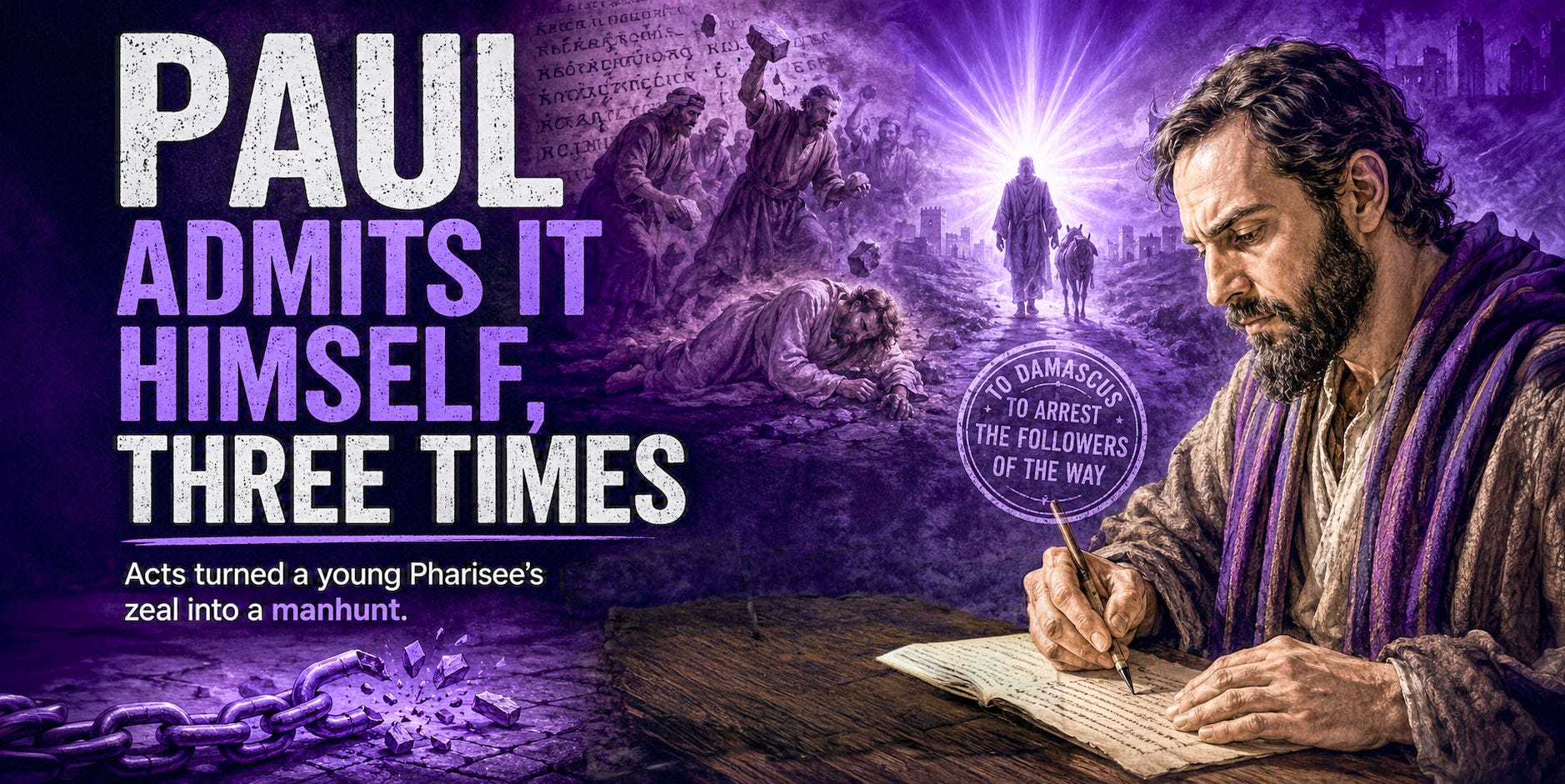
To the Galatians he writes that they’ve heard of his earlier life in Judaism, how he persecuted the church of God violently and tried to destroy it, and that the Judean churches knew him only by reputation as the man who once tried to destroy the faith he now proclaims. To the Corinthians he calls himself the least of the apostles, unfit to be called one, because he persecuted the church of God. To the Philippians he lists it among his credentials as a Pharisee: as to zeal, a persecutor of the church.
Three letters, three different audiences, three different rhetorical purposes. These are the earliest Christian writings we have, decades ahead of any gospel, and the man is volunteering the worst thing anyone could say about him.
What a Man Without a Prison Could Do
Imagine running a community with no jail. You let the innocent go, you execute anyone who’s committed a capital crime, and then what do you do with everyone in between?
Paul in the 30s was a young Pharisee with no office, no troops, no jail, and no power to execute anyone. He was also working outside Jerusalem. When he tells the Galatians that the churches of Judea knew him only by reputation, he puts his own persecuting somewhere else, out in the synagogues of the diaspora. The best clue to what he did to others is what was later done to him.
In 2 Corinthians he lists his sufferings, including five occasions on which he received the thirty-nine lashes from Jewish authorities, a punishment given to someone who’s crossed a line and is still allowed to stay. Paul kept coming back for it, which tells you both that he still considered himself a Jew and that the local synagogues still considered him one of theirs, or they’d have expelled him instead of flogging him.
Twenty years earlier, Paul was the one handing out the punishment. The earliest followers of Jesus were Jews meeting in synagogues and making a claim their neighbors found scandalous, that a man Rome had crucified was God’s messiah. Deuteronomy calls anyone hanged on a tree cursed, and Paul himself later quotes that verse. The movement was also taking in gentiles without asking them to keep the Law, which meant uncircumcised men eating at the same table. Disputes like that got settled with public floggings and expulsions. Paul flogging believers in the 30s and synagogues flogging Paul in the 50s are the same procedure, run out of the same synagogues.
A synagogue only flogs its own. Whatever Paul did to the first followers of Jesus, he did it to fellow Jews, inside the community all of them still belonged to, which makes his persecution evidence that the movement hadn’t left the synagogue yet.
What the Acts Improves
Acts makes it all a thriller. A crowd stones Stephen, a member of the Jerusalem community accused of speaking against the temple, and the men throwing the rocks lay their coats at Paul’s feet. He then goes house to house dragging men and women off to prison. He asks the high priest for letters authorizing him to arrest followers of the Way in Damascus and march them back in chains. Later, defending himself before Agrippa, the Jewish king Rome kept on the throne in the region, he says he cast his vote against believers condemned to death.
Paul never says he killed anyone. He never mentions arresting anyone, or having anywhere to put them, or holding a warrant. Every one of those details comes from Acts alone, and several of them fail against what we know of the period. The high priest couldn’t compel anyone in Damascus. The city sat in another province, and in 2 Corinthians Paul says the men hunting him there answered to Aretas, the Nabataean king whose territory ran along the city’s southern edge. A letter from Jerusalem carried whatever deference a synagogue chose to give it, and nothing more.
Casting a vote means sitting on a body that sentenced people to death, which puts Paul on the Sanhedrin, the council of chief priests and elders that heard capital cases. He tells the Philippians he was circumcised on the eighth day, a Hebrew born of Hebrews, a Pharisee, and he leaves the council seat out. Acts also has him raised in Jerusalem and trained under Gamaliel, the most respected Pharisee teacher of that generation, and has him tell Agrippa that every Jew knows he was brought up in the city from the start. Paul writes that the churches of Judea had never seen his face.
Acts was written decades later by someone with a case to make about the continuity of the movement and the innocence of its leaders. The conversion lands harder when the man on the road to Damascus is at his most terrifying.
The Jewish Christians Who Hated Paul
The Ebionites were law-observant Jewish followers of Jesus who lasted into the early centuries, and they loathed Paul. Everything we know about their complaint concerns Torah observance. Irenaeus says they rejected him as an apostate from the Law, and Epiphanius passes along a story that he was a Greek convert who took on circumcision hoping to marry the high priest’s daughter. Nothing about him having hunted their own spiritual ancestors, which sounds like an argument against the persecution until you notice that both reports come from hostile outsiders writing one and three centuries later, summarizing a group whose own books are gone.
The Pseudo-Clementine literature, which comes out of the same Jewish-Christian currents, cuts the other way. In the Recognitions, an unnamed enemy leads a violent assault on James in the temple, throws him down the steps, then heads for Damascus with authority to arrest believers. Scholars have long read that figure as Paul with the name filed off, which puts a memory of the persecution inside the very tradition supposed to have lost it.
A Man with Baggage
Paul’s past wouldn’t matter much if he were one of the men Jesus picked. He was around, and he wasn’t picked.
Paul’s entire authority rests on Jesus skipping the men he’d spent his ministry training and appearing in secret to a thirteenth, unconnected man, handing him new instructions and leaving the original disciples in the dark to spread a wrong form of Christianity until Paul showed up to correct them.
If a man’s past doesn’t count when you’re weighing a claim like that, what else were you planning to use?
If that was not enough, the moment everything relies on is told four times in the New Testament, and no two of the four agree.
Acts tells this story three times and contradicts itself each time. Paul's own version has no road, no light, and no blindness in it. All four, side by side, unlocked only for supporters below.
If even a small fraction of regular readers became supporters, I’d spend less time running the business side of this publication and more time in the archives doing the research this work demands.
If you’re getting something out of these pieces, consider supporting The Unholy Truth. Supporters get the bonus sections, the Friday Editions, and the full archive.
Support the work and unlock all exclusive content on the site.
Sources and Further Reading
Galatians 1:13-14, 1:22-23; 1 Corinthians 15:9; Philippians 3:6; 2 Corinthians 11:24-33
Paula Fredriksen, Paul: The Pagans’ Apostle (2017)
E.P. Sanders, Paul and Palestinian Judaism (1977)
Bart D. Ehrman, Peter, Paul, and Mary Magdalene (2006)
Irenaeus, Against Heresies 1.26.2
Epiphanius, Panarion 30
Pseudo-Clementine Recognitions 1.70-71
Acts 7:58, 8:3, 9:1-2, 13:9, 22:3, 26:10
Re "Paul’s entire authority rests on Jesus skipping the men he’d spent his ministry training and appearing in secret to a thirteenth, unconnected man, handing him new instructions and leaving the original disciples in the dark to spread a wrong form of Christianity until Paul showed up to correct them."
Which would make Jesus the dumbest god on record. Tale a troop of disciples on the road, teach them up, but teach them the wrong things, so a super secret apostle can teach the right things ... against all of the resistance created by the disciples who actually saw, lived, heard, was instructed by the god itself.
Sounds like a recipe for success ... not.
I really appreciate writing that makes us think and question a status quo whose consistent practice in America led to many of Paul's followers to elect a pedophile braggart to the highest office. Reading Paul, I am struk by the his level of self pity and importance, something absent in Jesus.