


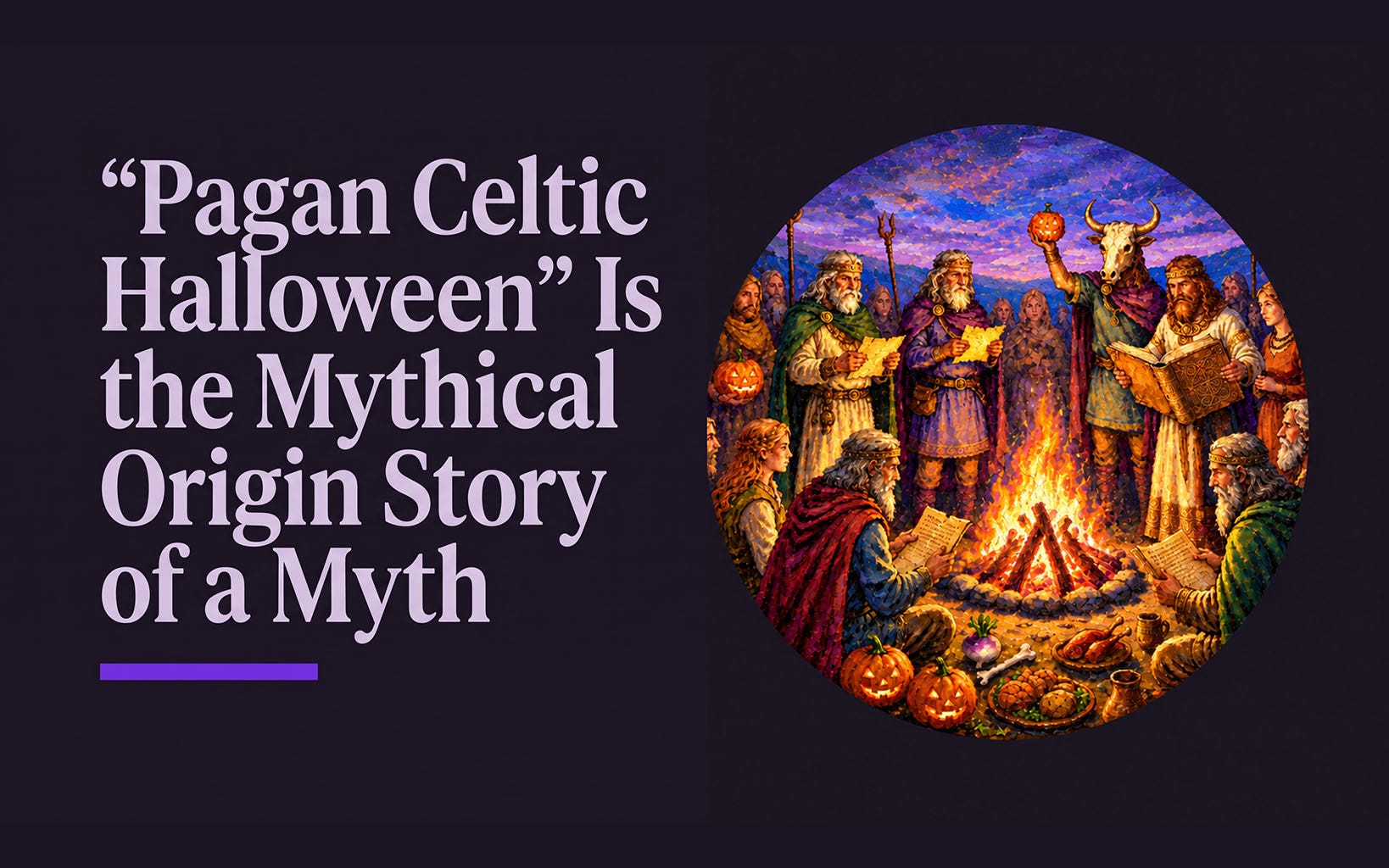
If you leave it to the internet, the origin of Halloween is that the ancient Celts celebrated Samhain, druids spoke to the dead, and three thousand years later, kids dress as Spider-Man to beg for Twix. Online gurus are so certain of it that they repeat it insistently every year. And to be fair, it might have been a great story if only it weren’t fiction about a fictitious holiday. It’s like a couple of thousand years from now, when popular culture holds that the novel The Shining was based on the biography of King Stephen of England, and of course, he lived in a castle called Rock.
The biggest inconvenience in the traditional “pagan Celtic Halloween” theory is that the druids never wrote down a single word. Everything we think we know about Samhain comes from medieval Christian monks copying down folklore centuries after Ireland converted, mixed with an 18th-century British officer who made up a fake Celtic death god out of thin air.
The paper trail for feeding the dead, bargaining with ghosts, and going door-to-door in costumes doesn’t lead us to Irish bonfires, but to barefoot Romans throwing beans at midnight, medieval peasants trading prayers for spiced cakes, and Slavic families leaving vodka on the floor for their dead grandfathers.
And once you’re done, let me know in the comments what you think about all this. I read all comments and value even those that disagree with me.
What the Internet Says of Halloween’s Origins
It’s the last evening of October, more than two thousand years ago, and a Celtic village in Ireland is closing out the year. The harvest is in, the cattle are coming down from the summer hills, and everyone knows winter is about to move in for the long haul. This is Samhain, the night the calendar flips from the bright half of the year to the dark one, and it’s New Year’s Eve besides, which makes it the most dangerous night there is. The old year is dead, the new one hasn’t started, and the wall between the living and the dead has gone missing for the occasion.
The dead take the hint. Grandmothers and grandfathers come home along with every other spirit holding a grudge, so families set out food and drink and hope the visitors stay friendly. Up on the hilltop, druids light the great sacred bonfire and burn crops and animals as offerings, and villagers file up to carry a flame back and relight their own hearths. Anyone who has to leave the house after dark pulls on animal skins and a mask to pass as a ghost, so the ghosts will walk right by. Turnips get carved into grinning lanterns to keep evil off the doorstep.
Centuries pass, and Christianity arrives. In this telling the new religion can’t beat the old festival, so it joins it. The popes move a feast for all the saints onto November 1, the night before becomes All Hallows’ Eve, and in time the name wears down into Halloween. Then the famine of the 1840s sends the Irish across the Atlantic with their fires, costumes, and food for the dead, and in America the turnips give way to pumpkins. The result is a pagan holiday wearing a Christian coat, and it’s tidy enough to fit in a paragraph and explains every Halloween custom with a single ancient cause, which is reason enough to go looking for the evidence.
Detailed Account of Samhain
Julius Caesar, the well-known Roman general who conquered Gaul, reports, and we have no reason to doubt, that druids refused to write their teachings down, meaning no Celtic priest left a word about what Samhain meant. The descriptions we have come from medieval Irish manuscripts copied out by Christian monks, long after Ireland converted, and the sagas where heroes wander into fairy mounds on Samhain night survive only in those books. The idea of a Celtic death god named Samhain goes back to General Charles Vallancey, an army engineer turned antiquarian, who wrote in 1786 about an Irish judge of departed souls called Saman, and later writers folded him into the festival.
What the old stories do show is that Samhain opened the winter half of the year, that cattle came down from their summer pasture, and that the doors to the fairy mounds swung open. Ghosts of ordinary dead grandmothers barely turn up. The part of Halloween most people recognize, feeding and bargaining with the human dead, has a much clearer paper trail on other calendars.

Rome Fed Its Ghosts Every February and Never Reached Ireland
Rome ran a full ghost-management program centuries before anyone wrote a line about Samhain. Parentalia lasted from February 13 to 21, and Roman families spent those days at the family tomb leaving bread, wine, salt, grain, and violets for the Di Manes, the collective spirits of their dead. Temples closed, magistrates left off their badges of office, and nobody got married. The poet Ovid, in his poem on the Roman calendar called the Fasti, says that when Romans once skipped the rites during a war, the dead climbed out of their graves and wailed through the streets of the city. Ghosts who haunt because the food stopped coming make up the plot of half the horror movies streaming this month.
February 21 was Feralia, the last day, when the whole community settled up with the dead. Lemuria followed in May (the 9th, 11th, and 13th), when the head of each household walked barefoot through the house at midnight, tossed black beans over his shoulder, and announced nine times that he was paying the ghosts off with them. The logic matches the candy bowl on the porch, where a household pays its visitors so nothing worse happens.
The popular version then drags in Pomona, the Roman goddess of orchard fruit, whose festival supposedly fell on November 1 and fused with Samhain to give us apple bobbing. None of the surviving Roman calendars list a festival for her on that date, and the fusion would need Rome and the Celts of Ireland in the same room. Rome took Gaul in the 50s BCE and southern Britain from 43 CE, but its legions never conquered Ireland, where Samhain comes from, or most of Scotland. Apple games at Halloween turn up in records of Irish and Scottish parties many centuries after the last legion went home, which makes a Roman orchard goddess an odd suspect.
Soul Cakes for Purgatory Explain Trick-or-Treating Better Than Bonfires
The “treat” half of Halloween has a paper trail that leads straight to the Church. Around the year 1000, Odilo, the abbot of the powerful monastery of Cluny in France, ordered his monks to pray for all the dead on November 2, and All Souls’ Day spread from Cluny across Western Europe. Once the doctrine of Purgatory took hold (it reached its settled form in the twelfth century), a dead relative’s suffering could be shortened by the prayers of the living, and prayers could be bought.
Poor people turned that into a trade. In the first days of November they went door to door promising prayers for a household’s dead in exchange for a spiced soul cake, and folk belief held that every cake eaten sprang one soul loose. William Shakespeare, in The Two Gentlemen of Verona, can toss off a joke about whining “like a beggar at Hallowmas” and expect the audience to know exactly who he meant.
Costumes came from the same church calendar. Parishes too poor to own a saint’s bones had parishioners dress as the saints for the processions, and villagers also dressed as angels and demons, partly to honor martyrs and partly to scare off wandering spirits. Strip out the Purgatory bookkeeping and the doorstep transaction survives intact: a visitor from the margins of the village asks for food, and the household pays so that the dead and the visitor both stay on its side.

Poland’s Dead Grandfathers Still Get Dinner
Slavs called the dead dziady, “grandfathers,” and expected them home for a meal. Households in Poland, Belarus, and Lithuania set extra places at the table, left food out overnight, poured vodka on the ground or dropped scraps on the floor for souls with no living family to feed them, and in some regions lit bonfires at crossroads to light the way home. Clergy in the region spent centuries condemning the feasts, and the Church did what it did everywhere else, which was to move the dead onto its own calendar. Autumn dziady slid into All Saints’ Day and All Souls’ Day on November 1 and 2. Most of what we know comes from the clergy who complained and the nineteenth-century folklorists who wrote down what villages still did, so dates for the oldest forms stay murky, while the habit of feeding the dead shows up in every source.
It worked extremely well. On November 1 the country shuts down for All Saints’ Day, and millions of people carry candles to cemeteries until the graveyards glow after dark. The Polish poet Adam Mickiewicz built his most famous play, Dziady, in the 1820s around a village ritual where a conjurer calls up the ghosts with food, fire, and vodka, which tells you how alive the custom still was. Candles on graves, food for the dead, and a public holiday to do both: that’s Halloween’s ghost business surviving in Poland with a Christian label on it.
If you’re finding value here, I’d love for you to consider becoming a paid subscrtiber to keep The Unholy Truth alive.
Three Popes, Three Dates, and No Mention of Samhain
The standard account credits the Church with a deliberate campaign to replace Samhain and cites three papal actions. In 609, Pope Boniface IV rededicated the Pantheon in Rome, a temple to all the gods, to Mary and the martyrs on May 13. Between 731 and 741, Pope Gregory III dedicated a chapel in St. Peter’s Basilica to all the saints, and the feast moved to November 1. In 835, Pope Gregory IV extended November 1 across the Frankish Empire, working with Louis the Pious, the son of Charlemagne and emperor of the Franks.
The sources beg to differ. None of the records for these decrees mention Samhain or Ireland. Boniface’s dedication fell on May 13, the last day of Lemuria, the Roman festival in which households threw beans to pay off ghosts, so Rome had an older ghost calendar of its own to replace and needed no Celtic model. November 1 didn’t become the general date for All Saints until the ninth century, roughly two hundred years after Boniface and four centuries after Ireland had converted to Christianity. The timeline shows Rome and the Franks organizing their own saints’ days, and the link to Samhain comes from writers working centuries later.
The comments section is open to all subscribers, free or paid.
What’s Samhain All About Then?
Samhain was an Irish festival marking the start of winter, and the rest of Halloween’s ghost business arrived by other roads: Roman tomb visits, Catholic prayer-for-pay, and Slavic ancestor dinners, stitched together over a thousand years by a Church with a feast for every occasion.
The bonus section for paid subscribers covers the stories that gave Samhain its reputation, including the hanged man who asks a hero for a drink, the Irish priest who described druid bonfires on a hilltop more than a thousand years after the druids were gone, and the small-town Alberta newspaper that printed “trick or treat” for the first time in 1927. Upgrade to read it.
Exclusive Content for Paid Subscribers
Hanged Men, Fairy Mounds, and the Road From Soul Cakes to Trick-or-Treat
The best-known Irish story set on Samhain night is the Adventure of Nera. The king of Connacht offers a prize to anyone who’ll tie a twig around the ankle of a hanged prisoner. Nera, one of the king’s warriors, takes the dare, and the hanged man comes alive and begs for a drink, so Nera …