


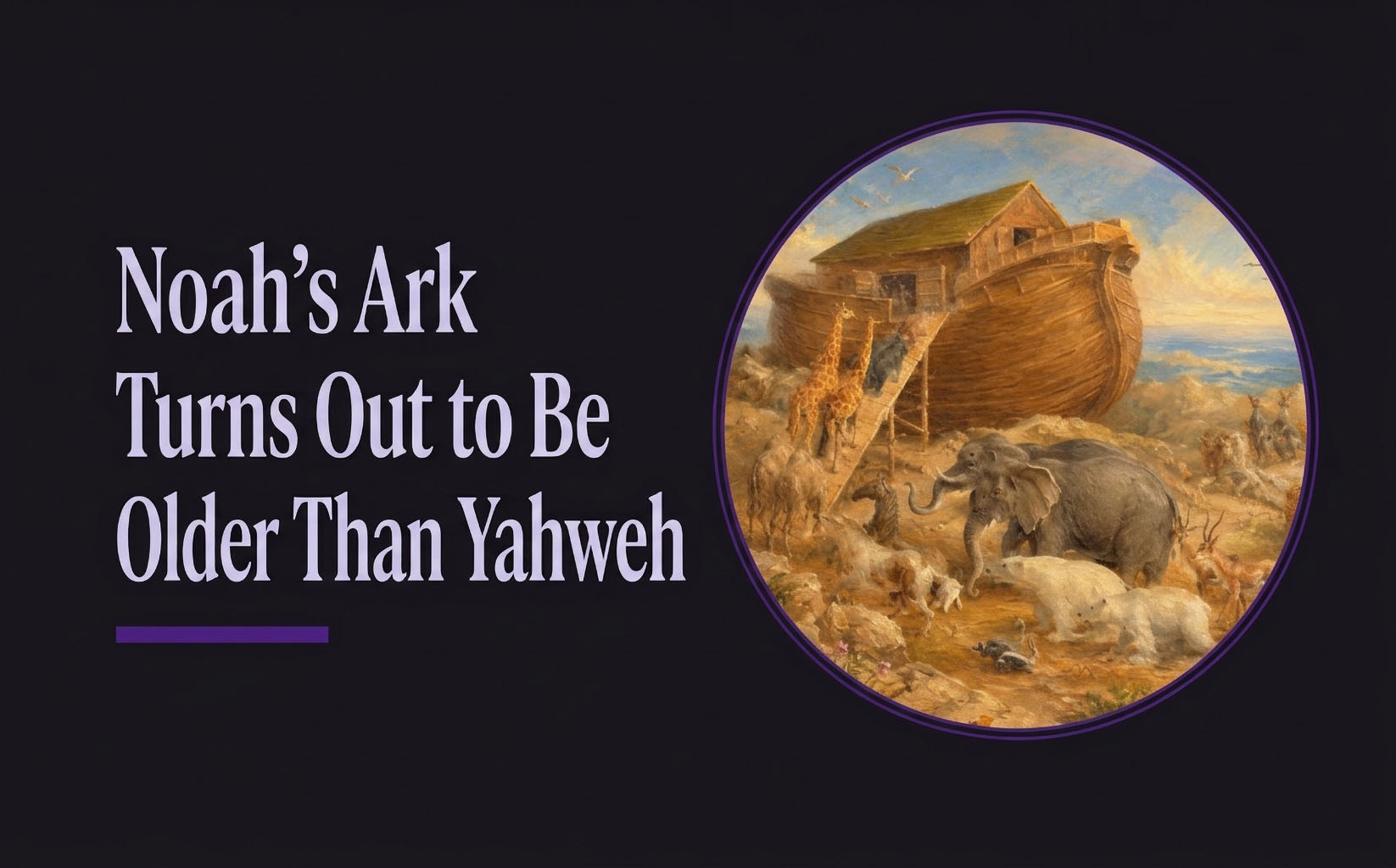
In December 1853 an Iraqi-born archaeologist digging for the British Museum had a problem with the mound covering the ruins of Nineveh, the capital of the Assyrian Empire. The northern half of the mound had been promised to a rival team, and he was sure the best of the site lay under it, so he sent his workmen in after dark. They dug by lamplight for two nights and found nothing. On the third night a trench wall fell away and exposed carved stone panels, the wall of a palace room nobody knew was there, showing a king hunting lions. By the custom of the time, whoever uncovered a palace kept the right to dig it, and the next morning he went back to working in daylight.
The palace belonged to the last great king of Assyria, who’d spent his reign in the 600s BCE collecting every text his agents could buy, copy, or confiscate. When Nineveh was sacked and burned in 612 BCE, the fire that destroyed the library baked its clay tablets hard. The workmen found the floor heaped with them, thousands of broken pieces mixed with ash and rubble, and they shoveled the lot into crates for the long trip to the museum without anyone on the mound being able to read a line.
The crates then sat in storage for nearly twenty years, because the handful of people on earth who could read the script had tens of thousands of fragments to get through. One of those fragments, a piece of baked clay about six inches across with a crust of lime hiding part of its surface, held the story of a man warned by a god to build a boat.
Every children’s Bible tells that story as Yahweh’s from start to finish, with his anger, his flood, and his rainbow. The fragment in the crate was a late copy of a story that was already on clay in southern Iraq by about 1750 BCE, complete with the warning, the boat sealed with tar, the animals, and the grateful sacrifice on dry ground. The name Yahweh shows up nowhere on earth, in any language, until an Egyptian temple inscription carved around 1380 BCE, where it’s one entry on a list of nomad territories. As the god of a people called Israel, he first appears in writing around 840 BCE. The boat had been afloat in literature for close to four centuries before anyone scratched the name of its supposed architect onto anything, and for about nine centuries before anyone recorded him as Israel’s god.
Subscribe for free to get the next origin story in your inbox, and upgrade whenever you want the bonus sections.
Either way, thank you for being here.
Before We Begin
Today’s piece covers where the Noah’s Ark story came from, something I’ve touched on several times but never dug into in detail. A quick summary of the Bible’s version comes first, so the comparison is fair. As always, your likes and comments help me pick the next topic. I’d also love to hear from Christian and practicing Jewish readers about how they reconcile the story with its older sources.
Noah’s Ark is an unusual story because at some point there were apparently two versions of it, and both were considered scripture, so someone decided to reconcile them. The result is one Noah’s Ark story told in two versions that run in parallel and don’t always agree. So, as best we can, here’s a quick rundown.
Genesis 6-9 covers the whole thing in four chapters. God looks at the human race ten generations after Adam, sees that it’s violent and rotten all the way through, and regrets having made it. He decides to wipe out every living thing on land and makes one exception for Noah, the only righteous man of his generation. Noah gets instructions for a three-deck wooden box about 450 feet long, sealed with pitch, and orders to load his wife, his three sons, their wives, and breeding stock of every animal.
Noah is six hundred years old when the rain starts. It falls for forty days, the water rises until it stands more than twenty feet above the highest mountains, and everything that breathes air dies except the eight people and the animals on board. Months later the ark grounds in the mountains of Ararat. Noah sends out a raven and then a dove to test for dry land, and the family walks out about a year after going in.
Noah’s first act on dry ground is to build an altar and burn some of the animals as an offering. God smells it, promises never to destroy the earth by flood again, tells the survivors to have children and fill the earth, and sets his bow in the clouds as the sign of the promise.
A Banknote Engraver Reads a Broken Tablet in 1872
George Smith left school at fourteen to train as a banknote engraver and taught himself to read cuneiform, the wedge-shaped script of ancient Iraq, on his lunch breaks at the British Museum. The museum eventually hired him to sort and join the broken tablets from Rassam’s crates. In November 1872, once the lime had been cleaned off that six-inch fragment, he read a passage about a ship coming to rest on a mountain and a dove sent out to look for land that found nowhere to perch and came back.
A colleague later claimed Smith jumped up, ran around the room, and started taking off his clothes. On December 3 he read his translation to a packed meeting in London with the prime minister, William Gladstone, sitting in the audience. A newspaper, the Daily Telegraph, paid to send him to Rassam’s mound to find the missing lines, and he turned up another flood fragment within days of starting to dig.
Plenty of Victorians heard the news as good news for the Bible, on the theory that a second ancient report of the flood proved the flood happened. That reading depended on the tablets being young, and Smith’s had been copied in the 600s BCE, late enough to leave Genesis its seniority. Over the following century older copies kept coming out of the ground, and each one pushed the story further back, until it was sitting eight centuries ahead of the earliest Hebrew writing of any sort.
Three Men Built the Boat Before Noah Did
The flood hero has three names in Mesopotamia, depending on the language and the century.
In Sumerian he’s Ziusudra, a king of the city of Shuruppak. On a tablet from around 1600 BCE the gods decide to wipe out mankind, the god Enki tips Ziusudra off, the storm rages for seven days and seven nights, and the survivor offers a sacrifice and is rewarded with eternal life.
In Akkadian, the language of Babylon, he’s Atrahasis, which means “exceedingly wise,” and he stars in a long poem that runs from the creation of humans to the flood. The best copy was signed and dated by its scribe to the reign of a Babylonian king who ruled around 1640 BCE, and the poem was already in circulation a century before that.
The third name is Utnapishtim, the one Smith found. He appears in the Epic of Gilgamesh, where the hero Gilgamesh, terrified of dying, tracks down the one man the gods ever made immortal and gets the flood story from him in the first person. The authors of the epic lifted the episode from Atrahasis and fitted it into their own poem, in places nearly word for word.
Mesopotamians treated the flood as the hinge of their whole history. Their list of kings, which survives in copies from around 1800 BCE, splits the past into the reigns before the flood and the reigns after it. There’s a plausible seed for all of this, too. Southern Iraq is a dead-flat plain between two big rivers, and archaeologists digging at Shuruppak, the flood hero’s own city, found a thick deposit of river silt from around 2900 BCE. A bad regional flood, retold for a thousand years, is enough to get a boat and a survivor.
The Raven, the Dove, and the Smell of Roasting Meat
Genesis 6-9 and the Babylonian versions share the same scenes in the same order.
In both, a god decides to drown humanity and one man receives a private warning. He’s given building instructions with measurements and a set number of decks, and he’s told to coat the boat with pitch inside and out. The Hebrew word for pitch in Genesis 6:14, kopher, is used in that sense nowhere else in the Bible, and it’s the same word the Babylonian story uses, kupru. He loads his family and the animals, the door is shut, and everything outside dies.
When the water drops, the boat grounds on a mountain, Mount Nimush in Gilgamesh and the mountains of Ararat in Genesis. Both survivors then release birds to test for dry land. Utnapishtim sends out a dove, which comes back, then a swallow, which comes back, then a raven, which finds food and stays away. Noah sends a raven and then a dove three times, until it stops returning.
Both survivors leave the boat and burn an offering, and the divine response is nearly identical in the two texts. In Gilgamesh the gods, who’ve gone hungry since their worshippers drowned, smell the sweet smoke and gather around the sacrifice like flies. In Genesis 8:21, Yahweh “smelled the pleasing odor” and resolved never to send another flood. Elsewhere the Hebrew Bible states that God doesn’t eat and doesn’t need feeding (Psalm 50:12-13), so a verse in which the smell of a burnt offering changes his mind is a survival from an older story in which the gods depended on sacrifices for food.
Both stories end with a promise and a visible reminder of it. The mother goddess lifts her necklace of blue stones and swears she’ll look at it and never forget those days. The God of Genesis sets his bow in the clouds and says that when he sees it he’ll remember.
A Tablet the Size of a Phone and a Boat Shaped Like a Bowl
In 2014 Irving Finkel, the British Museum’s curator of cuneiform tablets, published a tablet that a member of the public had brought to his desk, inherited from a father who’d picked it up in the Middle East after the Second World War. It’s about the size of a cell phone, it dates to around 1750 BCE, and its sixty lines are a god’s building instructions to Atrahasis.
The boat it describes is giant and a round version of the coracle, the tarred basket-boat that ferried people and livestock across Iraq’s rivers into the twentieth century, with a floor close to an acre in size, walls of coiled palm-fiber rope, and exact quantities of tar for waterproofing. The tablet also says the animals went aboard “two by two,” a phrase nobody had seen in a cuneiform flood story before.
The Gilgamesh version turns the boat into a perfect cube, 120 cubits on every side, and Genesis makes it a long box of 300 by 50 by 30 cubits. The Hebrew word translated “ark” means a box or chest, and the only other thing the Bible calls by that name is the basket baby Moses floats in. Each culture rebuilt the vessel to its own taste while the plot underneath (warning, boat, animals, mountain, birds, sacrifice) stayed where it was.
Where Yahweh Was While the Tablets Were Being Written
The gods of the Mesopotamian flood are Enlil, who orders it, Enki, who leaks the plan, their father Anu, and the mother goddess who mourns her drowned children. Yahweh isn’t in the cast, and he isn’t anywhere else either. The cities of Syria and Iraq left behind thousands of god names from these centuries, in offering lists, treaties, and the personal names parents gave their children, and his isn’t among them. Ugarit, a port on the Syrian coast that burned around 1185 BCE, kept official lists of its gods headed by El, the father of the gods, with Baal and Asherah close behind, and Yahweh isn’t on them.
His first appearance is at a temple the pharaoh Amenhotep III built at Soleb, in what’s now Sudan, around 1380 BCE. A list of foreign territories carved on its columns includes “the land of the nomads of Yhw,” somewhere in the deserts south of Canaan. That fits the Bible’s own oldest poetry, which remembers Yahweh marching up from the south, from Seir and Edom and Mount Paran (Judges 5:4, Deuteronomy 33:2).
Israel enters the record around 1208 BCE, on a victory monument of the pharaoh Merneptah, and the name itself is built on El, the old Canaanite high god, with no Yahweh in it. The first inscription to name Yahweh as Israel’s god is a boast by Mesha, king of neighboring Moab, around 840 BCE, about hauling Yahweh’s sacred vessels out of an Israelite town and presenting them to his own god.
The flood story, meanwhile, had already reached the neighborhood. A piece of the Atrahasis flood was found at Ugarit, written before the city fell, and a piece of Gilgamesh from the 1300s BCE turned up at Megiddo, in the middle of what would become the kingdom of Israel. Scribes in Canaan were copying the Mesopotamian classics as school exercises before there was an Israel to speak of and while Yahweh was still a name attached to desert nomads far to the south.
One God Has to Play Both Parts
The Babylonian flood story is built on a dispute between two gods. Enlil wants humanity destroyed, and Enki, who’s sworn not to warn anyone, keeps to the letter of his oath by speaking to the wall of a reed hut while Atrahasis listens from the other side. When the water goes down and Enlil finds survivors, he’s furious, and Enki answers that he should’ve punished the guilty and spared the rest.
In a religion with one god, both roles fall to the same deity. Yahweh orders the drowning and arranges the rescue, and with no second god to object, the regret is his as well. Genesis 6:6 says he was sorry he’d made humans. Genesis 6:5 gives the reason for the flood as the human heart being evil all the time, and Genesis 8:21 gives the reason for never sending another one as the human heart being evil from youth. The same fact serves as the grounds for the sentence and for the pardon, a contradiction that results from giving two gods’ lines to one speaker.
The Hebrew writers changed one element of substance, the motive. In Atrahasis the humans multiply until their noise keeps Enlil awake, and the flood is his final attempt to restore quiet. Genesis replaces the noise with wickedness and violence, which turns a story about an irritable god into a story about justice. The change was their own, and it created a problem the Babylonian version doesn’t have, because a flood sent as moral judgment has to account for every drowned infant and animal, and a flood sent by a god who wanted quiet doesn’t.
The Flood Gets a Third Retelling in Seventh-Century Arabia
The Quran tells Noah’s story more than half a dozen times, most fully in chapter 11, and gives him a chapter of his own, chapter 71. By then the flood had been in circulation for about 2,400 years, and the Arabian version went through the same process as the Hebrew one, with the plot kept and the theology replaced.
The inherited plot doesn’t change much. God warns Noah, Noah builds a ship under God’s direction, a pair of every animal goes aboard (11:40), the water covers everything, and the ship comes to rest on a mountain, here called Judi (11:44). Even the figure of 950 years attached to Noah in Genesis 9:29 reappears (29:14).
The elements that once made God resemble the older Near Eastern deities have disappeared. The Quran omits the birds, the burnt offering, the deity savoring the sacrifice, and the divine regret that frames the flood story in Genesis. By the time Islam emerged, Jewish theology had largely shed Yahweh’s anthropomorphic traits. The Quran therefore presents a thoroughly transcendent God, stripping away the human-like details and retelling the flood story free of the mythological features that once linked Yahweh to the gods of the ancient world.
The additions come from the centuries of Jewish and Christian storytelling that separate Genesis from Muhammad. In Genesis, Noah never says a word to his neighbors. Later tradition made him a preacher who warned them for years and was laughed at, a role already visible in the New Testament, where 2 Peter 2:5 calls him a herald of righteousness. The Quran builds its whole account on that figure. Noah pleads with his people night and day, they put their fingers in their ears (71:7), the leading men mock him while he builds (11:38), and only a few believe. One of his sons refuses to board, says a mountain will save him, and drowns (11:42-43), and his wife is named among the damned (66:10). In Genesis the whole family survives.
A lone messenger mocked by his city’s leading men, who are then destroyed, is also a description of the position Muhammad was in when these passages were first recited in Mecca. The Babylonians told the story about gods who needed feeding, the Hebrew writers told it about justice, and the Quran tells it about what happens to people who reject a prophet.
If even a small fraction of regular readers became supporters, I’d spend less time running the business side of this publication and more time in the archives doing the research this work demands.
If you’re gaining value from these pieces, consider supporting The Unholy Truth. Supporters receive bonus sections for every post and full access to the archive.
Support the work and unlock exclusive content for the full story.
The Boat That Outlived Its Gods
The story of the boat changed everywhere it went. In one place it was a reed boat covered in tar. In another it became a huge wooden ark. Later it became a rectangular chest, and later still a vessel tied to a different religious tradition. Each new culture retold the story in its own way, replacing old gods, changing names, and adding its own beliefs.
But underneath all those changes, the story still comes from ancient Mesopotamia. Long before anyone spoke of Yahweh, a storyteller in what is now southern Iraq imagined a man building a boat to save what mattered after a devastating flood and wrote the story down on clay tablets. Empires rose and fell, languages disappeared, and gods were forgotten, but the story survived. It simply kept finding new audiences.
Today’s exclusive content begins after the Sources and Further Reading section: what the gods decided to do to humans once the water went down, and the four-word answer Genesis gives them. It’s there for supporters of The Unholy Truth. If you’d like to read it, becoming a supporter is also what keeps this work going.
Sources and Further Reading
W. G. Lambert and A. R. Millard, Atra-Hasis: The Babylonian Story of the Flood (Oxford University Press, 1969). The standard edition of the poem, with the Sumerian flood tablet included.
Andrew George, The Epic of Gilgamesh: A New Translation (Penguin, 1999). Tablet XI is the flood.
Irving Finkel, The Ark Before Noah: Decoding the Story of the Flood (Hodder & Stoughton, 2014). The round-boat tablet and its “two by two” line.
Stephanie Dalley, Myths from Mesopotamia: Creation, the Flood, Gilgamesh, and Others (Oxford University Press, 1989).
David Damrosch, The Buried Book: The Loss and Rediscovery of the Great Epic of Gilgamesh (Henry Holt, 2007). George Smith and the 1872 announcement.
Richard Elliott Friedman, Who Wrote the Bible? (Summit Books, 1987). The two flood strands in Genesis laid out verse by verse.
Mark S. Smith, The Early History of God: Yahweh and the Other Deities in Ancient Israel (2nd ed., Eerdmans, 2002).
Thomas Römer, The Invention of God (Harvard University Press, 2015). The Egyptian “Yhw” lists and Yahweh’s southern origin.
Tikva Frymer-Kensky, “The Atrahasis Epic and Its Significance for Our Understanding of Genesis 1-9,” Biblical Archaeologist 40 (1977).
Anne Draffkorn Kilmer, “The Mesopotamian Concept of Overpopulation and Its Solution as Reflected in the Mythology,” Orientalia 41 (1972).
Genesis 6-9; Judges 5:4-5; Deuteronomy 33:2.
Supporter Bonus
What the Gods Decided Once the Water Went Down
In Atrahasis the flood is the gods’ fourth attempt to reduce the human population. Enlil first sends a plague to thin out the noisy humans, then a drought, then a famine so severe that parents eat their children, and each time Enki shows…
Z Sitchin’s version most likely.