


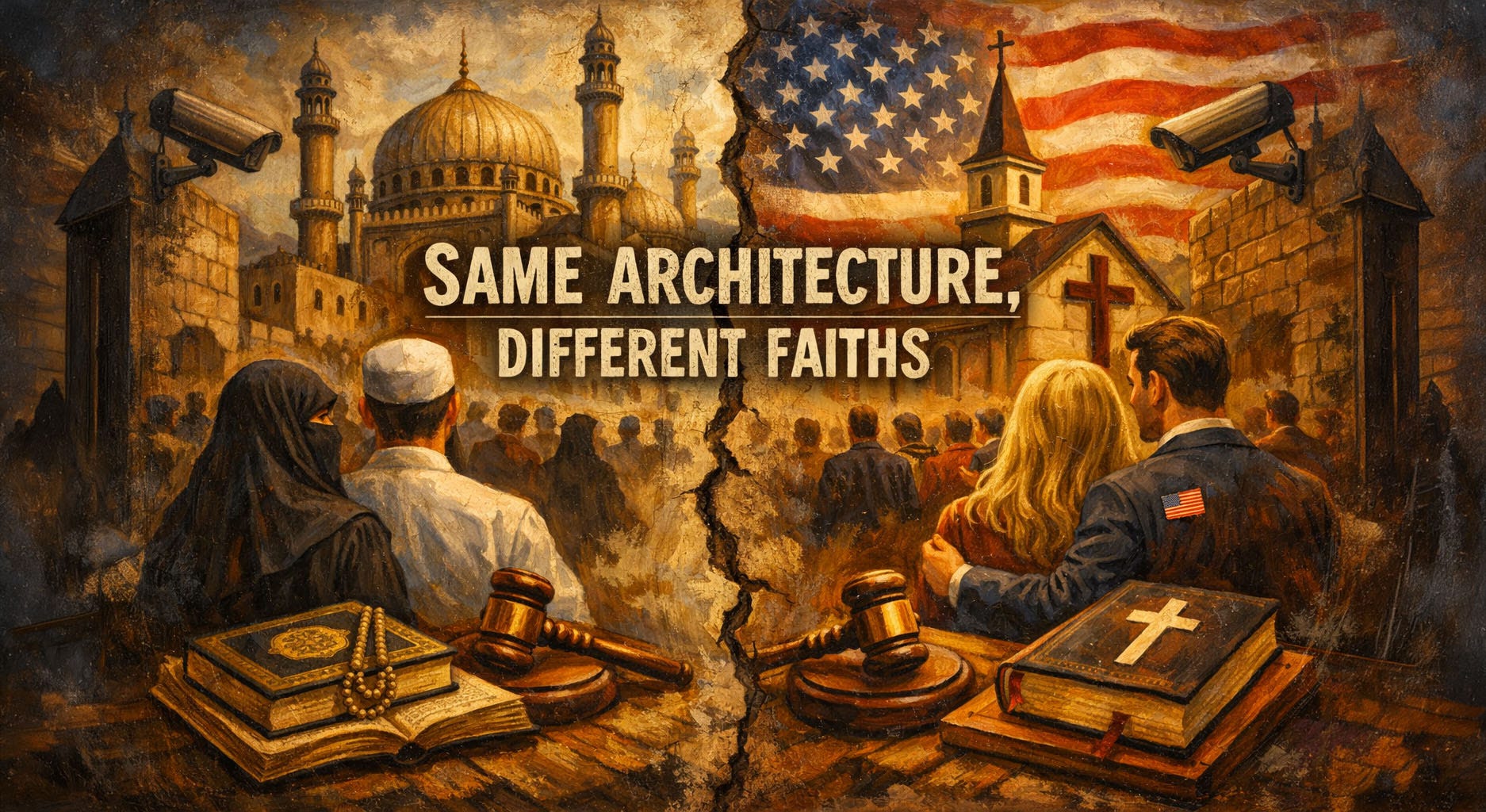
What you’re reading is the full series—all three parts—of “Muslims and Evangelicals Are the Same Coin,” which I originally published on The Unholy Truth in separate installments over the course of a week. I’ve brought them together here so the full argument can be read in one place, as a complete piece.
Enjoy it, and let me know what you think in the comments.
PART I
American evangelicals love talking as if Islam is some alien thing from another planet. They describe Muslims as backward, rigid, obsessed with sex, obsessed with rules, obsessed with sin, obsessed with policing women, obsessed with what people do in private, obsessed with what children are taught, obsessed with protecting society from moral decay.
And every time they do that, the obvious point goes sailing over their heads.
They are describing themselves.
Not all Christians, obviously. Not all Muslims either. In fact, the whole point of this article is that the religious label is often irrelevant. Mainstream conservative Muslims across much of the Muslim world and American evangelicals share far more than evangelicals would ever feel comfortable admitting. The resemblance is not superficial. It is structural. It shows up in family life, in politics, in gender expectations, in fear of secular culture, in suspicion of outsiders, in their constant language of moral decline, and in the belief that society falls apart the moment religion loses control.
That is why the two groups often sound like enemies while behaving like cousins.
The irony gets even better when you look at how both communities imagine themselves. Conservative Muslims often believe the West is spiritually empty, sexually chaotic, and morally unmoored. American evangelicals often believe the Muslim world is authoritarian, repressive, and dangerously religious. Both are partly describing real things. Both are also staring into a mirror and pretending they are looking through a window.
Morality Must Be Enforced From Above
One of the clearest similarities is that both conservative Muslims appnd American evangelicals distrust the idea that ordinary people can be left alone to figure out their own moral lives.
They do not really believe freedom is safe. They may use the word freedom constantly—evangelicals certainly do—but what they usually mean is the freedom to preserve their own moral order, not the freedom of others to reject it.
Conservative Muslims often frame this through religion, community, modesty, family honor, divine law, and the belief that society must visibly submit to moral rules. American evangelicals frame it through “biblical values,” “family values,” the sanctity of marriage, the protection of children, and the claim that America is collapsing because it pushed God out of public life.
Both believe society becomes dangerous when religion stops setting the boundaries. Both fear that once people are allowed too much room to choose for themselves, everything starts sliding: sex, gender, family, authority, education, respect, even truth itself.
That is why both groups are so vulnerable to moral panic. Moral panic is one of their favorite fuels. A schoolbook becomes civilizational collapse. A television show becomes proof of cultural decay. A gay couple becomes an assault on the natural order. A woman choosing her own life becomes evidence that society has forgotten God. Everything is always one step away from disaster. That constant alarm is useful: it keeps followers obedient, keeps them emotionally mobilized, and makes them feel under siege, which is one of the fastest ways to stop people from questioning the system they are defending.
This is also where both communities stop being just religious and become political tribes. For conservative Muslims, Islam fuses with civilization, anti-colonial memory, and resistance to Western domination. For evangelicals, Christianity fuses with nationalism, heritage, and the fantasy of a moral America that once existed and can be restored. Which is why criticism of their religion is never heard as criticism of ideas. It is heard as an attack on the group itself. Disagreement stops being disagreement; it becomes betrayal, and then war.
And once the tribe is under threat, intellectual freedom becomes a casualty. In conservative Muslim settings this means hostility to reinterpretation, pressure against scholars who question inherited doctrine, and reflexive suspicion toward critical history. In evangelical America it appears through culture-war attacks on universities, book banning campaigns, and the rejection of anything that might loosen conservative belief. The logic is identical: truth is already known, so questioning becomes dangerous. That is not confidence. That is fear in ceremonial clothing.
Contrary to popular belief, Islam did not begin as the rigid legal machine many people now imagine. Much of what people now associate with hardline Islamic control—including the criminalization of apostasy, blasphemy, and homosexuality—emerged later through legal and political developments, long after Muhammad’s death. And if American fundamentalists ever got the power they want, it is not difficult to imagine those same prohibitions being turned into law one by one.
It’s all about the mindset, not necessarily religion.
The Protection Myth
This is another area where the family resemblance is almost embarrassing.
Conservative Muslims and American evangelicals both speak endlessly about protecting women while building social systems designed to control them. The details differ. The vocabulary differs. The clothing rules differ. The legal frameworks differ. But the pattern is painfully familiar.
Women are told they are precious, and then treated as dangerous. They are told they are honored, and then monitored. They are told they are central to the family, and then denied equal authority within it. Their sexuality is treated not as their own but as a social risk that men—fathers, husbands, pastors, scholars, community elders—must manage on their behalf.
In conservative Muslim environments this shows up through modesty codes, restrictions on mixing, pressure around marriage, family honor, and the expectation that women carry the burden of public morality on their bodies. In evangelical America it looks different but is no less legible: purity culture, anti-abortion absolutism, suspicion of feminism, the theological praise of submissiveness, and the endless effort to turn motherhood into a woman’s entire moral destiny.
In both worlds, the female body becomes a battlefield where men fight their war against modernity.
And in both worlds, the men doing the lecturing call this protection.
The Architecture Is the Same
Conservative Muslims and American evangelicals did not coordinate. They do not like each other. They do not read each other’s texts or attend each other’s conferences or agree on almost anything theological.
And yet they built the same building.
Same load-bearing walls, same floor plan, same locks on the same doors. The wallpaper is different. The prayers are in different languages. The women dress differently and the men argue about different books. But the structure underneath—who holds authority, who carries shame, who gets monitored, who gets protected by being controlled—is the same structure.
That is not coincidence. It is what happens when any tradition decides that the most important thing religion can do is keep order. Once that decision is made, everything else follows. The family becomes a hierarchy. The community becomes a surveillance system. The woman becomes a symbol. The outsider becomes a threat. And God becomes the enforcer of arrangements that were always, underneath the theology, about power.
Both communities built that building. Both communities live in it. Both communities tell their children it is the only safe place in the world.
PART II
In isolation, American evangelicals and conservative Muslims may think they agree on very little. Some would even be horrified to be placed in the same sentence—Muslims are terrorists who hate Americans for their freedom, remember?—let alone the same argument.
But spend enough time inside both worlds, and the horror starts to look like recognition.
Part I of this piece laid out the structural similarities—the politics, the gender roles, the fear of secular culture, the constant surveillance sold as community and security. If you haven’t read it, the short version is this: these aren’t two opposing civilizations, just two versions of the same one arguing about the brand name.
Part II is where it gets personal.
Because the architecture of control doesn’t stay abstract. It lands in the body. It shows up in who gets to decide what happens to a pregnancy, what desire is allowed to look like, what a family is actually for, and what happens to anyone who uses the side door instead of the front one.
Both communities have spent generations perfecting the answers to those questions, and yes, the answers differ in detail, but in substance, they’re close enough to be embarrassing.
Abortion
What’s interesting—and more complicated—is what actually happened with abortion across the Muslim world. Tunisia, Kazakhstan, Uzbekistan, Kyrgyzstan, Turkey, and Tajikistan all moved beyond the debate long ago. Access was settled, quietly, and life moved on. These are Muslim-majority societies, many of them deeply conservative in their social fabric, and yet they arrived at a more pragmatic position than the American religious right ever has when it comes to the termination of unwanted pregnancies.
But step outside that list, and the picture changes fast. Across much of the Middle East, North Africa, and South Asia, abortion is either heavily restricted or banned outright, not because religious authority and state power have merged into the same voice. In Egypt, Iraq, and Pakistan, abortion is largely illegal except to save the mother’s life. In Yemen and Afghanistan under the Taliban, the question barely exists as a public conversation at all. And the language is almost identical to what you’d hear from a Republican lawmaker in Alabama or Texas: life begins at conception, the family must be protected, women’s bodies are treated as communal property, justified as divine will.
Then the United States had its convulsion—the overturning of Roe, the culture war turned into law—and something interesting happened in Turkey. The idea of restricting abortion surfaced briefly in political conversation, which isn’t entirely surprising if you understand Turkey’s complicated relationship with America: a mixture of love, suspicion, and a nagging conviction that whatever Americans do, they probably do it best. The idea was floated, studied, discussed—and then just as quietly walked back. It never became serious policy.
The reason almost certainly had little to do with women’s rights. Turkey’s retreat was more likely about keeping the image of the traditional Turkish family intact—about not producing children outside of marriage, not creating the social disruption that comes with unwanted pregnancies in a society where family reputation still does enormous work. The protection, in other words, wasn’t really about women. It was about the family unit, the community’s image, the same honor architecture operating through a different lever.
And that logic—protecting the family unit, not the woman—is exactly where conservative Muslims and American evangelicals converge most completely. Both sell abortion restrictions as being about life, about God, about the sanctity of the family. But follow the argument far enough and you always arrive at the same place: a woman’s reproductive choices are too important to be left to the woman. Someone else—a husband, a cleric, a legislature, a pastor—needs to be in the room. The beliefs in the shop window may differ, but the purpose behind them does not.
When these societies land on an outcome that looks modern or human-rights-friendly, that does not necessarily mean they got there for the right reason.
That’s the thread that runs through all of it—the exceptions and the restrictions alike. Whether the outcome is access or prohibition, the woman is rarely the one who decides. The men just disagree about which answer God prefers.
Shared Fear of Sexual Freedom
Both groups are deeply convinced that sexual freedom destroys civilization—not merely disrupts or complicates it, but destroys it.
That’s why so much of their rhetoric sounds hysterical to outsiders. They’re not merely objecting to behavior they dislike. They genuinely believe that loosening sexual rules leads to social death. Marriage collapses. Birth rates collapse. Gender collapses. Authority collapses. And then, in their imagination, society dissolves into a selfish carnival of lust, loneliness, and broken children.
This is why they spend so much time fixating on homosexuality, pornography, sex education, premarital sex, divorce, and gender nonconformity. These issues are never treated as private matters. They’re treated as symbols. The point isn’t only what people do, but what those acts represent in a world where religion no longer controls the script.
And that’s what terrifies them.
American evangelicals often speak as if Muslim conservatism is uniquely obsessed with sex, while overlooking that they are too, even if it takes a different form. They just package it in a different accent. They preach about purity balls instead of hijab. They talk about biblical marriage instead of modesty codes. They lobby school boards instead of religious ministries. But the nervous energy is the same, because they can’t stop talking about what other people do with their bodies when control over the body is one of the clearest signs of social power.
They Both Worship the Family as a Cage
Listen to either group long enough and you’ll hear the same sermon: family is the foundation of civilization.
That much, most people can agree on. But what they forget to tell you is that by “family,” they mean family as they personally define it: one that is father-led, morally policed, sexually disciplined, hierarchical, and insulated from outside influence.
The family becomes less a place of love and more a system for training obedience.
On one hand, they scream about smaller government when it suits them; on the other, they want an intrusive one enforcing the life they prefer. Children must be shielded from dangerous ideas. Wives must support male leadership. Men must defend moral order. Elders must be respected. Shame must keep everybody in line. Religion must be passed down. Social roles must stay clear. Community judgment must remain strong.
That arrangement is sold as stability. Sometimes it does create stability. It also creates silence, hypocrisy, repression, and fear—especially for anyone who doesn’t fit the approved script.
Both conservative Muslims and evangelicals are full of people who learned very early that belonging was conditional. Behave correctly, believe correctly, marry correctly, desire correctly, vote correctly, dress correctly, and you’re safe. Step out of line, and suddenly the family that preached love turns into a disciplinary committee.
Swear words are a great threat to society. Corrupt politicians, even well-documented fraudsters with blatant lies, who sell ideas shaped by the religion they believe in? Perfectly alright.
Both Are Experts at Selective Modernity
This part is almost funny.
Both communities claim to resist modernity, but of course, right up to the point where it becomes useful.
Conservative Muslims use smartphones, social media, luxury brands, global finance, modern medicine, and digital platforms while complaining that the modern world is morally rotten. American evangelicals do the same—running megachurches like corporations, using mass media with machine-like efficiency, and embracing every tool that helps them sell old doctrines in fresh packaging.
Neither group rejects modernity. They reject the parts that weaken hierarchy.
They’re fine with technology and comfort. They like power. They like scale. They’ll take modern medicine when they need it, modern infrastructure when it serves them, and modern communications when it helps them organize and preach.
What they hate is modernity’s attack on inherited authority: individual autonomy, secular law, gender equality, sexual freedom, public skepticism, and the idea that power has to justify itself instead of hiding behind tradition.
And then comes the hypocrisy. The same people who preach the sanctity of marriage get divorced, cheat, and chase sex outside marriage while still demanding moral discipline from everyone else.
In the Muslim world, the hypocrisy just takes different forms. In some places, girls are pushed toward sexual acts that don’t “damage” the hymen. Some hospitals offer hymen repair surgeries to prepare a girl for marriage. Some people arrange quick Islamic marriages with a cleric and two witnesses, with no legal trail, just to create a temporary religious cover—and then “enjoy life” while flattering themselves they’re still good Muslims and that the modern world is corrupt.
It’s impossible not to miss the shared logic behind it: the rule stays in place, the mirage stays intact, but the real behavior is kept out of sight.
The Rule Stays Sacred, Not the Behavior
Conservative Muslims don’t live in the morally disciplined society they preach. American evangelicals don’t live the Christ-centered lives they demand from everyone else. Both communities have developed sophisticated systems for maintaining the appearance of the rules while quietly negotiating around them: the hymen surgeries, the temporary marriages, the divorced pastors preaching family values, the megachurch leaders caught in the scandals they’d spent careers condemning.
The rules aren’t really about behavior. They’re about power, about who gets to define normal, about keeping the hierarchy intact while the people at the top of it do whatever they like.
And the people who pay the real price are never the ones writing the rules: the daughter whose body is inspected before marriage, the woman whose autonomy is legislated away by men who will never face an unwanted pregnancy, the kid who figured out early that belonging was conditional and spent years performing a version of themselves that wouldn’t get them thrown out.
Both communities call this tradition. Both communities call this love.
This is about control, built into the system from the start.
The only honest question left is whether the people inside these systems already know that—and have simply decided that the safety of belonging is worth the cost.
Most of them do know. That’s the part nobody says out loud. And in Part III, that silence matters even more, because once the obsession with control is stripped bare, the real difference between these two worlds is not where they police sex most aggressively, but what they do when the subject is poverty, mercy, and the people at the bottom.
PART III
There is a particular kind of conservative who can lecture you for an hour about moral decay, sexual discipline, the sanctity of family, and the collapse of civilization—and then vote against feeding hungry children without losing a moment of sleep.
That is not a contradiction to them. That is a philosophy.
This is the third piece in a series comparing two of the most powerful religious conservative movements in the world—mainstream conservative Muslims and American evangelicals. Part I and Part II showed how structurally identical these communities are. The same family architecture. The same gender politics. The same fear of secular culture. The same moral panic. The same side doors for the people writing the rules. Two communities that hate each other and cannot stop building the same house.
But there is one place where they part ways. Not on women. Not on sexuality. Not on the endless supervision of other people’s lives.
On the poor.
And that divergence is not a footnote, either. It is the whole story. Because what a community does with its most vulnerable members is not a policy question. It is a character question.
One of these movements still understands that. The other traded it in for something that felt more like power.
The Biggest Difference Is How They Think About Helping the Poor
Now we get to the part evangelicals especially don’t like hearing.
In much of the Muslim world, even quite conservative Muslims tend to see helping the poor as a public good that governments should be involved in. State welfare, subsidized basics, public assistance, and redistributive expectations are often morally acceptable, even admirable. A government that visibly helps people survive can earn religious and social respect for doing so.
That doesn’t mean Muslim-majority governments are always effective. Many are corrupt, inefficient, authoritarian, or deeply unequal. But the moral ideal still matters. The poor aren’t usually framed as proof of personal failure in the same way they often are in American conservative rhetoric.
Conservative Muslims often recognize that life’s unfair, that not everyone’s dealt the same hand at birth, that poor people virtually always are born to poor parents, and that the situation they’re in isn’t primarily their fault. They also recognize luck and that you may work hard and things can still go south. They’ve got a point, really. A bankrupt rich person isn’t at the same starting point as a person from a family of limited means. Rich people may lose all their assets, but they keep their connections and expensive educations. In a macro setting, Iceland’s a good example. After the 2007–2008 financial crisis, Iceland’s financial system imploded, but the country didn’t suddenly become poor. Wealth doesn’t vanish that cleanly. The assets may go, but the education, institutions, infrastructure, and social capital remain. In other words, the kind of poverty that leaves people powerless and desperate, needing help to meet basic needs, is rarely self-inflicted.
In American evangelical politics, by contrast, there’s a powerful current that praises charity but distrusts welfare, glorifies private giving while attacking public support, and treats state assistance as dependency, moral weakness, or theft from the deserving. Feed the poor through church programs and people applaud. Feed them through taxes, and suddenly, many evangelicals start shouting about freedom.
That contradiction says a great deal.
It means the issue isn’t generosity itself. It’s control.
Private charity lets the giver remain morally superior. It allows compassion to be filtered through churches, donors, and local gatekeepers. It can come with sermons, conditions, social discipline, gratitude, and the pleasant glow of personal virtue. State help is different. It treats survival as a public responsibility rather than a private favor.
And that’s where the evangelical discomfort kicks in.
Because once you accept that society as a whole has a duty to protect the vulnerable, the entire mythology of rugged individualism starts to wobble. Then poverty becomes not just a personal tragedy but a political indictment. Then the rich can no longer pretend they owe nothing but occasional kindness. Then compassion stops being optional.
Many conservative Muslims, for all their own harshness in other areas, don’t have the same allergy to that conclusion. They may be socially conservative, religiously rigid, even authoritarian, yet still believe that a decent society should materially support the poor.
That’s a moral difference, not a small one, either.
What Evangelicals Miss Is the Heart
American evangelicals love to present themselves as the guardians of moral truth. They fight over prayer, marriage, abortion, schools, books, drag shows, bathrooms, and pronouns with endless energy. They are exhausted by compassion but fully awake for control.
That is the problem.
For all their preaching about Jesus, a huge part of evangelical politics has become a machine for defending hierarchy while neglecting mercy. They are fierce on sexual ethics, fierce on symbolism, fierce on punishing outsiders, fierce on maintaining boundaries. But when the issue is healthcare, wages, housing, debt, hunger, childcare, or basic material dignity, the urgency suddenly drops.
The heart goes missing.
Needless to say, it’s not always. There are evangelicals who care deeply about justice and poverty. There are Muslim conservatives who are cruel and indifferent. But the dominant tendency in American evangelical public life is impossible to miss: moral strictness for the powerless, moral flexibility for the rich, and deep suspicion toward any collective attempt to build a more humane society.
That is why so many evangelicals can recognize discipline in conservative Muslim societies and even secretly admire parts of it, while still hating Islam as a rival civilization. They are looking at a familiar moral architecture built under a different brand name.
The real scandal is not that the two worlds resemble each other.
The real scandal is that one of them still more easily accepts that helping the poor is part of public righteousness, while the other keeps confusing compassion with weakness and greed with freedom.
That should trouble any evangelical who claims to care what Jesus actually taught.
So, What’s Going On?
Three pieces. One argument.
Conservative Muslims and American evangelicals are not opposites. They are not ancient enemies representing incompatible visions of humanity. They are parallel products of the same anxiety—that the modern world is dangerous, that freedom is a threat, that the body must be controlled, that hierarchy is sacred, and that God is most useful as an enforcer.
They built the same house. They police it the same way. They protect the same people at the top and extract the same price from everyone at the bottom. They sell control as love and call the transaction tradition. They are experts at manufacturing siege mentality, because a community that feels under attack does not ask inconvenient questions about who is actually running things.
None of that is unique to Islam. None of it is unique to Christianity. It is what happens when religion decides that order matters more than people.
But one difference remains. And it is not small.
One of these movements still carries, however imperfectly, the idea that a decent society owes something to its most vulnerable members. That helping the poor is not charity. It is obligation. That a government which feeds people is doing something righteous, not something suspicious. That mercy is not weakness dressed in soft clothing. It is the whole point.
The other movement had that idea once. It is still in their texts. It is still in the words of the figure they claim to follow, who was more concerned with the hungry and the sick and the outcast than with almost anything else.
They let it go, but not accidentally. They let it go because compassion is harder to monetize than fear, harder to weaponize than shame, and considerably less useful for winning elections.
That is the real scandal. Not that the two worlds resemble each other. Not that both have built systems of control and called them systems of love.
The scandal is that one of them knew better.
And chose this anyway.