


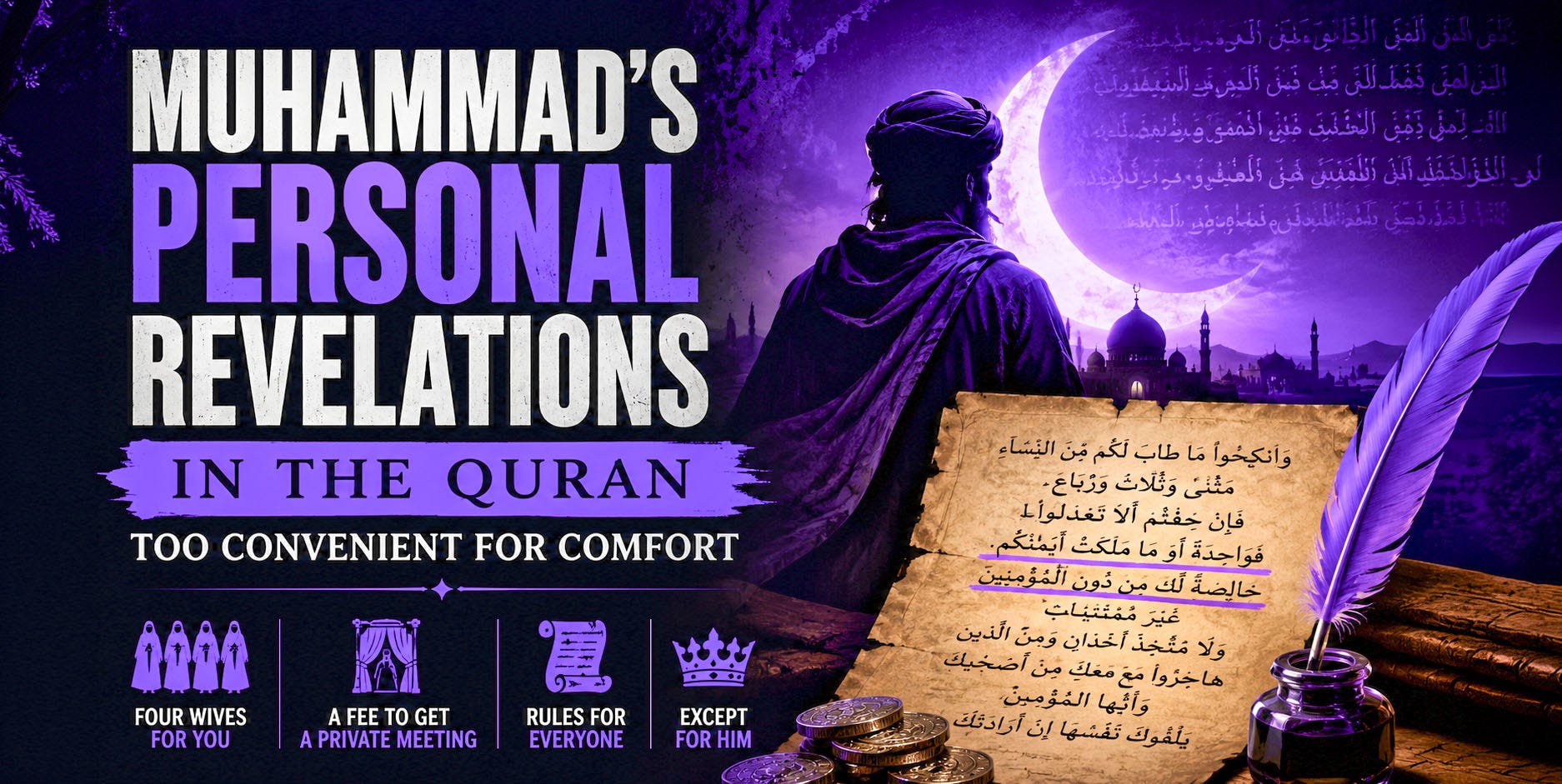
Islam’s scripture arrived in pieces over roughly twenty-two years, and a good portion of it arrived in response to something happening that week. A battle went badly and a verse came, a woman complained about her husband and a verse came. That’s the traditional account, preserved by Muslim commentators who built an entire genre around cataloguing which situation produced which passage, and it’s also what critical historians describe, since the Medinan chapters read like the working papers of a man running a city. Which raises the question of what happens when the situation needing a ruling belongs to the man delivering the rulings.
Four Wives for the Community, No Ceiling for the Prophet
Chapter 4, verse 3 gives believing men a limit of four wives, with the standard advice that one is safer if you can’t treat them equally. Chapter 33, verse 50 addresses one man and hands him a longer list: the wives whose dowries he’s paid, the women he owns, his cousins on both his father’s and mother’s side who emigrated with him, and any believing woman who offers herself to him if he wants to marry her. Then the clause that does the work: “exclusively for you, not for the rest of the believers.”
The verse names its own exception. Nobody had to reason it out of the text later. Two verses on, the door closes behind him, since 33:52 says no more women after these, no trading one wife for another, “even if their beauty pleases you,” with the women he already owns exempted from the freeze. Muslim tradition counts nine wives living when he died, and it never treated that number as a scandal, because the scripture had already ruled on it.
Zayd, Zaynab, and an Adoption Law That Moved at a Convenient Moment
Zayd was a slave Muhammad had freed and then adopted, which in Arabia carried the full legal weight of sonship. Zayd’s wife was Zaynab, Muhammad’s own cousin. The marriage soured, and chapter 33, verse 37 preserves the part a later editor would have cut: Muhammad tells Zayd to keep his wife and fear God “while you concealed within yourself what God was to disclose, and you feared the people, while God has more right that you fear Him.” He wanted her, he knew how it would look, and the verse preserves both facts.
Then comes the resolution: “So when Zayd had no longer any need for her, We married her to you,” with God performing the marriage directly. The stated purpose is that believers should feel no difficulty about marrying the ex-wives of their adopted sons. The obstacle to that marriage was that Zaynab had been the wife of his son, and the passage takes that obstacle apart from both ends. Verses 4 and 5 of the same chapter abolish adoption as a legal relationship and instruct people to name children after their birth fathers. Verse 40 states that Muhammad is not the father of any of your men. He’s the messenger of God and the last of the prophets.
Adoption stayed abolished across Islamic law from that point on, which is why Muslim-majority legal systems today handle orphan care through guardianship arrangements that withhold the family name and inheritance rights. The ruling behind all of it entered the record attached to one marriage.
Aisha’s Remark About a God in a Hurry
Chapter 33, verse 51 tells him he may put off whichever of his wives he wishes and take in whichever he wishes, and that if he wants one he’d set aside, no blame attaches. The traditional setting is the wives quarrelling over the rotation of nights.
Aisha, his youngest wife and the daughter of his closest political ally, is recorded reacting to it: “I feel that your Lord hastens in fulfilling your wishes and desires.” That’s Sahih al-Bukhari, hadith 4788, sitting inside the collection Sunni Islam treats as its most reliable source after the Quran. The tradition kept the line and read it as a wife’s jealousy rather than an accusation. It still means the tradition preserved a complaint about the timing of these verses from someone who slept in the house.
The Oath He Swore, the Wives Who Talked, and the Chapter That Settled It
Chapter 66 opens with God asking him why he forbids himself something lawful “seeking to please your wives.” The commentators offer two versions of what he’d sworn off. In one he’d been eating honey at a wife’s house and two others conspired to tell him his breath smelled, so he gave up honey. In the other he’d been found with Maria, a Coptic slave woman sent to him as a diplomatic gift from the Byzantine governor of Egypt, and he promised to stay away from her.
The chapter releases him from the oath, and then it turns on the two wives. They’re told to repent because their hearts have deviated. If they back each other against him, God is his protector, along with Gabriel, the righteous among the believers, and the angels. And verse 5 floats the replacement: if he divorced them, his Lord might give him better wives, “previously married or virgins.”
Somewhere in Medina two women complained about their husband’s household arrangements and got answered by the creator of the universe, with the angels listed as character witnesses.
A Fifth of Everything Taken, and Everything Taken Without a Fight
Chapter 8, verse 41 assigns one-fifth of all war spoils to God and the Messenger, his relatives, orphans, the poor, and travellers. Since God doesn’t collect, the Messenger administers the share.
Chapter 59 goes further with property seized from a Jewish tribe expelled from Medina. Verse 6 explains that these gains belong to the Messenger because the community “did not spur a horse or a camel for it,” meaning no fighting took place, so no soldier holds a claim. Verse 7 distributes it and then adds a line that outgrew its context entirely: “Whatever the Messenger gives you, take it, and whatever he forbids you, abstain from it.” That sentence became the standard proof text for treating his rulings and personal practice as binding law alongside the Quran itself. It arrived in a passage about dividing confiscated real estate.
The Fee to Speak With Him Privately, and How Long It Survived
Chapter 58, verse 12 instructs believers to give charity before consulting the Messenger in private. People had been taking up his time, and the fee sorted the urgent from the merely curious.
Verse 13 cancels it: “Are you afraid of spending in charity before your private consultations? Since you did not do it, and God has turned to you in mercy, then establish prayer and pay the alms.” The reports say almost nobody paid, and that Ali, his cousin and son-in-law, was the only man who ever handed over the coin. Two consecutive verses preserve a rule, the community’s refusal to follow it, and its withdrawal.
House Rules, Written Into Scripture
Chapter 33, verse 53 is the longest passage in the Quran about etiquette, and every clause of it concerns his home. Don’t come to his houses for a meal unless you’re invited. Don’t show up early and wait around for the food to be ready. Eat and then leave, and don’t settle in for conversation, because it bothers him and he’s too embarrassed to tell you. Ask his wives for things from behind a screen. Don’t cause the Messenger distress. And don’t ever marry his widows after him.
Chapter 49 tells believers not to raise their voices above his voice or address him the way they address each other, in case their deeds are cancelled without their noticing. Chapter 24 tells them not to summon him the way they summon one another, and not to leave a meeting without his permission.
What Historians Do With the Timing
The scholarly reading doesn’t require anyone to be a fraud. W. Montgomery Watt, whose Muhammad at Medina remains a standard account, treats the Medinan chapters as the administrative record of a leader consolidating a community, in which marriages did political work. Marrying Abu Bakr’s daughter and Umar’s daughter bound him to his two strongest supporters, and later marriages sealed terms with defeated tribes. Fred Donner’s Muhammad and the Believers describes the same material as the governing output of a movement that had turned into a state. Barbara Freyer Stowasser’s Women in the Qur’an, Traditions, and Interpretation follows what happened next, as verses produced by specific household disputes hardened into permanent law for women who never met anyone involved.
Muslim scholarship arrived at the same observation from the other direction and built a whole discipline on it, cataloguing which circumstance produced which passage. You can’t open those commentaries without accepting the premise that a large portion of the book responds to events on the ground.
The traditional defense is straightforward and has been on the table since the ninth century. A prophet carries burdens ordinary believers don’t carry, so he receives provisions ordinary believers don’t receive, and the exemptions are compensation for a job nobody else has.
Both explanations account for the verses, and neither makes the pattern go away, because the pattern sits in the text rather than in anyone’s reading of it. The exemptions cluster around marriage, money, and access to his person, they appear at the moment each became contested, and the text flags most of them as applying to him alone.
A Book That Existed Before the Universe, Ruling on Dinner Guests
The Quran presents itself as universal and permanent. Chapter 34, verse 28 tells Muhammad he was sent “only as a deliverer of good news and a warner to all of humanity.” Chapter 85 calls it a glorious recitation “recorded in a preserved tablet,” kept with God rather than composed on earth. Mainstream Sunni doctrine went further and settled on the position that the Quran is eternal and uncreated, God’s own speech, existing alongside him before anything else existed at all.
That position had to be fought for. In 833 the caliph al-Ma’mun set up courts of inquiry and required judges and scholars across the empire to affirm the opposite, that the Quran was created in time like everything else God makes. Ahmad ibn Hanbal, the Baghdad jurist whose followers became one of the four Sunni schools of law, refused and was imprisoned and beaten for it. Around 848 the caliph al-Mutawakkil reversed the policy so completely that holding the created-Quran view became a capital offense. The eternal, uncreated reading won, and it’s what most Muslims are taught today.
Follow that doctrine to where it goes. The instruction to eat and leave instead of sitting around his house making conversation existed before there was a house, a meal, or a guest to overstay. The passage releasing him from an oath he swore to placate two jealous wives existed before there were wives to placate. The fee for a private word with him, paid once by one man and cancelled in the very next verse, was inscribed with God before the creation of the world and preserved for a species that would mostly never meet him.
The theologians who set mainstream Sunni doctrine saw the difficulty and produced an answer: God’s speech is eternal as meaning, while the Arabic wording and its sequence came into being in time. That’s a serious answer, and it concedes the thing that matters here, which is that the wording tracks the events.
The same concession sits inside the doctrine of abrogation, which Muslim jurists had to develop because verses in the book cancel other verses in the book. A text handed down whole from outside time has no occasion to revise itself.
A seventh-century leader running his household through his own religious authority is ordinary enough, and men with religious authority have done it in every century on every continent. What’s harder to square is the claim attached to this particular record. A Muslim in Lagos or Jakarta or Detroit in 2026 inherits rules about how loudly to speak in the presence of a man who died in 632, when to get up from his dinner table, and which of his cousins he was permitted to marry. Orphans across most Muslim-majority countries still can’t be adopted with a family name and inheritance rights, because one marriage in Medina required the category to be taken apart. Women pray behind a partition traceable to a verse about access to his wives’ rooms.
The book asks to be read as guidance for all people in all centuries, and a good share of its legislative content reads as the minutes of one man’s decade in one town. The commentaries Muslims have relied on for twelve hundred years say the same thing about how those verses arrived. They just don’t count it against the book.
If even a small fraction of regular readers became supporters, I’d spend less time running the business side of this publication and more time in the archives doing the research this work demands.
If you’re getting something out of these pieces, consider supporting The Unholy Truth. Supporters get the bonus sections, the Friday Editions, and the full archive.
Support the work and unlock exclusive content for the full The Unholy Truth experience.
Sources and Further Reading
The Quran, chapters 4, 8, 24, 33, 49, 58, 59, and 66. Translations quoted here follow Sahih International and Mustafa Khattab’s The Clear Quran.
Sahih al-Bukhari, hadith 4788, for Aisha’s comment on chapter 33, verse 51.
W. Montgomery Watt, Muhammad at Medina (Oxford University Press, 1956).
W. Montgomery Watt, Muhammad: Prophet and Statesman (Oxford University Press, 1961).
Barbara Freyer Stowasser, Women in the Qur’an, Traditions, and Interpretation (Oxford University Press, 1994).
Fred M. Donner, Muhammad and the Believers: At the Origins of Islam (Harvard University Press, 2010).
Nicolai Sinai, The Qur’an: A Historical-Critical Introduction (Edinburgh University Press, 2017).
Michael Cook, Muhammad (Oxford University Press, 1983).
John L. Esposito, Islam: The Straight Path (Oxford University Press, various editions).
Maxime Rodinson, Muhammad, translated by Anne Carter (Pantheon, 1971).
The argument about an uncreated vs. created Quran is almost a carbon copy of the Trinitarian vs. Arian argument over whether Jesus is the uncreated Son, existing “of the same substance as the Father” from before the foundation of the world, or merely the first of all God’s creation, through whom the rest of creation came to be.
That argument was settled almost universally in favor of Trinitarianism centuries before Muhammad. I wonder if that influenced the Muslims’ decision on how they should view the Quran?