


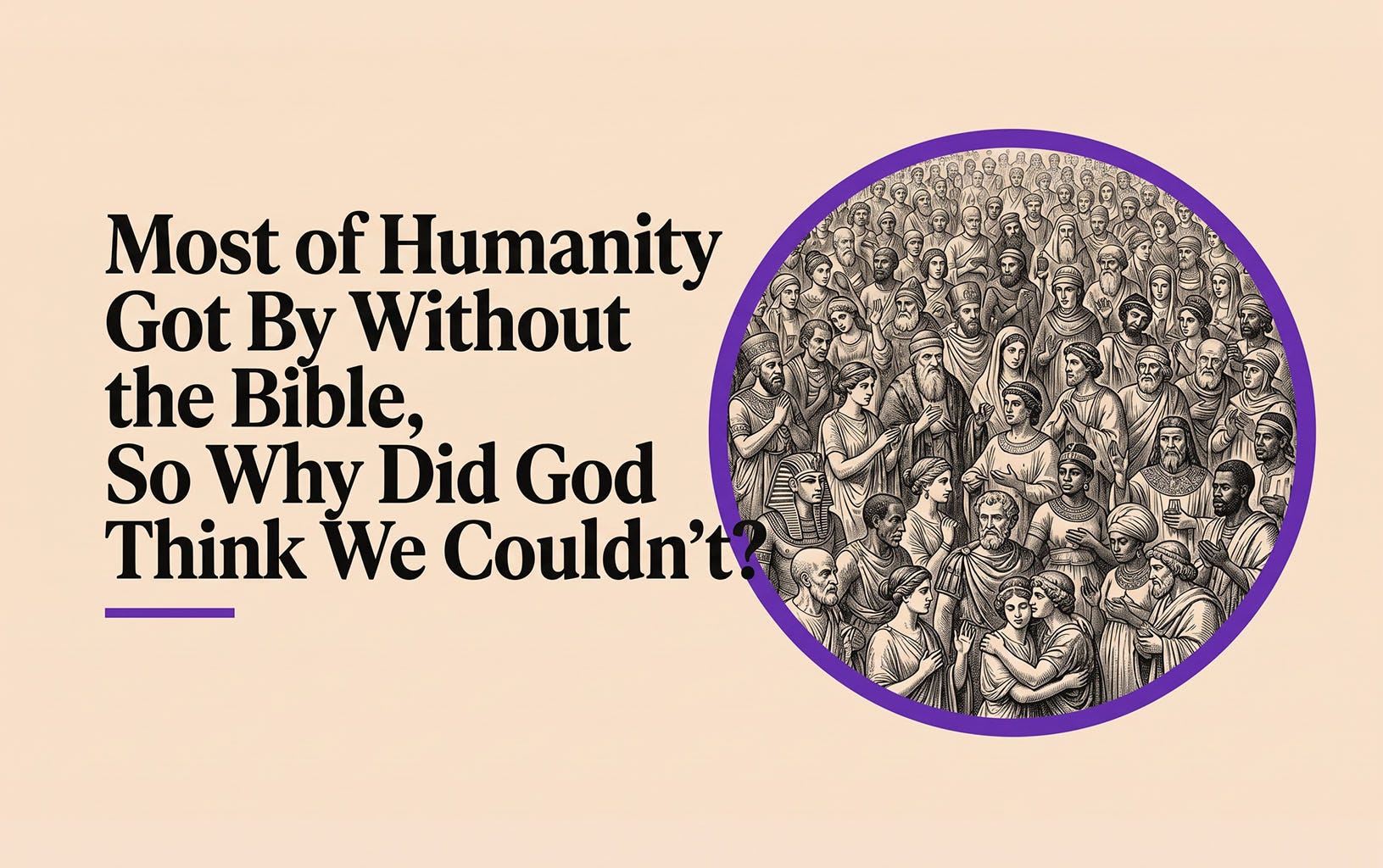
Long before the first word of Genesis was penned, before Islam swept across the desert, and long before the chosen people were announced, tens of billions of human beings walked the Earth. They fell in love, buried their dead, huddled around fires, and tried to make sense of the dark. They had no holy books, no formal creeds, and no prophets we’d recognize.
If you stack human existence against the timeline of history, the great book religions turn out to be a recent, highly regional addition to a religious life that had already been running for hundreds of thousands of years.
So today we’re asking different questions: why did God sit through all those generations in silence, then make himself known to one small group of people in the ancient Near East? And what was most of humanity doing while he kept quiet?
If you don’t agree with me or you think you have satisfying answers to these questions, the comments are open to everyone, and I’d like to hear from you.
Most Humans Who Ever Lived Never Heard of Abraham
The Population Reference Bureau, a Washington nonprofit that tracks demographic data, estimates that about 117 billion humans have been born since our species showed up. People who look like us have been around for roughly 300,000 years. Yet, writing appeared in Mesopotamia around 3200 BCE, and the oldest parts of the Hebrew Bible took written shape somewhere in the first millennium BCE. Christianity is about 2,000 years old and Islam about 1,400.
If we line the dates up against the population curve, the picture changes. Tens of billions of people lived and died before anyone wrote a word of Genesis, and billions more lived afterward in places where no one would hear of Abraham for centuries: the Amazon, the Arctic, the Australian interior, the Pacific islands, and most of sub‑Saharan Africa. Across the full span of human history, the religions of the book are a late, regional development. The default human religion, the one practiced by most people who’ve ever drawn breath, had no scripture, no creed, and no founder anyone can name.
The Ojibwe Elder Who Said Only Some Stones Are Alive
In the 1930s an American anthropologist named A. Irving Hallowell was living among the Ojibwe along the Berens River in Manitoba. He asked an old man whether all the stones around them were alive. The man thought it over and answered, “No! But some are.”
That answer is a better way into animism than any textbook definition. The word comes from Victorian anthropology, where it described a childish error: primitive people supposedly projected souls onto objects because they couldn’t tell living things from dead ones. Hallowell’s informant had no trouble telling the difference. He’d seen particular stones move or respond in ways that made a relationship with them sensible, so he treated those stones as persons, and he understood perfectly well that most stones were just stones.
That’s much closer to what animism means to the people who live it. The world is full of persons, and only some of them are human. Bears, rivers, mountains, certain trees, the weather, and the dead can all be persons, which means you owe them what you’d owe any person: respect, good manners, a fair exchange, and sometimes gifts. Hunters across the northern forests, from Lapland to Labrador, apologized to the animals they killed and handled the bones carefully so the animal would return. Those rules come out of a relationship, and they have more in common with how you’d treat a neighbor than with reciting a statement of faith.
In this world, nobody asks whether you believe in the bear since the bear is standing in front of you. The only question is whether you’re treating it right.
Trance Healers From Siberia to the Kalahari
If animism describes the world, shamanism describes the specialist who deals with it. The word comes from the Evenki, reindeer herders in Siberia, whose shamans drummed themselves into trance to travel to other worlds, bring back lost souls, find game, and heal the sick. The drum was the shaman’s ride. Many Siberian groups described it as a horse or reindeer that carried him between worlds, and his coat, hung with iron pendants, bones, and ribbons, served as armor and as a map of the spirit world at the same time. Russian explorers picked the word up, European scholars started applying it everywhere they found something similar, and they found something similar almost everywhere.
The San of southern Africa hold all-night trance dances where healers enter a state they describe as dying, then pull sickness out of people with their hands. Inuit healers made spirit journeys to the bottom of the sea to bargain with the woman who controls the seals and whales when hunting went bad**, and in many tellings the shaman calmed her by combing the tangles out of her hair, since she had no fingers to do it herself**. Healers in the Amazon drink a vision-producing vine brew to see and fight whatever is making a patient sick**, singing songs they say the plants taught them**.
Early writers got carried away and lumped every village healer, priest, and fortune-teller on Earth into one ancient world religion called shamanism, which never existed as a single thing. Even after you throw that out, a core pattern holds across continents that had no contact with each other. Some person in the community uses rhythm, fasting, pain, or plants to reach an altered state, travels in that state to a world of spirits, and comes back with healing or information. The job usually starts with a crisis. In Siberian accounts, a future shaman falls sick for months and dreams of spirits cutting his body apart and rebuilding it, sometimes counting the bones as they go. He comes out of it with spirit helpers, often animals, and an obligation he can’t turn down, since in many traditions a person who refuses the call stays sick or dies. The world he travels through usually has three levels (an upper world, the middle world where people live, and a lower world) joined by a great tree or pole that he climbs or descends.
The likeliest explanation for all this overlap is anatomy. Every human population has the same nervous system, and drumming, sleep loss, and mind-altering plants produce similar experiences in all of them. A Siberian herder and a Kalahari forager who hit the same altered state will report some of the same things, like flying, dying, turning into an animal, or squeezing through a tunnel into another place. The clearest link between those experiences and ancient art comes from southern Africa, where San rock paintings show dancers bent forward with their arms stretched behind them and blood running from their noses. San informants in the 1800s explained that this is how a healer looks when the healing power boils up inside him during trance. Some archaeologists think the zigzags, dots, and half-animal figures in Ice Age European caves record the same kind of visions. That reading is contested, but it’s a serious argument about the oldest religious images we have, and none of those images came with a holy book attached.
Earth-Divers and the Bear in the Big Dipper
Comparative mythology has a reputation for squinting at stories until every one of them turns into the same hero’s journey. Squinting isn’t evidence, but some recurring myths are specific enough that coincidence gets hard to defend.
Take the earth-diver story, for example. In the beginning there’s only water. Animals dive one after another trying to reach the bottom, and the smallest, least promising one (a muskrat in many Ojibwe and Cree tellings, a loon or a duck elsewhere) comes back half-drowned with a pawful of mud that grows into the land. In the Haudenosaunee (Iroquois) version, the mud gets spread on the back of a great turtle, which is why North America is still called Turtle Island. In Eastern Europe and parts of Siberia, the story picked up a Christian coat of paint: God sends the devil down to fetch the mud, the devil hides some in his mouth, and when he spits it out it becomes the mountains and swamps. Versions turn up across North America, Siberia, and Eastern Europe, which tracks the routes people took into the Americas.
Or take the Cosmic Hunt, where the stars of the Big Dipper are a bear or an elk being chased across the sky by hunters. Siberian peoples tell it, many North American peoples tell it, and the Greeks told their own version about Callisto being turned into a bear and set among the stars. In the Mi’kmaq telling from eastern Canada, the bowl of the Dipper is the bear and the handle is a line of bird-hunters chasing her all summer. They catch her in the fall, and her blood dripping from the sky turns the leaves red. When researchers ran dozens of versions through the same software biologists use to build family trees of species, they concluded the story likely crossed into the Americas with some of the earliest migrants, back in the Ice Age.
Flood stories show the same kind of spread. Mesopotamia, India, Greece, Mesoamerica, and dozens of North American peoples all tell of a world drowned and restarted, and in many Ojibwe tellings the earth-diver goes down after the flood to rebuild the land. Some researchers argue that the myths of Eurasia and the Americas share a whole storyline, from creation out of chaos to a flood to the end of the world, while the older myths of Africa south of the Sahara and Australia mostly don’t. That claim is contested, but the basic point holds up: some myths are older than farming and traveled on foot.
That bears directly on Genesis. The Bible opens with a formless earth and darkness over deep water, then raises dry land out of it, and the Hebrew word for “the deep” is a cousin of the name Tiamat, the Babylonian sea monster whose split body became sky and earth. The flood story follows Mesopotamian flood stories that were circulating centuries earlier, down to the details. In the Babylonian version, the survivor’s boat comes to rest on a mountain, he sends out a dove, a swallow, and a raven to look for dry land, and when he offers a sacrifice afterward the gods smell it and gather around like flies. Noah lands on a mountain, sends out a raven and a dove, and offers a sacrifice whose smell pleases God. The book religions inherited their raw material from people who never wrote anything down.
Songlines, Sacred Groves, and the Extinct Moa
Aboriginal Australian traditions show how far religion can sit from a book. In what English speakers call the Dreaming, ancestral beings traveled across the land at the beginning of things, shaping it as they went, and their routes are preserved in long song cycles that work as maps, law, and history at once. A single songline can run hundreds of miles and cross several language groups, with each group holding its own stretch of the song and the knowledge to go with it. Some coastal stories describe land that’s now underwater, which fits sea levels that rose at the end of the Ice Age more than 7,000 years ago. The religion is welded to specific waterholes, ridges, and rocks. You can’t convert to it from Ohio, and if you push the people off their country you’ve damaged it in a way no book-burning could.
That tie to place often has ecological effects. India and Ghana both have sacred groves, patches of forest protected by taboo, and they’re frequently the oldest surviving forest in their districts. In many Indian groves, dedicated to a local goddess or guardian spirit, nobody is allowed to take so much as a fallen branch. Many hunting peoples kept seasonal bans on taking certain animals.
The temptation is to turn this into a fable about wise natives living in harmony with nature, and the evidence won’t cooperate. The Maori settled New Zealand around 1300 with a religion full of ancestral and forest spirits, and the moa, a giant flightless bird, was hunted to extinction within roughly two centuries. A spirituality rooted in the land trains people to pay close attention to it. Whether they act wisely on what they notice is a separate matter, as it is for everybody else.
Holy Books Promise Everyone the Same Truth, But…
Writing things down changed religion in ways that are easy to miss when you grew up inside the result. A text makes faith portable, so it can travel with soldiers and merchants. It also makes faith fixed, which means you now need official interpreters, and once you have official interpreters you get heretics. Animist peoples had plenty of feuds and wars, but nobody burned a neighbor over whether the bear spirit had one nature or two.
The idea that your neighbor’s gods are false gods arrived with biblical monotheism. Before that, other people’s gods counted as foreign gods, and foreign gods could be borrowed, matched up with your own, or recruited. Ancient treaties listed the gods of both kingdoms as witnesses. Greek travelers looked at Egyptian gods and called them by Greek names, so Amun became Zeus. When Rome besieged a city, its priests sometimes called out to the enemy’s chief god and offered it a bigger temple in Rome if it switched sides, and after the city of Veii fell in 396 BCE, its goddess Juno got exactly that. Rome took in Isis from Egypt and Cybele from Anatolia without anyone worrying that Jupiter would get jealous.
Christianity and Islam both present themselves as truth for all humanity, regardless of birthplace. In practice, the strongest predictor of which religion you’ll hold is still where you were born and who raised you. A kid in Mississippi grows up Baptist, and a kid in Tamil Nadu grows up Hindu for the same reason they speak different languages. The animist traditions never pretended otherwise, and they made no claim that their local spirits ruled the whole planet.
Wouldn’t a Super-Intelligent Being Have Picked a Better Delivery System?
For 99% of our history, God lived in the timber of a tree, the current of a river, and the marrow of a bone. The sovereign monarch issuing written decrees from a mountaintop only showed up at the very end.
The technique chosen by a super-intelligent being is to talk in secret with a handful of individuals and hope everyone else believes them, without giving anyone a test to separate the charlatans from the chosen. Every generation after that is left believing things on evidence it can’t check, and the message itself is boxed in by geography, time, and whatever language the locals happened to speak.
You’d expect a God who’s meant for everyone to speak past time, geography, human language, and human culture. Why would he decide our genetic code wasn’t enough to get us through life?
Exclusive Content for Paid Subscribers
The Monotheism Paradox
How the “One True God” Unwittingly Created the Secular World
If written scripture was meant to bring humanity into a singular, undeniable truth, it triggered one of the greatest ironies in history: it accidentally created the modern secular mind.
When you tell a culture that only one god is real and all other spirits are…