


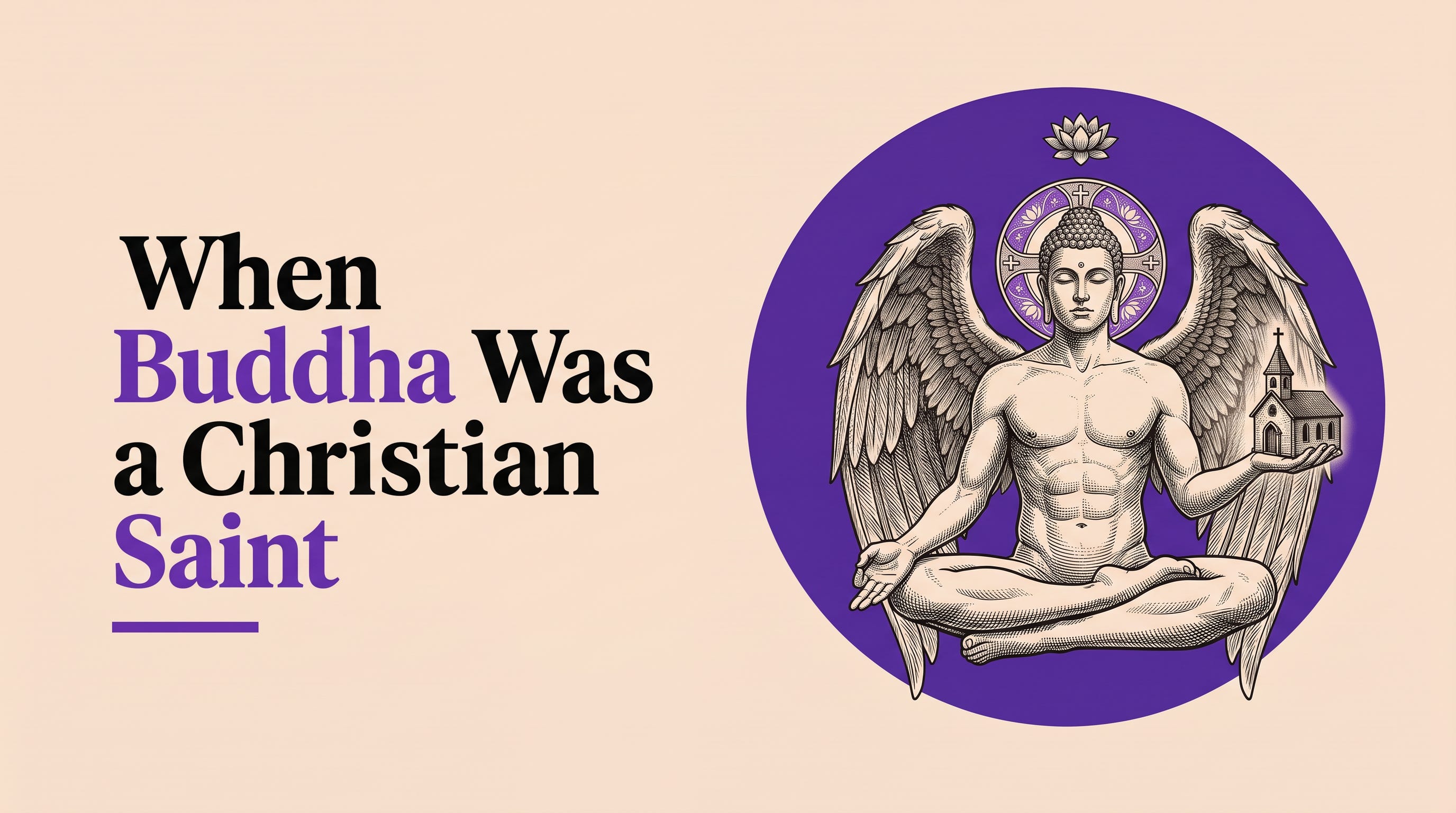
In older editions of the Roman Martyrology, the official Catholic register of saints and their days, under November 27 you’ll find two names listed together: Barlaam, a hermit, and Josaphat, an Indian prince who gave up a kingdom for God. The Greek church kept them on August 26, the Slavic churches on November 19. They had a feast, a biography, a place in the most widely read book of saints’ lives in medieval Europe, and at least one bone sitting in a silver reliquary in Belgium, where it still gets carried through the streets once a year.
Josaphat is the Buddha, and the churches that venerated him for a millennium had no idea.
One thing before we get into it. This is a step outside the usual territory here, so if you want more pieces like this one, say so in the comments. If you hated it, say that too, because a quiet comment section tells me little.
The Prince with a Palace to Hide Death From Him
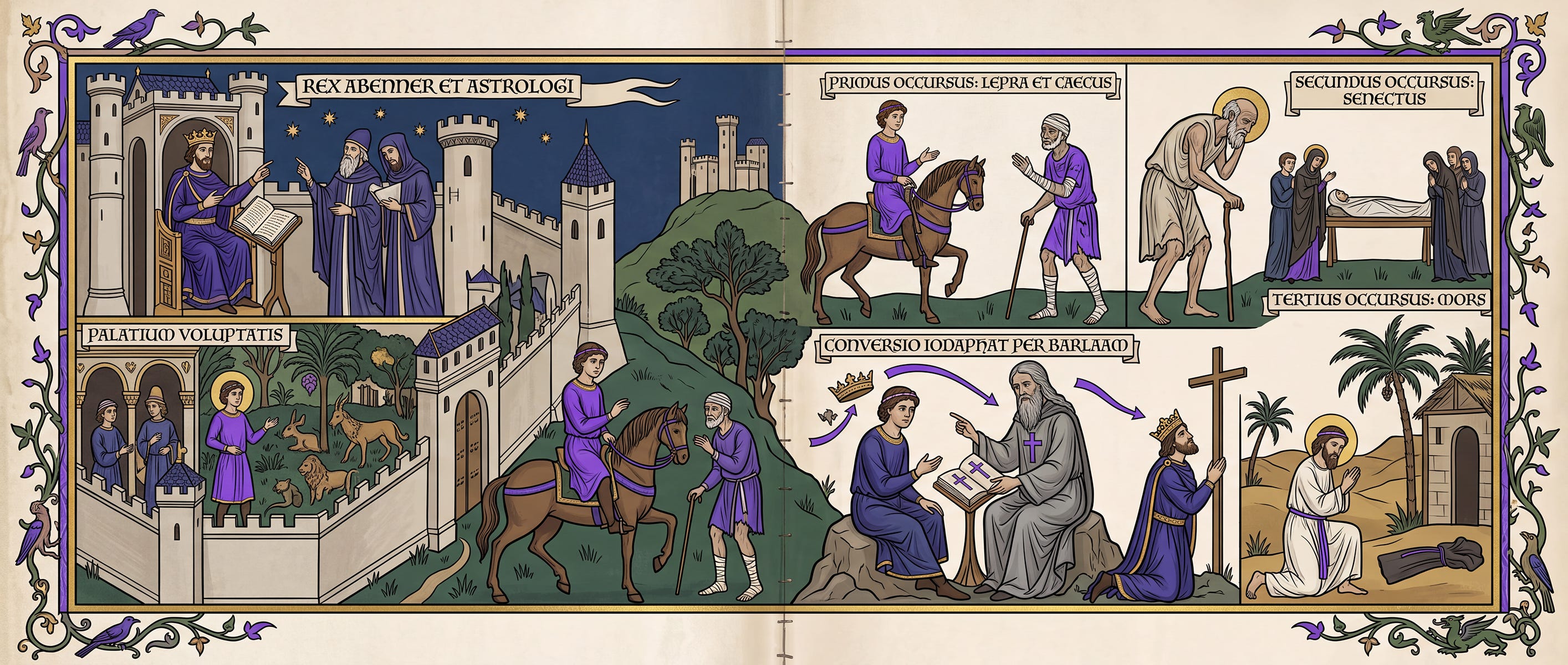
The Christian version, as medieval Europe received it, goes like this. A king in India named Abenner, a persecutor of Christians, has a son. His astrologers warn him that the boy will one day convert to the faith his father is trying to stamp out. So the king does what fathers in these stories always do: he builds his son a palace, fills it with pleasure, and gives orders that the prince is never to see anything that might turn his mind toward suffering or the divine.
It fails the way it has to, because Josaphat gets out. On one ride he sees a leper and a blind man and learns for the first time that bodies break down. On another he meets a man so old he can barely stand, and he learns that this happens to everyone, including him. Then he learns about death. Shaken loose from the palace and everything in it, he’s found by a wandering ascetic named Barlaam, who teaches him in parables. Josaphat converts. His father tries seduction, argument, and threat to pull him back, then gives up and converts too. Josaphat rules for a while, hands the kingdom over, walks into the desert, and spends the rest of his life as a monk. Miracles happen at his grave.
Anyone who’s heard the standard life of the Buddha has just read it. The palace, the shielding father, the prophecy at birth, the escape, the sick man and the old man and the corpse, the teacher in the wilderness, the renounced throne, the years of asceticism. The Christian version bolted on a conversion and a set of sermons, kept the plot, and shipped it to Europe under a new name.
Bodhisattva, Budhasaf, Yudhasaf, Iodasaph, Ioasaph, Josaphat
The name gives the whole thing away once you line it up. “Bodhisattva,” the Sanskrit title for a being on the path to buddhahood, became Bodisav in Middle Persian. Arabic scribes rendered that as Budhasaf. Then somebody’s pen slipped. In Arabic script, the letter b carries one dot below and the letter y carries two, so a single extra dot turns Budhasaf into Yudhasaf, and that misreading is the form that traveled. Georgian took it as Iodasaph. Greek smoothed it to Ioasaph. Latin dressed it up as Iosaphat, and English got Josaphat.
Barlaam took a similar route, arriving from the Arabic Bilawhar by way of Georgian.
The Route Ran Through Missionaries and a Monk
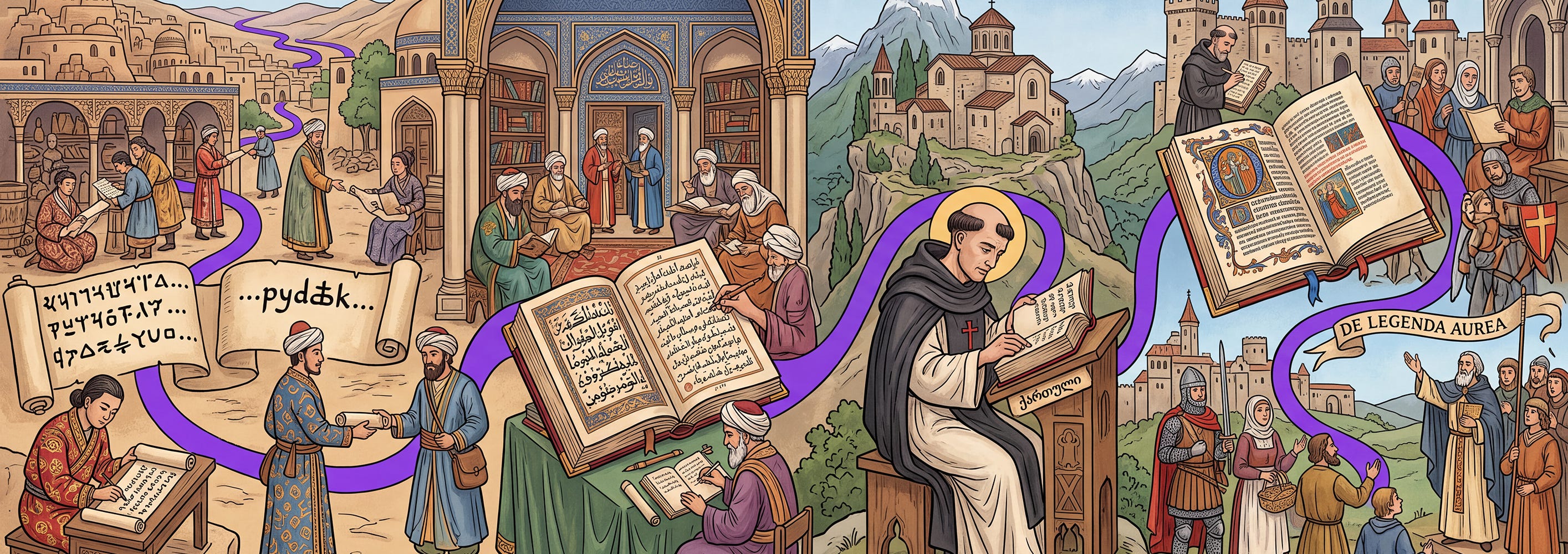
We figured Manichaeans carried the story to the West thanks to the fragments of the tale that turned up in the ruins at Turfan in western China written in Uighur, Parthian, and Persian. From there an Arabic version circulated in Abbasid Baghdad under the title Bilawhar wa-Budasf. A Georgian Christian writer then rewrote the Arabic into a Christian book, the Balavariani, adding the conversion, the theology, and the martyr’s temperament that the original didn’t have.
The version that conquered Europe was the Greek one, and for centuries it carried the name of John of Damascus, an eighth-century theologian with the prestige to make the book stick. Most scholars now credit Euthymius, a Georgian monk at the monastic community on Mount Athos who translated it from his own language into Greek before dying in a riding accident in Constantinople in 1028. From Greek it went into Latin, and from Latin into every literary language in Europe. It landed in the Golden Legend, the thirteenth-century saints’ collection that sat in more medieval libraries than almost anything else. One of its embedded parables, about a suitor choosing among caskets, worked its way through an English translation and into The Merchant of Venice.
A Doge Sent a Piece of the Buddha’s Spine to Portugal
In 1571, the Doge of Venice, Luigi Mocenigo, presented King Sebastian of Portugal with a bone and part of the spine of Saint Josaphat. When Spain seized Portugal in 1580, the relics left with the Portuguese pretender to the throne, wandered through exile, and reached Antwerp around 1633, where Cistercian monks at St. Salvator’s abbey took them in. In 1672 they were paraded through the city. After the French Revolution shut the abbey down, the relics moved to St. Andrew’s Church, where a silversmith made a new reliquary for them in the 1840s. It goes out in a procession every year.
In other words, there’s a bone in Antwerp that Catholic Europe honored as a relic of the Buddha, and the people carrying it thought they were honoring an Indian prince who’d taken up the cross.
If even a small fraction of regular readers became supporters, I’d spend less time running the business side of this publication and more time in the archives doing the research this work demands.
Marco Polo Missed What the Resemblence Meant
The clues were sitting in the open for a long time. One manuscript of Marco Polo’s travels remarks on how much the life of the man he calls Sakyamuni resembles the life of Saint Josaphat, and stops there. In the sixteenth century a Portuguese chronicler named Diogo do Couto, working in India, saw the same overlap and concluded that the locals had gotten hold of the Christian story and corrupted it into a legend about their own teacher. He had the arrow pointing exactly backward.
Two European scholars finally worked it out in 1859 and 1860, and the identification held. The Catholic Encyclopedia of 1913 states it without a fight: the story is a Christianized version of a legend of the Buddha, and the name comes from a corruption of bodhisattva. The feast day stayed on the books for decades after that admission, which is easier to understand once you know that Barlaam and Josaphat were never formally canonized. They arrived by reputation, through a martyrology entry and a bestselling book of saints’ lives, and reputation is harder to revoke than a decree.
There’s one more thing worth knowing about the text. Tucked inside it sits a version of a second-century Christian defense of the faith addressed to a Roman emperor, a document otherwise lost. The book that smuggled the Buddha into the Christian calendar is also the reason we still have it.
In the bonus section below, I’llwalk through the one parable from this book that outlived the book itself: a man hanging over a pit, a beast above him, a dragon below, two mice chewing through the branch, and a few drops of honey on his tongue. It starts in the Mahabharata, arrives in Greek with a unicorn attached, and shows up sixteen hundred years later in Tolstoy, who used it to describe his own breakdown without ever learning where it came from. If you’ve been reading these for free and want to fund the digging, this is where you do it.
Exclusive Content for Paid Subscribers
The Man Hanging Over the Pit
The book that made the Buddha a saint is full of parables, and one of them has outlived every version of the book it traveled in.