


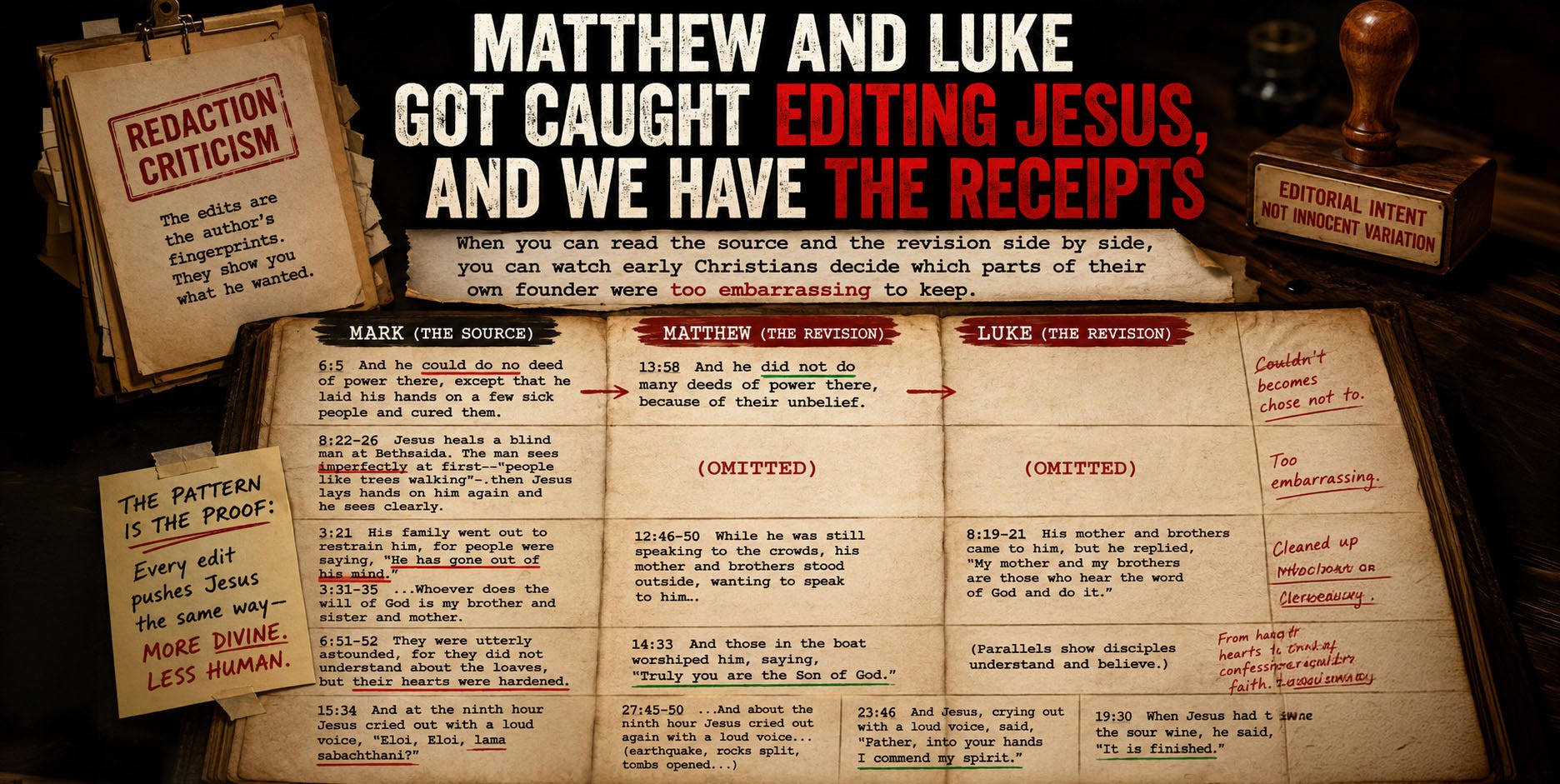
There’s a version of the Jesus story where nobody ever changed anything. The Gospels just landed, fully formed, four independent witnesses who happened to agree on the important stuff and differ only in the small details any four witnesses would differ on. That’s the version most people carry around without ever stating it out loud, and it’s the version the church has every reason to leave undisturbed.
The problem is that we can check. Matthew and Luke both used Mark as a written source, copying him sentence by sentence in long stretches, which means we can lay the original beside the revision and read the edits directly. This is documented evidence, the kind a copyright lawyer would call open and shut: two later authors working from a document we still have, making changes we can point to, line by line.
And once you start reading those changes as a set instead of one curiosity at a time, a pattern shows up that’s hard to explain as innocent. Matthew and Luke edited Mark in a direction, with every change pushing the same way, toward a Jesus who’s more powerful, more dignified, more in control, and less human. The previous piece argued that Mark gave us a Jesus the church buried. This one is about the burial itself, the actual mechanics of how two writers took an uncomfortable text and made it preachable.
The Tool That Makes This Visible
Biblical scholars have a word for studying how a writer changes his sources: redaction criticism. The idea is that if you know what an author started with, then every alteration he made (every word added, dropped, softened, or moved) is a window into what his agenda was. The edits are the author’s fingerprints. They show you his theology more reliably than anything he says outright, because they show you what he did when he thought nobody was comparing.
This only works because Markan priority is settled. The agreement among textual scholars, running from Streeter through Metzger and Ehrman and the rest of the academic mainstream, is that Mark came first and the other two leaned on him heavily. Matthew reproduces something like ninety percent of Mark, and Luke takes over half. They follow his outline, keep his phrasing, and preserve his sequence often enough that the dependence isn’t seriously disputed by anyone working in the field.
So we’re not guessing at a lost original. We have the original and Mark sits right there in the canon, two books to the right of Matthew, and the men who revised him left him in the same Bible as the evidence of what they changed. The church canonized the source and the edited copies together and then trained its readers never to compare them.
“Could Do No Deed of Power There”
Mark sends Jesus home to Nazareth, and it goes badly. The locals know him, they’re unimpressed, and Mark reports the consequence flatly: Jesus “could do no deed of power there, except that he laid his hands on a few sick people and cured them” (Mark 6:5). The verb is the issue. Mark says Jesus couldn’t. The lack of faith in the room actually stopped him. His power had an off switch, and other people’s doubt was holding it.
Matthew copies the scene almost word for word, right up to that verb, and there he stops and changes it. In his version Jesus “did not do many deeds of power there, because of their unbelief” (Matthew 13:58). Couldn’t becomes didn’t, so the constraint becomes a choice. Matthew’s Jesus surveys the unbelieving crowd and declines to perform, like a king refusing to entertain a hostile court, and his power stays infinite and intact the whole time.
That’s the entire theological distance between the two Gospels compressed into one edited word. Mark wrote a Jesus with limits set by other people. Matthew couldn’t live with it, so he reached in and adjusted the grammar until the limit disappeared.
The Healing That Vanished
Sometimes the telling edit is a deletion, and a deletion tells you even more than a changed word.
Mark 8:22-26 has Jesus heal a blind man at Bethsaida, and it’s the strangest healing in the New Testament because it takes him two tries. He puts saliva on the man’s eyes, lays hands on him, and asks what he sees. The man sees something, but it’s wrong: people who look like walking trees, the world half-developed, the focus not there yet. Jesus has to lay his hands on him a second time before the man sees clearly, because the first attempt left the job half-finished.
For a wandering folk healer this is a normal day. For the cosmic Christ that later theology built, a Jesus through whom all things were made, a botched first attempt at a simple healing is a theological emergency. So look at what the other two do with it. Matthew keeps nearly every healing in Mark, often expanding them, cranking up the drama and the crowds. This one he drops entirely, and Luke drops it too. The single miracle in Mark where Jesus needs a second go is the single miracle that didn’t make it into either revision.
Two authors, working independently, looked at the same passage and made the same call. That repeated, matching deletion is editorial judgment rather than coincidence or lost text. The story embarrassed them, so it didn’t survive the copy.
Cleaning Up the Family
Mark has no patience for Jesus’s relatives. Early in the Gospel his family hears what he’s doing and goes out “to restrain him, for people were saying, ‘He has gone out of his mind’” (Mark 3:21). His own people think he’s lost it and set out to physically haul him home. A few verses later his mother and brothers show up asking for him, and Jesus won’t go out to them, telling the crowd that his real family is whoever does the will of God (Mark 3:31-35). He picks the strangers in the room over the blood relatives standing in the doorway.
Matthew keeps the second scene and quietly amputates the first. The mother and brothers still arrive, Jesus still gestures at his disciples as his true family, but the part where the relatives think he’s insane and come to seize him is gone (Matthew 12:46-50). Luke does the same surgery and trims the rest into something almost warm, a quick line about his mother and brothers being those who hear God’s word and do it (Luke 8:19-21). John, working later and from a different angle, finishes the rehabilitation by planting Mary at the foot of the cross as the model disciple.
Watch what happens to Mary across these edits. In Mark she’s part of a family that thinks her son is mentally ill. By the time the tradition is done with her she’s the serene, faithful mother of Christian art. That rehabilitation started right here in the text, with Matthew and Luke deciding the embarrassing detail had to go, long before any painter touched it.
Don’t just read this piece only in your inbox, like it, comment on it, criticize it, so that I’m not in the void and you have a say in how The Unholy Truth takes shape.
Promoting the Disciples
The twelve disciples in Mark are close to useless, and Mark seems to want you to notice. They miss the point of the parables, they panic in the boat, they fail to grasp the feeding miracles, they argue about rank moments after Jesus predicts his own death. When he’s arrested they run. The whole portrait is so consistent that it has its own name in the scholarship.
Take the moment Jesus walks on the water. In Mark, the disciples see him, lose their minds with fear, and then Mark twists the knife: they were astounded “for they did not understand about the loaves, but their hearts were hardened” (Mark 6:51-52). They’ve just watched him feed thousands and they still understand nothing. Their hearts are hardened, which is the exact language the Hebrew Bible uses for Pharaoh, the villain of the Exodus. Mark is comparing the inner circle to Pharaoh.
Matthew takes that same scene and turns it inside out. His disciples don’t cower in incomprehension. They worship Jesus and declare, “Truly you are the Son of God” (Matthew 14:33). Where Mark has hardened hearts, Matthew has a confession of faith. The disgrace becomes a creed. Luke runs the same upgrade across his whole Gospel, smoothing the disciples into earnest students wherever Mark left them looking like fools.
There’s a theory about why Mark wrote them this way, that he was needling the Jerusalem church leadership by portraying their founding figures as clueless. Whether or not that holds, the editorial direction is plain. Mark’s apostles are an embarrassment, and Matthew and Luke went back through the text handing out the dignity Mark had withheld.
Rewriting How Jesus Died
Mark’s Jesus dies with one line on his lips, screamed in Aramaic: “My God, my God, why have you forsaken me?” (Mark 15:34). That’s the whole speech. No forgiveness for the executioners, no calm handing-over of his spirit, no announcement that the mission is complete. He dies asking why God left him, and then he dies with a wordless cry that Mark doesn’t even bother to render as speech. It’s the bleakest death scene in the New Testament, and it was the first one written.
The defenders will tell you the cry is the opening of Psalm 22, which ends in vindication, so Jesus really meant the triumphant part. The trouble is that this argument asks you to supply the ending Mark refused to write, to hear the psalm’s resolution in a line that gives you only its despair. Mark could have quoted the hopeful verses. He quoted the abandonment.
Now watch the other three flinch. Matthew keeps the cry, because he’s following Mark closely here, but he packs the scene with portents around it, earthquakes and splitting rocks and tombs breaking open, so the despair drowns under cosmic spectacle. Luke can’t keep the line at all. He deletes it and writes a new one: “Father, into your hands I commend my spirit” (Luke 23:46), a death of perfect trust. John deletes it too and gives Jesus a victory cry instead, “It is finished” (John 19:30), a closing line that declares the mission accomplished and leaves no room for abandonment.
Three writers, three different ways of handling the same unbearable sentence. One kept it but buried it in fireworks. Two cut it outright and wrote replacements pointing the opposite direction. The forsaken Jesus, the one screaming at an absent God, exists in exactly one Gospel, the earliest, and the tradition spent the rest of the century making sure he never died that way again.
The Edits All Lean the Same Way
Any single change you could wave off. Authors paraphrase. Memories differ. Maybe Matthew had another source for the Nazareth scene, maybe Luke just liked his crucifixion line better. Pick the changes apart one at a time and each has an innocent story available.
The trouble is the direction. Line them up and they don’t scatter the way honest variation scatters. Every edit pushes Jesus the same way. Couldn’t heal becomes chose not to, the failed healing disappears, the family that called him crazy gets cleaned up, the idiot disciples turn into confessing believers, and the abandoned death turns serene. Every major change runs in that one direction, toward a Jesus stronger, less limited, less human, and less abandoned than Mark had him. The vector is one hundred percent consistent, and consistency at that scale is the signature of deliberate intention.
This is what redaction criticism actually exposes. Two communities, a decade or two after Mark, received a Gospel they found theologically intolerable in specific places, and they fixed it. They had a picture of who Jesus needed to be, divine, sovereign, composed, surrounded by faithful men, dying in command of the situation, and they edited the earliest account until it matched the picture. The Jesus most Christians worship is, in measurable part, the product of that editing.
If you’re not already a paid subscriber and you’re finding value here, I’d love for you to consider becoming one to keep The Unholy Truth alive.
The Mindset Was Different Than Modern Morality
The writers whose work ended up in the Bible, starting with Paul, weren’t working from evil agendas. They believed that salvation ran through faith in Jesus, full stop, so saving people from hell justified whatever it took to get them there. Once you accept that premise, editing a Gospel or signing an apostle’s name to your own letter stops looking like fraud and starts looking like rescue.
Think about it. You’d feel fine lying to your own kids if you were convinced the lie kept them safe from predators, and you wouldn’t even file it under lying. My neighbor’s ten-year-old believes strange men will steal his organs if he ever gets in their car, and his mother isn’t losing a minute of sleep over having planted that. She knows it’s false. She also knows it works, and to her, the second part settles the question.
That’s the headspace the early church operated in. The men reshaping Jesus across the first and second centuries weren’t cynics gaming a system they didn’t believe in. They were true believers who’d decided the stakes were eternal, and people who think the alternative is your eternal damnation will tell you almost anything to keep you out of the fire. Judging them by modern standards of honest authorship misses what they thought they were doing. They thought they were saving your life.
Sources and Further Readings
Bart D. Ehrman, Jesus, Interrupted: Revealing the Hidden Contradictions in the Bible (HarperOne, 2009)
Bart D. Ehrman, The New Testament: A Historical Introduction to the Early Christian Writings (7th ed., Oxford University Press, 2019)
Bruce M. Metzger and Bart D. Ehrman, The Text of the New Testament: Its Transmission, Corruption, and Restoration (4th ed., Oxford University Press, 2005)
E. P. Sanders, The Historical Figure of Jesus (Penguin, 1993)
Adela Yarbro Collins, Mark: A Commentary (Hermeneia, Fortress Press, 2007)
Joel Marcus, Mark 1-8 and Mark 8-16 (Anchor Yale Bible, Yale University Press, 2000 and 2009)
Mark Goodacre, The Synoptic Problem: A Way Through the Maze (T&T Clark, 2001)
Tags: biblical criticism, redaction criticism, Gospel of Mark, synoptic problem, historical Jesus, Markan priority, New Testament scholarship
My father used to beat me with the belt and cause welts. It was abuse. It created trauma. It created permanent damage to me and in our relationship. And he must've been feeling uncomfortable about it, because he preached sermons from the actual pulpit on "Spare the rod, spoil the child."
It may be true that the "The arc of the moral universe is long, but it bends toward justice." (Dr. Martin Luther King, Jr., quoting Theodore Parker, an American Unitarian minister and abolitionist.) And although my father could be arrested today for his abuse of me, that fact is a measure of change, more than a condemnation of his entire generation. But no matter what that fact suggests, it remains the case that I'm traumatized by events that occurred 70 years ago and that in spite of my father's efforts, he could never fully overcome the violence that he perpetrated during his life.
And Christianity? What an abusive religion it is been! What a hugely important and violent institution of the systematic torture of children, women, slaves, indigenous people, LGBTQA+ people, the environment, the poor, the un-housed, and in every possible way, the other! Human beings cannot be trusted with truth or wisdom. Any more than they can be trusted with science.
If only we weren't stuck with them! Unfortunately, we've got no alternatives to humans.