


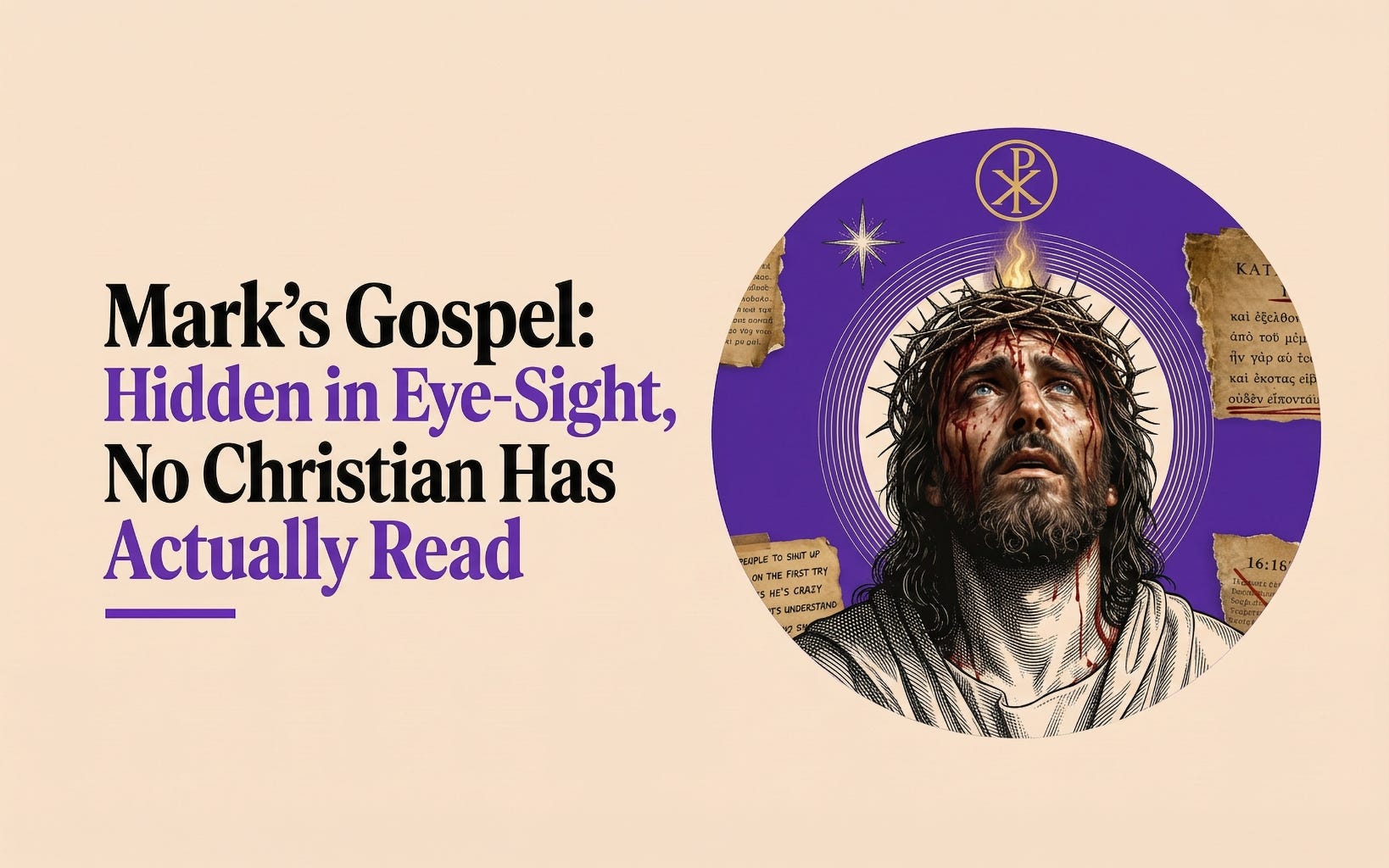
Many people think they’ve read, or at least skimmed, the Gospels and know what they are about. In reality, what they’ve read is a composite Jesus, a figure assembled from four different accounts that blend in their heads into one smooth narrative. The serene healer of John’s discourses gets fused with the moral teacher of Matthew, the Greek-friendly cosmopolitan of Luke, and somewhere in the back, unnoticed, the strange and unsettling Jesus of Mark.
Mark gets buried. Pastors skip past him to mine Matthew for ethics and John for theology. Sunday school curricula prefer his stories once the later evangelists have rewritten them. When people quote “the Gospels,” they mean a version of Jesus that Mark didn’t write and wouldn’t have recognized.
Strip the synthesis away and read Mark on his own terms, in the order he wrote, ending where he chose to end, and you meet a man nobody in the pews has actually met. This Jesus tells people to shut up about his identity. He fails to heal on the first try. He goes mute on the cross except to scream that God has abandoned him. His followers never understand him, his family thinks he’s lost his mind, and the story stops with three terrified women running from an empty tomb and saying nothing to anyone.
That’s the original Gospel. Everything Christians find comforting about Jesus was added later by writers who found Mark’s version intolerable and rewrote it.
The Gospel That Came First
Modern textual scholarship has reached a firm consensus, going back through Streeter and continuing through Ehrman, Metzger, and the broader academic mainstream, that Mark is the earliest of the four canonical Gospels. He wrote sometime around 70 CE, just after the destruction of the Jerusalem Temple by Roman forces. Matthew and Luke, written between 80 and 95 CE, both used Mark as their primary source. They copied his stories, kept large stretches of his wording, and rearranged his sequence. John, written later still around 90 to 110 CE, took a wildly different theological direction but knew the same general tradition.
This matters because it inverts how most Christians read the New Testament. The canonical order (Matthew, Mark, Luke, John) creates the impression that Matthew sets the baseline and Mark is a shorter follow-up. The reverse is what actually happened: Mark is the foundation, and Matthew and Luke are the revisions built on top of him. The things they changed, added, smoothed over, or quietly deleted from Mark tell you exactly what early Christians found embarrassing about their own earliest written account of Jesus.
If you want to know what Christianity tried to bury, read what Mark wrote that the others refused to copy.
Telling People To Shut Up: The Messianic Secret
William Wrede, a German biblical scholar writing in 1901, noticed something so strange in Mark’s text that it shaped a century of New Testament scholarship. Throughout the Gospel, Jesus is constantly telling people, demons, and his own disciples to keep his identity quiet. Wrede called it the Messianic Secret, and once you see the pattern, you can’t unsee it.
In Mark 1:25, Jesus rebukes an unclean spirit who recognizes him as “the Holy One of God” and orders the demon to “be silent.” In Mark 1:34 he won’t let the demons speak “because they knew him.” In Mark 1:44 he heals a leper and tells him to “say nothing to anyone.” In Mark 3:12 he sternly orders the unclean spirits “not to make him known.” In Mark 5:43, after raising Jairus’s daughter from the dead, he gives “strict orders that no one should know this.” Most famously, in Mark 8:30, when Peter finally confesses that Jesus is the Messiah, Jesus orders the disciples “to tell no one about him.”
This is bizarre behavior for a divine figure on a mission to save humanity. The Jesus of John’s Gospel does the opposite, announcing his identity in long public discourses, declaring “I am” sayings to crowds, and openly performing signs designed to provoke belief. Mark’s Jesus actively suppresses recognition. He performs miracles and then demands silence. He teaches in parables, he says, so that outsiders “may indeed look but not perceive” (Mark 4:12).
That last verse is worth pausing on. Mark has Jesus quote Isaiah to justify deliberately obscuring his message from the public. The parables aren’t pedagogical tools to make hard truths accessible. They’re filters, designed to keep most listeners out. Read straight, without the harmonizing instincts most Christians bring to the text, this is a Jesus who doesn’t want widespread followers. He wants a small, confused circle of insiders, and even they don’t get it.
Wrede’s original explanation was that Mark invented the secrecy theme to explain why so few Jews had recognized Jesus as Messiah during his lifetime. The historical Jesus, on this reading, was never publicly proclaimed as Messiah at all, and Mark had to construct a literary reason for the silence. Later scholars have refined and disputed Wrede’s specific theory, but the pattern runs through the whole Gospel and can’t be argued away. Whatever theological purpose it served, Mark’s Jesus moves through his own ministry like a man trying not to be identified.
A Jesus Who Can’t Always Heal On The First Try
Mark 8:22-26 is one of the most quietly devastating passages in the New Testament, and the reason most Christians don’t notice is that they read past it without registering what it actually says.
People bring a blind man to Jesus and beg him to heal him. Jesus takes the man outside the village, puts saliva on his eyes, lays hands on him, and asks if he can see anything. The man looks up and says he can see people, but they look like trees walking around. Jesus lays his hands on the man’s eyes a second time, and only then does the man see clearly.
A failed first attempt: the miracle didn’t take.
For a human folk healer, this is unremarkable. For the incarnate Son of God who later writers described as having authority over creation itself, it’s theologically catastrophic. Matthew, in his redaction of Mark, drops this story entirely. So does Luke. They preserve every other healing miracle in Mark, often expanded and intensified, but this one quietly disappears. The early Christian writers who copied Mark saw the problem and edited it out.
The same pattern shows up in Mark 6:5, where Jesus arrives in his hometown of Nazareth and “could do no deed of power there, except that he laid his hands on a few sick people and cured them.” Mark says directly that Jesus couldn’t perform miracles in Nazareth because of the locals’ lack of faith. Matthew softens this in his parallel passage (Matthew 13:58) to “he did not do many deeds of power there,” a small grammatical adjustment that flips the theology. Mark’s Jesus is constrained by his audience’s belief. Matthew’s Jesus chooses not to act. The difference is the entire question of whether Jesus has limits.
Mark wrote a Jesus with limits, and the tradition spent the next century writing the limits out.
The Family That Thought He Was Crazy
Mark 3:21 contains a sentence that no English translation preserves with its original force. The Greek says that Jesus’s family went out “to seize him,” because people were saying “he is out of his mind.” His own relatives believed he was mentally ill and tried to take him into custody.
A few verses later (Mark 3:31-35), his mother and brothers arrive at the house where he’s teaching and send word in asking for him. Jesus refuses to come out. He looks at the strangers sitting near him and says, “Here are my mother and my brothers! Whoever does the will of God is my brother and sister and mother.” This is a denial of his blood family, delivered while they’re standing outside waiting for him.
Matthew preserves the family episode (Matthew 12:46-50) but carefully strips out the part where they think he’s insane and try to detain him. Luke does the same (Luke 8:19-21), trimming the scene down to a brief, neutral exchange. John goes further still, presenting Mary at the foot of the cross as a model of faithful discipleship.
Mark’s account is the harshest of the four. His Jesus has a family that doesn’t believe in him, doesn’t follow him, and at one point actively tries to bring him home as a mental case. The mother who appears in Christmas pageants holding the infant Christ in serene blue robes isn’t Mark’s Mary, and the Mary Mark actually wrote is one of the people Jesus walks away from when she comes asking for him.
Disciples Who Never Understand Anything
If you want a single test for whether someone has actually read Mark, ask them what they think of the disciples. Anyone who’s spent time in Mark walks away with the impression that the Twelve are, frankly, hopeless. They don’t understand the parables (Mark 4:13). They don’t understand the feeding miracles (Mark 6:52, 8:17-21). They don’t understand the passion predictions (Mark 9:32). They squabble about which of them is greatest right after Jesus tells them he’s going to be killed (Mark 9:33-34). Peter rebukes Jesus for predicting his own death and gets called “Satan” in response (Mark 8:33). At Gethsemane they fall asleep three times while Jesus prays in agony (Mark 14:32-42).
Then, when Jesus is arrested, “all of them deserted him and fled” (Mark 14:50). Peter denies him three times. In the original ending of the Gospel, the disciples never reappear at all, and the men Jesus had spent the whole story training are gone before the women even reach the tomb.
This relentless portrait of disciple-failure is so distinctive that scholars have given it a name: the Markan disciples motif. Some have argued Mark is deliberately attacking the Jerusalem leadership of the early church (Peter, James, John), painting their predecessors as fools to discredit their later authority claims. Others see it as theological reflection on the universal failure of human understanding before God’s mystery. Either way, the heroic apostolic band that later tradition celebrates is nowhere to be found in Mark. Mark’s apostles are confused, cowardly, and absent at the moment that decides everything.
Matthew softens this considerably. In Matthew, when Jesus walks on water, the disciples worship him and confess “Truly you are the Son of God” (Matthew 14:33). In Mark’s parallel (Mark 6:51-52), they’re “utterly astounded” because “they did not understand about the loaves, but their hearts were hardened.” Matthew turns a moment of failure into a moment of correct theological confession. Luke elevates the disciples wherever possible, presenting them as faithful learners instead of dense companions.
Mark’s apostles were an embarrassment to the later evangelists, and Matthew and Luke quietly went back through the text and gave them dignity Mark hadn’t.
“My God, My God, Why Have You Forsaken Me?”
The crucifixion scene in Mark is shorter than any other Gospel’s, and everything in it runs darker. Jesus says nothing on the cross except for one cry, in Aramaic, before he dies: “Eloi, Eloi, lema sabachthani?” Mark translates it for his Greek readers: “My God, my God, why have you forsaken me?”
That’s it. No “Father, forgive them, for they know not what they do” (that’s Luke). No “It is finished” or “Behold your son, behold your mother” (those are John). No prayer of confident self-surrender. Mark’s Jesus dies asking why God has abandoned him.
The line quotes Psalm 22, and Christian apologists have spent two thousand years arguing that Jesus must have meant the whole psalm, which ends in vindication, rather than the opening line of despair. This reading has the disadvantage of asking us to ignore what the text actually says in favor of what we wish it said. Mark shows us a man crying out about divine abandonment, then dying with “a loud cry” that isn’t even reported as words. The bystanders mock him. The centurion’s confession that follows (”Truly this man was God’s Son,” Mark 15:39) is delivered, depending on translation choices, either as straight theological recognition or as bitter Roman irony at a dead would-be king.
Matthew keeps the cry of abandonment but adds material around it. Luke removes it and substitutes “Father, into your hands I commend my spirit” (Luke 23:46), a serene line of trustful submission. John removes it and replaces it with “It is finished” (John 19:30), a victorious declaration of completed mission.
Three of the four canonical Gospel writers couldn’t tolerate a Jesus who died in despair, and two of them rewrote the death scene outright. The earliest version, Mark’s, is the one that leaves him on the cross screaming about the God who walked out on him.
The Ending That Wasn’t An Ending
Mark’s Gospel originally ended at chapter 16, verse 8. Three women come to the tomb early in the morning to anoint Jesus’s body. They find the stone rolled away. A young man in white tells them Jesus has been raised and instructs them to tell the disciples and Peter that he’s going ahead to Galilee. And then, in the final sentence of the original Gospel, “they went out and fled from the tomb, for terror and amazement had seized them, and they said nothing to anyone, for they were afraid.”
That’s the ending. There are no resurrection appearances, no reunited disciples, no Great Commission, no ascension; the women run away terrified and tell no one. The Gospel cuts off mid-scene, on the Greek conjunction gar (”for”), which in standard Greek prose never ends a sentence, let alone a book.
The verses you find in most Bibles after 16:8, telling stories of post-resurrection appearances and ending with the famous “go into all the world” commission, are a later addition. Manuscript evidence is decisive on this point. The oldest and best Greek manuscripts of Mark, including Codex Sinaiticus and Codex Vaticanus from the fourth century, end at 16:8. Early church fathers like Eusebius and Jerome explicitly note that the longer ending wasn’t present in their best manuscripts. Modern critical editions of the New Testament (the Nestle-Aland, the United Bible Societies Greek New Testament) mark verses 9-20 as a secondary addition.
Some manuscripts have what scholars call the “shorter ending,” a brief paragraph attempting to round off the abrupt finale. Others have the “longer ending” (16:9-20), which is itself a composite of resurrection material scribes pieced together from the other Gospels. A few manuscripts have both endings stacked back to back, the scribes unsure which forgery to trust.
The early church couldn’t live with how Mark actually ended. Multiple anonymous scribes, working independently, wrote fake endings to give the Gospel the resolution the original author refused to provide. These endings then got copied for centuries until they were treated as Scripture. Today, when a preacher quotes Mark 16:17-18 about believers handling snakes and drinking poison, they’re quoting a forgery.
Mark, the actual Mark, ended his Gospel with terrified women running from an empty tomb and telling no one anything they’d seen, and every triumph readers think they remember from the closing chapter was written by somebody else, decades or centuries later.
What Mark Was Actually Doing
The skeptical reading of all this is that Mark, writing in the immediate aftermath of the Roman destruction of Jerusalem, was working with traditions about a failed Jewish messianic figure executed by Rome a generation earlier, and his Gospel preserves the rough edges that later theology scrubbed off. Mark is closer to the historical Jesus than the other Gospels precisely because he hadn’t yet been fully theologized.
The theological reading, championed by scholars like Frank Kermode in The Genesis of Secrecy and by Bart Ehrman in his work on the historical Jesus, sees Mark as a careful literary writer using opacity and failure as theological strategies. His Jesus hides his identity because the cross is the only place his identity can be properly understood. His disciples fail to comprehend because the mystery of God’s action in history exceeds human categories. His ending breaks off without resurrection appearances because the reader is the one who has to finish the story, by going to Galilee, by believing without seeing.
Both readings are doing the same work: they’re taking Mark seriously as the source rather than treating him as a shorter, less interesting Matthew. He’s the foundation, and everything else in the canon is built on top of him.
If you’re finding value here, I’d love for you to consider becoming one to keep The Unholy Truth alive.
What Got Lost When Mark Got Buried
Christianity ended up canonizing four Gospels and then teaching its laity to harmonize them. The result is that the dominant cultural image of Jesus is a composite figure who never existed in any single source: Mark’s healings, Matthew’s ethics, Luke’s social conscience, John’s metaphysics, all flattened together with the rough patches filed off.
That harmonized Jesus has been useful to the institution. He’s confident. He’s clear. He knows who he is and announces it. He dies victoriously, instructs his disciples to evangelize the world, ascends bodily into heaven, and leaves behind a clear apostolic chain of authority. He’s the Jesus of creeds and councils, of imperial Christianity, of certainty.
Mark’s Jesus is the wrong Jesus for that institution. He’s secretive, sometimes limited, sometimes harsh with his family, dismissive of his closest followers’ competence, and dies asking God why he’s been abandoned. His resurrection isn’t witnessed by anyone in the original text. His chosen disciples have all fled. The only people who learn he’s risen are three women too terrified to tell anyone.
You can see why Matthew rewrote him. You can see why Luke smoothed him. You can see why John replaced him with a serenely divine figure announcing himself in long discourses. And you can see why the church, for two thousand years, has kept him in the canon while training nobody to actually read him, present in every Bible, rarely preached, rarely read on his own terms.
Anyone willing to sit down with Mark on his own and read him straight through, in his order, stopping where he stopped, encounters a Christianity nobody in a pew has met, and it isn’t the Christianity the institution was ever in a position to sell.
Sources And Further Readings
Bart D. Ehrman, Jesus, Interrupted: Revealing the Hidden Contradictions in the Bible (HarperOne, 2009)
Bart D. Ehrman, Misquoting Jesus: The Story Behind Who Changed the Bible and Why (HarperOne, 2005)
William Wrede, The Messianic Secret (1901; English translation Cambridge: James Clarke, 1971)
Frank Kermode, The Genesis of Secrecy: On the Interpretation of Narrative (Harvard University Press, 1979)
Bruce M. Metzger and Bart D. Ehrman, The Text of the New Testament: Its Transmission, Corruption, and Restoration (4th ed., Oxford University Press, 2005)
Adela Yarbro Collins, Mark: A Commentary (Hermeneia, Fortress Press, 2007)
Joel Marcus, Mark 1-8 and Mark 8-16 (Anchor Yale Bible, Yale University Press, 2000 and 2009)
N. Clayton Croy, The Mutilation of Mark’s Gospel (Abingdon Press, 2003)
The way I was introduced to studying the gospels was that Mark was first, notes from Peter’s sermons taken by John Mark, a young man who was a camp follower so to speak. Matthew was based on Mark, containing references to appeal to Jewish followers of Jesus. Neither were going to incite the wrath of devout Jews by proclaiming a blasphemy, that Jesus was God or God’s son. Mark hints, Matthew builds a case, then Luke expands it to the Gentiles.
Consider how Mary’s role in Mark is merely a footnote. Matthew acknowledges her & Joseph as Jews of good standing with the Magi discovering Jesus’ portent in the stars. Luke fleshes out the backstory with a narrative that smacks of the Greek gods procreating with mortals but immaculately. One might question whether a young girl would be able to extemporaneously produce the Magnificat & remember it vividly when interviewed by Luke. The story also provides for Mary avoiding being stoned for becoming pregnant out of wedlock or having to marry someone other than Joseph.
I think the important part of the Gospels isn’t the ripping yarns or plot twists, but the message of loving & taking care of your neighbor. Jesus was always telling his disciples to feed, heal, & comfort people, don’t worry about who’s first because the first will be last.
Just one person’s opinion.
For me the most telling feature of Mark’s gospel is the original ending, which had no resurrection account, simply the women finding an empty tomb and fleeing. If we had no other gospel account, we might conclude Jesus was simply a failed prophet whose sacrifice came to naught. Maybe at the time Mark composed his gospel that was the prevailing opinion. There are other peculiar aspects of Mark, like the mysterious young man in white linen, that suggest large parts of the narrative have been lost or redacted out. Perhaps one day a scroll or papyrus will turn up that is close to the autograph version. How many biblical scholars would sacrifice their first-born to get the keys to the Vatican archives?