


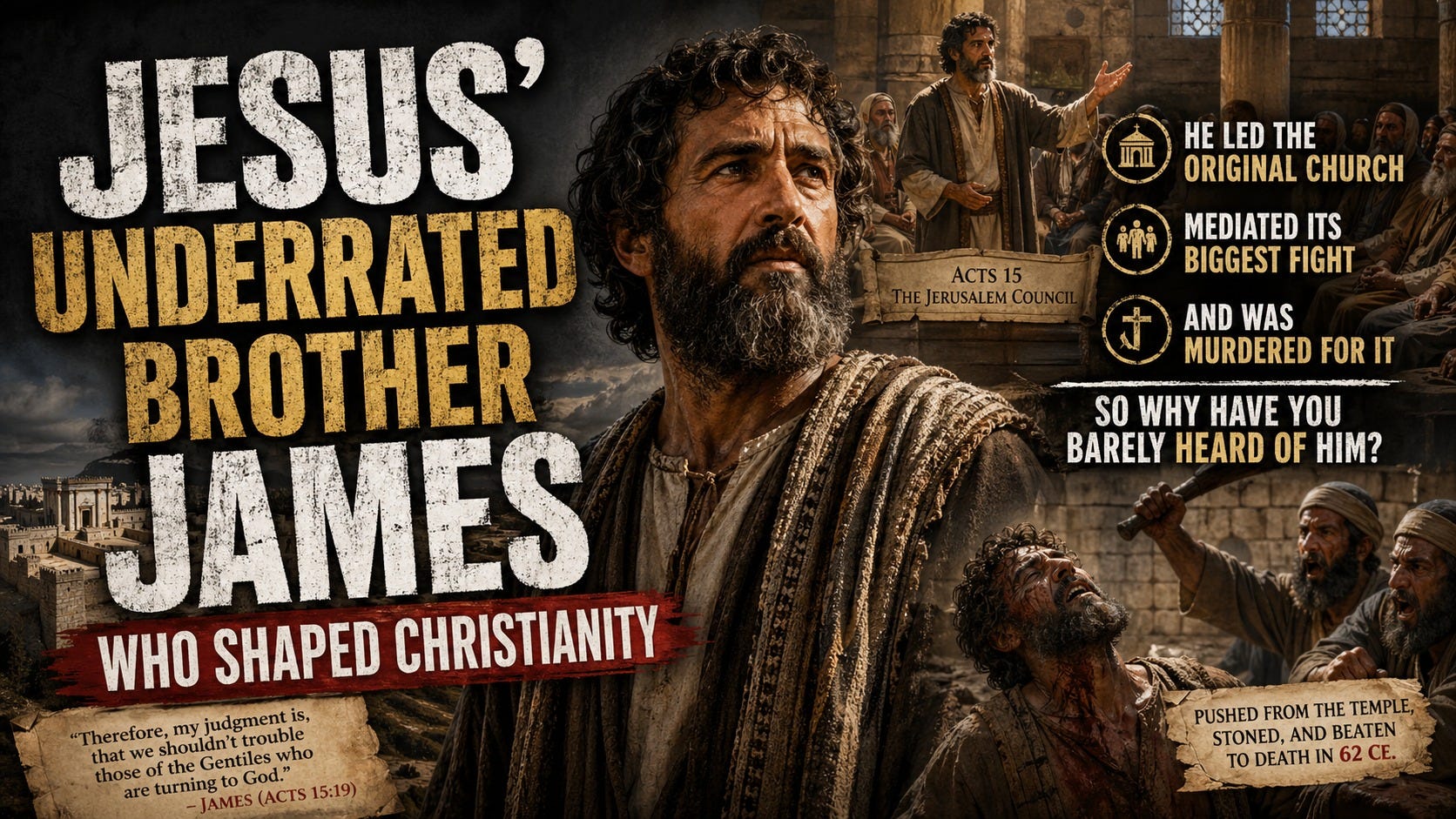
For an average Christian today James the Just isn’t an interesting figure. If they hear the name chances are some would shrug, a few would mistake him for one of the Twelve, and almost none would know that for roughly thirty years he was the most powerful figure in the movement Jesus left behind.
When Jesus died, having failed to fulfill the prophecies of a messiah, Christianity was in total chaos, and in that environment James the Just, Jesus’ brother, was seen as the natural leader. The man who stayed in Jerusalem, ran the original church, mediated its biggest doctrinal fight, and was eventually murdered for it. The man whose own brother, the one Christians worship as God, called him family in the most ordinary sense.
That a figure this central could be reduced to a footnote, if not edited out of his own bloodline, tells you almost everything you need to know about how Christian tradition handles inconvenient history.
When the Bible Doesn’t Mean What It Says
Mainstream Christianity has spent two thousand years trying to muffle: Jesus had brothers. The Gospel of Mark, the earliest gospel, names them. Mark 6:3 reports the people of Nazareth saying, “Is this not the craftsman (traditionally, and perhaps erroneously known as carpenter), the son of Mary and brother of James and Joseph and Judas and Simon? And are not his sisters here with us?” Matthew 13:55 repeats the list with minor variation, and Paul, writing earlier than any of the gospels, refers in Galatians 1:19 to “James the Lord’s brother.” The Greek word in every case is adelphos, brother. It’s the same word used for any other ordinary fraternal relationship in the New Testament. If the writers had meant cousin or kinsman, Greek had precise words for that too: anepsios for cousin (which Paul actually uses in Colossians 4:10 for Mark being the cousin of Barnabas) and syngenēs for relative more broadly (which Luke uses in 1:36 for Elizabeth being Mary’s relative). The vocabulary was sitting right there, and the writers chose differently.
Once the doctrine of Mary’s perpetual virginity began to solidify in the second century, formally articulated in the Protoevangelium of James around 145 CE and ratified as official church teaching at the Second Council of Constantinople in 553 CE, a doctrine without biblical support but with enormous theological convenience, those siblings became a problem. If Mary were a perpetual virgin, she couldn’t have produced more children. So James and the others got reclassified. The Catholic tradition, following Jerome, decided they were cousins. The Orthodox tradition, following an earlier reading, decided they were stepbrothers from a previous marriage of Joseph. Both readings exist not because the text supports them but because the text contradicts a doctrine the institutional church had committed to.
James was Mary’s son and Jesus’ younger brother. They grew up together, and they probably worked the same trade. James would’ve watched his older brother build a movement, get arrested, get executed, and then, according to tradition, appear to him risen. Paul mentions this appearance in 1 Corinthians 15:7, almost in passing, as if it were established knowledge among his readers. Whatever happened, James went from being one of the brothers who reportedly thought Jesus was out of his mind during his ministry (Mark 3:21, John 7:5) to becoming the head of his movement after his death.
The Pillar Paul Had to Answer To
The part most modern Christians have no idea about is that after the crucifixion, when the seemingly failed movement reignited as rumors started spreading that Jesus had resurrected and some people had seen him, the center of gravity in early Christianity was Jerusalem, and Jerusalem's bishop was James, making him the head of the movement his brother Jesus started.
Paul makes this explicit when he writes about going to Jerusalem to confer with the leadership. In Galatians 2:9, he names “James and Cephas and John, who were reputed to be pillars.” James is listed first, Cephas is Peter, and the order’s significant. Paul, no shrinking violet about his own status, places James at the head of the column. This is the man Paul has to negotiate with, the man whose approval the Gentile mission needs, the man whose envoys can rattle Peter into backing down at Antioch.
That episode in Antioch is one of the most revealing scenes in the entire New Testament, and most readers skim past it. Paul tells the story in Galatians 2. Peter has been eating with Gentile converts in Antioch, sharing meals across the Jew-Gentile boundary, treating the new movement as something genuinely universal. Then “certain men came from James” and Peter, suddenly skittish, withdraws from the Gentile tables, and Paul confronts him to his face and accuses him of hypocrisy. The thing to notice is the political reality embedded in that little phrase, “men from James.” Peter, the rock, the keys, the figure later Christianity would build a papacy on, gets cold feet the moment James’s people show up. James outranks him in Jerusalem, the Jerusalem leadership outranks the diaspora practice, and Paul, the renegade apostle, knows it.
The Verdict That Molded Christianity
The Jerusalem Council in Acts 15 confirms the structural reality. The dispute is over whether Gentile converts have to be circumcised and observe the Torah, and after the speeches, after Peter’s contribution, after Paul and Barnabas report what God has done among the Gentiles, it’s James who issues the ruling. Not Peter. James. “Therefore, my judgment is,” (krino, in the Greek, the word a magistrate uses when he hands down a decision) “that we shouldn’t trouble those of the Gentiles who are turning to God.” The compromise James imposes is light: abstain from food sacrificed to idols, from blood, from things strangled, from sexual immorality. Four prohibitions instead of the full Torah, and that ruling shaped the trajectory of every Christian community that ever existed. Every Gentile who ever called himself Christian without converting to Judaism owes that possibility, in part, to James’s verdict.
James’s compromise wasn’t Paul’s compromise, though. James kept the Torah, and he expected Jewish believers in Jesus to keep the Torah. He let the Gentiles in under reduced terms because the messianic age was understood to involve Gentile inclusion, but he ran the Jerusalem church as a Torah-observant Jewish movement that recognized Jesus as the Messiah. He was, in modern terms, a messianic Jew. He went to the Temple, he prayed in Jewish fashion, and he ate kosher. The later traditions about him, preserved most vividly in Hegesippus, who’s quoted by Eusebius, describe him as so ascetic and so devout that the Jewish leadership actually respected him, calling him James the Just. Hegesippus claims his knees were calloused like a camel’s from constant prayer in the Temple, and the image, however legendary in its details, captures something real: James wasn’t a renegade against Judaism. He was a Jew who believed his brother was the Messiah, and he ran a congregation of Jews who believed the same.
Paul Was the Eccentric, Not James
Paul’s letters, our earliest Christian documents, are the record of a man arguing with the Jerusalem position even as he claims to honor it. Read Galatians cold, without two thousand years of Pauline Christianity coloring the text, and what you find is a man defending himself against people who think he’s gotten it wrong, and those people are the followers of James. Paul wins the argument historically, not theologically, because Jerusalem fell, the Jewish-Christian movement scattered, and the Gentile churches Paul had planted survived to dominate the next centuries. But in James’s lifetime, Paul was the eccentric one, the loose cannon, the apostle who had to keep coming back to Jerusalem to make sure the leadership still recognized him.
The Epistle of James in the New Testament, whether actually written by him or by someone in his circle (scholars argue both ways), preserves a theology that reads almost as a direct counter to a misreading of Paul. “What good is it, my brothers, if someone says he has faith but doesn’t have works? Can that faith save him?” The famous line: “Faith by itself, if it doesn’t have works, is dead.” Luther hated the letter, called it an epistle of straw, and wanted it out of the canon. He understood, correctly, that James was offering a different account of how a person stands right before God than the one Luther had built his Reformation on, and what Luther couldn’t admit was that James’s account was almost certainly closer to what Jesus himself taught. Jesus’ surviving sayings, especially in the Sermon on the Mount, are saturated with works-based righteousness: do this, don’t do that, by their fruits you’ll know them. James sounds like Jesus because James knew Jesus and was raised in the same tradition.
Murdered by the High Priest
The end of James’s career is told in two sources, one Jewish and one Christian, and they agree on the headline. Around 62 CE, during a brief gap between Roman procurators, the high priest Ananus the Younger, a Sadducee hostile to the Jesus movement, convened a Sanhedrin and had James executed. Josephus tells the story in Antiquities 20.9.1, calling James “the brother of Jesus who was called Christ,” and that single phrase from a non-Christian Jewish historian is one of the most important external attestations to the historical Jesus we have. Josephus reports that the more reasonable Jews, those committed to the law, were so disturbed by this judicial murder that they petitioned the Romans, and Ananus was deposed for it.
Hegesippus’s version, as preserved by Eusebius, is more elaborate and more legendary. He says the scribes and Pharisees pushed James up to the Temple parapet and demanded he denounce Jesus before the Passover crowds, and James instead proclaimed Jesus as the Son of Man at the right hand of God. They threw him down and started stoning him, and while he was still alive, praying for his attackers, a fuller stepped forward and finished him with a club used for beating cloth. Hegesippus adds that some Jewish witnesses considered the destruction of Jerusalem eight years later to be God’s punishment for James’s death, a claim that suggests how seriously his contemporaries took him.
The Heretic First Christians
Eight years later, the city did fall. The Roman armies broke Jerusalem in 70 CE, leveled the Temple, and ended the institutional center of Jewish-Christian Christianity in a single campaign. The Jerusalem church scattered, and tradition says they fled to Pella, in the Decapolis. From there, the Torah-observant Jesus movement persisted for centuries as small sectarian communities, the Ebionites and the Nazarenes, but they were marginalized by the Gentile churches that had Paul’s letters and didn’t have a Temple to worry about. By the fourth century, Epiphanius and other heresiologists were treating the Ebionites as a deviation, a Christological error, an embarrassment. They were nothing of the kind. They were the descendants of the Jerusalem church James had built, and in a real historical sense they were the original Christians. The label “heretic” was applied retroactively by the people who’d won.
This is where the airbrushing becomes flagrant. In the canonical New Testament, you can still see James, barely. He gets a couple of cameos in Acts, he gets the epistle bearing his name, and Paul’s letters acknowledge him through gritted teeth. But the church that grew out of Paul’s mission and Constantine’s patronage had no use for a Torah-observant Jewish bishop running things from a Temple courtyard, so James got demoted. He became “James the Less” in some traditions, conflated with another James in the Twelve, and he got rebranded as a cousin to protect Marian doctrine. The apocryphal traditions, the Protoevangelium of James and the First and Second Apocalypses of James from the Nag Hammadi library, preserve fragments of a James who was deeply revered, who received secret teachings from the risen Jesus, who was a kind of esoteric heir. None of that survived into orthodoxy. The James who actually existed, the brother, the bishop, the bridge, was sanded down into a hagiographic blank.
This publication exists because readers like you choose to support it.
If you’re not already a paid subscriber and you’re finding value here, I’d love for you to consider becoming one to keep The Unholy Truth alive.
The Loyal Brother Got Footnoted
There’s a final, almost unbearable irony in the way the tradition handled him. The brother who stayed loyal, who built the institutional church Paul kept needing to consult, who died praying for his murderers, that brother got demoted, reclassified, and shoved into an apocryphal corner. The renegade apostle who never met Jesus in the flesh, who started fights with the Jerusalem leadership, whose own letters reveal the deep rifts in the early movement, that one got fourteen books in the canon and the title “Apostle to the Gentiles.” History was written by the side that ended up with the printing press.
If you want to understand Christianity at its source, you have to put James back where he belongs: at the head of the table, the first leader, the bridge between Jesus the Galilean Jew and the global religion that would eventually be unrecognizable to him. Without James, you don’t get a Jerusalem Council, you don’t get a Gentile mission with any institutional legitimacy, and you don’t get a Christianity that holds together for the crucial decades between the crucifixion and the fall of Jerusalem. He shaped what came after. He just never got the credit, because the people writing the history had every reason not to give it to him.
I spent 9 years in Roman Catholic seminary, and I never heard any of material - or any hint of it. Thank you, Tanner. I so appreciate your historical research, frankness and clarity!
Thank You Tanner. This is important.