


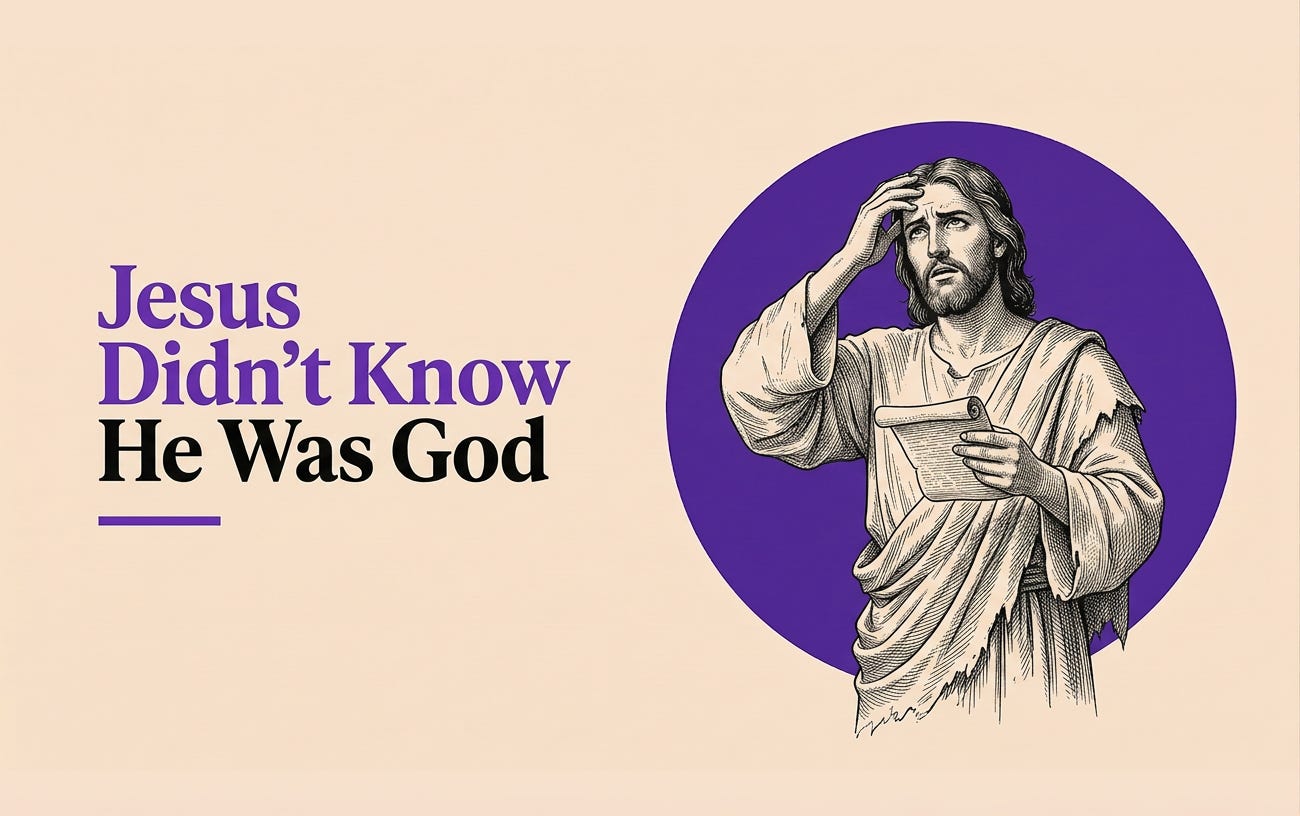
History has a way of inflating its heroes. The farther you stand from an event, the taller the stories grow, and the more the rough edges get smoothed over, which takes time. Muhammad’s evolution from a man who made mistakes, admitted them, asked for forgiveness, and retracted his own earlier words into a “demigod” with no sins and no mistakes, whose every word carried the power of the holy book, took centuries.
Jesus breaks that rule, since his evolution in the New Testament unfolded over mere decades, and you can watch it happen in real time by comparing the gospels.
What Jesus Says About Himself in Mark
In Mark 10:17-18, a man runs up, kneels, and calls Jesus “Good Teacher.” Jesus doesn’t accept the compliment. He asks why the man is calling him good, since nobody is good except God alone. If you’re God, that’s a strange way to answer a man who just called you good. It reads exactly like what it looks like: a Jewish teacher drawing a hard line between himself and God.
In Mark 12:28-34 a scribe asks which commandment comes first. Jesus quotes the oldest creed in Judaism, the one every observant Jew recited daily: hear, O Israel, the Lord our God, the Lord is one. The scribe agrees with him, and Jesus tells him he’s not far from the kingdom. Nobody in that scene thinks the answer needs a footnote explaining that the one Lord comes in three persons.
In Mark 13:32 Jesus talks about the end of the world and says nobody knows the day or the hour, not the angels in heaven and not the Son, only the Father. He names himself and puts himself on the side of the people who don’t know. An all-knowing God who doesn’t know something is a problem the church would spend centuries trying to solve.
Then there’s Mark 15:34. On the cross, Jesus’ last words in Mark are a scream: my God, my God, why have you forsaken me? He’s quoting Psalm 22, a psalm of a suffering man calling on God, and Mark leaves it there with no softening. Jesus dies addressing God as someone other than himself, and someone who seems to have left.
Mark also has no birth story. Jesus first walks on stage as an adult getting baptized by John, a wilderness preacher whose ritual was for the forgiveness of sins. The spirit comes down on him, and a voice from heaven calls him Son, giving the impression of a man being chosen, and that’s how a good number of early Christians read it.
Each Gospel Moves the Moment Further Back
The earliest Christian material puts Jesus’ elevation at the resurrection. Paul, writing in the 50s, quotes an older creed in Romans 1:3-4 that says Jesus was declared Son of God in power by being raised from the dead. A speech in Acts 2:22-36 calls Jesus a man God vouched for, then says God made him Lord and Messiah after raising him.
Mark pushes the moment back to the baptism. Matthew and Luke, writing in the 80s, push it back to the conception, with a virgin birth and angels. John, writing last, pushes it back before creation: in the beginning was the Word, and the Word was with God, and the Word was God.
So the high claims show up in the latest gospel, and the further you get from the events, the bigger Jesus gets. That’s the opposite of what you’d expect if Jesus had been walking around Galilee announcing his own divinity. A claim that explosive would be in the earliest sources, front and center, and the later writers would be the ones toning it down.
Matthew and Luke Edit Mark
We know Matthew and Luke copied Mark, because they reproduce whole stretches of his wording. That gives us something rare in ancient history: we can watch two authors revising a source in real time, and their changes tell you what bothered them.
Take the rich man again. Matthew 19:16-17, in the oldest manuscripts, has the man ask what good thing he should do, and Jesus answers, why do you ask me about what is good? The “why do you call me good” line is gone, and with it the denial.
In Mark 6:5, Jesus goes to his hometown and can’t do any miracles there apart from healing a few sick people. Matthew 13:58 changes “couldn’t” to “didn’t,” and adds that it was because of their unbelief. A Jesus who couldn’t do something became a Jesus who chose not to.
Mark 3:21 says Jesus’ family went out to restrain him because people were saying he’d lost his mind. Matthew and Luke both drop it. Luke also drops the line about the Son not knowing the day or hour. And Luke cuts the cry of abandonment from the cross completely, replacing it with a calm “Father, into your hands I commit my spirit.” John goes further still, with Jesus serenely announcing “it is finished.” Three later writers, three different replacements for the same embarrassing last words.
The Copyists Pick Up the Pen
For roughly fourteen centuries every copy of the New Testament was made by hand, mostly by believers who knew what the text was supposed to mean. When it didn’t say that clearly enough, some of them helped it along.
Matthew kept the “not even the Son” line in his version of the end-times speech (Matthew 24:36). Plenty of later manuscripts don’t have it. If you own a King James Bible, check: the phrase is missing from Matthew and still sitting in Mark, because the scribes behind the text the King James translators used got to one and not the other. A fourth-century bishop of Milan even claimed the phrase had been slipped in by heretics, which gets the history exactly backward.
Luke 2:33 originally called Joseph and Mary Jesus’ “father and mother.” That’s awkward for a virgin birth, so many manuscripts changed it to “Joseph and his mother.” Luke 2:43 called them “his parents,” and the same fix appears there. The King James has both changes.
1 Timothy 3:16 originally spoke of Christ as the one who was revealed in the flesh. In Greek, scribes abbreviated the word for God in a way that looked almost identical to the word for “who,” and adding a couple of strokes turned one into the other. The King James reads “God was manifest in the flesh.” The oldest manuscripts don’t.
At Jesus’ baptism in Luke 3:22, several early sources have the heavenly voice quoting Psalm 2:7: you are my son, today I’ve become your father. That reading says Jesus became Son of God on a particular day as an adult, which is exactly what the church would later condemn. The version that won reads “with you I’m well pleased.”
Then there’s the big one, the only verse in the King James that spells out the Trinity in so many words, 1 John 5:7. It isn’t in any Greek manuscript from the first thousand years of Christianity. I’ll get to how it got there.
The Bishops Split Jesus in Two
By the early fourth century, Christians had a theology that called Jesus God and a Bible that kept showing him as something less. The fight broke open in Alexandria, Egypt, where a popular priest named Arius taught that the Son was the first and greatest thing God created, divine in a lesser sense but not equal to the Father. Arius had plenty of Bible on his side. He leaned heavily on John 14:28, where Jesus says The Father is greater than I.
The emperor Constantine, who wanted one church for one empire, called the bishops together at Nicaea in 325. The council wrote a creed calling the Son “true God from true God” and “of one substance with the Father,” and Arius was exiled. That settled the vote. It didn’t settle the verses, which were all still sitting there in every copy of the gospels.
The solution that won out over the next century was to divide Jesus into two natures, one fully divine and one fully human, joined in one person. The Council of Chalcedon made this official in 451. In practice it works like a sorting machine. When Jesus says he doesn’t know the day or hour, that’s his human nature talking, while his divine nature knew perfectly well. When he cries out that God has abandoned him, that’s the human side. When he says “I and the Father are one,” that’s the divine side.
With this non-Biblical finding of the bishops, every verse where Jesus sounds like a man becomes evidence of his humanity, and every verse where he sounds like more becomes evidence of his divinity, so no possible sentence in the gospels could ever count against the doctrine. If Mark had written “Jesus said, I’m not God,” the two-natures answer would have filed it under the human side and moved on. A claim that survives every conceivable piece of evidence isn’t being tested by the evidence.
When’s an Interpretation No Longer an Interpretation?
Every reader interprets, since you can’t open a two-thousand-year-old book written in another language for another culture without making judgment calls about what the words meant to the people who first heard them. But where do we draw the line on reinterpretation?
There are more than 30 verses in the Bible where Jesus implies or outright says he isn’t God. After Jesus’ promotion to God’s equal, every one of these problematic verses had to be reinterpreted.
Reinterpretation is making sense of what you have, and the Bible doesn’t say Jesus has a split personality, switching back and forth between his human side and his divine side mid-sentence without warning anyone, either not realizing the confusion it would cause or not caring. That idea was brought in from outside, centuries later, to solve a problem the text created. Furthermore, once it’s in place, there’s no way for him to say he isn’t God and mean it. Every denial gets filed under his human side, and the doctrine stays standing no matter what he says.
So when you create evidence, such as a split personality, to make the Bible say what you need it to say, is it still interpretation? If we’re allowed to make things up so the Bible means what it doesn’t say, does it matter what the Bible says at all?
It gets worse, because the churches that teach Jesus is God’s equal, somewhere between 2.3 and 2.6 billion people, go further and make the belief the test of who counts as a Christian. Catholics, the Orthodox, and most Protestant churches refuse to recognize Jehovah’s Witnesses or Latter-day Saints as Christians on exactly this point, and the Athanasian Creed, still part of the official creeds of the Catholic, Anglican, and Lutheran churches, says anyone who doesn’t hold this belief about the Trinity will perish forever.
Apply that test to the first Christians and see who’s left standing. Peter, preaching the church’s first sermon in Acts 2, calls Jesus a man God vouched for, whom God made Lord and Messiah after raising him from the dead. The thousands in Jerusalem who were baptized that day never heard a word about Jesus being equal with the Father, because nobody had come up with it yet. By the standard of today’s churches, the apostles were heretics and the first church was full of fake Christians. So was Jesus himself, who answered the most important question he was ever asked by reciting that the Lord our God is one.
Exclusive Content for Paid Subscribers
What Christian Scholars Say About All This
Most of what’s in this piece comes straight from the textbooks used in seminars. Mark is the earliest gospel and Matthew and Luke copied it, which is the standard view in Catholic and mainline Protestant schools and taught at most evangelical ones. The scribal changes are documented by ….