


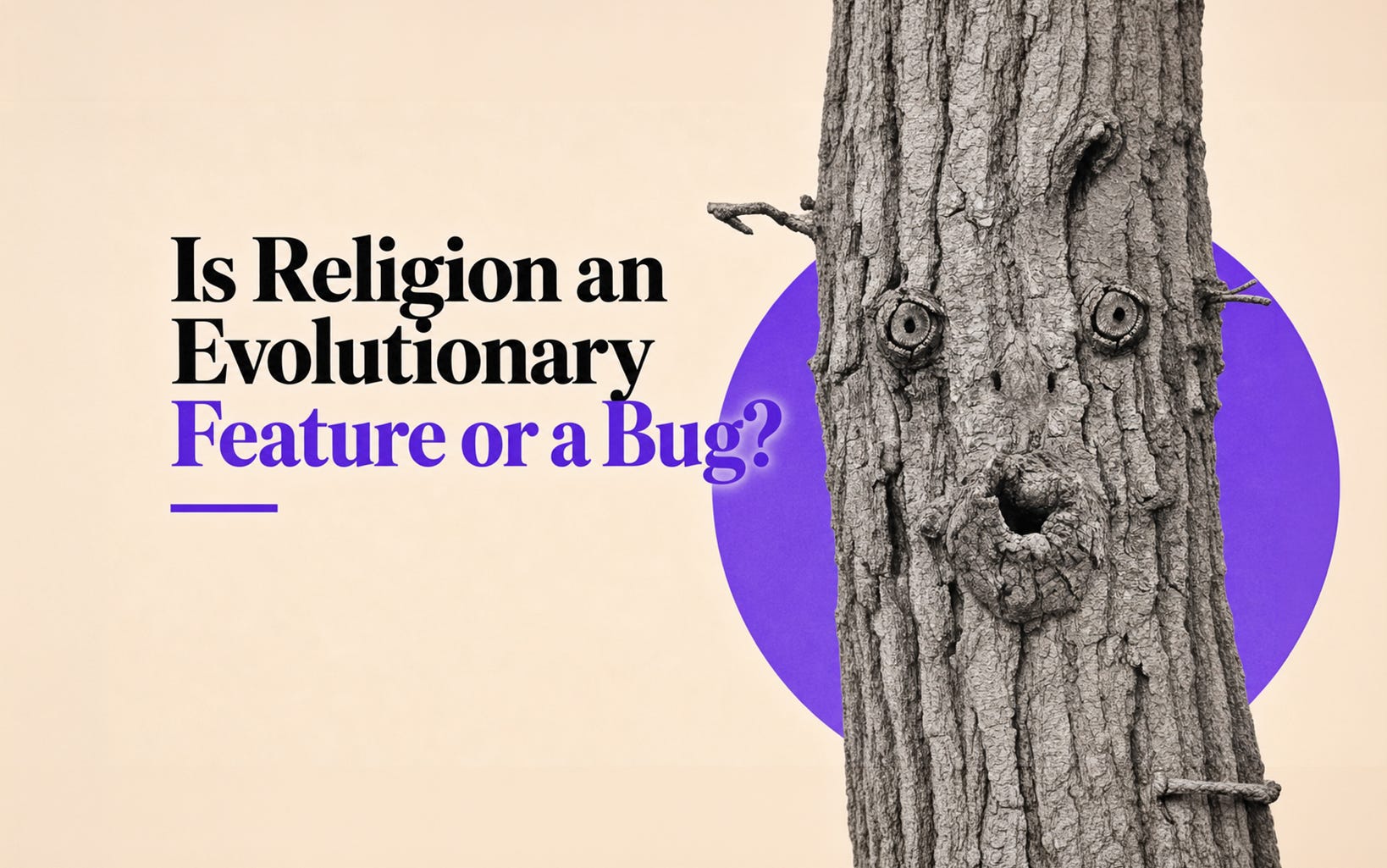
There are two options when it comes to gods. The first says the gods are real and human beings perceive them because there’s something there to perceive. The second says our ancestors were frightened and ignorant, they heard thunder, and they invented a thunder god because nobody had told them about static discharge yet. Both stories treat belief as a conclusion, something people arrived at after looking around and thinking it over.
In reality, belief is equipment, and the cognitive machinery that produces gods was installed long before anybody had a theology to put in it. It was installed because it kept people alive.
The Grass Moves and You Run
Think about the cheapest decision your ancestors made a thousand times a year. You’re on the savanna, the grass moves twenty feet to your left, and you’ve got about a quarter of a second to decide whether that’s wind or something that has just ordered its lunch.
If you get it wrong in one direction you sprint for no reason, needlessly burn a few calories, and look ridiculous. Get it wrong in the other direction and your genes are removed from the pool.
When one error is trivially cheap and the other is fatal, selection doesn’t build you an accurate detector, it builds you a jumpy one. Evolution couldn’t care less whether you got it right. All it weighs is the expected cost of being wrong.
Anthropologists call the result hyperactive agency detection, which is a clinical name for a system that assumes a mind behind every ambiguous movement and asks questions later. The system fires on rustling grass, on footsteps in an empty hallway, on the shape in the closet at 3 a.m., and on the face you see in a burnt piece of toast. It fires on weather, on disease, on a run of bad luck. You can’t turn it off by knowing better, which is why people with graduate degrees in atmospheric physics still flinch at thunder.
Once you’ve got a detector that finds minds everywhere, gods become the expected output.
Your Brain Finds the Pattern Regardless
Human beings are pattern-finding animals of extraordinary power, and that power comes from a willingness to accept patterns on very thin evidence. Two events in sequence, and we’ve got a cause. The berries from the low bushes made three people sick, so the low bushes are cursed. Nobody has time to run a controlled trial on berries, and the cost of a false pattern (avoiding a bush that was fine) sits nowhere near the cost of a missed one.
B.F. Skinner watched this in pigeons in 1948. He fed them on a timer, regardless of what they were doing, and within a few sessions the birds were turning counterclockwise, bobbing, and swinging their heads, each one repeating whatever it happened to be doing when the food arrived. The pigeon is running the same rule you run, which is that things happening together are probably connected, and that rule has paid for itself so many times that the occasional useless head-bob is a rounding error.
Now put those two systems together in one skull and you’ve got a machine that assumes a mind behind ambiguous events sitting next to a machine that connects events into causes on almost no evidence. Feed it a drought, a stillbirth, a sudden recovery, a herd that showed up when it was needed. What comes out is a person who wants something, whose intentions can be read, and whose mind might be changed if you offer the right thing.
Nobody Can Imagine Being Dead
Ask a young child what happens to a mouse after a cat eats it. With little to no prior training, children reliably report that the dead mouse doesn’t need food anymore and can’t see, then report in the same breath that it still misses its mother and knows where it is. The body stops, the mind keeps going, and children reach this on their own before anybody teaches them a religion.
Adults never lose it. Trying to imagine your own nonexistence means running a simulation of the experience of having no experiences, and the machinery quietly refuses. What’s left is a strong intuition that minds and bodies are separate things, which makes ancestors who go on existing somewhere the default assumption rather than a doctrine anyone had to argue for.
Dead relatives are also useful. A grandfather who’s still watching is a grandfather who still enforces the rules he enforced alive, and that’s where this stops being about individual brains.
The Part That Got Selected: Groups
Everything so far explains why belief comes easily to one human head. It doesn’t explain why religion got organized, expensive, and universal. For that you need to look at what belief does to a group.
If we think in terms of costs, fasting, circumcision, food restrictions, celibacy, tithes, scarification, dietary rules that make it impossible to eat with outsiders, and festivals that shut down weeks of productive work all take something from the people who follow them. Any economist looking at that ledger sees waste; any biologist looking at it sees a signal that’s hard to fake.
The problem every cooperating group has to solve is freeloaders, people who take the benefits of membership without paying the costs. You can’t read commitment off someone’s face, but you can read it off their behavior when the behavior is expensive enough that nobody would bother faking it. A man who’s given up pork, alcohol, and Saturdays for thirty years has posted a bond. The group can extend him credit, marry him into families, and leave him with the harvest, because the cost of his exit is visible.
That prediction has been tested against nineteenth-century American communes, about two hundred of them, religious and secular, all trying to hold a community together on shared property. In any given year the religious communes were roughly four times more likely to survive than the secular ones. Two decades in, most of the religious communes were still standing and almost none of the secular ones were, and among the religious communes the ones that demanded more of their members lasted longest. The same demands imposed by the secular communes did nothing for their survival, because a rule you can argue with is a rule members eventually argue their way out of.
Human beings also behave differently when observed, which is why the drawing of a pair of eyes above an honesty box raises the money people put in it. A high god with full access to your thoughts is the only enforcement mechanism that scales past the number of people who can keep track of each other, and it arrives free with equipment you already had. Groups carrying that belief could trust strangers, trade at distance, and field larger armies than groups that couldn’t.
This publication runs on your support. If you find value in what you read here, consider joining to help keep The Unholy Truth alive and independent.
Does This Mean There’s No God?
Most or all of what we’ve covered so far gets brought out by convinced atheists to make a case against God, so I wouldn’t blame you if you thought I was heading in that direction.
Instead I’ll leave you with this: Having evolved to believe in a creator, and building or borrowing a religion around that belief, doesn’t mean no creator exists outside the universe. Convincing yourself for no good reason that you’re being followed, your phone lines are tapped, and your house is bugged doesn’t guarantee every one of those beliefs is wrong.
For supporters: the story above has a serious fight inside it that I kept out of the main piece. Researchers split hard on whether religion was selected for at all or whether it’s a side effect of cognitive systems built for other jobs, and the strongest evidence for the group-selection side (Sosis and Bressler’s commune numbers, the Big Gods thesis) took a significant hit from a 2019 study in Nature that found moralizing gods showed up after societies got complex rather than before.
Below the line I walk through both the commune data and the challenge to it, including what the critics got right and where the original thesis still holds. If you want the argument with its weak points exposed, that’s what your support pays for, and it’s how this publication stays free for everyone else.
Exclusive Content for Supporters
Where the Evidence Gets Contested
The commune numbers, in detail. Sosis and Eric Bressler examined 83 communes founded in nineteenth-century America with enough surviving records to code. At year twenty, 39% of religious communes were still operating against 6% of secular ones…
