


In the winter of 1904, British archaeologist Flinders Petrie was exploring the wind-scoured, turquoise-mining plateau of Serabit el-Khadim in the western Sinai. His team was excavating the ruins of an ancient temple to Hathor when they began examining rough, reddish sandstone slabs left by Semitic laborers nearly 4,000 years earlier.
Most of the inscriptions were weathered marks scratched by miners seeking safe passage or a rich seam of ore. But one slab drew Petrie’s attention. Its surface bore a jagged, angular glyph: a stick-figure man with both arms lifted toward the sky, apparently crying out in alarm or prayer.
Petrie immediately recognized it as an early form of the Semitic letter Heh, the precursor to our modern H. Nearby was the earliest known phonetic writing system in human history, devised by Canaanite workers who adapted simplified Egyptian hieroglyphs to record their own language. As Petrie and his colleagues assembled the surrounding letters, they understood that they were not reading royal propaganda or an official priestly liturgy. Instead, they had found the raw handwriting of Bronze Age desert laborers. Hidden among those scratches were the first faint traces of a divine name that would ultimately transform the Western world.
For thousands of years, the history of God has been presented from the top down: a fully formed, omnipotent creator speaking from a burning bush or mountaintop and delivering a perfected theology to a waiting people. Yet as archaeologists and textual scholars looked beneath the Hebrew Bible’s polished surface, examining Egyptian temple walls, fragments of Ugaritic clay tablets, and the margins of the Dead Sea Scrolls, a very different account began to take shape.
Two Egyptian Temple Lists and a Desert Tribe Called Yhw
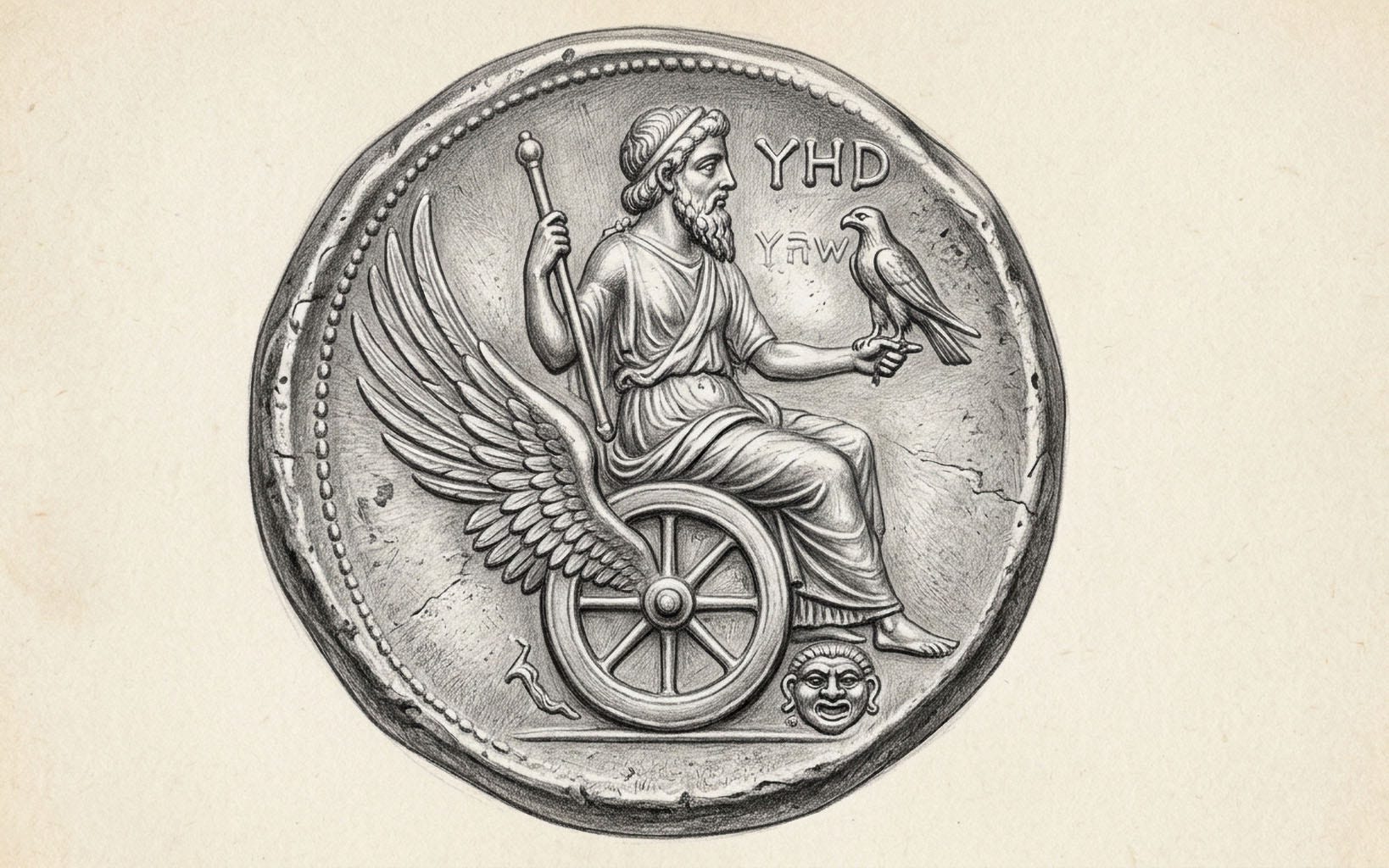
Two Egyptian temple inscriptions list the peoples Egypt dealt with, one from the reign of Amenhotep III (around 1370 BCE) and a copy from the time of Ramesses II roughly a century later. Among the desert peoples they name a group called the Shasu of Yhw. Those are the same consonants as Yahweh’s name, and the Shasu were herders who roamed the region south of Canaan, in the territory later called Edom. Nothing in either list connects them to Israel. The first Egyptian mention of Israel comes around 1208 BCE on a victory monument of Pharaoh Merneptah, and it names a people in the central hill country with no god attached. The nation’s own name ends in El (Yisra-el), the name of the old chief god of Canaan, and Yahweh’s name appears nowhere in it. A people loyal to Yahweh from the start would have named themselves after him, and the earliest label for Israel honors a different god.
Seir, Teman, and a Priest in Midian
Some of the oldest poetry in the Bible keeps pointing south. The Song of Deborah in Judges 5 has Yahweh marching out of Seir, from the fields of Edom, with the earth shaking and the clouds pouring. Deuteronomy 33 has him coming from Sinai and shining out from Seir, and Habakkuk 3 has him arriving from Teman, which sits in Edom too. Israel lived in the hills to the north, so a god who has to travel up from the opposite direction to reach his own people has a home address somewhere else.
According to the Moses story, he meets Yahweh while working for his father-in-law Jethro, a priest of Midian, and when Jethro hears how Yahweh pulled Israel out of Egypt, he announces in Exodus 18 that Yahweh is greater than all gods and then presides over the sacrifice, with Aaron and the elders eating at his table. A Midianite priest is the ranking clergyman in that scene, and Moses’ own in-laws hand the Israelites their introduction to the god. Scholars call this the Midianite or Kenite theory, and the story reads like a preserved memory of where the cult came from.
Ugarit, Seventy Sons, and an Old Chief Named El
Ugarit was a port on the Syrian coast, destroyed around 1180 BCE, and its clay tablets preserve Canaanite religion about as it looked when Israel was emerging from it. The head of the family there is El, an aged, bearded father figure married to the goddess Asherah, with seventy sons, one of them the storm god Baal. Israel’s culture grew out of Canaanite culture, with the same language family, the same cities and the same divine titles, and the patriarchs in Genesis worship El under local names throughout: El Shaddai, El Elyon, El Bethel. Exodus 6:3 admits it outright, with God telling Moses he appeared to Abraham, Isaac and Jacob as El Shaddai and never revealed the name Yahweh to them. Genesis 4:26 contradicts that cheerfully by having people call on Yahweh in the days of Adam’s grandson, which tells the reader the authors were working from separate traditions with separate timelines.
Deuteronomy 32:8-9 and the Verse the Scribes Fixed
Standard Hebrew Bibles say the Most High divided the nations according to the number of the sons of Israel. The Dead Sea Scrolls, and the Greek translation made centuries before the standard Hebrew text was fixed, read “sons of God” there, which makes far more sense of the next verse. Elyon (the Most High, a title of El) hands out the nations to his sons, each son gets a people, and Yahweh’s share is Jacob. In that arrangement Yahweh is one of El’s sons, assigned Israel the way each of his brothers got a nation of their own. Later scribes with a stricter theology changed the phrase because a divine family under El made them uncomfortable. Psalm 82 left the scene intact, with God standing in the council of the gods to sentence the others to die like mortals for ruling unjustly, and verse 6 calls those gods sons of the Most High before the sentence lands.
Yahweh of Samaria and His Asherah
Around 800 BCE, travelers at a desert way station called Kuntillet Ajrud in the Sinai scratched blessings onto storage jars and plaster invoking “Yahweh of Samaria and his asherah” and “Yahweh of Teman and his asherah.” Scholars argue over whether that last word means the goddess, a sacred pole, or her image, and every option leaves Yahweh traveling with a female partner who shares his blessings. The Jerusalem temple housed an Asherah object until Josiah’s reformers hauled it out around 622 BCE (2 Kings 23), which means it had sat in Yahweh’s own house for generations. By around 840 BCE a Moabite king named Mesha was boasting on a stone monument that he’d dragged the vessels of Yahweh before his own god Chemosh, so Yahweh was already a national god with a rival nation’s king treating him as one.
Over the following centuries, Yahweh picked up El’s titles, El’s role as head of the council, and El’s temple language, and the old chief disappeared as a separate figure, with Asherah following after Josiah. The first unambiguous monotheism arrives during the Babylonian exile, around 550 BCE, when the anonymous author of Isaiah 40-55 has Yahweh announce that there is no other god. That’s roughly eight centuries after Egyptian scribes first wrote the name Yhw on a temple wall, and a long way from a burning bush.
The Unholy Truth is a full-time commitment, made possible directly by readers like you. If you find value in these deep dives, consider upgrading your subscription to keep the work going and unlock all exclusive content on the site.
Sources and Further Reading
Mark S. Smith, The Early History of God: Yahweh and the Other Deities in Ancient Israel (2nd ed., Eerdmans, 2002)
Mark S. Smith, The Origins of Biblical Monotheism (Oxford University Press, 2001)
Francesca Stavrakopoulou, God: An Anatomy (Knopf, 2022)
Thomas Römer, The Invention of God (Harvard University Press, 2015)
William G. Dever, Did God Have a Wife? Archaeology and Folk Religion in Ancient Israel (Eerdmans, 2005)
Israel Finkelstein and Neil Asher Silberman, The Bible Unearthed (Free Press, 2001)
Primary texts: Judges 5, Deuteronomy 32-33, Exodus 3-4, 6, 18, Psalm 82, 2 Kings 23, Isaiah 40-55, Habakkuk 3
🔮👀✨Politics…? Not religion…? We need to put our primitive beliefs and superstitions behind us…! We are not primitive hunter gathers any more living at the mercy of our environments…? We are a hop skip and a jump from joining and becoming the Gods we seek…?❔❓🙏🏼
"The first unambiguous monotheism arrives during the Babylonian exile, around 550 BCE, when the anonymous author of Isaiah 40-55 has Yahweh announce that there is no other god."
Leaving the Bible out of it, the Egyptian pharaoh, Akhenaten, introduced monotheism roughly around 1350 B.C.. Some scholars have even put forth that that the seeds of Judaism began with Akhenaten. (This is fascinating period in Egyptian history, by the way.)
On top of that: "For thou shalt worship no other god: for the LORD, whose name is Jealous, is a jealous God...Exodus 34:14 'God' never says there aren't other gods, just that he is number one. That one really stuck with me when I was a kid.