


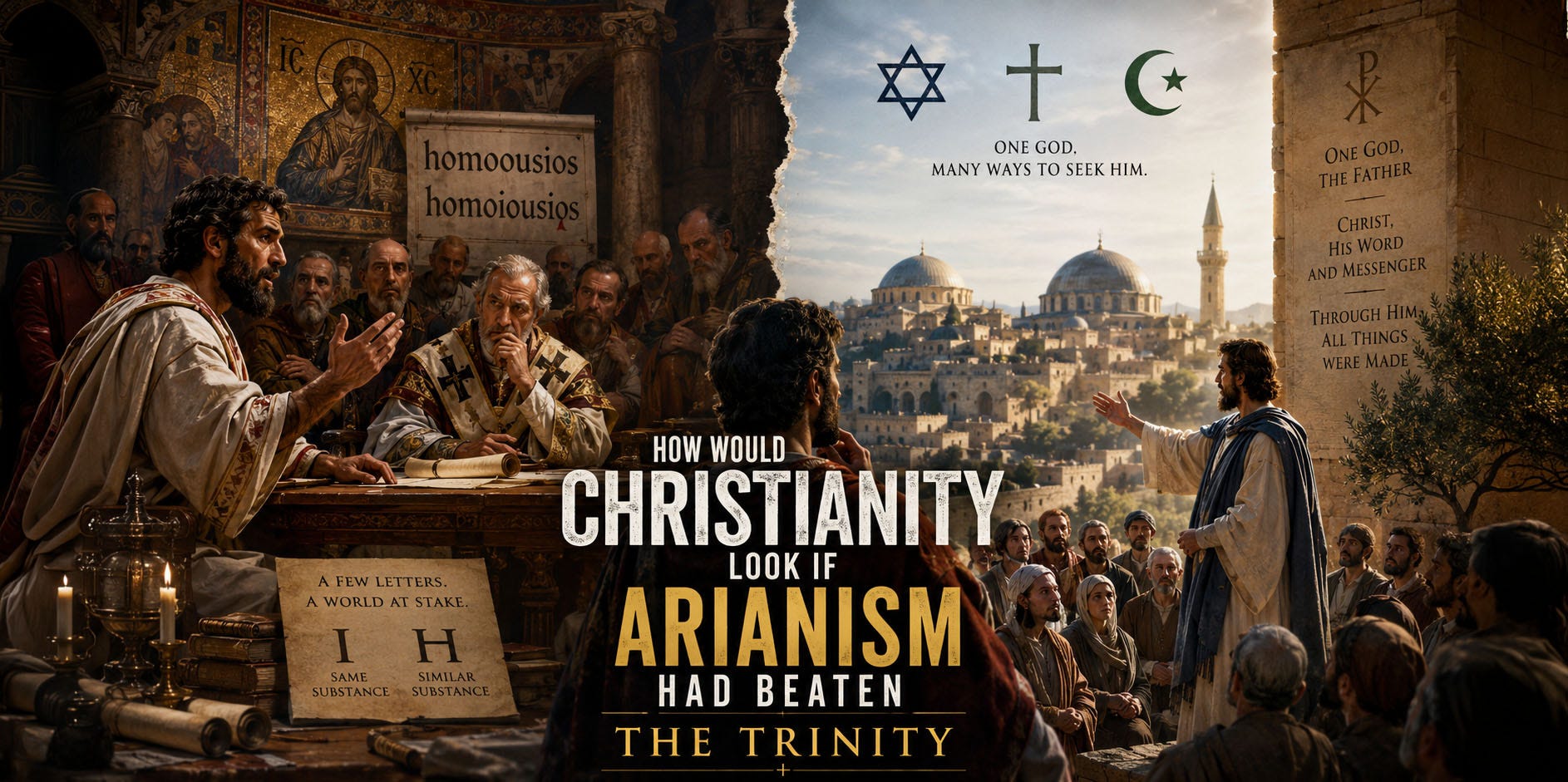
In the summer of 325, a few hundred bishops gathered in a lakeside town in what’s now northwestern Turkey and argued about a single vowel. The town was called Nicaea, modern-day Iznik, and the vowel was the difference between two Greek words: homoousios and homoiousios. One meant the Son was of the same substance as the Father. The other meant he was of a similar substance. An iota stood between them, and Edward Gibbon would later sneer that the whole Christian world had convulsed over a diphthong.
There was more at stake than the spelling of a Greek word. It was all about whether Jesus of Nazareth was God in the fullest sense, co-eternal and uncreated, or whether he was the highest and first of God’s creatures, exalted beyond anything else but still, at the end of the day, made. That question split the fourth-century church down the middle, and the side that lost gave its name to one of history’s great roads not taken. The man at the center was a priest from Alexandria named Arius, and the position he argued has been called Arianism ever since, mostly by the people who beat him.
Yes, none of this was enough to kill Arianism. For most of the fifty years after that famous council, the empire’s official theology was something other than what Nicaea had declared, and at several points the bishops who held the Nicene line were the ones in exile, deposed, or hiding. The Trinity we inherited was the survivor of a brawl that could have ended differently more than once.
Today, we imagine an alternative universe where Arius and his successors had consolidated their advantage instead of squandering it, and the Christianity that conquered Europe and then the globe was Arian rather than Trinitarian. What would that world look like?
What Arius Was Saying
Start with the man and his claim, because the caricature has buried both.
Arius was a presbyter in Alexandria in the early fourth century, an ascetic and a popular preacher with a gift for putting doctrine into singable verse. His central conviction was simple and, to his mind, obviously biblical. God is one, utterly transcendent, without beginning, the only source of everything else. If that’s true, Arius reasoned, then the Son cannot share that exact status, because to be a son is to be begotten, and to be begotten is to have a beginning. His famous slogan, which his enemies quoted with horror, was that “there was a time when the Son was not.” The Son was the firstborn of all creation, the agent through whom God made everything else, divine in a real and exalted sense, but still brought into being by the Father and therefore subordinate to him.
Unlike his opponent Arius, he had the luxury of being able to point to a stack of New Testament passages that supported him. The Gospel of John has Jesus saying the Father is greater than he is. Paul calls Christ the firstborn of all creation in Colossians. The Synoptic Gospels show a Jesus who prays to God, who doesn’t know the day or the hour, who pleads in Gethsemane for the cup to pass. Read without the later doctrinal scaffolding, a great deal of the earliest Christian writing fits a subordinationist picture more naturally than it fits the fully developed Trinity. Bart Ehrman has spent a career pointing out that the earliest Christians held a wide range of views about who Jesus was, and that the highest claims, the ones that make him eternal God equal to the Father, took time to crystallize.
The man who beat Arius was a deacon and then bishop of Alexandria named Athanasius, and the gap between their temperaments tells you a lot about why the fight went the way it did. Athanasius was stubborn past the point of reason, willing to be exiled five separate times rather than concede a syllable, and convinced that the entire logic of salvation collapsed if Christ was a creature. His argument was that only God can save, so if Christ saves, Christ must be God, full stop. No created intermediary, however exalted, could bridge the gap between the infinite and the human. For Athanasius the stakes weren’t academic. They were the difference between a Christianity that could deliver what it promised and one that couldn’t.
How Close the Vote Really Was
The popular memory of Nicaea runs like this: the bishops met, condemned Arius, wrote the Nicene Creed, and Christianity had its Trinity decisively.
The reality was a mess that dragged on for the better part of a century. Nicaea condemned Arius in 325, yes, and the word homoousios went into the creed at the insistence of the emperor Constantine, who cared less about the theology than about an empire that wouldn’t stop fighting over it. But Constantine had no deep commitment to the Nicene position, and within a few years he’d recalled Arius from exile and turned on the Nicene hardliners. Athanasius spent much of the next decades banished. When Constantine died, his son Constantius II took the eastern empire, and Constantius was openly sympathetic to the Arian side. Under him a series of councils met and produced creeds that walked back Nicaea, some of them explicitly stating that the Son was like the Father without the loaded word “same.”
By the late 350s the situation had reached the point where Jerome, looking back, wrote that the whole world groaned and was astonished to find itself Arian. That’s a partisan exaggeration, Jerome being firmly Nicene, but it captures something true. For a stretch of years the official theology of the Roman state, backed by the emperor and a majority of the eastern bishops, was not the Trinity as later defined. The Nicene party was on the defensive, sometimes in open retreat.
What turned it around wasn’t a knockout argument. It was a combination of factors that could easily have broken the other way. The Cappadocian Fathers, Basil of Caesarea and the two Gregorys, did the hard intellectual work of clarifying the language so that “three persons, one substance” stopped sounding like either three gods or a single God wearing masks. The emperor Theodosius, who took the throne in 379, happened to be a westerner and a committed Nicene, and he used state power to enforce the Nicene position the way Constantius had used it to undercut it. The Council of Constantinople in 381 ratified and expanded the Nicene Creed, and with imperial muscle behind it, the Arian churches inside the empire withered. That’s also when the duality became officialy the trinity.
Swap a few of those variables and the story inverts. Give Constantius a longer reign or a Nicene-hostile successor instead of Theodosius. Let one of the Cappadocians die young, as people constantly did. Imagine the imperial enforcement machine pointed the other direction for another two decades. None of these are wild counterfactuals. They’re small adjustments to a process that was already balanced on a knife’s edge. The Trinity won a contest it could plausibly have lost, and the people of the time knew it was a contest, which is why they fought so viciously.
A Christianity Built Around a Created Christ
Run the counterfactual forward and the first thing that changes is the shape of the central claim itself.
Trinitarian Christianity rests on a paradox it asks believers to hold without fully resolving: God is one, and God is three, and the Son is fully God and fully man at once. Centuries of councils after Nicaea, at Ephesus and Chalcedon and beyond, were spent trying to nail down exactly how the divine and human natures coexisted in Christ without either swallowing the other. The doctrine of the incarnation, God becoming flesh, is only coherent if Christ was God to begin with.
An Arian Christianity has none of that machinery, because it doesn’t need it. Christ is the supreme creature, the firstborn, the one through whom God made the worlds and through whom God redeems them, but he’s a creature. There’s no paradox of two natures to resolve, no mystery of how the infinite fits inside a Galilean carpenter, because the Arian Christ was always a being God created for exactly this purpose. The theology is, frankly, easier. It reads more straightforwardly off the surface of the New Testament texts, which is a large part of why it had such staying power among ordinary believers and not just clever bishops.
This has consequences that ripple outward. Worship changes first. In a Trinitarian church you can pray to Christ as God without contradiction, because Christ is God. In an Arian church, prayer and worship in the fullest sense belong to the Father alone, with Christ as the mediator who brings the worshipper to God rather than the destination of worship himself. The whole devotional texture of the religion shifts. The intense Christ-centered piety that runs through medieval and modern Western Christianity, the personal relationship with Jesus that evangelicals talk about, the crucifix as the central image of suffering God, all of it gets reframed. Christ remains central, but as the great intermediary rather than as God-in-the-flesh dying for you.
And the early relationship between Christianity and the two other monotheisms it shares a god with looks completely different.
The Argument With Judaism and Islam That Never Happens
This is where the counterfactual gets interesting, because Christianity’s deepest tensions with its monotheistic neighbors run straight through the doctrine of the Trinity.
Judaism’s core confession is the Shema: hear, O Israel, the Lord our God, the Lord is one. To the rabbinic tradition, the Christian claim that Jesus was God incarnate looked like an assault on that oneness, a smuggling of a second deity into the heart of monotheism. The charge of polytheism, of worshipping a man as God, sat at the center of the Jewish rejection of Christian claims for two thousand years. Strip out the full divinity of Christ and that charge loses most of its force. An Arian Christianity that worships one God and honors Christ as God’s highest creature and chosen agent is far closer to the Jewish picture of how God works through prophets and anointed figures. The gap doesn’t vanish, but it narrows dramatically.
The Islamic case is more explicit. The Quran is direct and repeated on this point. God neither begets nor is begotten. To assign partners to God, the sin of shirk, is the one unforgivable offense. The Quran addresses Christians directly and tells them not to say “three,” to stop exaggerating in their religion, to recognize that the Messiah was a messenger and nothing more. Islamic theology treats the Trinity as the great Christian error, a corruption of the pure monotheism that Jesus himself supposedly preached. The scholar of early Islam Fred Donner and others have noted how much of the Quran’s argument with Christianity is specifically an argument against the divinity of Christ and the threeness of God.
Now imagine the Christianity that Muhammad’s community encountered in seventh-century Arabia had been Arian rather than Trinitarian. The single largest theological objection Islam raises against Christianity would have been substantially pre-answered. An Arian Christian and an early Muslim agree that God is one, that God does not beget, that Jesus was the exalted servant and messenger of God rather than God himself. Some scholars have actually wondered whether the forms of Christianity present on the edges of Arabia carried subordinationist strains, which would help explain why the Quran’s Christology lands where it does. Whether or not that’s the historical case, the counterfactual changes the whole shape of the argument. Two of the three Abrahamic faiths spend centuries defining themselves partly in opposition to a Christian doctrine that, in this alternate world, was never adopted. The theological distance between the three shrinks. The polemics that filled libraries and justified wars would have needed different fuel.
That said, Arianists were far from being pacifists. People find reasons to fight regardless of doctrine, and a shared monotheism has never stopped Jews, Christians, and Muslims from killing each other when politics demanded it. But the specific intellectual battlefield changes shape entirely. The endless Christian-Muslim disputations about the Trinity, the Jewish-Christian arguments about whether God can have a son, the whole vast literature of monotheistic one-upmanship, would have been arguing about something else.
The Doctrines That Never Get Built
Theology builds upward. Once you’ve laid a foundation, everything you construct afterward has to rest on it, and a different foundation means a different building.
The Trinity is load-bearing for an enormous amount of later Christian thought. The doctrine of the incarnation depends on Christ being God. The medieval theology of the Mass, where the bread and wine become the body and blood of God himself, depends on Christ being God. The veneration of Mary as Theotokos, the God-bearer, the mother of God, depends on the child she bore being God. That title was fought over and ratified at Ephesus in 431 precisely because it encoded the divinity of the Son into the status of his mother. In an Arian world, Mary is the mother of the Messiah, honored certainly, but not the mother of God, because there’s no God for her to have mothered. The entire towering structure of Marian devotion, the cathedrals named for Our Lady, the rosary, the apparitions, rests on a foundation the Arians never poured.
The same goes for the elaborate later refinements that consumed centuries of councils. The two natures of Christ defined at Chalcedon, the arguments over whether Christ had one will or two that split the church in the seventh century, the whole exhausting business of monophysitism and monothelitism and the rest, none of it arises in an Arian Christianity. Those were all problems generated by the prior commitment to Christ’s full divinity. Remove the commitment and the problems evaporate. The eastern churches that broke away over exactly these questions, the Copts and the Armenians and the Assyrians, might never have separated, because the disputes that divided them were downstream of Nicaea.
What replaced all this was a religion that sits somewhere between Trinitarian Christianity and Islam. Strictly monotheistic. Centered on a single transcendent God and on Christ as that God’s supreme agent and revealer. Lighter on metaphysical paradox, heavier on the straightforward reading of scripture. Less mystical, less given to the sense of God-among-us that the incarnation makes possible, but also less burdened by the centuries of definitional warfare the Trinity required to stabilize.
If you find value here and can afford it, I’d love for you to consider becoming a paid subscriber to keep more posts accessible to everyone.
Done already? Thank you!
Why the Trinity Won Anyway
It's worth asking why, given how close the contest was and how much simpler the Arian position looks on paper, the Trinity prevailed, but not because it has any better biblical case.
The Trinity's triumph came from a combination of imperial power, intellectual firepower, and emotional pull, none of it having much to do with which reading of scripture was stronger Theodosius backed Nicaea with the full weight of the state, made it the official religion of the empire, and used law to suppress the alternatives. The Cappadocians supplied the conceptual vocabulary that made the Trinity defensible in sophisticated debate, which mattered because the educated classes were the ones writing the history and training the next generation of clergy. And the Athanasian argument, that only God can save, had real emotional and devotional pull. People wanted a savior who was God, not a savior who was God’s employee. The promise that the infinite had stooped all the way down to share human flesh and human death was, for many believers, the whole point. Arianism’s tidier God was also a more distant one.
None of that is how the doctrine gets remembered today.
The Trinity feels, to most Western Christians, like the bedrock of the faith, the thing that was always there, revealed once and for all in the pages of the New Testament. But the New Testament never states the doctrine of the Trinity. The word doesn’t appear. The fully worked-out claim that God is three persons in one substance was hammered out over three centuries of argument, ratified by councils, enforced by emperors, and defended against alternatives that large numbers of intelligent, devout Christians found more persuasive. It was a historical achievement, contingent on people and politics and luck, not a fact that dropped from heaven fully formed.
Sources and Further Reading
Bart D. Ehrman, How Jesus Became God: The Exaltation of a Jewish Preacher from Galilee
Richard E. Rubenstein, When Jesus Became God: The Struggle to Define Christianity during the Last Days of Rome
Rowan Williams, Arius: Heresy and Tradition
Lewis Ayres, Nicaea and Its Legacy: An Approach to Fourth-Century Trinitarian Theology
R.P.C. Hanson, The Search for the Christian Doctrine of God: The Arian Controversy 318-381
Fred M. Donner, Muhammad and the Believers: At the Origins of Islam
John Behr, The Nicene Faith
I like the story of how the Unitarians were one the earliest Protestant sects, and they based their theology on the fact that the Trinity is not in Scripture. Of course several others have arisen since.
Christ always called himself, "the son of man," not the son of god.
He prayed to the father, begged for release, and healed in the name of God.
"No man may come to father, but through me," to me, means his teachings, not his divinity.
I pray to God in Christ's name, not to Christ himself.