


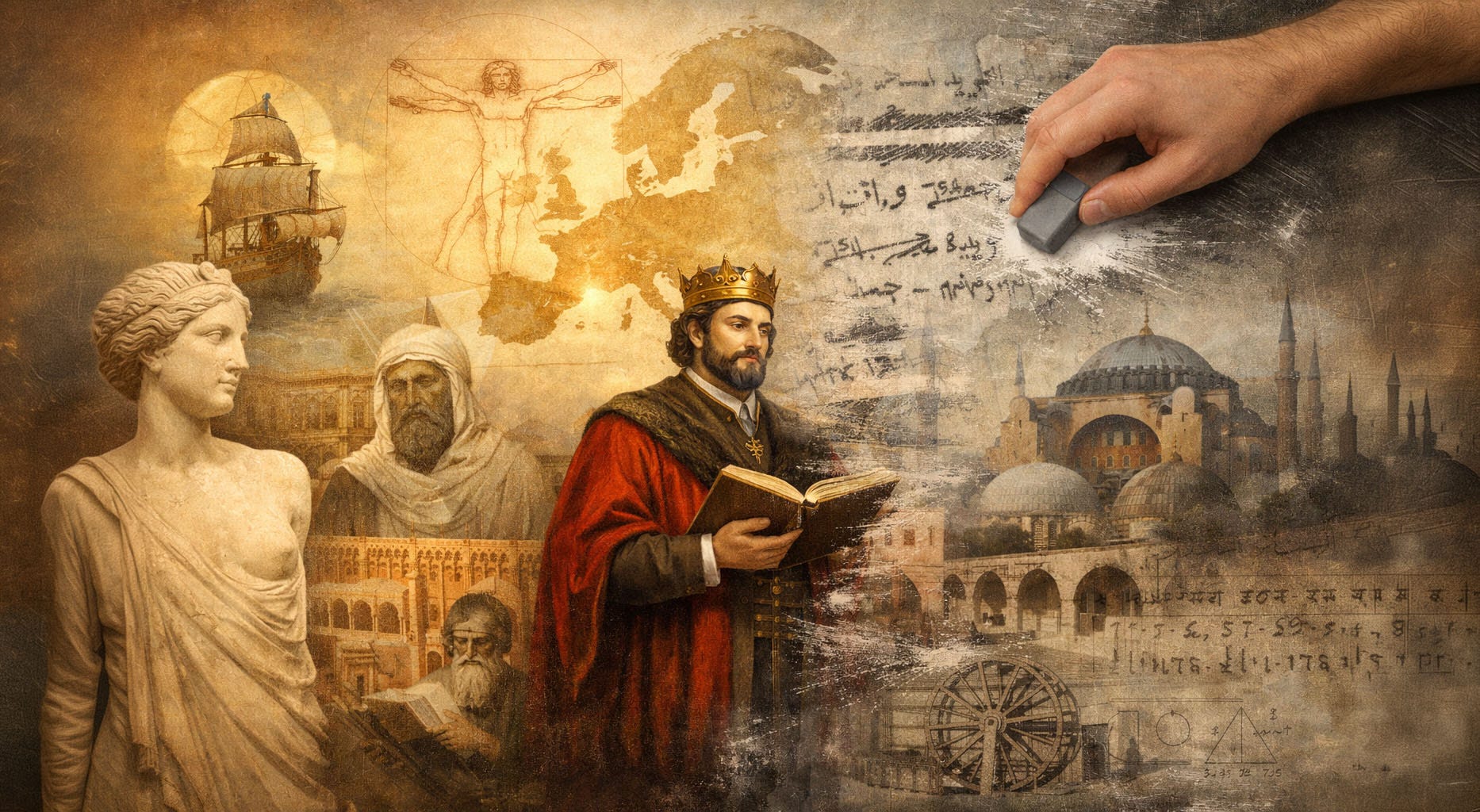
History is not just a record of events. It’s a story shaped by what people choose to remember, repeat, and pass on. Nowhere is this more obvious than in the way the modern West tells the story of the world.
If you grew up in Europe or North America — or anywhere else in the Western world, for that matter — you were probably taught a very clean narrative. Civilization started in Greece. Democracy was invented in Athens. Science was reborn in Europe after a long “Dark Age.” Progress marched forward thanks to brave explorers, rational thinkers, and Enlightenment philosophers. The rest of the world mostly watched, waited, or needed saving.
That story feels comforting. It flatters us. It makes power look deserved, not taken. One tiny problem, though: it’s also deeply misleading.
The West edited this story through historians (all men, of course) with inflated egos, looking down on other civilizations (plus women). Scientists were not much different. Even the much-praised, considered the father of modern biology by many, Charles Darwin, believed Africans were “less evolved,” that Europe’s cold climate had refined human intelligence through natural selection, and that Black people would eventually be bred out. He didn’t think this way because he was a cartoon villain or a modern right-wing populist. He thought this way because he was a product of his society, and his views reflected the spirit of his age, and most importantly, at the time, they were anything but controversial. And this was in the 19th century. Imagine how bleak things were before him.
In short, rewriting history wasn’t always done out of malice. But it was certainly done consistently — by men with a superiority complex who believed their crooked viewpoint was what being “civilized” meant.
Before We Begin
As always, I’m referring to every nation and civilization involved as ‘they’.
Let’s first start with what Europe did give the world.
Modern constitutional government, the idea that rulers are subject to law, the expansion of individual rights, freedom of speech, freedom of the press, secular legal systems, modern universities, industrial-scale medicine, vaccination programs, and technologies that reshaped daily life — all of these developed or were formalized in the West. The scientific revolution, peer review, modern engineering, and mass literacy were born, built, tested, and improved largely in Europe and later North America.
The Enlightenment mattered, the abolitionist movements mattered, and the slow, painful emergence of women’s rights, labor protections, and civil liberties mattered. These ideas weren’t inevitable in human history; they spread because people fought for them, often against their own governments, churches, and elites.
In the 21st century, Western historians can speak freely, knowing they won’t be prosecuted by the government. They’re able to share their views openly, and peer-reviewed work in the West generally reflects scholars’ honest opinions. But these scholars often build on old assumptions, sometimes unaware of the blind spots they’ve inherited. Even when they notice, change can be slow and difficult.
Anyway, let’s get started.
The Myth of Western Originality
Mathematics. Astronomy. Medicine. Philosophy. Law. Engineering. Navigation. Even basic concepts like hospitals, universities, and the scientific method. All Western ideas — or so people think.
In reality, Europe was a late adopter, not the original source.
Long before Europe climbed out of feudalism, other civilizations were already running advanced societies.
Mesopotamia developed law codes when much of Europe was still tribal. India developed sophisticated mathematics, including zero and negative numbers. China built massive infrastructure, civil service exams, paper money, and complex metallurgy. The Islamic world preserved, expanded, and systematized Greek, Persian, Indian, and Roman knowledge while Europe was burning books — and people.
The West also likes to think it invented mental health care, not realizing that for most of history, the East handled mental suffering far more humanely. In the Islamic world, hospitals treated mental illness centuries before Europe stopped chaining people to walls. Physicians wrote about depression, anxiety, grief, and trauma as medical conditions, not sins or possessions. Patients were treated with dignity, rest, conversation, music, and medicine. Meanwhile, in much of Europe, mental illness was blamed on demons, witchcraft, or moral failure, and the “treatment” involved confinement, punishment, or prayer. Modern Western psychiatry deserves credit for eventually abandoning that cruelty, but the idea that compassion and psychological insight started in the West is just another rewritten memory.
The Convenient “Dark Ages”
The idea of the European Dark Ages is central to Western self-mythology.
According to the story, Europe fell into intellectual darkness after Rome collapsed. Then, suddenly, the Renaissance arrived and Europeans remembered how to think again, which removes everyone else from the timeline.
While the rest of Europe was struggling, the Eastern Roman Empire, which was simply called the Roman Empire after the fall of the West, preserved Roman law and Greek philosophy. Islamic scholars translated Aristotle, Galen, and Euclid into Arabic, commented on them, corrected them, and expanded them. Jewish scholars acted as translators between Arabic and Latin worlds. Medical schools operated in Baghdad and Cordoba centuries before European universities existed.
But in Western textbooks, this is often reduced to a brief footnote , that is if it’s mentioned at all.
The Dark Ages are often portrayed as a global phenomenon, not just a European one. That lets Europe frame its own recovery as a universal leap forward, rather than a late return to a world that never really stopped moving.
In reality, it wasn’t even “Europe” that fell into a Dark Age, but its regions that fell under heavy Church control. In the Eastern Roman Empire, life continued largely as usual until its fall in the 15th century.
Stealing Ideas Without Stealing the Names
Another pattern is how Western history absorbs ideas while erasing their origins.
Take mathematics. We use Arabic numerals every day. The word algebra is Arabic. Algorithms come from the name of a Persian mathematician. Trigonometry was developed across Greek, Indian, and Islamic traditions.
Yet students are often taught these subjects without learning where they came from. They are presented as neutral tools that simply exist, floating free of culture.
This is not accidental.
When ideas lose their origins, they’re easier to claim. Once claimed, they’re treated as proof of Western superiority, instead of evidence of global collaboration.
The West did not just borrow knowledge. It laundered it.
Colonialism as a Footnote Instead of a Crime
Western history also has a habit of shrinking its worst actions.
Colonialism is often described as exploration, trade, or expansion. The violence is softened. The extraction is minimized. The resistance is framed as chaos.
Entire continents were reorganized to serve European economies. Borders were drawn with rulers. Resources were drained. Local industries were destroyed to prevent competition. Famines were allowed to happen because profit mattered more than lives.
But in Western narratives, colonialism becomes a side chapter, not the main engine of modern wealth.
This allows modern Western nations to enjoy the benefits of empire while pretending they rose through hard work alone. It also makes poverty in formerly colonized countries look like a local failure rather than the long-term result of systemic theft.
Science Without Context
Western science is often portrayed as purely objective and detached from power.
In reality, science developed alongside empire, industry, and war.
Navigation improved because empires needed to move ships. Medicine advanced because armies needed soldiers kept alive. Anthropology was often used to classify people into racial hierarchies that justified domination. Archaeology was shaped by colonial access to other people’s land and artifacts.
Yet Western history books often present science as a neutral march toward truth, untouched by politics or violence.
This framing makes Western knowledge appear morally clean while other cultures are described as superstitious or irrational, even when they produced empirical knowledge through different frameworks.
Erasing Resistance and Agency
Another trick is portraying non-Western societies as passive.
Colonized people are often shown as conquered easily, guided by Europeans, or saved by Western intervention. Their resistance is minimized or framed as disorder.
In reality, resistance was constant.
Empires faced revolts, sabotage, intellectual opposition, religious reform movements, and cultural survival strategies everywhere they went. Many colonial powers barely held control, relying on violence and collaboration from local elites to maintain authority.
But acknowledging this would disrupt the fantasy of Western inevitability.
So resistance is edited out, and domination is portrayed as destiny.
The Moral High Ground Illusion
The West also likes to imagine itself as the natural home of human rights, freedom, and equality.
This ignores how recently these values were extended to everyone.
Slavery was defended by Western powers for centuries. Women were excluded from political life until very recently. Indigenous people were treated as obstacles, not humans. Racial segregation existed openly well into the modern era.
Yet Western history often presents moral progress as something that naturally emerged from Western culture itself, rather than something forced through struggle, protest, and pressure from the very people the system oppressed.
This creates the illusion that the West teaches morality to the world, rather than learning it slowly, painfully, and often unwillingly.
What an Honest History Would Look Like
An honest history would be chaotic, because humans are complex.
It would show civilization as a shared human project, not a Western solo act. Europe did not “restart” science. The Renaissance was built on Eastern Roman and Islamic ideas that never took a break.
It would acknowledge borrowing, influence, failure, and exploitation alongside achievement. It would show progress as uneven and collective, not linear and owned.
It would also recognize that for a long time the West looked down on Muslims for theır poor morality — specifically for not aggressively persecuting gay men and decriminalizing homosexuality ın the Ottoman Empire altogether. The West, meanwhile, institutionalized and spread homophobia in the Muslim world during colonial times as part of a superior “Christian” morality. Today, it turns around and looks down on Muslims for homophobia, blaming Islam for a problem it helped export.
Most importantly, it would stop pretending that power equals wisdom.
This space runs on reader support. If you want to keep it going, become a paid subscriber for full access to exclusives and the complete archive.
Why Education Is the Biggest Threat to America As We Know It

America doesn’t fear guns. Doesn’t fear crime. Doesn’t even fear China. What it fears—deep down in its oversized patriotic gut—is a nation full of people who can think. That’s the real threat. Not missiles. Not migrants. But minds. If you want to destroy America
Why America Keeps Mistaking Arrogance for Strength

America likes to think it’s strong because it’s loud. Because it talks big. Because it never stops repeating words like freedom, leadership, and number one.
America’s Too Proud to Learn from a Country That Works

I have a strong readership from my Aussie friends. I’m genuinely humbled, and I want to thank you. So today, we’re digging into Australia—and what America (and others) can learn from this country of beaches, kangaroos, and working healthcare.