


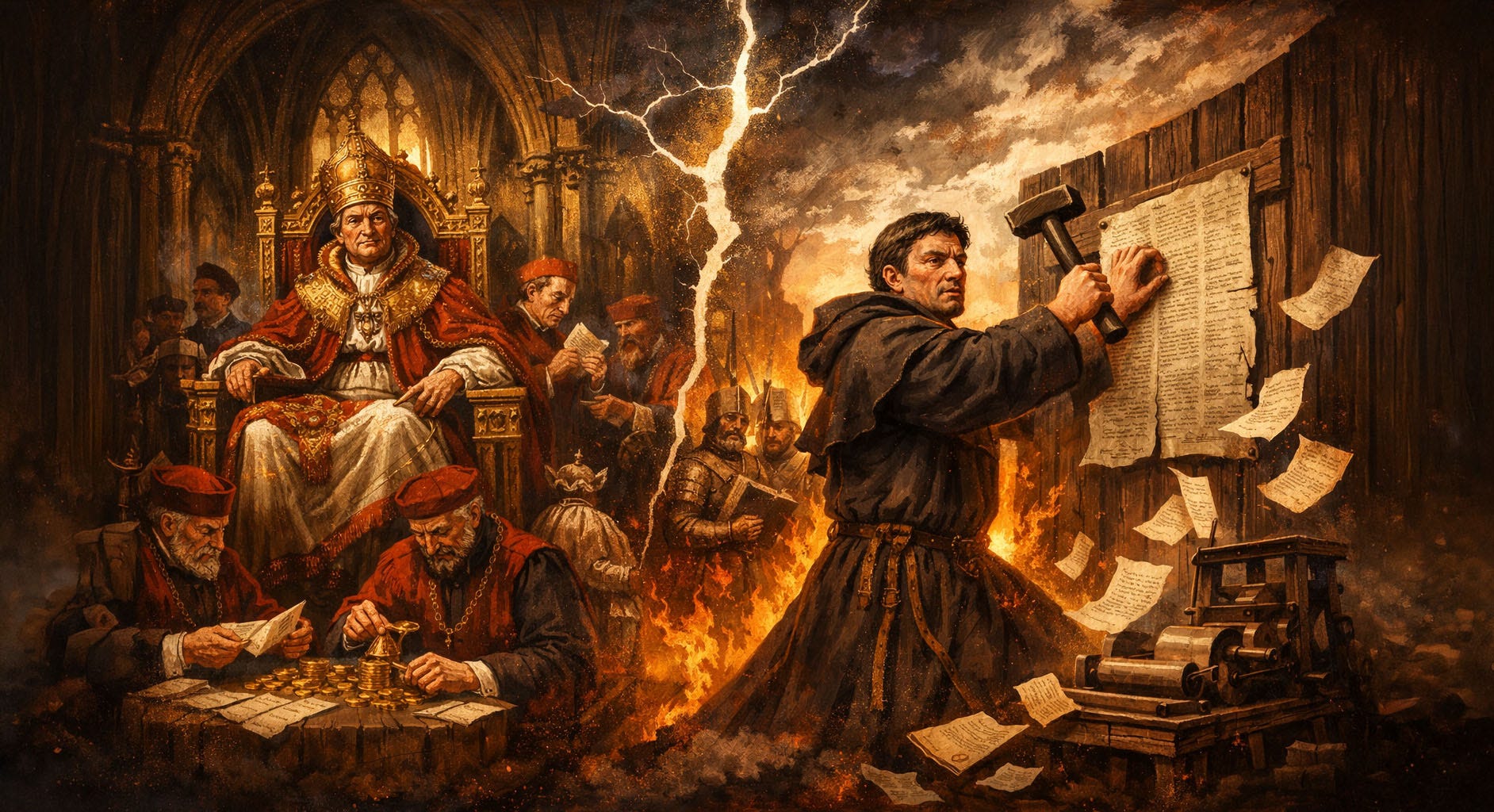
Before the Reformation, Christianity in Europe was a straight-up religious monopoly. One church. One pope. One version of “truth.” If you wanted to talk to God, you had to go through Rome. The Church was your spiritual landlord and your political babysitter. They baptized your kids, buried your dead, forgave your sins—for a price—and taxed your soul like it owed them rent.
Then came Martin Luther. A monk with a grudge and a hammer. When he nailed his 95 Theses to that church door in 1517, he didn’t just complain about indulgences. He lobbed a theological grenade that blew the whole system to hell. What followed wasn’t just a church fight—it was a total power shift. A media war. A cultural explosion.
And given how rotten the Catholic Church was at the time, you’d think the Catholics would’ve become the hardcore fundamentalists, and the Protestants the progressive reformers. But history had other plans. Things flipped in weird, ironic ways—and both sides clung to power wherever they could.
1. Kicking the Pope Off His Throne
Before Luther, the Pope was more than a religious leader—he was a king in all but name. Popes crowned emperors, collected taxes across borders, and played politics like seasoned mafia bosses. To question the Pope was to question God’s own voice on earth.
Luther came along and said: “Nah, this guy’s just a man in a funny hat.” He argued that the Bible—not the Pope—was the final authority. That idea sounds tame now, but it was straight-up treason back then.
Suddenly, people realized they didn’t need Rome to tell them what God wanted. They could read the Bible themselves (more on that in a minute). The Pope’s spiritual grip started to loosen. So did his political one.
The papacy was not only a spiritual power but also a geopolitical empire. Luther’s attack was as much about power as it was about doctrine
— Diarmaid MacCulloch, The Reformation
2. Bibles for the People, Power to the Princes
One of Luther’s smartest moves was translating the Bible into German. Until then, the Bible was mostly in Latin—meaning only clergy and scholars could read it. Everyone else had to take the Church’s word for what it said.
Luther said screw that. He translated the Bible so that even farmers and barmaids could read it. Suddenly, the average person had direct access to scripture. This was dangerous stuff.
But local rulers loved it. Why? Because now they didn’t have to listen to Rome either. They could set up their own churches, pick their own priests, and keep their own money. Kings and princes who backed Luther weren’t just being pious—they were being opportunists.
The vernacular Bible was not only a tool of piety but also a weapon of political independence
— Steven Ozment, The Age of Reform
3. From One Church to a Dozen Power Centers
The Reformation shattered the illusion of one “true” Church. Suddenly there were Lutheran churches, Calvinist churches, Anabaptist churches—each with their own rules, beliefs, and leaders. And they all claimed to follow the same Bible.
This wasn’t just theological chaos. It was political fragmentation. Religious belief became a matter of regional identity. Your faith was often determined by your prince or city council. “Cuius regio, eius religio” they called it: whoever rules decides the religion.
So much for personal belief.
The Reformation did not lead to religious freedom. It led to religious relocation and enforcement—just under new management
— Brad S. Gregory, The Unintended Reformation
4. War, Baby. Glorious, Bloody, Never-Ending War
With religion unchained from Rome, Europe turned into a battlefield of competing faiths. Protestant vs. Catholic. Calvinist vs. Lutheran. Everyone claimed God was on their side and used swords to prove it.
The Thirty Years’ War (1618–1648) was basically Europe’s longest church fight—with armies, famines, and massacres. By the end of it, they didn’t just break churches—they broke the idea that religion and politics could ever be cleanly separated again.
The wars of religion were not just about faith; they were about who got to define reality
— Mark Greengrass, Christendom Destroyed
5. Printing Press: The Reformation’s Secret Weapon
None of this would’ve happened without a technology that the Church couldn’t control: the printing press.
Luther’s pamphlets spread like wildfire. He was the first religious influencer. His followers mass-produced sermons, translated scriptures, and mocked the Pope in cartoon form. People were reading, debating, and fighting over theology like it was the hottest new gossip column.
Print didn’t just spread ideas. It changed how people thought. It made belief a public, participatory act. No more priests hoarding truth like it was gold. Now it was in pamphlets at the market.
Printing was to the Reformation what the internet is to modern protest movements
— Elizabeth Eisenstein, The Printing Press as an Agent of Change
6. Goodbye Celibate Priests, Hello Married Pastors
The Catholic Church treated sex like radioactive waste. Priests were celibate. Sex was only okay inside marriage and only for making babies. That was the holy standard.
Then Luther said, “Actually, I’m gonna marry a nun.” And he did. His marriage to Katharina von Bora became a symbol of the new normal. Protestant pastors were allowed to marry, have families, and live like regular humans.
This wasn’t just about sex—it was about control. The Church had long used celibacy to separate clergy from the people. Letting priests marry was a way of tearing down that wall.
Clerical marriage was as revolutionary as any doctrinal change—it normalized the clergy and humanized the pulpit
— Lyndal Roper, Martin Luther: Renegade and Prophet
7. Women: Still Screwed, but in New Ways
Don’t expect the Reformation to have been some feminist awakening. It wasn’t. But it did shake up gender roles in weird ways.
Protestants preached a more “domestic” ideal of womanhood: wives, mothers, silent in church. They killed off the convents—one of the only places women could escape marriage and pursue education. Now the home was your holy space, and being a wife was your sacred duty.
So yeah, the Pope lost power, but patriarchy didn’t.
In abolishing nunneries, the Reformation removed a key avenue for female autonomy
— Merry Wiesner-Hanks, Women and Gender in Early Modern Europe
8. Capitalism, Protestant-Style
You know who loved Protestantism? Merchants. Reformers emphasized personal responsibility, thrift, hard work, and the idea that God rewards the faithful—financially too.
This laid the groundwork for what Max Weber famously called the “Protestant work ethic.” It wasn’t just about salvation anymore. It was about proving your spiritual worth through material success. Greed just needed a moral outfit.
The Protestant ethic was not just about faith. It was about reshaping work, money, and ambition
— Max Weber, The Protestant Ethic and the Spirit of Capitalism
9. Churches as Nation-Builders
Once kings realized they could run their own churches, religion became a national project. England dumped the Pope and installed the king as head of the Church. Sweden did the same. So did much of Germany.
Faith wasn’t just personal—it was patriotic. Loyalty to the Church now meant loyalty to the state. And disagreeing with your national religion? That made you not just a heretic, but a traitor.
National churches became instruments of political unity and control—faith wrapped in a flag
— Euan Cameron, The European Reformation
10. Truth Became a Battlefield, Not a Pillar
When the dust settled, Europe had no single truth anymore. There were dozens of Christianities, each claiming to be “biblical.” This pluralism wasn’t neat. It was messy, violent, and full of hypocrisy.
But it also created space—however chaotic—for doubt, disagreement, and debate. Once people saw that religion could be contested, it opened the door for even deeper questions: What if none of these people are right? What if truth isn’t divine at all?
The Reformation cracked open the vault of certainty. What came out was modern doubt
— Alec Ryrie, Protestants: The Faith That Made the Modern World
Last Thoughts
Instead of fixing it, the Reformation shattered Christianity into pieces. Sure, it kicked out the popes—but replaced them with kings, councils, and pastors who still wanted control. It gave people Bibles, but it also gave governments new ways to use religion as a leash. It offered new faiths, but it also sparked blood-soaked wars. It was liberation and manipulation rolled into one.
But it changed the game forever. Today, we take for granted that faith is a choice, that authority can be questioned, and that no single voice owns the truth. Those seeds were planted by a grumpy monk with a hammer, a sharp tongue—and, let’s not forget, a man who openly preached hatred and violence against Jews, writing toxic screeds that would later be echoed by Nazi ideology and earned him the title of “spiritual forefather” in Hitler’s regime.
Still, the Church lost its monopoly. The people got options. And power—both sacred and secular—would never flow the same way again.
To be honest, only a small portion of subscribers are paid—most of my posts are free for everyone to read, with some exclusives. But reader support buys something priceless: time. Time to research, question power, and hold the powerful accountable. If you can afford it, your support helps keep this work alive.
Your turn: Now drop a comment, share your holy mess of thoughts, and follow for more brutally honest takes on religion, history, and power
Sources and Further Reading
The Reformation — Diarmaid MacCulloch (2003)
The Age of Reform — Steven Ozment (1980)
The Unintended Reformation — Brad S. Gregory (2012)
Christendom Destroyed — Mark Greengrass (2014)
The Printing Press as an Agent of Change — Elizabeth Eisenstein (1979)
Martin Luther: Renegade and Prophet — Lyndal Roper (2016)
Women and Gender in Early Modern Europe — Merry Wiesner-Hanks (1993)
The Protestant Ethic and the Spirit of Capitalism — Max Weber (1905)
The European Reformation — Euan Cameron (1991)
Protestants: The Faith That Made the Modern World — Alec Ryrie (2017)
I know this is an old article, but I happened to be thinking of Luther today. There is what bit of his theology that I have never been able to find an explanation of. Apologies if I have asked this before...
Luther denied free will, wrote a book about it which he was immensely proud of. Calvin also denied free will, and if there is no free will, then predestination is the only logical result. Calvin believed in predestination. Luther denied predestination. How did he square no free will with no predestination?
Knowledge is deadly to religion. Justly so.