


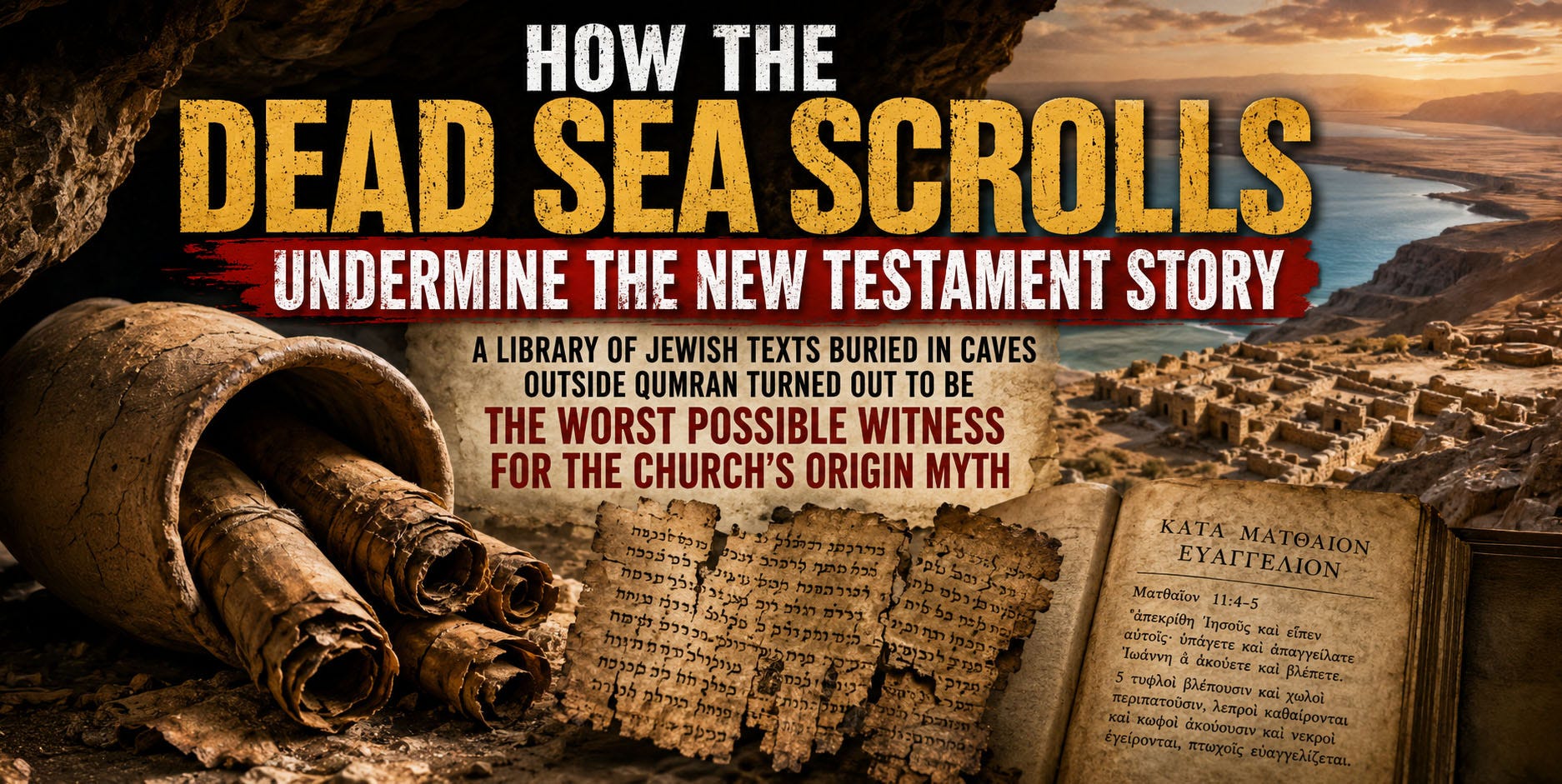
A devout Jewish carpenter from Galilee announced that the kingdom of God had arrived. He preached love, fulfilled prophecy, died as a sacrifice for sin, rose again, and his message exploded outward from Jerusalem because it was so radically new that nothing in Judaism could contain it. Paul carried the gospel to the gentiles, the church grew, and the rest folded into world history.
That story was already on shaky ground before 1947, when a Bedouin shepherd named Muhammed edh-Dhib chased a stray goat into a cave near the shore of the Dead Sea and found clay jars stuffed with leather scrolls. Over the next decade, eleven caves around the ruins of Qumran yielded somewhere between 900 and 1,000 manuscripts. They date from roughly the third century BCE to 68 CE, when the Romans burned the settlement during the First Jewish-Roman War, a few years after Jesus’ brother James was executed by the local authorities.
These scrolls are the most important manuscript find in the history of religion, and for anyone committed to the orthodox Christian story they are a sustained historical problem.
You won’t hear it from the cheerful documentaries that treat the scrolls as a charming archaeological curiosity, full of dramatic music and stock footage of camels. The actual content of the scrolls, when you read them next to the New Testament, contradicts claim after claim that Christianity has spent two thousand years presenting as unique, miraculous, and divinely revealed.
The Qumran Library and Its Apocalyptic Authors
The Qumran library is a working collection, a third of which are copies of Hebrew scripture, including every book of what Christians call the Old Testament except Esther. Another third are previously known Jewish writings, things like the Book of Enoch, Jubilees, Tobit, and Ben Sira. The final third are sectarian compositions, documents written by or for the community that lived at Qumran or by the wider movement it belonged to.
The mainstream view, defended by scholars including Geza Vermes, Lawrence Schiffman, James VanderKam, and John Collins, identifies that community with the Essenes, or at least with a faction inside the Essene orbit. The Essenes were one of the major Jewish sects of the late Second Temple period, and Josephus, Philo, and Pliny the Elder all describe them. They were apocalyptic, separatist, obsessed with ritual purity, and led by priestly figures who’d broken with the Jerusalem temple establishment.
For more than a century before Jesus was born, this community was already living out a worldview that the New Testament treats as Christianity’s stunning new revelation. They were already practicing ritual washing for the forgiveness of sins, already organized into a “new covenant” community that saw itself as the true Israel, and already expecting an imminent end of the age, a final battle between the forces of light and darkness, and the arrival of one or more messianic figures who’d judge the wicked and vindicate the righteous.
The Messianic Expectation Was Already on the Shelf
One of Christianity’s central marketing claims is that Jesus’ identity as messiah was a shocking development that took everyone by surprise, then fulfilled prophecies in ways nobody had seen coming. The scrolls show this is nonsense.
Qumran sectarians were saturated in messianic expectation. Multiple texts speak of an anointed figure who’ll come at the end of days. Some texts expect two messiahs, one priestly (the Messiah of Aaron) and one royal (the Messiah of Israel). Others speak of a single messianic deliverer. Still others describe an eschatological prophet who’ll herald the messianic age, modeled on the figure of Elijah in Malachi 4.
The text known as 4Q521, sometimes called the “Messianic Apocalypse,” is the clearest parallel. Written probably a century before Jesus’ birth, it describes what the heavens and earth will do when the messiah comes. The messiah will heal the wounded, give life to the dead, and proclaim good news to the poor.
Compare that to Jesus’ answer in Matthew 11:4-5 and Luke 7:22, when John the Baptist sends messengers asking whether Jesus is the one who’s to come. Jesus says, in effect, look at what’s happening: the blind see, the lame walk, the dead are raised, and the poor have the gospel preached to them.
For two thousand years, Christian readers have been told this was Jesus pointing to a unique fulfillment of Isaiah. The truth is that Jesus, or whoever wrote Matthew and Luke, was using a recognized first-century checklist for what the messiah was supposed to do, a checklist that was already circulating in Jewish apocalyptic communities a hundred years before he was born. The exact phrases about healing the wounded, raising the dead, and preaching good news to the poor show up in 4Q521 with the same compressed structure Jesus uses.
The scholar John Collins, whose work on Qumran messianism is the standard reference, has been clear about what this means. The “good news to the poor” passage in Q (the hypothetical source behind Matthew and Luke) reproduces a Jewish messianic formula that was already operating before any Christian wrote a word.
The “Son of God” Title Was Already Jewish
In 1992, the so-called “Son of God” text, catalogued as 4Q246, was finally published in full after decades of delay. It’s an Aramaic fragment, dated to the first century BCE, and it describes a figure who’ll be called “the Son of God” and “the Son of the Most High,” who’ll rule an everlasting kingdom, whose dominion will extend over the nations.
Open Luke 1:32-35. The angel Gabriel tells Mary that her son will be called “the Son of the Most High,” that the Lord God will give him the throne of David, that he’ll reign forever, and that he’ll be called “the Son of God.”
The wording is so close that some scholars, including Joseph Fitzmyer, who initially resisted any messianic reading of 4Q246, were eventually forced to acknowledge the parallel. Luke’s author was working with phrases that had been circulating in Jewish apocalyptic literature for at least a century before he wrote.
Christianity built an entire theology on the supposed uniqueness of these titles for Jesus. The scrolls show that “Son of God” and “Son of the Most High” were already part of the standard Jewish messianic vocabulary in Aramaic-speaking Palestine before Jesus was born.
The historical Jesus, if there was one, inherited his titles from existing Jewish vocabulary. So did the gospel writers. They picked the phrases up from a religious milieu where the language was already in use, and they applied it to their candidate.
And for the record, most scholars do believe there must have been a historical Jesus, though this is a deduction rather than a certainty. The main argument is that Jesus’ biography contains enough embarrassing elements (a crucified messiah, a Galilean backwater origin, baptism by John for the forgiveness of sins) to make it unlikely anyone would have invented him from scratch.
John the Baptist Was Probably One of Them
The Qumran texts say John lived in the wilderness near the Jordan, eating a restricted ascetic diet. The Qumran community lived in the wilderness near the Dead Sea, eating a strict ritual diet under priestly supervision.
John performed ritual immersion in the Jordan for the forgiveness of sins as a preparation for the imminent kingdom. The locals performed daily ritual immersion in mikvaot, the stone-lined pools that still scar the Qumran ruins, as preparation for the imminent kingdom. Their rule scroll, the Community Rule (1QS), explicitly ties the washing to repentance and forgiveness in the context of joining the new covenant community.
John preached an imminent eschatological judgment in which a fiery winnowing would separate the righteous from the wicked. The War Scroll (1QM) lays out an imminent eschatological battle in which the Sons of Light would defeat the Sons of Darkness.
John quoted Isaiah 40:3, “the voice of one crying in the wilderness, prepare the way of the Lord,” as the scriptural identity of his mission. The Community Rule quotes Isaiah 40:3 as the scriptural identity of the Qumran community’s mission, almost verbatim, complete with the same allegorical reading of “the wilderness” as the place of separation from the corrupt Jerusalem establishment.
Scholars including Geza Vermes, James VanderKam, and Joan Taylor have all argued in various ways that John the Baptist was either a former member of the Qumran-style Essene community, an offshoot, or someone deeply shaped by their theology. The argument isn’t certain, but it’s strong enough that it’s moved from speculation to a serious working hypothesis in mainstream scholarship.
What this means for the Christian story is that the figure the gospels treat as the divinely-appointed forerunner of Jesus, the man who supposedly recognized Jesus as the messiah at his baptism, was operating inside a Jewish sectarian tradition that had been doing the same wilderness-baptism-repentance-apocalyptic-kingdom routine for a hundred years before Jesus showed up. John fit a recognizable type, which is why the gospels themselves have people speculating that he might be Elijah or one of the prophets returned. People speculated because he looked exactly like what Jewish apocalyptic tradition said the eschatological prophet was supposed to look like.
Paul’s “New Covenant” Was Already Old
Paul, in his letters and in the Last Supper accounts that depend on him, makes a great deal of the “new covenant” in Jesus’ blood. The author of Hebrews builds an entire architecture of supersession around the idea that the old covenant has been replaced by a new one.
The Qumran community had been calling itself “the new covenant” for at least a century and a half before Paul. The Damascus Document (CD), which exists in medieval copies discovered in a Cairo synagogue in 1896 and in much older Qumran fragments, repeatedly refers to the community as “those who entered the new covenant in the land of Damascus.” The phrase is drawn directly from Jeremiah 31:31, the same passage Hebrews cites.
The Christian claim that the “new covenant” idea was a stunning theological breakthrough delivered by Jesus and unpacked by Paul collapses the moment you read the Damascus Document. The phrase was already a self-designation for a Jewish sect. The exegetical move of applying Jeremiah 31 to a present-day community of the elect had already been made. Paul was repurposing an existing concept and redirecting it toward a different messianic claimant.
The Beatitudes Have Qumran Cousins
In 4Q525, a fragmentary Qumran text often called the Beatitudes Scroll, we have a list of blessings that follows a structure recognizable to anyone who’s read the Sermon on the Mount. “Blessed is the one who...” followed by a quality, followed by a consequence. The Qumran beatitudes celebrate the pure of heart, the seeker of wisdom, those who walk in the law of the Most High.
This is the same literary form Matthew 5 puts in Jesus’ mouth. Blessed are the poor in spirit, blessed are the pure in heart, blessed are those who hunger and thirst for righteousness. Same construction, same theological orientation, same wisdom-tradition pedigree.
Émile Puech, the editor of 4Q525, has argued that the resemblance is structural and that both texts draw on a common Jewish sapiential tradition. Either way, Matthew was working in a recognized Jewish genre rather than transcribing a unique spiritual download from the Son of God.
The Sermon on the Mount is presented to Christians as the moral pinnacle of human history, a teaching so radical that it ruptured the Old Testament’s tit-for-tat ethics. The actual evidence shows it sitting comfortably inside the Jewish wisdom and beatitude tradition of the late Second Temple period, in which writers had been composing beatitude lists for at least a century before Matthew arrived.
John’s Cosmic Dualism Was Borrowed From Qumran
One of the most influential ideas in early Christianity is the cosmic dualism of light versus darkness, good versus evil, the children of God versus the children of the devil. Read the Gospel of John, especially the prologue, and you’ll see the language soaked through with this imagery. “The light shines in the darkness, and the darkness has not overcome it.”
This dualism was once treated by Christian theologians as evidence of John’s Greek philosophical sophistication, supposedly Hellenistic in flavor and therefore proof that John was the most theologically advanced of the gospels. The Dead Sea Scrolls demolished that reading.
The Community Rule contains a section now known as the Treatise on the Two Spirits. It teaches that God created two spirits in humanity, the Spirit of Truth and the Spirit of Falsehood, and that all people walk in one or the other. The Sons of Light are guided by the Prince of Light, while the Sons of Darkness are ruled by the Angel of Darkness. The two spirits are locked in conflict until the final age, when God will eradicate falsehood and the Sons of Light will be vindicated.
The vocabulary is almost identical to the Johannine corpus. Sons of light, children of darkness, the spirit of truth, the spirit of error, the prince of this world. The phrasing belongs to Palestinian Jewish apocalyptic sectarianism, already fully developed at Qumran before any New Testament book was written.
James Charlesworth, who edited the major scholarly Dead Sea Scrolls translation series, has been explicit about this. The Johannine dualism that Christians once treated as a Hellenistic theological achievement turns out to be a Jewish sectarian inheritance, with John’s gospel sitting closer to Qumran than to Plato.
The Teacher of Righteousness as the Jesus Template
The Qumran sect’s founder is referred to in their texts as the Teacher of Righteousness. He was a priestly figure, probably active in the second century BCE, who broke with the Jerusalem temple establishment and led his followers into the wilderness. His opponent is called the Wicked Priest or the Man of the Lie, a figure who persecuted the Teacher and his community.
The Pesher Habakkuk (1QpHab) describes the Teacher of Righteousness as the one to whom God has revealed all the mysteries of the prophets. His followers are told that those who keep faith with him will be saved at the final judgment.
The pattern is recognizable. A persecuted righteous teacher with esoteric knowledge of God’s plan, followed by a community of the faithful who’ll be vindicated at the end of days, opposed by a corrupt religious establishment whose leader is marked for destruction.
This is the template the New Testament inherits. Jesus is the persecuted teacher with esoteric knowledge of the kingdom, his followers are the faithful remnant, and the corrupt Jerusalem priesthood with its political enablers fills the role of the wicked. The end of the age is imminent, and the elect will be vindicated.
You can argue that the New Testament authors didn’t directly know Qumran texts, and the argument doesn’t need that level of dependence. The point is that the entire dramatic structure of the Jesus movement, the persecuted teacher, the faithful remnant, the corrupt religious establishment, the imminent eschaton, was already a recognized mode of Jewish sectarian self-understanding before Jesus was born. The gospels present the Jesus movement as a historical rupture, when the dramatic structure they describe was already a well-rehearsed Jewish sectarian template with the protagonist’s name as the main variable.
Why the Vatican Sat on the Scrolls for Forty Years
After the initial publications of the 1950s, control of the unpublished scrolls was handed to a small international team of scholars, dominated by Catholic priests and overseen by the École Biblique in Jerusalem under Father Roland de Vaux. For decades, this team refused to publish most of the texts and refused to grant access to outside scholars. By the late 1980s, more than forty years after the discovery, the majority of the Qumran material was still locked away.
The official explanation was that the work was complex and slow. The unofficial explanation, widely circulated among scholars including Hershel Shanks, who led the public campaign to break the monopoly, was that the texts contained material that was theologically inconvenient for Christianity and that the Catholic-dominated team was dragging its feet.
The dam broke in 1991, when the Biblical Archaeology Society published a two-volume facsimile edition of unpublished scrolls based on photographs that had leaked, and the Huntington Library in California announced it would make its complete set of scroll photographs available to any qualified scholar. The monopoly collapsed, and within a few years the full corpus was in print.
Was there a conspiracy to suppress the scrolls? The evidence doesn’t support a cinematic cover-up. It does support something more pedestrian and, in some ways, more damning: a religious establishment that had control of explosive material was happy to let it sit unread for decades because there was no upside, for them, in releasing it.
The accelerated publication of the 1990s revealed exactly what those scholars had been sitting on. Texts about a suffering messiah, texts about a “Son of God” figure, texts about resurrection of the dead in a Jewish apocalyptic frame, texts showing John the Baptist’s theology already in circulation a century before he was born, texts showing Paul’s “new covenant” already a Jewish sectarian self-designation.
None of this was a problem if Christianity was understood as one variant of Second Temple Jewish apocalyptic religion that happened to win the demographic lottery. All of it was a problem if Christianity was being sold as a unique divine intervention into history.
If you’re not already a paid subscriber and you’re finding value here, I’d love for you to consider becoming one to keep The Unholy Truth alive.
Christianity as a Surviving Apocalyptic Sect
After the scrolls, the picture of Christian origins changed dramatically. The scrolls tell us that late Second Temple Judaism was a boiling stew of apocalyptic expectation, messianic speculation, sectarian competition, and ritual innovation. Multiple groups — Essenes, Pharisees, Sadducees, Zealots, the Qumran community, the followers of John the Baptist, the followers of Jesus, and probably a dozen smaller movements we’ve no record of — were all working with overlapping vocabularies and overlapping ideas.
The Jesus movement was one strand of this stew. It picked up messianic vocabulary that was already in circulation, used Son of God titles that were already in use, practiced a baptism that was already standard in apocalyptic Jewish sectarianism, and preached a new covenant that was already a sectarian self-designation. It taught beatitudes in a form that was already a Jewish wisdom genre, and expected an imminent eschatological vindication that every other apocalyptic Jewish group also expected.
The Jesus movement and the Qumran community shared most of their theological vocabulary. Christianity survived through accidents of history: it outlasted the destruction of Jerusalem in 70 CE, expanded into the gentile world through Paul and his successors, decoupled from Jewish ritual law, and eventually found imperial patronage under Constantine. The Qumran community didn’t survive any of that. Their settlement was destroyed by the Romans in 68 CE, and if history had broken slightly differently we’d be reading about the Essenes the way we read about the Christians, and reading about the Jesus movement, if at all, as one of dozens of forgotten Jewish sects.
What the Dead Sea Scrolls do is more corrosive than any attempt to disprove the existence of Jesus or to directly refute any specific Christian doctrine. They show that nearly everything Christianity claims as its unique revelation — the messianic identity, the Son of God titles, the baptism for forgiveness, the new covenant, the beatitudes, the cosmic dualism, the imminent eschaton, the persecuted righteous teacher, the wicked priestly establishment — was already part of the Jewish religious environment Jesus was born into.
You can still believe in Jesus after reading the scrolls. What you can’t honestly believe is that his message was a thunderclap from heaven that ruptured human history.
Sources and Further Reading
Geza Vermes, The Complete Dead Sea Scrolls in English (Penguin, 7th edition).
James VanderKam, The Dead Sea Scrolls Today (Eerdmans, 2nd edition).
John J. Collins, The Scepter and the Star: Messianism in Light of the Dead Sea Scrolls (Eerdmans).
Lawrence Schiffman, Reclaiming the Dead Sea Scrolls (Jewish Publication Society).
James Charlesworth (editor), The Dead Sea Scrolls and the Christian Faith (Trinity Press International).
Joan Taylor, The Immerser: John the Baptist Within Second Temple Judaism (Eerdmans).
Hershel Shanks, Freeing the Dead Sea Scrolls and Other Adventures of an Archaeology Outsider (Continuum).
Émile Puech, work on 4Q525 and 4Q521 in the Discoveries in the Judaean Desert series.
Joseph Fitzmyer, The Dead Sea Scrolls and Christian Origins (Eerdmans).
" , , , , , , , , , , if history had broken slightly differently we’d be reading about the Essenes the way we read about the Christians, , , , , "
I would seriously love to read this scenario, in detail.
Just saying ~ it might be a fun read.
The Book of Enoch is cited in Jude. The citation parallels Matthew 25:31-46. And the (partial) Book of Enoch was among the Dead Sea Scrolls. It is also maintained by the Ethiopian Church, which is why we know the complete text today. Another Ethiopian book not maintained by the Catholic Church is The Ascents of Isaiah, which supplies a date for the execution of Peter by Nero in October, 64 CE. Clement notes that Paul was martyred under the prefects, which was between the time that Nero committed suicide and Galba became emperor, in June 68 CE. You may have heard that Nero martyred both Peter and Paul. This is not true, and the question is why did this become the story.